

FOUR TIMES IN A LIFETIME: Gaspar savors coaching in his 4th World Cup, this time with Ghana

Overview:
For many individuals, coaching in a World Cup can be considered a once-in-lifetime experience.
With Hartford Athletic honoring long-time goalkeeping coach Dan Gaspar, FrontRowSoccer.com thought that it would be appropriate to share a story from Michael Lewis’s View From the Front Row Substack. It was written about Gaspar’s experiences during the 2026 World Cup. We rarely share Lewis’ full Substack pieces, but we figured this time it was appropriate.
You can also read this story at View Front the Front Row at https://frontrow.soccer/lp8jn. And if you like what you read, you can subscribe to it. The Substack has monthly and yearly subscription rates.
Dan Gaspar celebrates with Ghana defender Jerome Opoku. (Photo courtesy of Dan Gaspar)
For many individuals, coaching in a World Cup can be considered a once-in-lifetime experience.
For Dan Gaspar, you can multiply that by four.
As goalkeeper coach of the Ghana men’s national team, the 71-year-old Gaspar is working his fourth cup with his third team. He was also an assistant coach with Portugal in 2010, and with Iran in 2014 and 2018, working with the keepers.
Today, he is coaching in his home country – the United States, which would be rare for any coach in the world.
“It is difficult to put into words,” he said in an email interview. “This is my fourth World Cup, but it’s the first one being played in the United States the country where I was born, where I grew up, and where I built my coaching career.”
Gaspar, who was given time off from his “day job” as a goalkeeper and assistant coach with Hartford Athletic (USL Championship), has had similar roles at World Cups with Portugal and Iran, working with his long-time friend and colleague, Carlos Queiroz.
“To represent Ghana on the world’s biggest stage while competing in my home country is something I never imagined when I first started coaching,” he said. “It brings together every chapter of my life my American roots, my international journey, and my passion for developing goalkeepers.
“What makes this World Cup even more emotional is that my family, who sacrificed so much and supported my dream every step of the way, finally has the opportunity to see me coach at the highest level in our own backyard. They have shared every success, every setback, and every long period away from home. Being able to look into the stands and know they’re there making this experience incredibly special.
“I’m deeply grateful to the Ghana Football Association, coach Carlos Queiroz, the players, and everyone who trusted me with this opportunity. It is a privilege I will never take for granted.”
That’s understandable.
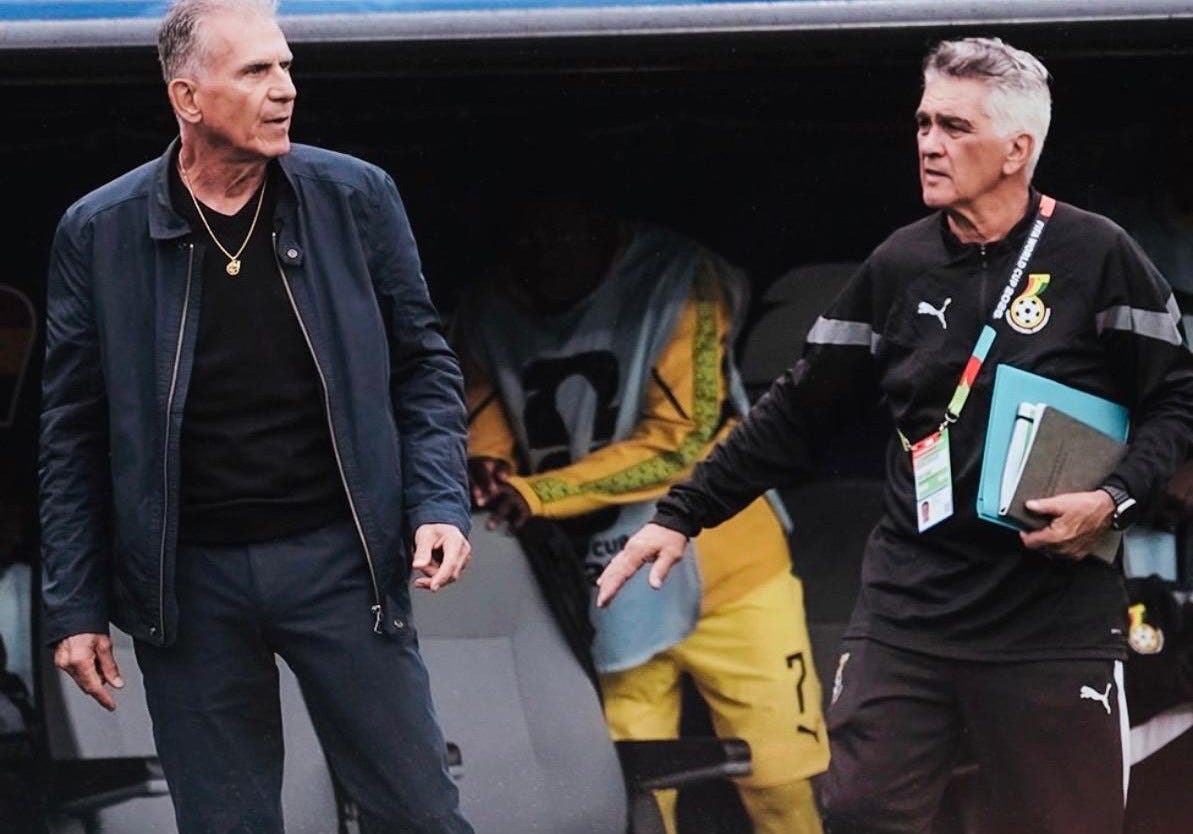
Ghana head coach Carlos Queiroz (left) and Dan Gaspar. (Photo courtesy of Dan Gaspar)
Each World Cup experience has been different. The 2010 tournament was hosted by South Africa; 2018 it was in Russia, and in 2022, Qatar welcomed the world.
Given the talent in Portugal, expectations are always high. Iran was at a different level, as is Ghana.
“Every World Cup has its own identity because every nation has its own football culture, history, and soul,” Gaspar said.
“With Portugal, expectations were enormous. The talent was world class, and with that came tremendous pressure. Every match carried the expectation of winning.
“Iran was different. It was built on resilience, discipline, unity, and incredible national pride. Football in Iran is much more than a sport. The stadium becomes one of the few places where people can freely celebrate, sing, dance, and express themselves. You quickly realize you are representing something much bigger than football.
“Ghana has been another incredible experience. There is a special energy around this team. The players combine athleticism, humility, passion, and belief with the unique spirit and magic of African football. They play with joy, but they also compete with tremendous courage.
“Although each country is different, they all share one thing: immense pride in representing their nation.”
Older and wiser, Gaspar is working hard with the Ghana goalkeepers but has learned to enjoy the moment.
“Personally, I’ve changed as well,” he said. “During my first World Cup, I was captivated by the event itself. Today, I appreciate the human side much more the sacrifices families make, the responsibility of representing millions of supporters, and the privilege of helping players perform on the biggest stage in football.”
He called his first World Cup experience, with Portugal in South Africa in 2010, “unforgettable.”
“Nothing truly prepares you for the scale of a World Cup,” Gaspar said. “Every training session, every tactical decision, every media interview, every recovery session, everything feels bigger because the entire football world is watching.”
Every country and culture is different and is a learning experience.
“There are memories I’ll never forget,” Gaspar said. “The constant sound of the vuvuzelas throughout every match. The infamous Jabulani ball that seemed to dip, swerve, and change direction in midflight. Goalkeepers certainly weren’t fans of it! Proud that Portugal goalkeeper Eduardo was voted second best goalkeeper in the World Cup.
“But beyond those memories, the biggest lesson I learned was that managing emotions is just as important as managing tactics. Talent alone isn’t enough. The teams that remain calm, disciplined, united, and emotionally stable over an entire tournament are usually the ones still standing at the end.”
Ghana booked a spot in the Round of 32, finishing third in Group L with a 1-1-1 mark behind England and Croatia. The Ghanaians, backed by a rock-solid team defense and goalkeeping, conceded only twice. They shut out Panama in their June 17 opener in Toronto, which went a long way in securing a knockout round berth.
“Opening matches are extremely important because they create belief,” Gaspar said. A victory validates the work that has gone into preparation, especially when you have a very short period to prepare together. It gives the players confidence and creates positive momentum inside the group.
“The result against Panama rewarded the commitment and sacrifice the players invested during camp. That said, it’s only the first step. World Cups are marathons, not sprints. Nothing has been accomplished yet. Our focus immediately shifted to preparing for the next challenge.”
Ghana then played England to a scoreless draw in Foxborough, Mass. on June 23, before it closed out group play with a 2-1 loss to Croatia in Philadelphia on June 27.
The African side meets Colombia in the final Round of 32 match in Kansas City, Mo. on July 3.
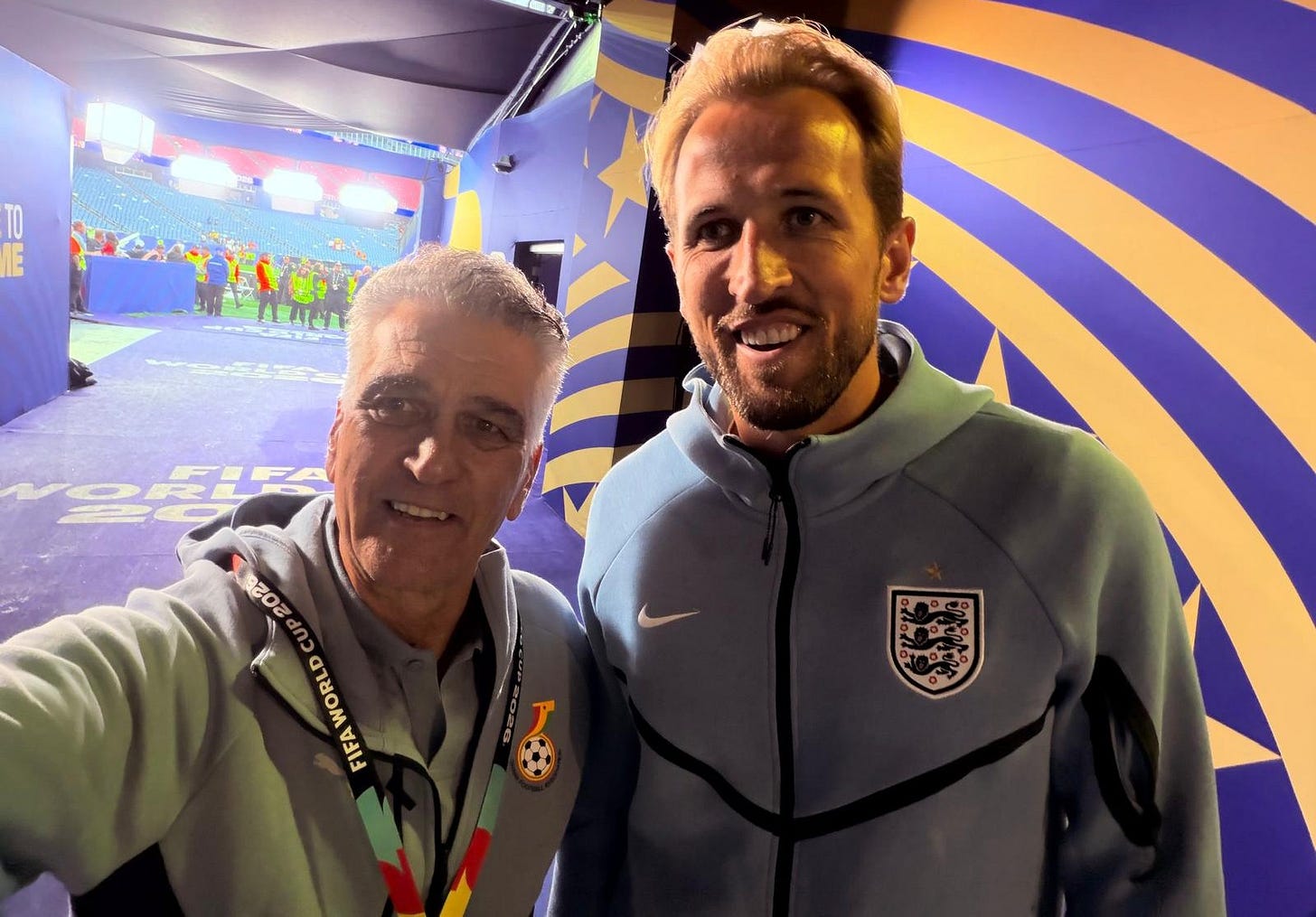
Dan Gaspar with England striker Harry Kane, who was blanked by Ghana. (Photo courtesy of Dan Gaspar)
Asked what constituted success for Ghana, Gaspar responded: “One of the biggest lessons I’ve learned from multiple World Cups is that looking too far ahead can be dangerous. Success starts with focusing completely on the next challenge. “Our objective is simply to maximize our potential every single day.
“We respect every opponent, but we respect ourselves more. We don’t fear anyone. We want to compete with courage, intelligence, discipline, humility, and pride every time we step onto the field.
“What has impressed me most about this group is how quickly the players have embraced our game model, our standards, and our professionalism. They have been humble, coachable, and completely committed to improving.
“If we continue growing, remain organized, and give ourselves an opportunity in every match, I truly believe this group is capable of achieving something special.”
Gaspar said that he was impressed with goalkeeping in the tournament.
“The overall level has been excellent,” he said. “Modern goalkeepers are expected to do far more than simply make saves. They must organize the defense, defend large spaces, start attacks with quality distribution, and make excellent decisions under constant pressure.
“The goalkeepers who have impressed me most are the ones who combine technical excellence with composure, leadership, and consistency. Those qualities become even more valuable in a World Cup, where every decision can change the course of a tournament.”
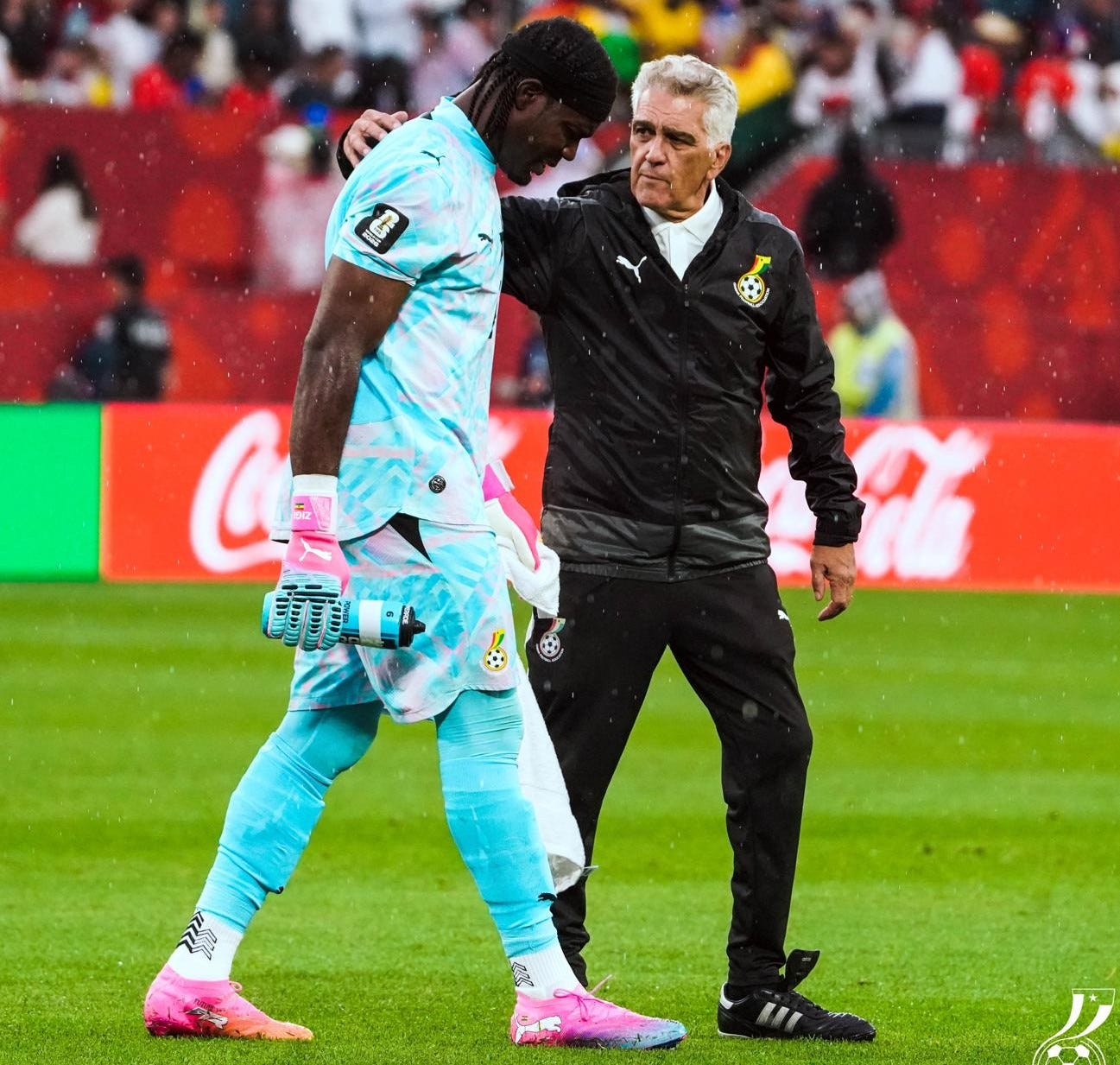
Dan Gaspar doing some coaching. (Photo courtesy of Dan Gaspar)
Ghana used two keepers in the opening round. Lawrence Ati-Zigi recorded a clean sheet against Panama, before Benjamin Asare took over for the last two matches, including the 0-0 tie with England.
Asked who he thought was the best goalkeeper he has ever worked with, Gaspar wouldn’t say.
“That’s always the most difficult question because I’ve been fortunate to work with outstanding goalkeepers throughout my career,” he said.
“Rather than naming one individual, I believe the very best all share the same characteristics: consistency, professionalism, courage, humility, and the ability to perform under pressure when their team needs them most.
“I’ve always told every goalkeeper I’ve coached that they should train and prepare with the belief that they are the best goalkeeper in the world. Confidence isn’t arrogance when it’s supported by hard work and daily commitment.
“That’s the mentality I try to build.”
However, he put the Ghana goalkeepers at the top of his list.
“So today, I can honestly say I believe the Ghana goalkeepers I work with are the best in the world because that’s how I expect them to think, prepare, and compete every single day,” Gaspar said. “I challenge them to wake up every day with the commitment to be better today that yesterday.”
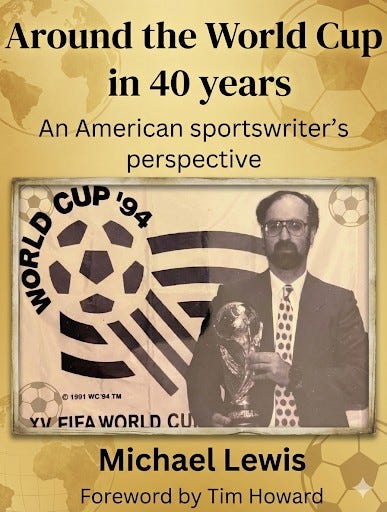
You can’t enjoy the World Cup without reading Michael Lewis’ book:
Around the World Cup in 40 Years, An American sportswriter’s perspective.
Here’s how you can purchase the book:
It’s available on Amazon for $29.95, and it’s available here:
https://tinyurl.com/48xm7xnj
You can also read this story at View Front the Front Row at https://frontrow.soccer/lp8jn. And if you like what you read, you can subscribe to it. The Substack has monthly and yearly subscription rates.
Crédito: Link de origem