

FO Talks: Can Pakistan, Saudi Arabia, Turkey and Indonesia Mediate the Iran War?
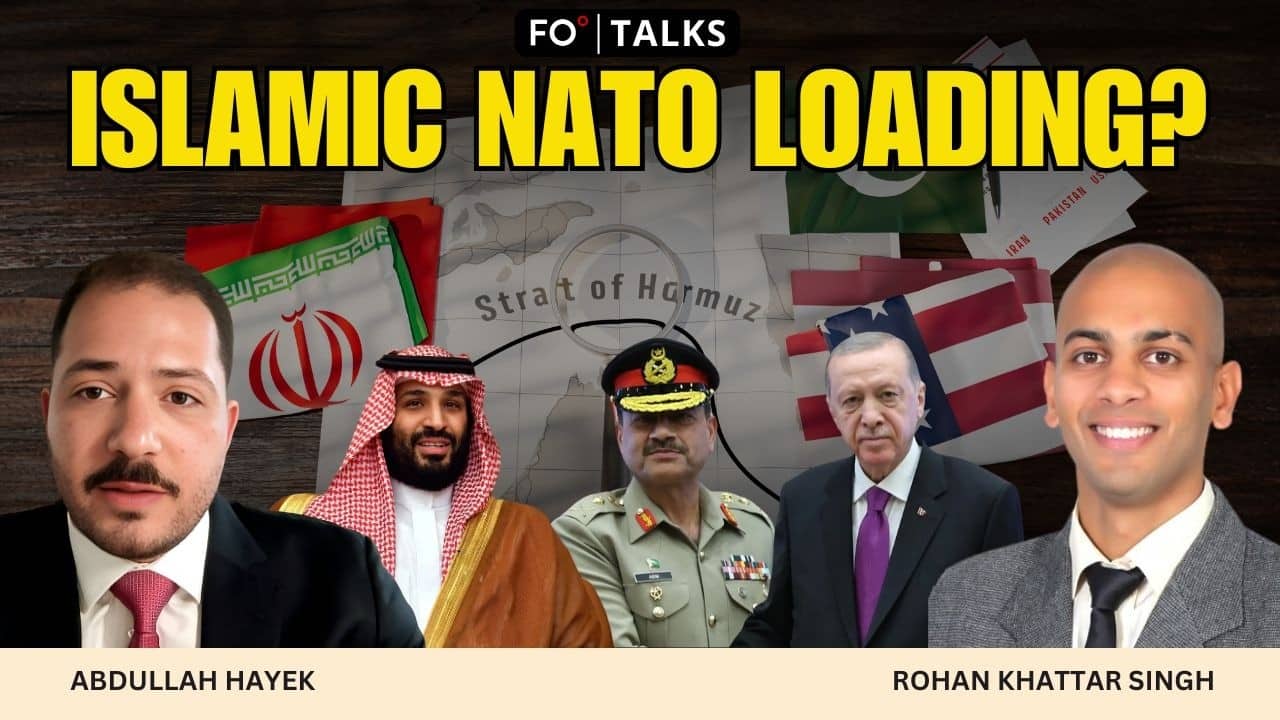
Fair Observer’s Video Producer Rohan Khattar Singh speaks with Abdullah O Hayek, a Middle East analyst and senior contributor at Young Voices, about a ceasefire that appears stable on the surface but remains deeply fragile underneath. The pause in hostilities between the United States, Israel and Iran reflects not resolution, but a temporary alignment of pressures — military fatigue, economic disruption and diplomatic intervention. The central question is not whether the ceasefire holds, but what kind of conflict it is merely postponing.
A ceasefire in name, not in substance
Hayek argues that the current arrangement should not be mistaken for a durable peace. As he puts it, the ceasefire is “fundamentally temporary and transactional rather than… strategic or durable.” It emerged not from resolved disputes but from converging constraints: battlefield exhaustion, global economic strain and mounting diplomatic pressure.
The underlying drivers remain intact. Iran’s nuclear trajectory continues. Israel’s objective of dismantling Iran’s regional network of proxies is unresolved. The US, meanwhile, has intensified coercive measures, including sanctions and an expanded maritime blockade that effectively restricts Iranian trade. Even within the ceasefire framework, conflict persists in other forms. Israeli operations in Lebanon continue, while Iran maintains leverage through asymmetric tools such as naval mines in the Strait of Hormuz.
For Hayek, this produces a situation where the ceasefire holds only in a narrow, technical sense. Beneath it lies what he describes as a pattern of “managed instability,” marked by periodic escalation, signaling and limited confrontation.
Battlefield dominance, strategic ambiguity
Khattar Singh turns to the 41 days of fighting that preceded the ceasefire, highlighting the scale of US and Israeli military operations. The destruction of Iranian military infrastructure was extensive, including the majority of its missile production capacity, naval assets and air force capabilities. Senior leadership figures were also eliminated.
Yet Hayek cautions against equating military success with strategic victory. “Wars of this kind… are decided by whether political objectives and agendas are achieved,” he explains. By that measure, the results are far less clear.
The US entered the conflict without a clearly defined end state. Israel’s stated objective of regime change in Iran remains unmet. Iran, despite suffering heavy losses, has not collapsed. Instead, it has adapted, reframing survival itself as a victory while shifting the conflict into economic and geopolitical domains.
The disruption of the Strait of Hormuz illustrates this shift. By targeting a chokepoint through which roughly a fifth of global energy flows, Iran imposed costs far beyond the battlefield. The result is a conflict that has expanded into global markets, where energy prices, shipping routes and trade flows become instruments of pressure.
The Gulf’s calculus of survival
The war has drawn in the Gulf states not as active participants, but as exposed stakeholders. A significant majority of Iranian strikes targeted Gulf infrastructure, underscoring their vulnerability despite attempts to remain on the sidelines.
Hayek describes their response as a calibrated strategy rooted in survival. They can launch relatively inexpensive drones in large numbers, but interception systems cost exponentially more. Economically, the disruption of the Strait of Hormuz directly threatens their core lifelines in oil and gas exports.
Politically, the Gulf states face a more complex dilemma. Alignment with the US and Israel offers security guarantees, but the war has exposed their limits. Simultaneously, open confrontation with Iran carries unacceptable risks.
The result is a hedging strategy. Gulf governments continue to rely on US partnerships while expanding diplomatic engagement, including support for mediation efforts involving countries such as Pakistan, Turkey and Egypt. Yet they maintain communication channels with Iran, even as tensions persist. This dual approach reflects an effort to contain the conflict rather than resolve it.
Time horizons and political pressure
Khattar Singh shifts the focus to domestic dynamics, contrasting the political constraints faced by Washington and Tel Aviv with Tehran’s longer strategic outlook. Hayek frames this as a clash of time horizons.
Iran operates on what he describes as a doctrine of endurance, where survival and gradual cost imposition are sufficient to claim success. In contrast, the US and Israel face immediate political pressures. Rising energy prices, war fatigue and electoral cycles constrain decision-making in Washington. In Israel, ongoing conflict, civilian casualties and internal political challenges place additional strain on leadership.
This asymmetry complicates the path forward. While Iran can absorb prolonged pressure, its adversaries must demonstrate tangible results within shorter timeframes. The absence of clear political victories raises questions about the sustainability of current strategies.
A region reshaped by instability
Khattar Singh and Hayek conclude by examining how the conflict is altering regional perceptions and alignments. Public sentiment in the Gulf has grown more critical of Israel, which is increasingly viewed as a source of instability. In the US, skepticism is rising, driven less by ideological opposition and more by concerns over cost and strategic clarity.
At the leadership level, however, pragmatism persists. Cooperation with Israel remains conditional and interest-based, while normalization efforts remain tied to unresolved issues such as Palestinian statehood. This divergence between public opinion and elite strategy is becoming a defining feature of the post-war landscape.
Hayek sees no clear winner. Instead, the war has left the region more unstable than before. The ceasefire may pause the violence, but it does not resolve the underlying tensions. If anything, it sets the stage for a conflict that continues in new forms, with escalation controlled not by resolution, but by calculation.
[Lee Thompson-Kolar edited this piece.]
The views expressed in this article/video are the author’s own and do not necessarily reflect Fair Observer’s editorial policy.
” post-content-short=” Fair Observer’s Video Producer Rohan Khattar Singh speaks with Abdullah O Hayek, a Middle East analyst and senior contributor at Young Voices, about a ceasefire that appears stable on the surface but remains deeply fragile underneath. The pause in hostilities between the United States, Israel…” post_summery=”In this episode of FO Talks, Rohan Khattar Singh and Abdullah O Hayek examine the fragile Iran War ceasefire. While the US and Israel achieved tactical gains, neither secured their objectives, allowing Iran to pursue endurance and economic disruption. The regional order has lost further stability, as Gulf states hedge their positions and global energy markets face increased geopolitical risk.” post-date=”May 28, 2026″ post-title=”FO Talks: Can Pakistan, Saudi Arabia, Turkey and Indonesia Mediate the Iran War?” slug-data=”fo-talks-can-pakistan-saudi-arabia-turkey-and-indonesia-mediate-the-iran-war”>FO Talks: Can Pakistan, Saudi Arabia, Turkey and Indonesia Mediate the Iran War?
Fair Observer’s Chief Strategy Officer Peter Isackson and former Swiss diplomat Jean-Daniel Ruch discuss the erosion of international law, the humanitarian catastrophe in Gaza and the weakening authority of international institutions. Drawing on his experience as a former political advisor to the UN Yugoslavia War Crimes Tribunal, Ruch argues that many of the norms designed to regulate conflict and protect civilians are now being openly disregarded by major powers. From the interception of humanitarian flotillas to the intimidation of International Criminal Court officials, the conversation paints a troubling picture of a global order in which legal standards increasingly depend on political power rather than universal principles.
Contested legality
The discussion begins with Israel’s interception of the Sumud humanitarian flotilla in international waters near Crete. Ruch explains that the flotilla consisted of 22 boats carrying 176 activists attempting to draw attention to the worsening humanitarian crisis in Gaza. According to UN estimates, Gaza requires around 600 aid trucks per day, yet only a fraction are currently allowed to enter. Ruch argues that, as an occupying power, Israel has a legal responsibility to ensure the basic needs of the civilian population are met.
Simultaneously, he acknowledges that the legality of the interception itself remains contested. International maritime law protects freedom of navigation on the high seas, while Israel maintains that it is enforcing what it considers a lawful blockade. Ruch suggests the operation’s tactical design was politically calculated. By intercepting the flotilla roughly 1,300 kilometers from Gaza, Israel minimized media visibility and avoided the dramatic confrontations that accompanied earlier flotillas.
For Ruch, however, the deeper issue is not the flotilla itself but the humanitarian conditions that motivated it. He describes the activists’ efforts as stemming from “a very noble intention” to draw attention to suffering that much of the world has begun to normalize. The flotilla becomes less a decisive legal test case than a symbolic reminder of a crisis that many governments and media outlets increasingly treat as background noise.
Politics of justice
Isackson notes that the International Criminal Court (ICC) has accused Israeli Prime Minister Benjamin Netanyahu of war crimes, though it has not formally charged him with genocide. Ruch argues that the ICC’s paralysis reflects immense political pressure placed on its judges and prosecutors.
He points to US sanctions targeting ICC officials, including restrictions that have reportedly prevented some judges from accessing banking services or using credit cards. Ruch also notes that sexual misconduct allegations involving ICC Prosecutor Karim A. A. Khan have further complicated proceedings. Thus, investigations appear to have stalled precisely as evidence has continued to accumulate.
Ruch believes that stronger prosecutors from an earlier generation, such as Carla Del Ponte, would likely have moved more aggressively. He argues that reports from organizations including Amnesty International, Human Rights Watch and Israeli groups such as B’Tselem provide substantial material for expanding charges. Yet he remains skeptical that Netanyahu will ever stand trial, largely because the Israeli leader can avoid traveling to countries obligated to enforce ICC warrants.
Ruch describes the modern Netanyahu as “a very diminished person” compared to the confident political operator he once knew. Drawing on his experience at the Yugoslavia tribunal, he compares Netanyahu’s visible decline to the condition of Ratko Mladić during his later court appearances. Ruch believes that leaders accused of grave crimes often appear transformed by the weight of history and prolonged conflict.
The collapse of international norms
Beyond Gaza, Ruch argues that broader norms governing diplomacy and warfare are rapidly eroding. He cites the killings of negotiators and political envoys, including Hamas leader Ismail Haniyeh and Iranian officials, as evidence that long-standing protections surrounding diplomacy are disappearing.
Historically, emissaries and negotiators were treated as untouchable even during periods of intense conflict. Ruch argues that this principle, once regarded as foundational to international relations, has now been casually discarded. “There is not much appetite for international law in Washington,” he says, linking the shift to a wider embrace of raw power politics.
The speakers also examine the language used to describe different conflicts. Ruch notes that Russia’s invasion of Ukraine in 2022 was widely labeled an “unprovoked aggression,” while the US-led attack on Iran in February was more often described as a “war of choice.” Similarly, Western governments framed Israeli military actions as self-defense while criticizing Iran’s retaliatory strikes without acknowledging Tehran’s own claims under Article 51 of the UN Charter. For Ruch, these distinctions illustrate how legal and moral terminology increasingly reflects geopolitical alignment rather than consistent standards.
Europe’s strategic confusion
Finally, Isackson and Ruch turn to Europe’s struggle for strategic autonomy. Ruch argues that European governments remain politically dependent on Washington even as American policies generate severe economic consequences for Europe itself. The continent’s shift away from Russian pipeline gas toward more expensive American liquefied natural gas has significantly increased household energy costs, particularly in Germany and Italy.
He notes that some European leaders quietly recognize the unsustainability of this arrangement. Yet attempts to develop an independent diplomatic strategy remain tentative and fragmented. Even modest proposals to reopen dialogue with Russia quickly face pressure to remain aligned with Washington.
Isackson criticizes European media for largely reinforcing official policy narratives rather than seriously debating alternatives. Ruch agrees that traditional media institutions are losing influence, especially among younger audiences who increasingly rely on social media. At the same time, he warns that algorithm-driven information environments risk trapping audiences inside ideological echo chambers.
The discussion concludes with reflections on French politics and the emergence of alternative foreign-policy voices. Ruch praises Jean-Luc Mélenchon and Dominique de Villepin for articulating more independent visions of France’s global role, even if neither fully fits within the existing political establishment.
Ultimately, Ruch characterizes the present moment as a turbulent historical transition in which institutions, norms and alliances are all being tested at once. The international system still exists formally, but its underlying rules are becoming harder to enforce as major powers increasingly act according to expediency rather than principle.
[Lee Thompson-Kolar edited this piece.]
The views expressed in this article/video are the author’s own and do not necessarily reflect Fair Observer’s editorial policy.
” post-content-short=” Fair Observer’s Chief Strategy Officer Peter Isackson and former Swiss diplomat Jean-Daniel Ruch discuss the erosion of international law, the humanitarian catastrophe in Gaza and the weakening authority of international institutions. Drawing on his experience as a former political advisor to…” post_summery=”In this episode of FO Talks, Peter Isackson and Jean-Daniel Ruch examine the erosion of international law amid the Gaza war and the Strait of Hormuz crisis. Political pressure has stalled ICC action against Israeli Prime Minister Benjamin Netanyahu, and major powers are systematically breaking long-standing diplomatic norms. Legal standards increasingly depend on geopolitical power rather than universal principles.” post-date=”May 22, 2026″ post-title=”FO Talks: The Stalled Tribunal — Is the ICC Afraid to Prosecute Israeli PM Benjamin Netanyahu?” slug-data=”fo-talks-the-stalled-tribunal-is-the-icc-afraid-to-prosecute-israeli-pm-benjamin-netanyahu”>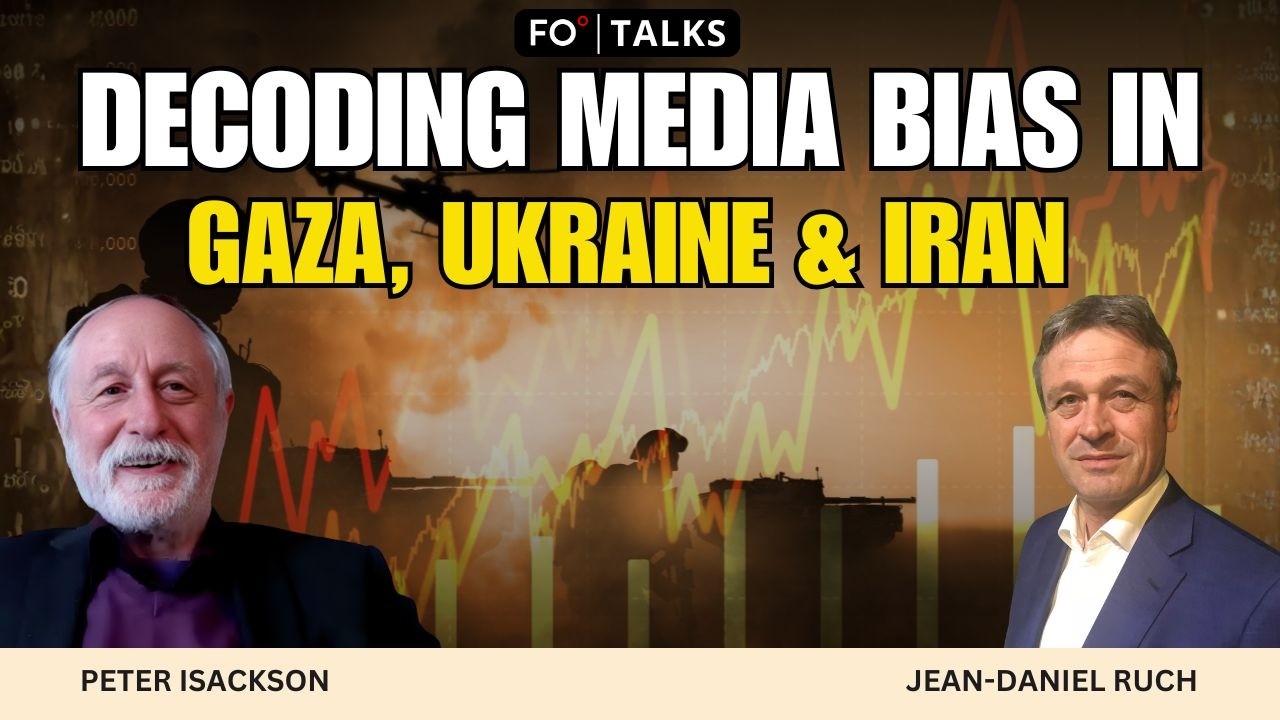
FO Talks: The Stalled Tribunal — Is the ICC Afraid to Prosecute Israeli PM Benjamin Netanyahu?
Fair Observer’s Video Producer Rohan Khattar Singh speaks with Simon Cleobury, Head of Arms Control and Disarmament at the Geneva Centre for Security Policy, about renewed tensions surrounding the Falkland Islands, known in Argentina as Las Malvinas. Following reports that the Trump administration may reconsider Washington’s diplomatic backing for the United Kingdom, the dispute has reentered global debate amid growing strains between US President Donald Trump and UK Prime Minister Keir Starmer over the US war in Iran. Cleobury explains why the islands remain one of the world’s most enduring sovereignty disputes and examines whether Trump’s transactional approach to alliances could destabilize the long-standing US–UK “Special Relationship.”
A dispute rooted in empire and war
Khattar Singh opens by asking why the Falkland Islands remain contested nearly two centuries after Argentina first claimed sovereignty. Cleobury traces the dispute back to the 17th century, noting that the English first landed on the islands in 1690, while the French established the first settlement in 1764 and introduced the name “Malovines,” from which “Las Malvinas” is derived.
After Argentina gained independence from Spain in 1816, Buenos Aires declared sovereignty over the islands in 1820. Britain reasserted control in 1833 and has governed the territory ever since. Cleobury explains that the dispute gained international prominence after World War II, culminating in a 1965 United Nations resolution encouraging peaceful negotiations between London and Buenos Aires.
The conflict escalated dramatically in 1982 when Argentina’s military government invaded the islands. Margaret Thatcher’s government responded by dispatching a naval task force that retook the territory after a ten-week war. Although Britain emerged victorious militarily, the sovereignty dispute itself remained unresolved.
Trump, Iran and diplomatic leverage
According to reports, leaked Pentagon memos suggest the Trump administration is considering diplomatic support for Argentina. Allegedly, the move is linked to White House frustration with Starmer’s reluctance to fully support Washington during the war in Iran.
Cleobury says such a shift would alarm Britain because US diplomatic backing has historically been central to the UK’s international position on the Falklands. He also notes that American military assistance during the 1982 war was widely viewed as crucial to Britain’s success.
Simultaneously, Cleobury doubts the administration will fundamentally abandon London. “I personally don’t think that the US is going to change its position here,” he says, pointing to subsequent efforts by Secretary of State Marco Rubio and King Charles III to calm tensions after the leak became public.
Still, Cleobury believes the Falklands issue has value for Trump as a pressure point. He argues that the White House is less interested in the islands themselves than in using them as leverage against NATO allies unwilling to fully align with US military objectives in Iran. Starmer’s domestic vulnerability, particularly after criticism surrounding the 2025 Chagos Islands agreement with Mauritius, makes the issue politically sensitive for the British government.
The Monroe Doctrine and Trump’s strategy
Khattar Singh raises the possibility that the administration’s thinking reflects a broader effort to revive an expanded version of the Monroe Doctrine, with Washington asserting dominance over the Western Hemisphere.
Cleobury acknowledges that siding more openly with Argentina could improve US standing in parts of Latin America. However, he argues that any gains would likely be outweighed by damage to relations with Britain. “I still take the view that any diplomatic gains with countries of the region wouldn’t outweigh the diplomatic fallout with the UK,” he explains.
He also points to contradictions within the administration’s broader territorial policies. Trump has simultaneously criticized Britain over the Chagos Islands while defending continued UK sovereignty there because of the strategic importance of the Diego Garcia military base. The Falklands do not carry the same military value for Washington.
The discussion highlights how Trump’s foreign policy often blends geopolitical calculation with personal relationships. Khattar Singh suggests Argentine President Javier Milei’s close ties with Trump could strengthen Buenos Aires’ leverage in Washington.
Cleobury agrees that personal rapport matters greatly to Trump but insists the US–UK alliance extends beyond individual leaders. “The relationship between the UK and US, which is often referred to as a special relationship, is fundamentally a very strong relationship,” he says.
The islanders and an unresolved deadlock
Toward the end of the discussion, Khattar Singh emphasizes a frequently overlooked dimension of the dispute: the wishes of the islanders themselves. In a 2013 referendum, 99.8% of Falkland Islanders voted to remain a British Overseas Territory.
Cleobury says Britain’s position rests heavily on the principle of self-determination, but Argentina rejects the referendum as illegitimate because it views British control as a colonial occupation rooted in historical injustice.
That leaves the dispute effectively deadlocked. Cleobury argues that sovereignty questions are ultimately indivisible and that proposals such as joint administration are unlikely to satisfy either side. Even under significant diplomatic pressure, he does not believe Britain would relinquish sovereignty over the islands.
As a result, the Falklands are likely to remain a persistent geopolitical flashpoint.
[Lee Thompson-Kolar edited this piece.]
The views expressed in this article/video are the author’s own and do not necessarily reflect Fair Observer’s editorial policy.
” post-content-short=” Fair Observer’s Video Producer Rohan Khattar Singh speaks with Simon Cleobury, Head of Arms Control and Disarmament at the Geneva Centre for Security Policy, about renewed tensions surrounding the Falkland Islands, known in Argentina as Las Malvinas. Following reports that the Trump…” post_summery=”In this episode of FO Talks, Rohan Khattar Singh and Simon Cleobury discuss renewed tensions over the Falkland Islands after reports that the Trump administration may reconsider US backing for Britain. Cleobury explains the dispute’s historical roots and the pressure facing UK Prime Minister Keir Starmer. This situation is shaped by great-power politics and the islanders’ demand for self-determination.” post-date=”May 21, 2026″ post-title=”FO Talks: Trump’s Iran Jolt — Why the US Is Threatening the UK Over the Falkland Islands” slug-data=”fo-talks-trumps-iran-jolt-why-the-us-is-threatening-the-uk-over-the-falkland-islands”>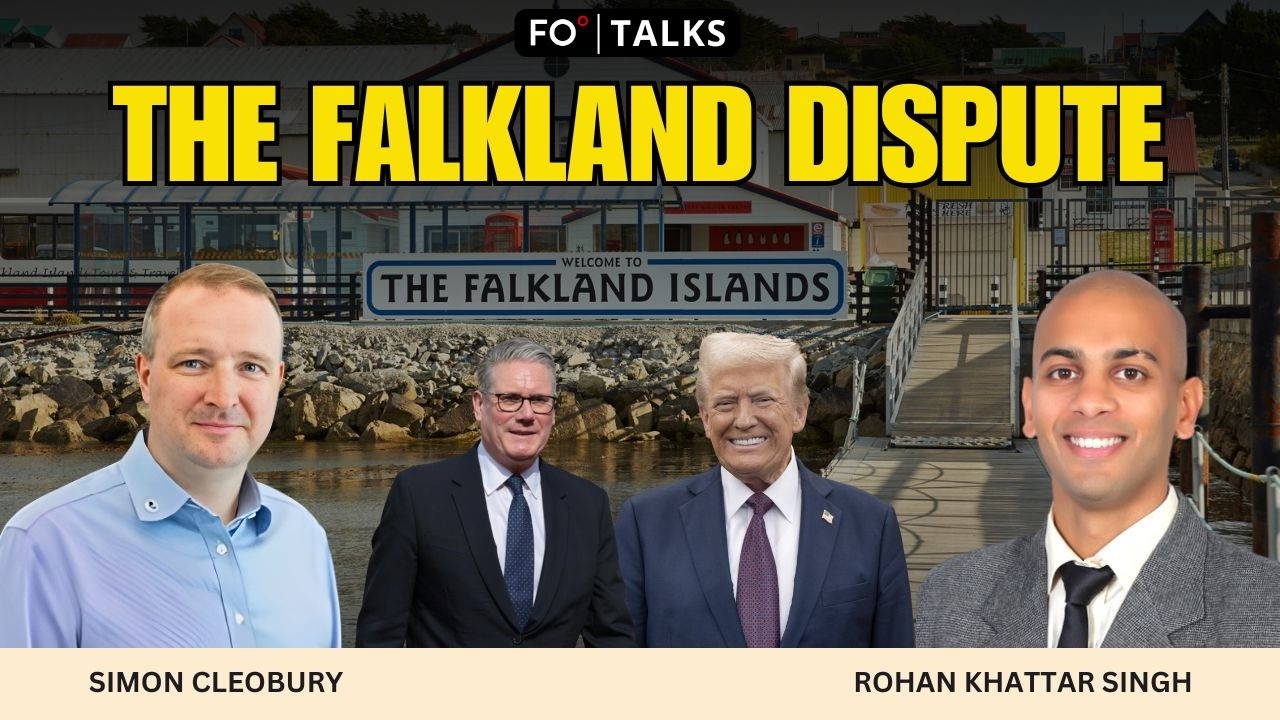
FO Talks: Trump’s Iran Jolt — Why the US Is Threatening the UK Over the Falkland Islands
Fair Observer’s Video Producer Rohan Khattar Singh speaks with Saya Kiba, a professor at Japan’s Kobe City University of Foreign Studies, about Japan’s evolving role in the Indo-Pacific under Prime Minister Sanae Takaichi. As uncertainty clouds the future of the Quad — the Quadrilateral Security Dialogue, a diplomatic partnership between the United States, Australia, India and Japan concerning Indo-Pacific security — Tokyo is strengthening ties with Australia and Southeast Asia through new diplomatic, economic and security initiatives. Kiba explains how Japan’s updated “Free and Open Indo-Pacific” strategy reflects a broader shift toward middle-power cooperation, while controversial discussions about exporting lethal weapons to the Philippines signal another change in Japan’s security policy, with the country slowly moving away from its post-war pacifist stance.
Japan’s middle-power strategy
Khattar Singh opens by asking about Takaichi’s recent five-day tour of Vietnam and Australia, which took place from May 1 to May 5. Kiba says the trip reflects Japan’s effort to deepen both bilateral and multilateral partnerships at a time of growing uncertainty in global politics.
Australia has become especially important as Japan loosens restrictions on arms exports and explores joint defense development projects. Simultaneously, both countries are reassessing the Quad’s future.
Kiba argues that the Quad has lost momentum amid uncertainty surrounding American policy. “The Quad cooperation has actually stopped,” she says, pointing to the failure to hold a planned summit in India last year. In response, she believes countries like Japan and Australia are increasingly relying on middle-power coordination to preserve regional stability even when Washington appears inconsistent.
For Tokyo, Southeast Asia remains equally important. Kiba describes the region as Japan’s “most essential neighboring partner,” particularly during ongoing energy and supply-chain disruptions across the Indo-Pacific.
Updating the Indo-Pacific vision
A major focus of Takaichi’s Vietnam visit was the announcement of an updated version of Japan’s “Free and Open Indo-Pacific” strategy, commonly known as FOIP. Originally introduced by former Prime Minister Shinzo Abe a decade ago, FOIP sought to promote regional cooperation around maritime security, infrastructure and rule-based order.
Kiba explains that the revised framework places greater emphasis on emerging economic and technological challenges. The updated FOIP now includes cooperation on artificial intelligence, supply-chain resilience, renewable energy and public–private investment partnerships.
Japan is not distancing itself from the US despite its growing regional activism. Washington remains Tokyo’s only formal military ally, and Japan continues to coordinate closely with the US government. Instead, the new strategy reflects Japan’s attempt to modernize its regional relationships.
“The updated FOIP is more focusing on the co-creation facing the new challenges together,” Kiba explains. Rather than treating Southeast Asian countries as aid recipients, Japan increasingly frames them as equal partners confronting common problems such as energy insecurity and economic vulnerability.
This shift is also visible in Japan’s “Power Asia” initiative, announced earlier this year. The program seeks to expand regional energy cooperation, particularly around renewable energy and zero-emission technologies. Meanwhile, it links partners such as Australia, India and Southeast Asian states into a broader Indo-Pacific framework.
Australia and the rise of minilateral alliances
Khattar Singh notes that even as the Quad struggles to maintain momentum, bilateral cooperation between Japan and Australia continues to intensify. Kiba says the two countries now share far more aligned strategic concerns than they did in previous decades, especially regarding China’s expanding military presence.
Their cooperation increasingly extends beyond traditional defense issues into “economic security,” including supply chains, critical minerals and energy resilience. Both governments also support deeper engagement with Southeast Asia through new regional frameworks.
Kiba highlights the growing importance of “minilateral” arrangements — smaller coalitions built around specific strategic goals. During a recent visit to Indonesia, Japanese Defense Minister Shinjiro Koizumi and his Indonesian counterpart mentioned trilateral cooperation among Japan, Australia and Indonesia.
For Kiba, these emerging security networks represent one of the most significant developments in Indo-Pacific diplomacy. Instead of relying entirely on large multilateral organizations, middle powers are constructing flexible regional partnerships designed to address practical economic and security concerns.
Japan’s debate over lethal arms exports
The most controversial part of Japan’s new strategy involves defense exports. Khattar Singh asks Kiba about reports that Tokyo may sell lethal weapons, including destroyers, to the Philippines. Such a move would have been politically unthinkable under Japan’s traditional postwar pacifism.
Kiba confirms that recent cabinet decisions have dramatically expanded Japan’s legal ability to export military equipment. “Technically, we can export any kind of the defense equipment,” she says.
However, the process remains politically and bureaucratically difficult. The relaxation of export restrictions occurred through a cabinet decision rather than parliamentary legislation, a process she says has generated domestic criticism.
“Many people criticize, and I agree [with] that point,” Kiba notes. She argues that such a major shift should involve broader democratic debate. Japan and the Philippines have only agreed to begin discussions regarding the possible transfer of Taylorcraft TC-19 aircraft and destroyers. Any final agreement would require extensive parliamentary review, operational planning and legal guarantees concerning transparency, maintenance and non-resale provisions.
Kiba emphasizes that Japan’s bureaucratic safeguards remain extensive. Recipient countries must comply with strict procurement rules and operational restrictions, while both governments would need to negotiate thousands of pages of technical and legal documentation before any transfer could occur.
For now, Japan’s evolving defense policy reflects a country attempting to balance regional security pressures with the institutional constraints of its democratic and pacifist traditions.
[Lee Thompson-Kolar edited this piece.]
The views expressed in this article/video are the author’s own and do not necessarily reflect Fair Observer’s editorial policy.
” post-content-short=” Fair Observer’s Video Producer Rohan Khattar Singh speaks with Saya Kiba, a professor at Japan’s Kobe City University of Foreign Studies, about Japan’s evolving role in the Indo-Pacific under Prime Minister Sanae Takaichi. As uncertainty clouds the future of the Quad — the Quadrilateral…” post_summery=”In this episode of FO Talks, Rohan Khattar Singh and Saya Kiba examine Japan’s role in the Indo-Pacific as uncertainty weakens the Quad. Prime Minister Sanae Takaichi’s FOIP strategy strengthens cooperation with Australia and Southeast Asia on regional security. Japan’s willingness to open discussions on selling destroyers to the Philippines marks a major shift from its traditional post-war pacifist stance.” post-date=”May 18, 2026″ post-title=”FO Talks: How QUAD Members Japan and Australia Are Now Maximizing Minilateral Cooperation” slug-data=”fo-talks-how-quad-members-japan-and-australia-are-now-maximizing-minilateral-cooperation”>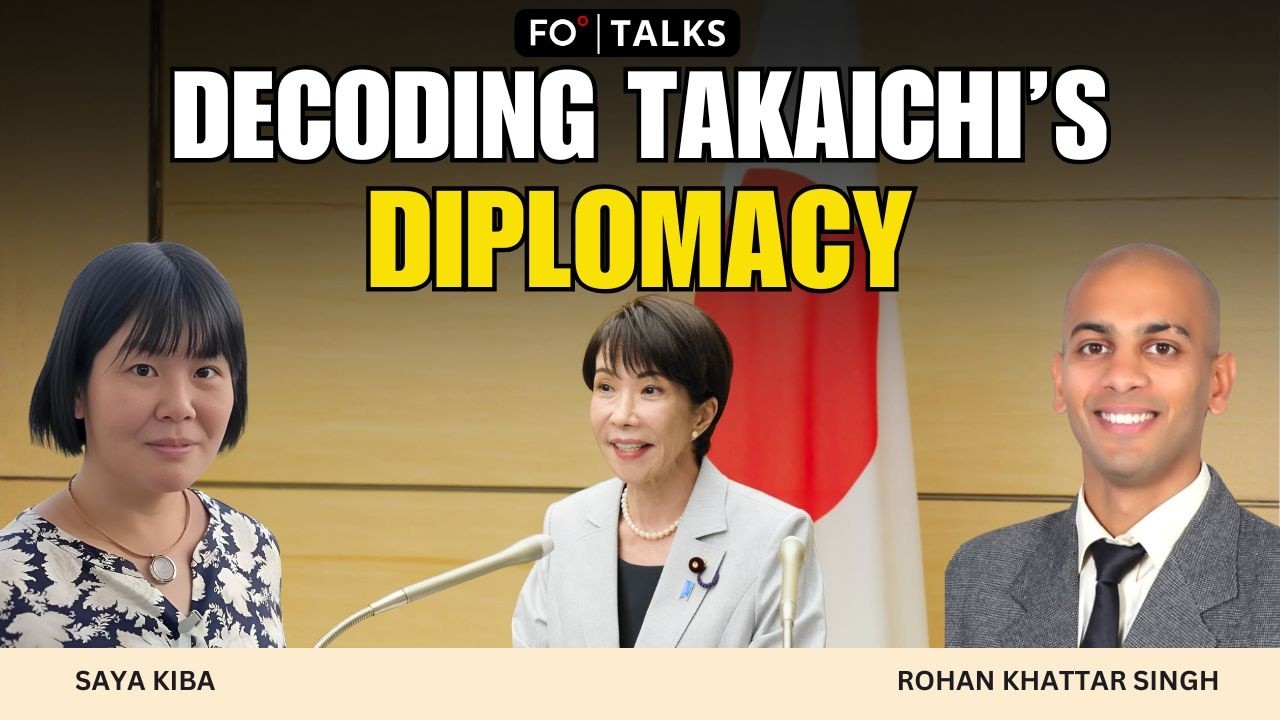
FO Talks: How QUAD Members Japan and Australia Are Now Maximizing Minilateral Cooperation
Kent Jenkins Jr., a former political reporter from The Washington Post turned communications consultant, speaks with author Paul Eckert about the widening fracture inside the American middle class and what it means for the future of democracy. Drawing on his 2026 book, Healing Middle-Class Democracy: Respecting Each Other, Cooperating Fairly, and Sharing Opportunity, Eckert argues that the postwar middle class has split into a prosperous upper tier and a struggling lower tier with increasingly different economic possibilities. Rising housing, healthcare, childcare and education costs have weakened the sense of shared opportunity that once anchored American society. Eckert proposes a broader democratic project built on mutual respect, fairness and investment in opportunity.
A middle class divided
Eckert begins by redefining the middle class through economic dependence on work. Unlike the wealthy, middle-class Americans cannot stop working without risking a major decline in their standard of living. Yet he argues that this broad category no longer shares common economic interests.
He distinguishes between an upper middle class, roughly the top 20% of working-age Americans, and a lower middle class that makes up the next 60%. Since the late 1970s, the upper tier has accumulated far more wealth while the lower tier has struggled with affordability and economic insecurity. “The middle class depends on democracy and democracy depends on the middle class,” Eckert says. Democratic stability weakens when most citizens no longer feel institutions work for them.
The divide becomes visible in daily life. First-time homebuyers increasingly find themselves priced out of the market. Childcare costs force many families into impossible tradeoffs between parenting and employment. Healthcare expenses remain financially disruptive even for insured households, while rising student debt undermines education as a path to mobility. Jenkins notes that Americans who once occupied a relatively unified middle-class world now experience sharply different realities.
Democracy and mutual respect
For Eckert, the economic split carries political consequences because democracy relies on compromise between groups with competing interests. If most Americans lose faith in democratic institutions, those institutions become fragile.
His first proposed remedy is respect. Eckert says that the upper and lower middle classes increasingly live apart socially and geographically, which fuels resentment and misunderstanding. Those at the top may view struggling Americans as irresponsible or lazy, while those below see arrogance and unfair privilege.
He insists both perspectives miss the structural realities shaping opportunity. “Everybody’s working hard, everybody’s ambitious, everybody wants to do the best they can,” he says, even if circumstances produce vastly different outcomes.
Rather than condemning success, Eckert argues that prosperous Americans should retain incentives to innovate and achieve. Simultaneously, society should recognize the unrealized potential inside the lower middle class. Respect, in his framework, means acknowledging the equal dignity of all forms of work and rejecting the assumption that economic outcomes perfectly reflect personal worth.
Fairness, cooperation and opportunity
Eckert’s second pillar, cooperating fairly, draws heavily from political philosopher John Rawls. He revisits Rawls’s “veil of ignorance” thought experiment, which asks people to imagine designing society without knowing where they or their children would end up within it.
The exercise, Eckert argues, reveals why democratic societies must balance individual freedom with collective responsibility. Inequality will always exist because talent, health, upbringing and opportunity differ. Yet fairness requires ensuring that those born into difficult circumstances still have meaningful chances to improve their lives.
That principle leads directly to Eckert’s third pillar: sharing opportunity. He carefully distinguishes this from simple redistribution. While some redistribution may be necessary, he argues that long-term democratic stability depends more on expanding people’s ability to generate prosperity themselves.
Education sits at the center of this strategy. Eckert advocates a continuous pipeline beginning with preschool and extending through vocational training, community colleges and universities. He emphasizes that four-year college degrees should not remain the only respected path to advancement. Vocational education, entrepreneurship and technical skills can also create mobility and economic security.
Artificial intelligence intensifies the urgency of these reforms. AI-driven disruption may soon affect upper-middle-class professionals as much as manufacturing workers. Instead of slowing innovation, Eckert argues that education systems should help workers adapt to emerging industries and technologies.
Philosophy, experience and democratic hope
Jenkins notes that Eckert’s argument stands apart from the anger and polarization dominating contemporary politics. Eckert explains that his approach emerges partly from personal experience. Raised in lower-middle-class Indiana, he later entered elite academic and political institutions, giving him firsthand exposure to both sides of America’s class divide.
His thinking also draws from philosophers including Rawls, John Dewey and Jürgen Habermas. Dewey emphasized mutual respect and challenged the historic bias against manual labor. Habermas focused on honest communication and democratic negotiation in the aftermath of Nazi Germany. Rawls provided the framework for fairness and social cooperation.
Eckert acknowledges that his vision may appear idealistic in a deeply polarized political climate. Yet he argues that democratic societies need ideals precisely because daily politics so often falls short. “The American dream can be just a hopeless fantasy or an empty aspiration,” he says. “It can also be a reality.”
The discussion closes on a cautiously optimistic note. Eckert believes that investing in the unrealized potential of the lower middle class could increase national productivity while preserving prosperity for those already succeeding. Democracy, in his view, remains the only system capable of balancing both goals at once.
[Lee Thompson-Kolar edited this piece.]
The views expressed in this article/video are the author’s own and do not necessarily reflect Fair Observer’s editorial policy.
” post-content-short=” Kent Jenkins Jr., a former political reporter from The Washington Post turned communications consultant, speaks with author Paul Eckert about the widening fracture inside the American middle class and what it means for the future of democracy. Drawing on his 2026 book, Healing Middle-Class…” post_summery=”In this episode of FO Talks, Kent Jenkins Jr. and Paul Eckert discuss the growing divide between America’s upper and lower middle classes. Rising costs in housing, healthcare, childcare and education have eroded shared economic opportunity, while social separation between classes fuels resentment and distrust. Eckert proposes rebuilding democracy through mutual respect, cooperation and investment in education and opportunity.” post-date=”May 17, 2026″ post-title=”FO Talks: A Dangerous Divide — Why a Middle-Class Breakup Threatens American Democracy” slug-data=”fo-talks-a-dangerous-divide-why-a-middle-class-breakup-threatens-american-democracy”>
FO Talks: A Dangerous Divide — Why a Middle-Class Breakup Threatens American Democracy
Fair Observer’s Video Producer Rohan Khattar Singh and Argentine international-relations analyst Ricardo Vanella discuss renewed geopolitical attention surrounding the Falkland Islands, known in Argentina as the Islas Malvinas. Following reports that the Trump administration may reconsider Washington’s diplomatic backing for the United Kingdom after Britain refused to support the US war in Iran, Argentina may now have a renewed diplomatic opportunity to explain its long-standing sovereignty claim with seriousness, restraint and strategic patience. Vanella argues that while Argentinian President Javier Milei’s close ties with US President Donald Trump may provide Argentina with unusual access in Washington, Buenos Aires must avoid overreading tactical signals from the White House. Instead of confrontation, he proposes a long-term South Atlantic framework centered on diplomacy, investment and trust-building between Argentina and the UK.
A dispute shaped by history and identity
Vanella begins by explaining why he refers to the islands as the Malvinas rather than the Falklands. For Argentina, he says, the issue is tied not only to sovereignty but also to history, identity and constitutional principle. Argentina views the islands as territory occupied by Britain since 1833, while the UK argues that sovereignty rests on long-term administration and the wishes of the islanders themselves.
The dispute remains emotionally and politically charged because it combines colonial history, international law and national identity. Khattar Singh notes how naming itself becomes a geopolitical tool, comparing the issue to disputes over geographic terminology elsewhere in the world.
Although Argentina lost the Falklands War in 1982, Vanella stresses that democratic governments since then have pursued the issue through diplomacy rather than force. “This is not about war,” he says. “This is about law, history, diplomacy and an unresolved sovereignty dispute.”
Trump, Milei and a changing geopolitical landscape
The immediate trigger for the conversation is a reported Pentagon memo suggesting the Trump administration may reconsider US diplomatic support for Britain regarding the islands. According to the report, the shift emerged partly because London refused to openly back Washington during the US confrontation with Iran.
Khattar Singh connects this possibility to what he describes as a revived “Monroe Doctrine” approach in Trump’s foreign policy, where Washington seeks to tighten influence over the Western Hemisphere and limit the role of rival powers, including European states. Argentina’s growing ideological alignment with the Trump administration has therefore attracted international attention.
Vanella urges caution. While Milei’s relationship with Trump may improve Argentina’s access in Washington, he warns against treating internal US debates as a definitive policy shift. “Access is not the same as a policy change,” he explains.
He argues that Argentina should use the moment carefully by combining political access with serious diplomacy. Legal arguments, regional support, multilateral engagement and strategic patience remain more important than personal relationships between leaders. As Vanella puts it, “Personal chemistry helps. It does not replace statecraft.” Vanella emphasizes that Washington has historically acknowledged the dispute while stopping short of formally backing Argentine sovereignty.
A shared South Atlantic vision
Vanella proposes what he describes as a long-term South Atlantic framework — a shared vision built around cooperation, investment, connectivity and trust-building. If both sides continue insisting only on their maximum demands, the dispute could remain frozen for another century.
His proposal centers on practical cooperation before any final sovereignty settlement. Britain could increase investments in Patagonia and Tierra del Fuego in sectors such as logistics, fisheries, energy and scientific research. Argentina, meanwhile, could strengthen its commercial and economic presence in London while building deeper ties with British institutions and businesses.
Vanella believes such a framework could gradually reduce mistrust while creating mutual economic incentives. “Diplomacy sometimes requires imagination, patience and very long horizons,” he says.
Importantly, he draws a firm line against any military approach. Argentina, he argues, must reject the possibility of armed confrontation entirely because another war would be “disastrous morally, strategically and diplomatically.” Instead, Buenos Aires should focus on strengthening economic credibility, regional partnerships and diplomatic influence. The serious Argentine position, he says, should be “firm but peaceful: no war, no adventurism, only diplomacy and statecraft.”
Self-determination, colonialism and global support
Khattar Singh raises the central contradiction in the dispute: Argentina describes the islands as a colonial holdover, while Britain argues that the islanders overwhelmingly support remaining a British Overseas Territory. In the 2013 referendum, nearly 99% of voters backed continued British rule.
Vanella responds that Argentina views the issue differently because much of the international community still treats the dispute as unresolved. Latin American organizations and many countries in the Global South continue supporting negotiations between Buenos Aires and London, even if not all explicitly endorse Argentina’s sovereignty claim.
He also notes that countries such as India have historically shown diplomatic sympathy toward Argentina’s position, including the use of the name “Malvinas” in official contexts. Yet symbolic support alone, he says, is insufficient. Argentina must prove itself “consistent,” “credible” and “reliable” over time if it wants major powers to take its diplomatic strategy seriously.
The “big club” of geopolitics
In the final section, Vanella frames the dispute within what he calls the global “big club” of powerful states. The US may dominate the system, he says, but the UK remains a crucial part of its infrastructure and alliances. Because of this, Argentina should avoid assuming Washington will dramatically abandon Britain.
Instead, Vanella believes Buenos Aires should pursue gradual trust-building with both the US and the UK while remaining active in multilateral institutions, including the United Nations, where long-term diplomatic opportunities may emerge.
Ultimately, Vanella argues that only a shared South Atlantic strategy can break the diplomatic deadlock. A long-term framework based on trade, investment, connectivity and cooperation may not immediately solve the sovereignty dispute, but it could create the trust necessary for meaningful negotiations later. In Vanella’s view, Argentina should remain firm in principle, peaceful in method and creative in strategy.
[Lee Thompson-Kolar edited this piece.]
The views expressed in this article/video are the author’s own and do not necessarily reflect Fair Observer’s editorial policy.
” post-content-short=” Fair Observer’s Video Producer Rohan Khattar Singh and Argentine international-relations analyst Ricardo Vanella discuss renewed geopolitical attention surrounding the Falkland Islands, known in Argentina as the Islas Malvinas. Following reports that the Trump administration may reconsider…” post_summery=”In this episode of FO Talks, Rohan Khattar Singh and Ricardo Vanella discuss renewed geopolitical tensions surrounding the Falkland Islands after reports suggest Trump may reconsider supporting Britain. Argentina shouldn’t overinterpret signals from Washington, but pursue patient diplomacy grounded in international law. Vanella proposes a South Atlantic framework based on investment and trust-building between Argentina and the UK.” post-date=”May 16, 2026″ post-title=”FO Talks: Why the US Could Abandon the UK and Back Argentina in the Falkland Islands Dispute” slug-data=”fo-talks-why-the-us-could-abandon-the-uk-and-back-argentina-in-the-falkland-islands-dispute”>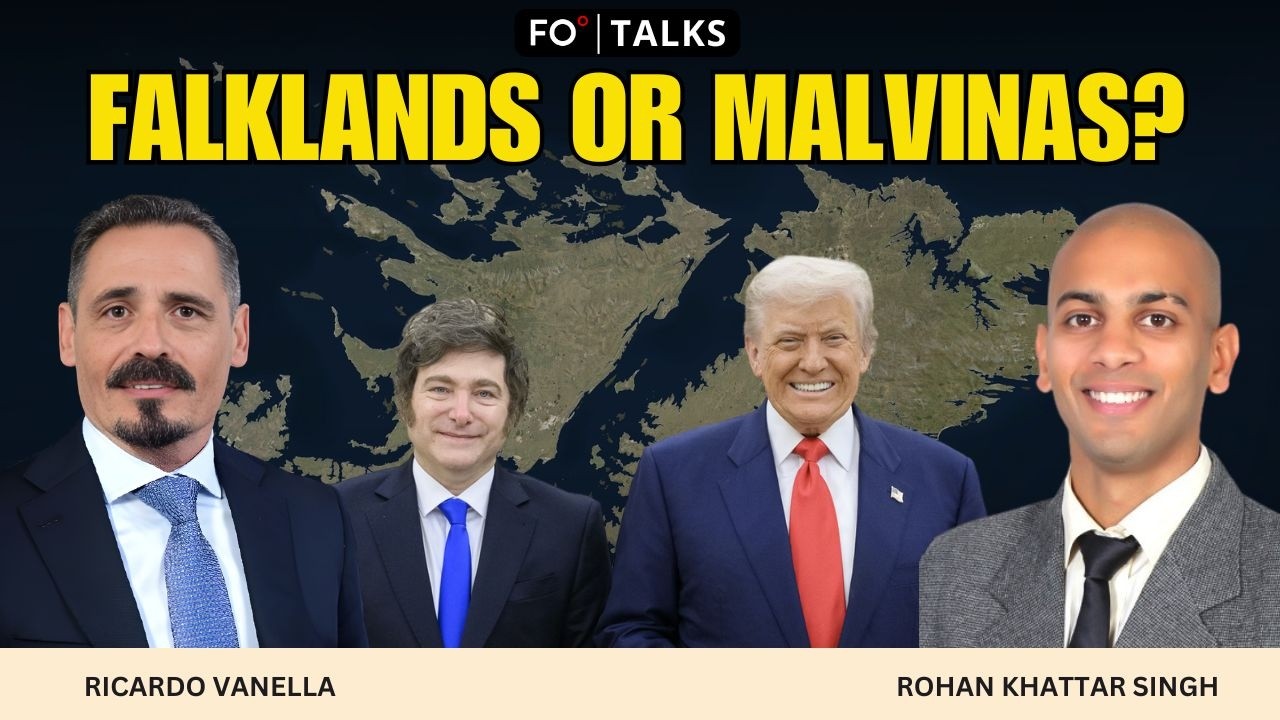
FO Talks: Why the US Could Abandon the UK and Back Argentina in the Falkland Islands Dispute
Fair Observer Contributing Editor Laura Pavón Aramburú speaks with American University Professor William M. LeoGrande about the rapid deterioration of US–Cuba relations under US President Donald Trump. They examine how Washington’s tightening of its long-standing embargo, combined with new pressure on countries supplying oil to Cuba, has deepened the island’s humanitarian and economic crisis. LeoGrande contrasts the current strategy of coercion with US President Barack Obama’s earlier engagement policy, arguing that decades of sanctions have failed to produce meaningful political change. Is the United States pursuing realistic diplomacy or repeating a regime-change strategy that has repeatedly failed elsewhere?
From engagement to economic strangulation
Aramburú opens by revisiting the Obama administration’s normalization efforts, which included restoring diplomatic relations, loosening travel restrictions and removing Cuba from the list of state sponsors of terrorism. LeoGrande notes that the two governments signed 22 bilateral agreements during Obama’s final years in office, reflecting an attempt to build cooperation around mutual interests.
Today, he says, the relationship has deteriorated dramatically. “The situation today in the bilateral relationship is probably as bad as it has ever been,” LeoGrande states. Alongside the traditional embargo imposed in 1962, the Trump administration has added new pressure through secondary sanctions targeting countries that export oil to Cuba, and foreign firms doing business in Cuba.
According to LeoGrande, Mexico, Algeria and Angola all halted shipments after Washington threatened economic retaliation. Russia remains willing to provide oil, but not enough to offset the losses. This has resulted in a worsening energy crisis that has disrupted transportation, electricity production and industrial activity across the island.
LeoGrande argues that the contrast between Obama and Trump reflects two fundamentally different theories of change. Obama believed greater engagement would gradually encourage economic and political opening. Trump’s approach, by contrast, seeks to “strangle the Cuban economy” until Havana accepts US terms.
Oil, leverage and the limits of regime change
The conversation then broadens into a larger debate about US regime-change strategies. Aramburú compares Cuba to recent US confrontations with Venezuela and Iran, questioning whether Washington’s objectives are clearly defined or driven by a broader ideological hostility toward socialism and anti-American governments.
LeoGrande points to Venezuela as an example of inconsistency. The US publicly pursued regime change while Venezuelan President Nicolás Maduro held office, yet Washington later appeared willing to work with the post-Maduro government so long as American oil companies regained access to the Venezuelan energy sector.
A similar logic may exist in Cuba. Current negotiations reportedly focus heavily on economic questions, including property claims, foreign investment and access to Cuba’s strategic minerals. Yet political demands remain a major obstacle, particularly calls from US Secretary of State Marco Rubio for leadership change in Havana.
For Cuban officials, sovereignty remains non-negotiable. LeoGrande argues that negotiations could succeed if they remain focused on economic normalization, but they are unlikely to survive any attempt by Washington to dictate Cuba’s political system.
A society under pressure
The discussion also explores the severe humanitarian effects of Cuba’s energy shortages. LeoGrande describes hospitals struggling to maintain electricity, factories closing for parts of the week and public transportation nearly collapsing because of fuel scarcity. Farmers often cannot move crops to market, further worsening food shortages.
Simultaneously, Cuba’s own economic failures have compounded the crisis. LeoGrande notes that the government delayed market reforms for years and became overly dependent on tourism. Attempts to unify Cuba’s currency system in 2021 also contributed to inflation and instability.
Even traditional pillars of the economy are weakening. Cuba’s sugar sector, once central to national identity and exports, has deteriorated so badly that the country recently had to import sugar. Cuba now needs major foreign investment to rebuild critical industries and modernize infrastructure.
Still, LeoGrande highlights some areas of resilience. China has supplied solar technology that is helping Cuba slowly expand renewable energy production, while the island’s biotechnology sector continues to demonstrate significant scientific capacity despite sanctions.
Generational divides and the Cuban diaspora
Aramburú raises the question of whether internal political change could eventually emerge from younger generations. LeoGrande describes a growing divide between older Cubans who remember the revolution’s early years more positively and younger Cubans whose experience has been dominated by austerity and economic stagnation.
Yet he remains skeptical that widespread unrest will produce regime collapse. “There’s no organized opposition,” LeoGrande explains, arguing that many critics eventually emigrate rather than build sustained movements inside Cuba. Dissatisfaction is widespread, but the state still retains strong institutional control.
The Cuban diaspora remains another major political force, especially in Florida. Cuban Americans have historically exercised outsized influence over US policy because of their concentration in a key electoral state and their strong focus on Cuba-related issues.
However, the community itself has become increasingly divided. Some supported Obama’s normalization efforts, while others continue backing a hard-line embargo strategy. Trump’s immigration policies have also created tensions by ending many of the special protections historically granted to Cuban migrants.
Negotiation or collapse?
The conversation concludes by considering possible future scenarios. LeoGrande argues that a direct US invasion of Cuba remains highly unlikely. Such an operation would alienate parts of Trump’s political base, impose enormous economic burdens on Washington and potentially trigger a prolonged guerrilla conflict.
Instead, he believes negotiations remain the only realistic path forward. “The only option for the United States to get something that it wants from the situation is to sit down at the negotiating table with the Cuban government,” he says.
Still, continued economic pressure risks producing another migration crisis similar to the Mariel boatlift or the 1994 raft exodus. For LeoGrande, the deeper tragedy is that ordinary Cubans continue paying the highest price for a geopolitical conflict that has lasted more than six decades.
[Lee Thompson-Kolar edited this piece.]
The views expressed in this article/video are the author’s own and do not necessarily reflect Fair Observer’s editorial policy.
” post-content-short=” Fair Observer Contributing Editor Laura Pavón Aramburú speaks with American University Professor William M. LeoGrande about the rapid deterioration of US–Cuba relations under US President Donald Trump. They examine how Washington’s tightening of its long-standing embargo, combined with new…” post_summery=”In this episode of FO Talks, Laura Pavón Aramburú and William M. LeoGrande examine how US President Donald Trump’s oil restrictions have pushed US–Cuba relations to a low point. The strategy of economic coercion has deepened Cuba’s humanitarian crisis without producing political change, while exposing the limits of regime-change policies seen in Venezuela. What is Cuba’s path forward?” post-date=”May 15, 2026″ post-title=”FO Talks: Making Sense of US Policy Towards Cuba Under Obama, Biden and Trump” slug-data=”fo-talks-making-sense-of-us-policy-towards-cuba-under-obama-biden-and-trump”>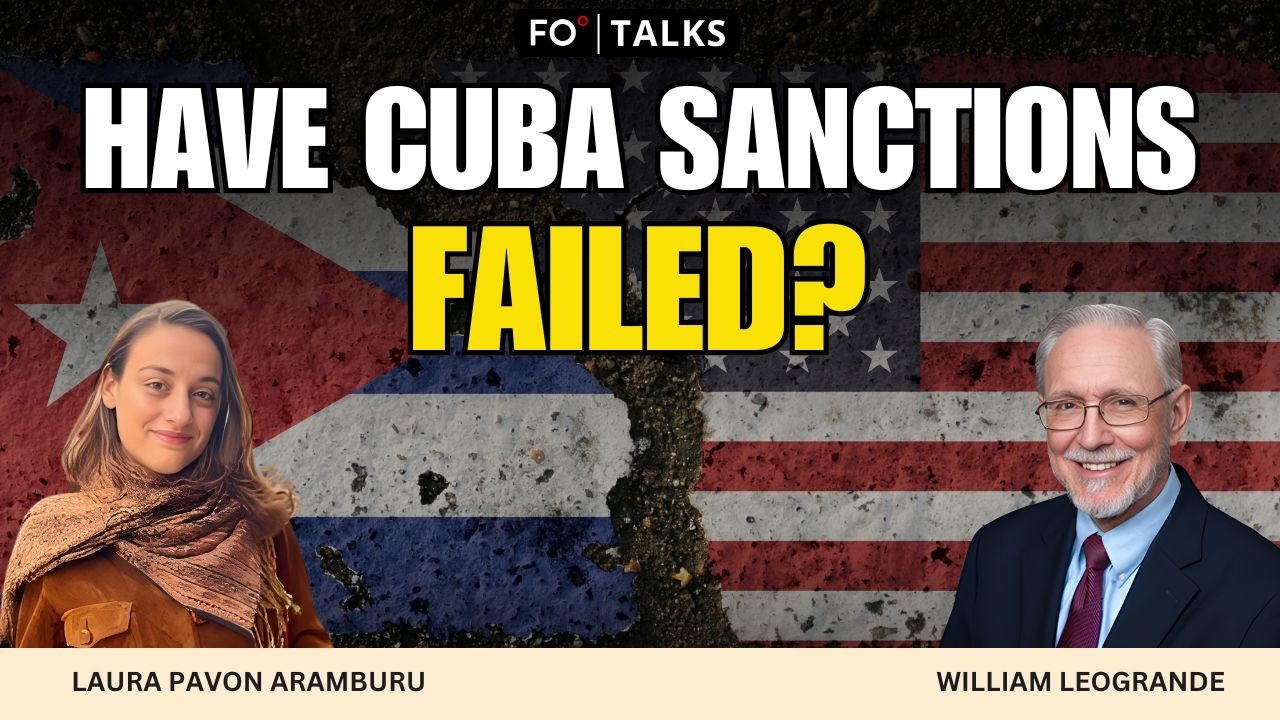
FO Talks: Making Sense of US Policy Towards Cuba Under Obama, Biden and Trump
Fair Observer’s Chief Strategy Officer Peter Isackson and Global Civilization Dynamics Founder Vinay Singh discuss a variety of tech subjects, starting with Meta’s decision to track employee keystrokes and mouse movements in order to train AI systems that can “replicate” human work. From there, Isackson and Singh widen the lens, arguing that the same logic driving automation may also undermine the consumer economy on which Western capitalism depends. Modern societies are optimizing for efficiency and consumption while eroding the human capacities — trust, attention and critical thinking — needed to sustain civilization itself.
From workers to data points
Singh opens with reports that Meta is increasing surveillance of employees by monitoring keyboard activity and mouse movements to improve AI agents. The company presents the move as a technical necessity, arguing that AI systems still struggle with many small human tasks. Yet both speakers see the development as symbolic of a deeper shift in management culture.
Isackson argues that workers are increasingly treated not as members of a productive community but as objects to be optimized. He compares the trend to a modern version of Charlie Chaplin’s Modern Times, where human beings become extensions of machines rather than the reverse.
Singh remains skeptical of claims that humans will simply “monitor” AI systems while retaining stable employment. He predicts that companies will eventually reduce headcounts dramatically, leaving only a handful of people supervising vast networks of automated agents. More troubling for him is the wider corporate tendency to imitate whatever large technology firms do. He warns that many executives now assume that if Meta or another tech giant adopts a model, every industry should follow it regardless of whether it fits their own business realities.
Isackson notes that boards, venture capital firms and financial actors often reinforce this pressure. Because they are removed from day-to-day production, they reward short-term efficiency gains without considering how workplace culture or human motivation may deteriorate over time.
The AI layoff trap
Isackson and Singh then turn to an economics paper describing what researchers call the “AI Layoff Trap.” The paper argues that firms are automating labor faster than the broader economy can absorb the consequences, creating a destructive feedback loop. Companies benefit individually from layoffs, but collectively they weaken consumer demand across society.
To illustrate the idea, Singh introduces his “three brothers” analogy. One brother owns a phone company, another a grocery chain and the third a car dealership. When the phone company lays off workers to cut costs, those unemployed workers spend less on groceries. The grocery business then suffers and cuts its own workforce. Those additional layoffs reduce spending on phones and cars, eventually harming the original company that initiated the cuts.
Singh calls this a “circular dynamic” that exposes how interconnected economic systems really are. What appears rational at the level of one corporation becomes destructive at the level of society.
Isackson connects the argument to Henry Ford’s realization that workers needed enough income to buy the products they produced. He notes that the US economy remains overwhelmingly consumer-driven, making large-scale demand destruction particularly dangerous. “When you start doing things that are focused on the logic of production,” he warns, “you may be undermining” the consumer system itself.
Both speakers argue that short-term thinking has become embedded in corporate culture. Firms focus narrowly on immediate efficiency gains while ignoring the wider social consequences of mass automation.
A crisis of trust
The conversation then shifts from economics to politics and social cohesion. Singh cites polling from Harvard Kennedy School showing that only 19% of young Americans trust the federal government to do the right thing most or all of the time. Trust in Congress, the presidency and the Supreme Court is similarly low.
For Singh, the numbers reflect growing financial insecurity and what he describes as a “crisis of community.” Younger generations increasingly struggle to see stable pathways into adulthood, employment or social belonging.
Isackson argues that the phenomenon extends beyond the United States. In Europe, citizens may still trust state institutions more because of stronger welfare systems, but confidence is eroding there as well. He also points to collapsing trust in mainstream media, which historically helped define shared expectations and social norms.
Singh believes generational disconnect worsens the problem. Younger people, he argues, often fail to learn resilience from older generations who experienced earlier economic crises such as the dot-com collapse or the 2008 recession. Social media has weakened those intergenerational relationships and replaced lived experience with digital interaction.
“Digital Doritos” and the loss of attention
The final section explores the cognitive consequences of constant digital consumption. Singh references studies linking short-form video platforms such as TikTok and Instagram to reduced attention spans and weaker concentration. Other research suggests that even the mere presence of a smartphone can impair cognitive performance.
Drawing on author Cal Newport’s idea of “Digital Doritos,” Isackson and Singh compare low-value online content to junk food for the mind. Isackson argues that the solution requires more than personal discipline. “We have to learn how to achieve balance,” he says. Societies must rethink education and culture rather than simply asking individuals to use their phones less.
He argues that the humanities remain essential because they expose people to history, literature and unfamiliar perspectives that cultivate deeper thinking. Standardized education systems increasingly prioritize measurable productivity instead of intellectual breadth or reflection.
Singh closes with an anecdote about watching children at a restaurant sit silently with headsets and tablets instead of interacting with one another. For him, the scene captures the broader danger of replacing lived human experience with digital immersion. The concern is not simply distraction, but the possibility that societies are losing the very habits of thought and social connection that make innovation, trust and civilization possible.
[Lee Thompson-Kolar edited this piece.]
The views expressed in this article/video are the author’s own and do not necessarily reflect Fair Observer’s editorial policy.
” post-content-short=” Fair Observer’s Chief Strategy Officer Peter Isackson and Global Civilization Dynamics Founder Vinay Singh discuss a variety of tech subjects, starting with Meta’s decision to track employee keystrokes and mouse movements in order to train AI systems that can “replicate” human work. From…” post_summery=”In this episode of FO Talks, Peter Isackson and Vinay Singh examine how AI-driven workplace surveillance treats workers merely as data to optimize, not people to develop. Rapid automation risks triggering an “AI layoff trap,” where companies destroy the demand their own economies depend upon. Short-form Internet content is weakening critical thinking, attention spans and lived human experience.” post-date=”May 14, 2026″ post-title=”FO Talks: Inside Meta’s AI Surveillance: Tracking Keystrokes and Clicks to Replace You?” slug-data=”fo-talks-inside-metas-ai-surveillance-tracking-keystrokes-and-clicks-to-replace-you”>
FO Talks: Inside Meta’s AI Surveillance: Tracking Keystrokes and Clicks to Replace You?
Editor-in-Chief Atul Singh and FOI Partner and geopolitical analyst Manu Sharma discuss how the Iran war reaches far beyond the battlefield into everyday economic life. What began as a military conflict in the Gulf has quickly spread through shipping lanes to fuel markets, agriculture, finance and trade. The war will raise the cost of fuel, travel, transport, fertilizers, food, medicine, industrial inputs and borrowing across much of the world.
A regional war with global consequences
Atul opens by asking Manu to map the immediate, medium-term and long-term implications of the conflict, along with its effects across different regions. Manu frames the crisis along both time and space, noting that what started as a regional war is already becoming something much larger. As he puts it, “we are seeing this grand convergence” as military disruption in one part of the world begins to reshape economic life in other parts of the world.
The most immediate shock comes through the Strait of Hormuz, one of the world’s most important energy chokepoints. Before the conflict, roughly 140 ships passed through the strait each day. Now traffic has almost completely stopped. That matters for crude oil, gasoline, jet fuel, petrochemicals and industrial inputs that move through the chokepoint.
The closed chokepoint has led to major consequencees. Air travel becomes more expensive as jet fuel supplies tighten. Hydrocarbon byproducts such as sulfur, lubricants, asphalt, plastics and chemical derivatives also grow scarcer. Since modern medicine depends heavily on these inputs, a prolonged conflict could drive up medical costs and disrupt pharmaceutical production. The first phase of the crisis hits energy, transport and the basic materials that support modern economies.
From fuel shock to food shock
As the discussion moves into the medium term, Manu explains how shortages in energy and industrial inputs begin to spread downstream. If fertilizer supplies remain constrained during the spring planting season, the effects will show themselves months later in weaker harvests and rising food prices. Modern agriculture, Atul notes, depends on both fuel and fertilizers. When both come under pressure at once, food shortages are inevitable.
The closed chokepoint also makes the Gulf monarchies especially vulnerable because they import almost all of their food. They also depend on steady flows of revenue from hydrocarbons to maintain social stability. If food becomes scarce and welfare systems come under strain, governments may have to sell their assets to stay in power.
The Iran war has made the investment climate highly uncertain. A “flight to safety” into hard assets such as precious metals and agricultural land is likely. This flight will be caused by the decline in normal economic activity because of the supply shock. It will also be exacerbated by declining confidence in institutions. Equities represent confidence in future growth. If that confidence weakens, capital retreats toward harder assets that appear more direct and less dependent on intermediaries. The result is a lower-trust global economy, marked by caution, volatility and a reordering of trade and investment patterns.
Stagflation and the strain on the dollar system
Looking further ahead, Atul asks what the world might look like five years from now if the conflict continues and critical infrastructure across the Gulf suffers sustained destruction. Manu sketches a grim scenario in which energy production capacity is damaged on a large scale, leading to long-lasting shortages and high input costs. That, in turn, creates the classic ingredients of stagflation: slower growth combined with persistent inflation.
Atul reminds viewers that the world experienced similar inflationary shocks after the 1973 Arab oil embargo and again after the 1979 Iranian Revolution. Manu sees the current war as a possible third Iran-linked stagflationary episode, one that could once again shake the foundations of the global economy.
This also raises deeper questions about the petrodollar system. Atul explains the historical bargain at its core: US security guarantees in exchange for a dollar-based oil order. Manu replies that if the United States cannot protect infrastructure in the Persian Gulf and keep shipping going through the Strait of Hormuz, then Gulf states may begin rethinking the currency architecture tied to that security relationship. Manu does not predict the end of the dollar, but he does suggest that its position could come under greater strain if the war exposes the limits of American protection.
Asia and Africa are exposed
The regional discussion begins with East and Southeast Asia, which Manu describes as the industrial engine of the world. The economies in this region depend heavily on Gulf energy and raw materials. If those flows are disrupted, output falls, finished goods become scarcer and inflation rises globally. Cheap electronics, clothes and household goods no longer remain so cheap. Western consumers feel the loss through a lower standard of living, but the effect within Asia may be even more politically significant.
Manu notes that many East Asian states built social stability on a promise of rising incomes and steady growth. If that growth model falters, long-suppressed political volatility could return. He stresses that these societies have a history of rapid and dramatic political change, a reality many outside observers underestimate.
South Asia appears even more vulnerable. Countries across the region depend heavily on remittances from Gulf workers and on imported energy. The Iran war has hit South Asia with a double whammy: rising import costs and falling external income. Manu is particularly pessimistic about pressure on the Indian rupee. India is stronger than it was during the 1991 balance-of-payments crisis, thanks to its services sector and wider diaspora, but will face increasing strains. Manu also warns that the region could face a mix of inflation, capital outflows and political strain.
In contrast to Asia, Africa is a continent rich in resources. Political structures are weak though. Manu sees intensifying competition for African resources with outside powers, private military actors and regional players jockeying to gain a greater share of the pie. Resource politics, proxy conflict and coercive competition all become more likely.
Europe’s bind and America’s test
For Europe, the war compounds an already difficult situation. After reducing reliance on Russian gas, many European economies now face further energy stress, inflationary pressure and rising borrowing costs. Manu believes Europe is also spending political capital by being associated with the US in a broader Western bloc whose credibility has weakened in the eyes of much of the world.
Atul closes by turning to the US. If Washington prevails decisively, its strategic and financial position may hold. If it fails to control the Strait of Hormuz or the war ends in stalemate, much larger questions emerge about the dollar, American power and the future of the global order. Should the US fail to prevail, the economic system that has shaped daily life across the world for decades will crumble.
[Lee Thompson-Kolar edited this piece.]
The views expressed in this article/video are the author’s own and do not necessarily reflect Fair Observer’s editorial policy.
” post-content-short=” Editor-in-Chief Atul Singh and FOI Partner and geopolitical analyst Manu Sharma discuss how the Iran war reaches far beyond the battlefield into everyday economic life. What began as a military conflict in the Gulf has quickly spread through shipping lanes to fuel markets, agriculture, finance and…” post_summery=”In this episode of FO Talks, Atul Singh and Manu Sharma examine how the Iran war is triggering a global economic chain reaction, thanks to the blockade of the Strait of Hormuz through which about 20% of global oil and gas pass. This supply-side energy shock has spread into food systems, financial markets and regional economies. The specter of stagflation has returned after the 1970s, raising questions about the dollar-based global financial system.” post-date=”May 13, 2026″ post-title=”FO Talks: The Iran War Could Crash the Global Economy, Here’s How” slug-data=”fo-talks-the-iran-war-could-crash-the-global-economy-heres-how”>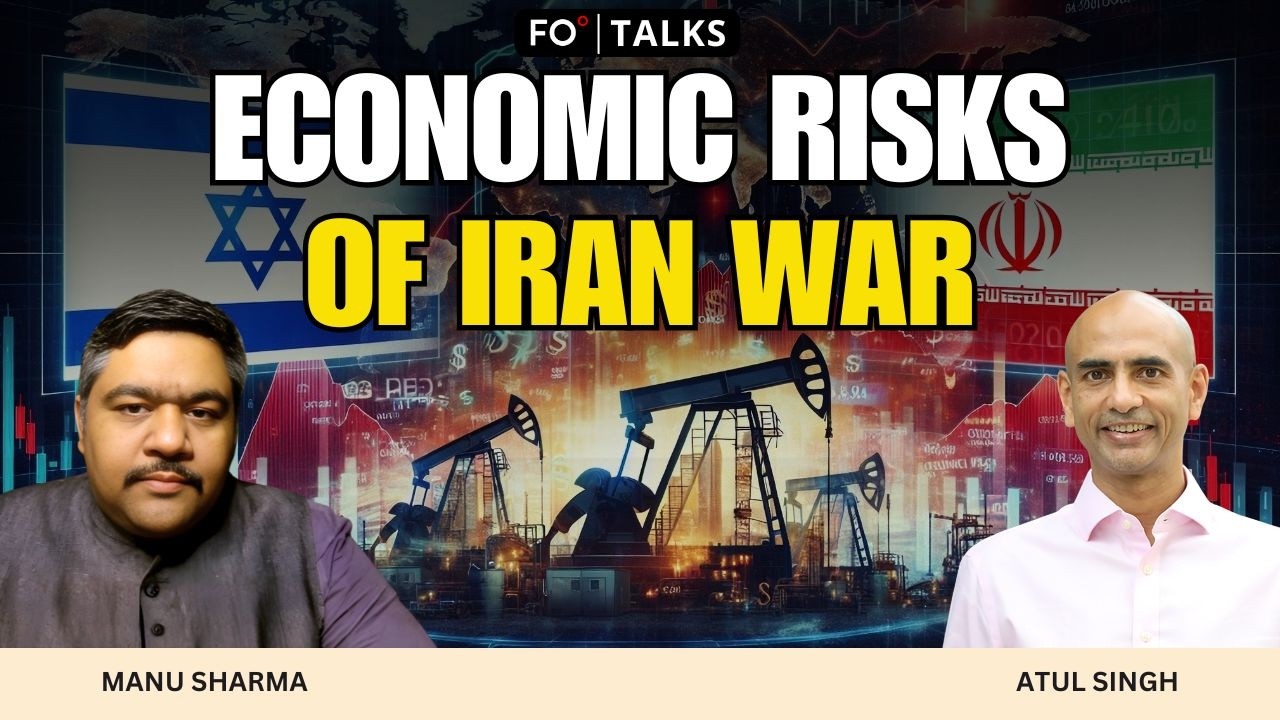
FO Talks: The Iran War Could Crash the Global Economy, Here’s How
Fair Observer’s Video Producer Rohan Khattar Singh speaks with Martin Plaut, a journalist, academic and author, about the deepening rupture between the Trump administration and South Africa. They examine why Washington barred South Africa from the 2026 G20 summit in Miami, Florida, and how decades of ANC foreign policy have collided with US President Donald Trump’s worldview. Plaut views the dispute as not simply about one diplomatic incident, but ideological alignment, domestic politics and competing visions of the global order. Can South Africa preserve its BRICS-oriented identity while remaining economically dependent on the United States?
A long-brewing rupture
Plaut argues that tensions between Washington and Pretoria predate Trump, rooted in the African National Congress (ANC)’s longstanding “third-worldist” foreign policy outlook. During the anti-apartheid struggle, both the Soviet Union and China supported the ANC, creating political loyalties that still shape South African diplomacy today. Pretoria continues to pursue close ties with Russia and China while promoting a multipolar world order through forums such as BRICS.
Khattar Singh highlights several recent flashpoints. South African military officials visited Iran, and Pretoria participated in joint naval exercises alongside Iran, Russia and China. For Plaut, these actions became impossible to separate from Trump’s confrontational posture toward the Iranian capital of Tehran. He suggests that the White House increasingly views South Africa not as a neutral middle power, but as a state drifting toward America’s strategic rivals.
The decision to exclude South Africa from the G20 therefore reflects more than personal animosity. Plaut believes that it signals growing American frustration with Pretoria’s geopolitical positioning and with what Washington sees as persistent anti-Western instincts inside the ANC.
Trump, Musk and the white farmer narrative
The discussion then shifts to the highly charged politics surrounding white South African farmers. Plaut explains that Trump’s relationship with South African President Cyril Ramaphosa deteriorated sharply after a White House meeting in which Trump confronted him with images of murdered farmers and allegations of anti-white discrimination.
Plaut acknowledges that violent crime in South Africa is severe and often brutal. However, he stresses that white farmers are not uniquely targeted compared to other vulnerable groups. Khattar Singh notes that available statistics show most farm murder victims in recent years have been black South Africans, complicating the narrative circulating on social media.
Plaut says that the issue resonates with Trump because it fits into a broader MAGA-era cultural framework. “What is the MAGA movement? It’s Make White America Great Again,” he says.
Tesla CEO Elon Musk also looms over the conversation. Musk, who was born in South Africa, has repeatedly amplified claims about attacks on white farmers through X. Plaut believes Musk and a circle of wealthy South African expatriates exert more influence over Trump’s understanding of the country than traditional diplomatic channels. “They just drip feed this stuff into his ear whenever they have the opportunity,” Plaut says.
The dispute also intersects with business interests. Musk reportedly wants to expand Starlink operations in South Africa but opposes Black Economic Empowerment policies requiring foreign firms to partner with black South Africans.
Israel, the ICJ and competing worldviews
Another major source of friction is South Africa’s genocide case against Israel at the International Court of Justice. Plaut describes the move as a significant irritant for Washington, particularly given the Trump administration’s skepticism toward international institutions.
For many South Africans, support for the Palestinian cause fits naturally within the ANC’s anti-colonial political identity. Yet Plaut notes that divisions persist within South Africa itself. Some conservative white South Africans identify strongly with Israel and view themselves as similarly isolated within a hostile regional environment.
The broader disagreement reflects competing attitudes toward global governance. Plaut argues that while much of the world still relies on institutions built after World War II, Trump increasingly favors personal diplomacy and transactional bilateral relationships over multilateral frameworks.
Khattar Singh raises the larger question of whether Africa itself is being sidelined. South Africa was the continent’s sole G20 representative for decades before the African Union joined the grouping in 2024. Plaut rejects the idea of a coordinated American strategy against Africa, instead portraying Trump’s approach as highly personal and improvisational.
South Africa’s declining dominance
Plaut repeatedly returns to South Africa’s internal problems. Ordinary citizens care less about G20 access than about failing infrastructure, unemployment and rising crime. Johannesburg has faced prolonged water shortages and rolling electricity outages, while youth unemployment has climbed to catastrophic levels.
“Sixty percent of young people under 25 are unemployed,” Plaut says. “It is just horrific.”
These weaknesses are eroding South Africa’s claim to continental leadership. Khattar Singh points to the growing prominence of countries such as Egypt, Kenya, Nigeria and Ethiopia. Plaut agrees that other African powers are increasingly “punching above their weight,” even as divisions inside the African Union make unified continental leadership difficult.
Simultaneously, the ANC itself is weakening politically. After losing its outright majority, the party now governs through coalition arrangements and faces mounting electoral pressure at the local level. Plaut compares its trajectory to other historic liberation movements that dominated politics after independence before gradually declining.
Can the relationship be repaired?
To repair relations with Washington, Ramaphosa has appointed Ralph Meyer as ambassador to the US. A former National Party politician who later helped negotiate the end of apartheid, Meyer is an experienced statesman capable of calming tensions after the previous ambassador accused Trump of leading a white supremacist movement.
Yet Plaut warns that waiting for Trump to leave office would be a mistake. American concerns about South Africa’s strategic orientation extend beyond one administration. Pretoria’s economic interests remain rooted to the US even as parts of the ANC remain emotionally and ideologically aligned with Russia and China.
The result is a country caught between competing worlds: politically drawn toward multipolarity, economically dependent on the West and increasingly uncertain of its own position within Africa.
[Lee Thompson-Kolar edited this piece.]
The views expressed in this article/video are the author’s own and do not necessarily reflect Fair Observer’s editorial policy.
” post-content-short=” Fair Observer’s Video Producer Rohan Khattar Singh speaks with Martin Plaut, a journalist, academic and author, about the deepening rupture between the Trump administration and South Africa. They examine why Washington barred South Africa from the 2026 G20 summit in Miami, Florida, and how…” post_summery=”In this episode of FO Talks, Rohan Khattar Singh and Martin Plaut examine why the Trump administration barred South Africa from the 2026 G20 summit. They explore South Africa’s ties with Russia, China and Iran, Elon Musk’s influence and politics surrounding white farmer violence. South Africa must balance its commitment to multipolarity with its economic dependence on the US.” post-date=”May 12, 2026″ post-title=”FO Talks: The Elon Musk Factor — Why Has Trump Snubbed South Africa from the G20?” slug-data=”fo-talks-the-elon-musk-factor-why-has-trump-snubbed-south-africa-from-the-g20″>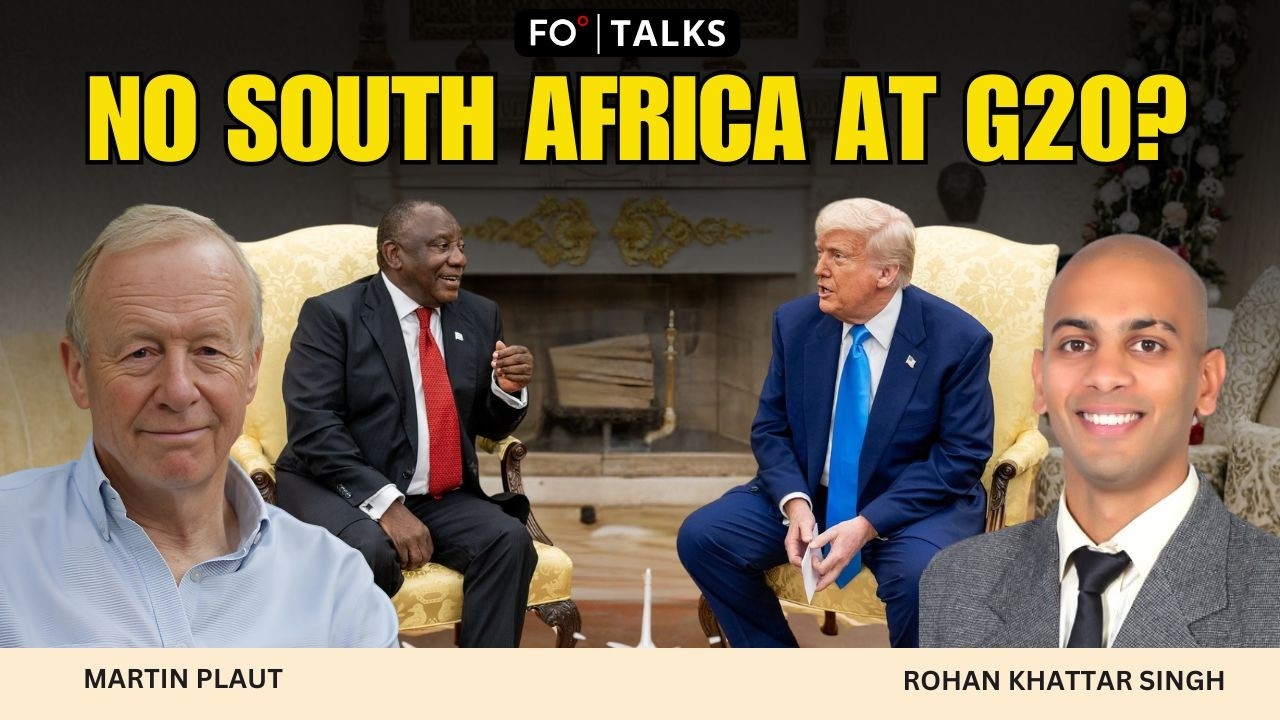
FO Talks: The Elon Musk Factor — Why Has Trump Snubbed South Africa from the G20?
Editor-in-Chief Atul Singh and FOI Senior Partner Glenn Carle, a retired CIA officer who now advises companies, governments and organizations on geopolitical risk, examine a conflict that has spilled far beyond the battlefield. The US–Israel–Iran war, anchored in a “double blockade” of the Strait of Hormuz, has ruptured the global resource, financial and security architecture. Crucially, this disruption extends beyond Hormuz to a second chokepoint at Bab al-Mandab, where Houthi threats have compounded shipping risks and insurance costs, effectively turning a regional crisis into a multi-node global supply shock.
An unwinnable standoff
The US and Iran are now in a military and diplomatic impasse. Iran blocked the Strait of Hormuz while the US Navy countered by restricting access to Iranian ports. The result has become an economic war of attrition rather than a decisive military contest. Negotiations continued intermittently in Pakistan, which is painting itself as a new neutral Switzerland for peace negotiations. However, both Iran and the US treat the negotiations as positioning exercises rather than genuine attempts at resolution.
Glenn argues that the structure of the conflict makes escalation unlikely. Neither a US invasion nor a prolonged Iranian blockade is sustainable. Economic pressures constrain both sides: Tehran cannot endure extended isolation, while Washington cannot justify the political and financial costs of indefinite deployment. A negotiated outcome is therefore likely, even if neither side formally acknowledges this.
Glenn expects a settlement resembling a diluted version of the 2015 nuclear agreement, with Iran accepting inspections while retaining its right to nuclear technology, and the strait reopening under conditions that implicitly increase Iranian influence. Both sides, he suggests, will declare victory. The underlying reality, however, is less ambiguous: The balance of leverage in the Gulf has shifted.
The supply shock that breaks the system
For Atul, the deeper story lies in the economic consequences. He calls the crisis the most severe supply-side shock since the 1970s, which has disrupted energy flows, industrial inputs and shipping routes. Hormuz’s closure has constrained not only oil and gas exports but also critical materials such as helium, aluminum and fertilizers. This has created a ripple effect across many supply chains, from semiconductors to agriculture.
The crisis has caused a breakdown between financial pricing and physical reality. Industry sources report that actual delivery prices exceeded benchmark prices by 20% or more, revealing a failure in market price discovery. This disconnect, Atul suggests, reflects a deeper structural flaw: Financial “screen prices” are increasingly driven by algorithms and interest rate expectations, while real-world scarcity is determined by physical delivery constraints.
War-risk insurance for transit through the Persian Gulf (if available), the extra costs of diverting around the African continent, port congestion, sanctions, variable freight rates, and differing grades of crude mean that European or Asian buyers may pay substantially more per barrel than North American buyers.
Similar price differentials are now in place for refined products. For instance, at over $200 per barrel, the average price of jet fuel is ~$40 higher in Asia than in North America. Jet fuel in Asia was, on average, cheaper than in the US before the war. Already, almost every one of the world’s major airlines has canceled flights due to the shortage and rising costs of jet fuel. In turn, this has led to a decrease in tourism, particularly to places like Thailand and Japan, because of the increase in air ticket prices.
At the household level, shortages of liquefied petroleum gas have caused restaurants and bakeries to shut down across South Asia. Aluminum shortages have caused cola cans to disappear. Supply chains for consumer goods are in disarray. Helium shortages have begun to affect semiconductor production. Across South, Southeast and East Asia, rising input costs have driven inflation and not only suppressed but also destroyed demand. Stagflation, the combination of stagnation and inflation, has already hit Asia.
A ceasefire will not end the supply shock. It will continue and cause much pain. There are silver linings, though. The supply shock is accelerating structural change, pushing the global economy to be less reliant on oil and gas for its energy needs. Solar panels, batteries and electric vehicles already have a higher demand.
The reverse flow of capital
Importantly, the Hormuz Crisis has led to what Atul terms the “Reverse Gulf Stream.” For decades, countries of the Persian Gulf sold oil, gas, fertilizers and other commodities denominated in dollars. These Gulf states invested this money in the West. In a nutshell, capital flowed from the Persian Gulf to the West, boosting financial markets and other asset prices. Now, that flow of capital has stopped.
Gulf states run generous welfare states. They now face revenue shortfalls and rising domestic costs. Some have requested dollar swap lines from the US, a move Atul describes as a “canary in the coal mine,” signaling stress even among the most financially resilient states like the UAE. This is a signal of financial stress even among historically wealthy states. There is a chance that they might sell assets they hold in the West to tide them over hard times.
The Gulf’s sovereign wealth funds, managing an estimated $5–6 trillion in assets, may be forced into large-scale liquidations. These pressures operate through multiple channels: equity sell-offs in Western markets, reduced investment in AI and technology sectors, declining purchases of US Treasuries and feedback loops in which falling asset prices force further liquidation.
In addition, Gulf countries are no longer pricing and paying everything in dollars. Alternative payment systems such as China’s CIPS have gained traction. Iran has charged transit fees in yuan, euros and cryptocurrencies, while many countries have purchased energy using non-dollar currencies. The implications of these developments extend far beyond the Persian Gulf. Reduced demand for dollars has weakened the foundations of the petrodollar system itself.
Experienced investors in our circle argue that bond markets are starting to recognize increased financial risks. Market yields on ten-year US Treasury securities have increased from 3.97% on February 27 to 4.35% on April 28. These investors expect bond yields to rise further. The US is spending a lot of money on the Iran war at a time when American debt has crossed $39 trillion. The “exorbitant privilege” that allows the US to borrow money at lower interest rates will become less exorbitant because of the growing loss of trust in the competence of the American government and the strength of the US. Furthermore, neither the Gulf countries nor America’s East Asian allies can keep buying US debt when their earnings drop. Our investor sources are convinced that bond yields will rise because of the war. Some even expect a 15-20% correction in equity markets within a few weeks.
Financial markets, long buoyed by liquidity, have begun to confront the constraints of the real economy. Atul warns that a “reverse contagion” could emerge, in which shortages in the physical economy trigger corrections in the prices of financial assets. The adjustment, delayed but inevitable, would reshape global capital flows. A “Reverse Gulf Stream” could emerge where capital does not flow from the Persian Gulf to the West but reverses direction and goes back to the Gulf countries.
A fractured security order
The conflict has also accelerated the fragmentation of global alliances. Glenn describes the United States as a “strategic loser,” noting that Iran has emerged with greater regional influence despite sustaining military damage. The regime has consolidated into what he characterizes as a garrison state dominated by the Islamic Revolutionary Guard Corps (IRGC), strengthening its capacity to extract leverage from control of the strait.
Confidence in US security guarantees has eroded. European leaders have openly criticized Washington’s strategy, while countries such as Spain and Italy have distanced themselves from the conflict. Note that Italy is led by Giorgia Meloni, a leader of the right who had good relations with US President Donald Trump. NATO, already strained, is further strained by the rift between Europe and the US, calling its long-term viability into question. For this reason, Europe has increased defense spending and coordination, signaling a shift toward greater autonomy from the US and a preparation for a post-NATO future.
A similar pattern has unfolded in East Asia. Japan, South Korea and Taiwan have deepened cooperation. These countries question US reliability after American forces and military equipment in the region have been redeployed to the Middle East. They regard Barack Obama’s Asia Pivot and Trump’s China focus as aspirational efforts by a superpower that is still fundamentally mired in the Middle East.
The Gulf states themselves are increasingly looking to external partners such as Pakistan for both diplomatic mediation and potential security support. Not only do these states face a threat from Iran but they also fear popular unrest at home. Hence, they are diversifying away from exclusive reliance on the US.
Across regions, allies have begun to hedge, investing in their own capabilities rather than relying on American protection. This realignment reflects a broader transformation. The US role as guarantor of global trade routes — central to its post-World War II dominance — has appeared less certain. As Atul notes, the inability to secure key chokepoints challenges the very foundation of American hegemony. At its heyday, the UK was able to keep the Strait of Gibraltar, the Suez Canal, the Bab al-Mandeb, the Strait of Hormuz and the Strait of Malacca open. That is the standard for a global superpower and that is the standard the US is failing to meet.
The Hormuz Crisis of 2026 is for the US what the Suez Crisis of 1956 was for the UK. Just as Suez demonstrated the limits of British power, Hormuz is revealing the limits of American might.
Technology, energy and the new balance of power
Amid these disruptions, structural shifts have accelerated. The transition to renewable energy has gained momentum as countries seek to reduce dependence on vulnerable supply chains. Glenn estimates that the timeline for renewables to dominate global electricity production could advance by five to six years.
China has stood out as a primary beneficiary. Its leadership in electric vehicles, solar technology and battery production puts Chinese companies in pole position to capitalize on this transition. Even in the US, electric vehicle sales have already gone up because of higher gas prices.
The war has also showcased the ongoing revolution in military technology. Cheap drones, costing tens of thousands of dollars, have threatened assets worth billions. This asymmetry has undermined traditional power projection, reducing the effectiveness of aircraft carriers and other capital-intensive systems. As Glenn illustrates, even highly effective defense systems can be overwhelmed by asymmetric warfare. Destroying 98 out of 100 incoming drones still leaves two capable of inflicting catastrophic damage at a fraction of the cost of the systems they target. The result has been a leveling effect. Regional actors have gained relative strength while superpowers have faced higher costs and greater vulnerability.
In a nutshell, the old order is now dead. The resource, financial and security architectures that shaped the post-World War II world are crumbling. What is emerging is not yet a coherent new system, but a world in transition — more fragmented, more competitive and less predictable than the one it is replacing.
[Lee Thompson-Kolar edited this piece.]
The views expressed in this article/video are the author’s own and do not necessarily reflect Fair Observer’s editorial policy.
” post-content-short=” Editor-in-Chief Atul Singh and FOI Senior Partner Glenn Carle, a retired CIA officer who now advises companies, governments and organizations on geopolitical risk, examine a conflict that has spilled far beyond the battlefield. The US–Israel–Iran war, anchored in a “double blockade” of the…” post_summery=”In this section of the April 2026 episode of FO Exclusive, Atul Singh and Glenn Carle argue that the Iran war has triggered a massive supply shock to the economy. Oil, gas, fertilizers and industrial inputs are scarce, causing shortages and price rises in the real economy. In fact, the resource, financial and security architectures of the post-World War II era are crumbling as the limits of American power become visible to the entire world.” post-date=”May 10, 2026″ post-title=”FO Exclusive: US–Iran Double Blockade of Hormuz Threatens Global Economy” slug-data=”fo-exclusive-us-iran-double-blockade-of-hormuz-threatens-global-economy”>
FO Exclusive: US–Iran Double Blockade of Hormuz Threatens Global Economy
Editor-in-Chief Atul Singh and FOI Senior Partner Glenn Carle, a retired CIA officer who now advises companies, governments and organizations on geopolitical risk, survey a month in which disparate events point in a single direction: a global order under strain. The US–Israel–Iran war anchors their analysis, but the surrounding developments — from space exploration to European politics — reveal deeper structural shifts. As Atul puts it, the aim is to “sift signal from noise” in a moment when American primacy appears less certain and states are recalibrating accordingly.
A brief moment of optimism
Atul and Glenn begin with the Artemis II mission. Astronauts orbited around the moon and returned, marking humanity’s first departure from Earth’s orbit in 54 years. For Glenn, the mission signals more than symbolic progress. It expands “the range of human capabilities” and promises technological spillovers that will boost economies for decades.
Yet even here, not all is rosy. Glenn notes that the current NASA architecture may prove financially unsustainable, with private-sector systems such as SpaceX’s Starship likely to dominate future exploration. Even in space, state-led models are giving way to hybrid or commercial ones, mirroring broader economic trends.
Israel, Europe and the politics of rupture
Atul and Glenn soon turn sombre and shine the light on Israel. The country was in the news for passing a law that, in effect, makes it mandatory for Palestinians to receive a death sentence if they are convicted by a military court of deadly terrorist acts. Those convicted have no right to appeal. Israeli civil and human rights groups say the law is racist. The language of the law implies that it could be applied to Israeli Arabs, for example, but not to Jewish citizens. This means they could be becoming second-class citizens in their own country.
The Israeli parliament has also passed a record $271 billion budget. This huge defense spending suggests the country is evolving into even more of a “Spartan state.” Israel is now the dominant military power in the region.
Israel is also increasingly losing international support. Italian Prime Minister Giorgia Meloni suspended defense cooperation despite her prior alignment with both Israel and US President Donald Trump. Meloni’s changed position reflects mounting domestic opposition in Italy to the war. Therefore, her government has denied US aircraft access to bases in Sicily. In Spain, Prime Minister Pedro Sánchez has been very vocal in opposing the war and attracted American ire.
Sánchez has also made a sweeping change to Spain’s immigration policy. His government has offered residency to 500,000 undocumented migrants, provided they have lived in Spain for at least five months and have no criminal record. This is an unconventional immigration policy at a time when other European countries are tightening, not opening, borders to immigrants.
The tensions over immigration in the US, Europe and elsewhere point to a deeper dilemma across advanced economies: demographic decline versus social cohesion. Immigration sustains growth but can lead to a clash of cultures. It can also cause political backlash, fueling the rise of far-right movements. Tensions in Europe over immigration are triggered by structural changes and are here to stay.
Britain and the crisis of governance
British Prime Minister Sir Keir Starmer is in increasingly hot soup. His decision to appoint Lord Peter Mandelson as ambassador to America has come back to haunt him. Mandelson was one of the architects of New Labour who brought Tony Blair and Gordon Brown to power. In the UK, Mandelson is known as “the Dark Lord” and “the Prince of Darkness,” because he has too many dodgy friends. These include folks in China and Russia and a certain Jeffrey Epstein.
After facing mounting criticism for appointing Mandelson, the Starmer government sacked Sir Oliver Robbins. Starmer blamed the Foreign Office for not telling him that Mandelson had failed security clearances. Robbins told a parliamentary committee there was a “very, very strong expectation” from the prime minister’s office to rush the process. Talk of Labour members of parliament defenestrating Starmer is now rife in London.
This political instability in the UK is worsening economic fragility. The broader picture is one of eroding confidence not only in the government but also in the country. Inflation, increasing debt and bond yields are pushing the country into a crisis.
Defense has also been in the news in the UK. Lord George Robertson said that Britain is in “peril” because of the Starmer government’s “corrosive complacency.” The former NATO secretary-general blamed the UK Treasury for its failure to fund the review’s recommendations.
Antisemitism is on the rise
In April, Britain’s chief rabbi, Ephraim Mirvis, warned that “a sustained campaign of violence” against Jews was gathering momentum. Nine people were arrested for planning an attack on an unknown Jewish target in one of the recent incidents.
Not only the UK but also the US is experiencing rising antisemitism. In fact, antisemitism is experiencing a dramatic, record-high surge globally. After the October 7, 2023, terror attacks on Israel and the subsequent Israeli conflict with Hamas in Gaza, antisemitic sentiment has increased. Data shows a nearly 350% increase in US incidents over the past five years, with over 9,300 incidents reported in 2024 alone. American Jewish Committee’s report, The State of Antisemitism in America 2025, chronicles rising physical attacks and online vitriol against Jews. One highlight from the report says, “In The Two Years Since October 7, An Overwhelming Number Of American Jews Feel Less Safe.”
In Europe, antisemitism is coming from two sources: the traditional far-right, as well as many recent Muslim immigrants. The nativist nationalist right has fanned prejudice against Jews, who have historically been the other. Many immigrants identify with the Palestinian cause. They believe that Jews oppress their fellow Muslims in an apartheid state and, often fanned by radical mosques, come to believe that attacks on Jews are justified.
Many Muslims come from societies where non-Muslims have few rights. So, they carry their prejudices to their new homes. French and British intelligence have been worried about many radical mosques preaching a toxic brew. For decades, Saudi money propagated an extreme form of Islam that was highly antisemitic. For years, the CIA focused on the Saudi promotion of puritanical and fanatical Wahhabi Islam, promoting both antisemitism and jihadism. The flames that have been fanned for years continue to burn.
Key developments in India, Canada, Japan and Hungary
In India, the Narendra Modi government suffered a politically embarrassing defeat. For the first time, a government bill was voted out by parliament. This has occurred only twice this century, the last time was in 2002. The government tabled amendments that would have increased the number of seats in the lower house of parliament from 543 to 850. This would have weakened India’s southern states, which duly voted against the bill. In addition to religion, language and region form the other two faultlines. Both faultlines have now returned to the forefront in Indian politics.
Canadian Prime Minister Mark Carney’s Liberal Party secured a small majority in the House of Commons after winning special elections, also called by-elections, to three constituencies. Under Carney and his predecessor, Justin Trudeau, the Liberals ran a minority government with coalition partners. Now, they have a majority in parliament and have strengthened Carney’s position.
In an important move, the Carney government has created a Canada Strong Fund, a sovereign wealth fund, to invest in energy, infrastructure, mining, agriculture and technology. This is a first for the country. The fund will have an initial corpus of $25 billion Canadian dollars, i.e. $18.4 billion. This is part of a broader strategy by Carney to boost Canada’s economy in the face of US tariff threats.
In combination with the private sector, the government will invest in “nation-building projects” such as port upgrades and natural resource development. The opposition has criticised the move. They make the argument that, unlike Norway, Canada is in debt, meaning its sovereign wealth fund will not be paid for by revenues but by borrowed money. Conservative leader Pierre Poilievre has called it a “sovereign debt fund.” In an innovative move, the Carney government will allow Canadians to directly pay into the new fund. This practice doesn’t exist in other countries with similar funds and might be a clever way to reduce reliance on Wall Street and Washington. Carney is taking a step to protect Canada from America’s capriciousness.
Japanese Prime Minister Takaichi Sanae announced a relaxation of restrictions on weapons exports to open up the defence industry’s trade with foreign countries. Sanae said, “No single country can now protect its own peace and security alone.” Last year, Sanae sparked a row with China last year by suggesting Japan would respond if Taiwan was invaded. Beijing said it would resist Japan’s “new form of militarism.” Glenn takes the view that this marks Japan’s emergence as a fully independent strategic actor, no longer relying entirely on the American security umbrella. Both Japan and Canada are similar in taking steps to rely less on the US and more on themselves.
In Hungary, the centrist Tisza party won around two-thirds of the seats in Hungary’s election, booting Viktor Orbán and his populist-right Fidesz party out of office after 16 years in power. Péter Magyar will be the new prime minister. He once belonged to Orban’s party and began to campaign against corruption and for the rule of law. Magyar won on competence and governance issues, overcoming apathy and energizing voters.
Magyar’s victory was shaped by late-campaign events that weakened Orbán. A leaked telephone call between Hungarian Foreign Minister Péter Szijjártó and Russian Minister of Foreign Affairs Sergey Lavrov reinforced perceptions of the government’s subservience to Moscow. Also, US Vice President JD Vance’s visit to support Orbán did not cut much ice with Hungarian voters.
For Glenn, Orbán was a pawn of Moscow who ran an “authoritarian and corrupt regime” aligned with Moscow. Atul offers a more qualified view, noting that Magyar was able to run a grassroots campaign, win handsomely and also that Orbán conceded defeat quickly.
On an important note, Magyar has made improving relations with the EU a priority. Now, Brussels is likely to release not only previously frozen funds for Hungary but also an aid package for Hungary that had so far been blocked by Orbán. Now, we have a completely new political landscape in Hungary and in Europe.
[Lee Thompson-Kolar edited this piece.]
The views expressed in this article/video are the author’s own and do not necessarily reflect Fair Observer’s editorial policy.
” post-content-short=” Editor-in-Chief Atul Singh and FOI Senior Partner Glenn Carle, a retired CIA officer who now advises companies, governments and organizations on geopolitical risk, survey a month in which disparate events point in a single direction: a global order under strain. The US–Israel–Iran war anchors…” post_summery=”In this section of the April 2026 episode of FO Exclusive, Atul Singh and Glenn Carle analyze key events of the month. They analyze the Artemis II mission, a discriminatory Israeli law, loss of international support for Israel, a deepening crisis in the UK, and antisemitism in the UK, the US and Europe. They also examine major political developments in India, Canada, Japan and Hungary.” post-date=”May 09, 2026″ post-title=”FO Exclusive: Global Lightning Roundup of April 2026″ slug-data=”fo-exclusive-global-lightning-roundup-of-april-2026″>
FO Exclusive: Global Lightning Roundup of April 2026
Fair Observer’s Video Producer Rohan Khattar Singh speaks with economist and game theorist Sinem Sonmez about a conflict in which economics proves as consequential as military force. Their discussion examines how the US-led blockade in the Strait of Hormuz, combined with strikes on Iranian infrastructure, pushed Iran into an increasingly unsustainable position. While the war revealed Iran’s military resilience in some areas, Sonmez argues that the decisive factor was economic vulnerability. The episode ultimately asks whether modern wars are now won less through battlefield dominance than through the ability to choke an adversary’s financial system.
A blockade built on economic pressure
Khattar Singh opens by asking Sonmez to explain the legal and strategic logic behind the blockade in the Strait of Hormuz. She notes that under UNCLOS Article 38, passage through the strait is ordinarily protected even during conflict. The United States, however, justified its actions by designating Iran a “rogue state” and arguing that it had the right to inspect vessels carrying war-sustaining material.
She states that the blockade only became possible after the US first degraded Iran’s military and industrial capacity. She argues that Washington delayed enforcement until it could reduce the risk posed by Iranian air power and ensure that economic pressure would be maximally effective. “The US had to destroy Iran’s critical infrastructure and industries in order to bring Iran’s economy to a standstill,” she says.
The blockade itself was a major logistical operation involving warships, fighter aircraft, helicopters and thousands of US personnel. Sonmez argues that its effectiveness demonstrated how maritime power can still determine the trajectory of modern conflict. Once Iranian exports were interrupted, Tehran rapidly lost economic room to maneuver.
Iran’s economic vulnerability
The central theme of the discussion is Iran’s structural dependence on oil revenues. Sonmez explains that oil accounts for roughly 13% of Iran’s GDP and provides the foreign exchange needed to finance imports. Without access to those revenues, the country faces currency devaluation, hyperinflation and industrial paralysis.
The blockade quickly exposed those weaknesses. Iran reportedly had only two to three weeks of storage capacity before it would have to shut down production entirely. According to certain figures, the blockade was costing Iran approximately $435 million per day, including hundreds of millions in lost oil and petrochemical exports.
The domestic consequences were severe. Nearly 12 million jobs or 50% of Iran’s workforce were reportedly at risk, while major sectors such as steel, petrochemicals and pharmaceuticals faced mass disruption. Sonmez argues that this pressure forced Iran to negotiate far sooner than it otherwise would have. “Iran runs on cash generated by oil exports,” she explains, warning that without foreign currency reserves and a currency devaluation, “hyperinflation ensues.”
Khattar Singh notes that Iran’s economy had already been weakened by years of sanctions following the collapse of the Joint Comprehensive Plan of Action in 2018. The war compounded those problems, leaving Tehran with shrinking options even before the blockade took full effect.
Regional escalation and China’s calculation
The conversation also explores Iran’s attempt to widen the conflict by targeting infrastructure and bases across the Gulf region. Khattar Singh points out that Iranian strikes hit the United Arab Emirates, Saudi Arabia, Qatar, Bahrain and even Oman, despite Oman’s role as a mediator.
Sonmez believes Tehran hoped Gulf states would pressure Washington to halt the assault once their own energy infrastructure came under threat. Instead, the strategy backfired. Reports suggested that Saudi Crown Prince Mohammed bin Salman favored a tougher US response after damage to regional infrastructure, including disruptions affecting Qatar’s liquefied natural gas capacity.
The role of China emerges as another critical factor. As Iran’s largest oil customer, Beijing was theoretically positioned to soften the impact of the blockade. Yet Sonmez argues that US pressure on Chinese banks and shipping companies successfully deterred major intervention. Chinese tankers reportedly rerouted away from the strait, while Beijing assured Washington it would not provide weapons or military assistance to Tehran.
For Sonmez, this became the decisive turning point. “The whole thing boils down to economics,” she says. Without Chinese financial or military backing, Iran lacked the capacity to sustain a prolonged confrontation.
Military surprises and political realities
Despite Iran’s economic weakness, the war still revealed unexpected strengths. Sonmez notes that the scale of Iran’s drone and missile arsenal surprised observers and imposed significant costs on US defensive systems. Iranian attacks also continued even after senior military figures were killed.
“The organization ran seamlessly,” Sonmez says, describing how Iranian operations continued despite leadership losses. That resilience complicated assumptions that decapitation strikes alone could cripple the Iranian state.
Still, Sonmez argues that military endurance could not overcome financial exhaustion. She believes Tehran entered negotiations because it needed immediate economic relief and had to preserve the regime’s ability to pay the military and security establishment that keeps it in power.
Khattar Singh and Sonmez close by turning to the broader global economy. Sonmez expresses astonishment that US stock markets rallied during the crisis despite continuing uncertainty surrounding oil prices, private credit markets and heavily valued AI companies. She compares the surge in markets to the dot-com bubble and argues that investor optimism became detached from underlying risks.
Even after the ceasefire reduced oil prices, Sonmez remains skeptical that the underlying structural problems have disappeared. The episode ends with a broader warning that economic fragility, financial markets and geopolitical conflict are now deeply interconnected. Military victories may shape headlines, but the long-term balance of power increasingly depends on who can survive economic pressure the longest.
[Lee Thompson-Kolar edited this piece.]
The views expressed in this article/video are the author’s own and do not necessarily reflect Fair Observer’s editorial policy.
” post-content-short=” Fair Observer’s Video Producer Rohan Khattar Singh speaks with economist and game theorist Sinem Sonmez about a conflict in which economics proves as consequential as military force. Their discussion examines how the US-led blockade in the Strait of Hormuz, combined with strikes on Iranian…” post_summery=”In this episode of FO Talks, Rohan Khattar Singh and Sinem Sonmez examine how the US-led blockade in the Strait of Hormuz pushed Iran’s already economy toward crisis. Oil dependence, limited storage capacity, sanctions and foreign exchange shortages made Iran unable to sustain a prolonged war. Modern conflict increasingly turns on economic leverage as much as military power.” post-date=”May 08, 2026″ post-title=”FO Talks: Economy, Sanctions and Oil — Why Iran Could Not Sustain This War” slug-data=”fo-talks-economy-sanctions-and-oil-why-iran-could-not-sustain-this-war”>
FO Talks: Economy, Sanctions and Oil — Why Iran Could Not Sustain This War
Fair Observer’s Video Producer Rohan Khattar Singh speaks with author Ali Omar Forozish about Turkey’s attempt to navigate an increasingly fragmented world order without fully committing to either East or West. Under Turkish President Recep Tayyip Erdoğan, the Turkish capital of Ankara is expanding ties with Russia- and China-led institutions while remaining embedded within NATO and the broader Western security system. Forozish believes this balancing act reflects both Turkey’s geopolitical realities and its growing desire for strategic autonomy. Yet the discussion also raises a central question: Can a middle power sustain a position between rival blocs without eventually being forced to choose?
Turkey’s search for its own center of gravity
Forozish frames Turkey’s geopolitical strategy through political scientist Samuel Huntington’s “Clash of Civilizations” thesis rather than political scientist Francis Fukuyama’s “End of History.” In his view, the contemporary world is increasingly divided into competing civilizational and geopolitical blocs, leaving countries such as Turkey searching for a distinct position between them.
He says Turkey occupies a “liminal space” shaped simultaneously by the Islamic and Ottoman past and the secular, Western-oriented republic created in the 20th century. Ankara’s frustrations with both camps have reinforced this ambiguity. Turkey spent decades attempting to join the European Union without success, while its NATO membership has also generated suspicion among non-Western powers.
As a result, Forozish believes Ankara no longer seeks full integration into either side. “Turkey believes its role identity is not to be a side, but to be [the] center of gravity,” he states.
Domestic politics reinforce this orientation. Erdoğan’s alliance with politician Devlet Bahçeli’s Nationalist Movement Party has strengthened nationalist narratives that portray the West as hostile to Turkish sovereignty and Islamic civilization. Forozish links this outlook to the long-standing “Sèvres Syndrome,” a belief among Turkish nationalists that foreign powers continue to seek Turkey’s fragmentation and subordination.
Hedging between NATO and Eurasia
Khattar Singh and Forozish describe Turkey’s strategy as one of institutional hedging rather than outright realignment. Ankara is deepening engagement with non-Western organizations while avoiding a complete break with NATO.
Turkey formally applied for BRICS membership in 2024, although it ultimately received partner status rather than full accession. At the same time, Turkey has maintained dialogue-partner status within the Shanghai Cooperation Organization since 2013, making it the only NATO member connected to the group.
Forozish argues these moves are pragmatic rather than ideological. “It’s not a complete shift to the Eastern Bloc,” he says. “It’s just a complementary act for them.”
Geography remains central to Ankara’s calculations. Turkey seeks to position itself as a logistical bridge between Europe and Asia through the so-called Middle Corridor, a trans-Caspian trade route connecting China and Europe while bypassing Russia. The corridor has gained importance following disruptions tied to the war in Ukraine and wider instability across Eurasia.
Under optimal conditions, delivery times along this route could reportedly fall to around 15 days. Ankara therefore sees infrastructure and transit connectivity as tools for expanding both economic influence and geopolitical leverage.
An “unholy alliance” of convenience
Despite Turkey’s growing engagement with Russia and China, Forozish rejects the idea that a coherent Eurasian bloc is emerging. Instead, he characterizes the relationship as an “unholy alliance” built on mutual convenience rather than shared values or long-term trust.
The three states continue to compete across multiple arenas. Turkey and Russia back opposing actors in conflicts such as Syria and Libya, while Ankara’s push to expand influence among Turkic states in Central Asia challenges Moscow’s historic dominance in the region. China, meanwhile, remains economically dominant within the relationship.
Trade figures illustrate the imbalance. Turkey runs trade deficits of roughly $40–50 billion with China and approximately $16 billion with Russia. According to Forozish, this leaves Turkey functioning more as a transit and consumer economy than an equal strategic partner.
Tensions also persist over the treatment of Uyghurs in China. Forozish warns that Ankara’s silence on the issue could generate domestic backlash inside Turkey, where many nationalists and Islamists identify closely with Turkic Muslim communities.
For him, the partnership ultimately reflects transactional realpolitik rather than ideological solidarity. Russia gains opportunities to weaken NATO cohesion, China expands access to European markets and Turkey acquires leverage against the West.
The danger of “double isolation”
Khattar Singh presses Forozish on the risks of Turkey’s balancing strategy failing. If Ankara drifts too far from the West without securing meaningful alternatives from Russia or China, it could find itself isolated from both camps at once.
Forozish describes this possibility as “double isolation” or “strategic homelessness.” Turkey could become too Eastern for Western allies to fully trust while remaining too connected to NATO for Russia and China to treat as a dependable partner.
Such a scenario would create economic as well as geopolitical vulnerabilities. Turkey remains deeply integrated with Western capital markets and trade networks. A decisive rupture with Europe and the United States could intensify inflation, weaken the lira and trigger capital flight.
Forozish also warns that strategic isolation could deepen domestic radicalization. “Turkey will be the hub for the radical Islamists,” he says, describing what he views as the most dangerous possible outcome of a failed balancing strategy.
The conversation ultimately presents Turkey’s Eurasian pivot as a high-risk effort to maximize flexibility in a multipolar world. Ankara may gain short-term leverage from balancing rival powers, but the structural tensions within the strategy place clear limits on how far that balancing act can go.
[Lee Thompson-Kolar edited this piece.]
The views expressed in this article/video are the author’s own and do not necessarily reflect Fair Observer’s editorial policy.
” post-content-short=” Fair Observer’s Video Producer Rohan Khattar Singh speaks with author Ali Omar Forozish about Turkey’s attempt to navigate an increasingly fragmented world order without fully committing to either East or West. Under Turkish President Recep Tayyip Erdoğan, the Turkish capital of Ankara is…” post_summery=”In this episode of FO Talks, Rohan Khattar Singh and Ali Omar Forozish discuss Turkey’s attempt to balance between the West and a Russia–China-led Eurasian bloc. They examine Turkey’s BRICS application, its ties to the Shanghai Cooperation Organization and its promotion of the Middle Corridor trade route. This strategy gives Ankara leverage, but risks isolating Turkey from both sides.” post-date=”May 07, 2026″ post-title=”FO Talks: Turkey’s Eurasian Partnership with Russia and China Risks Isolation in NATO” slug-data=”fo-talks-turkeys-eurasian-partnership-with-russia-and-china-risks-isolation-in-nato”>
FO Talks: Turkey’s Eurasian Partnership with Russia and China Risks Isolation in NATO
Fair Observer’s Video Producer Rohan Khattar Singh speaks with historian Daniel J. Fernández-Guevara about why Cuba, despite facing one of the gravest crises in its modern history, still has not collapsed. The island is enduring deep economic pain, constant blackouts, inflation, outmigration and institutional strain. Yet Fernández-Guevara argues that anyone trying to understand Cuba must look beyond the usual predictions of imminent regime change and pay attention to the forces that have long sustained the country: national sovereignty, historical memory and local resilience.
A crisis without a clear breaking point
Fernández-Guevara describes Cuba’s present condition as a “polycrisis,” borrowing the term as it applies to the island from scholar Mayra Espina. The country is confronting several overlapping emergencies at once: economic decline tied to Venezuela’s reduced support, structural adjustments to a harsher global market, severe demographic loss through migration and the corrosion of the solidarity networks that once helped people endure hardship.
This has brought grave social consequences. Infant mortality has risen, life expectancy has fallen and the energy grid is in near collapse. Blackouts have become routine, disrupting hospitals, schools and daily life. Fernández-Guevara goes so far as to say the situation is in some respects worse than the crisis that followed the collapse of the Soviet Union.
Even so, he resists declaring that Cuba is on the verge of collapse. As he notes, “Everyone who has forecasted the change in government in Cuba has been wrong for 67 years.” That does not make the current situation any less severe. It means only that suffering alone has not translated neatly into regime change.
Why Cuba never fully embraced the China or Vietnam model
Khattar Singh presses Fernández-Guevara on why Cuba has not taken the same path as China or Vietnam, both of which incorporated major elements of capitalism while preserving one-party rule. Fernández-Guevara explains that Cuba has repeatedly opened parts of its economy, then pulled back once private wealth began to accumulate too visibly.
He recalls a remark from someone close to the Cuban government: “Cuba wants to have a country that makes millions and millions of dollars but without any millionaires.” That paradox lies at the heart of the Cuban system. The leadership wants growth, foreign exchange and investment, but remains wary of the inequalities that market reform can unleash.
This pattern has produced a stop-start cycle of reform and retrenchment. Tourism was opened. Small private restaurants, or paladares, emerged. Independent drivers and other small entrepreneurs found room to operate. But each time the private sector began to develop social and economic weight, the state moved to contain it.
Fernández-Guevara suggests that Cuba has not followed a long-term strategic reform plan so much as it has improvised under pressure. It has had to adapt not only to the global spread of capitalism, but also to shifting regional politics and the collapse of older support systems.
Sovereignty, memory and the rejection of foreign pressure
For Fernández-Guevara, the key to Cuba’s endurance lies not only in institutions, but in history. He believes many outside observers underestimate how central national sovereignty remains to Cuban political identity. Cubans may be deeply critical of their own government, but that does not mean they welcome external intervention.
He points to a long history of US involvement in Cuban affairs. After the war of 1898, the United States intervened directly and then imposed the Platt Amendment, which embedded US power in the island’s constitutional order. Washington later backed Batista, including after his 1952 coup against a constitutional government. That memory still shapes how many Cubans understand foreign pressure today.
As Fernández-Guevara puts it, “national sovereignty is a very important thing” in Cuba. The 1959 revolution, despite all its failures and contradictions, still carries symbolic weight because it is seen by many as the moment Cuba definitively resisted outside domination.
That helps explain why US pressure does not always produce the outcome Washington expects. Hardship can fuel anger, but it can also reinforce a siege mentality, strengthen nationalist sentiment and push people to rely more heavily on one another.
Trump, Rubio and the logic of maximum pressure
The conversation then turns to US President Donald Trump’s renewed focus on Cuba and the role of Secretary of State Marco Rubio in shaping policy. Fernández-Guevara argues that the Trump administration sees Cuba as unusually weak after the pandemic, the collapse of tourism, currency unification and the continuing deterioration of the energy system.
He contrasts this with the years of US President Barack Obama’s administration, when normalization created what he remembers as a mood of genuine optimism. Cubans repaired homes, opened businesses and believed the long freeze with Washington might finally end. Trump’s first term halted that opening, and US President Joe Biden largely continued the same restrictions. Then came Covid-19 and a disastrous currency reform, which compounded the damage.
From Fernández-Guevara’s perspective, the current administration appears to believe this is the best possible moment to force concessions. He describes that approach as “the bluster of the art of the deal,” with foreign policy treated as a coercive business negotiation.
Yet he is careful not to pretend that Washington’s aims are fully clear. Economic liberalization appears to be one goal. Tourism and foreign capital may be another. But whether the US wants a negotiated transition or a more confrontational outcome remains uncertain.
Why Cuba still endures
Khattar Singh closes by asking the most important question: If life in Cuba is so hard, why has the system not broken? Fernández-Guevara says that Cuba lacks a coordinated opposition of the kind seen in Venezuela, while still retaining a powerful state structure, especially through the military. Protest exists, but it remains fragmented and localized.
At the same time, ordinary Cubans have decades of experience surviving under pressure. Communities share resources. Families improvise. People leave when they can, adapt when they cannot and continue living inside a system that has taught them endurance.
This is what outsiders miss. Cuba is not simply a failing state waiting to tip over. It is a society marked by exhaustion, pain and uncertainty, but also by a long political memory and a stubborn resistance to external designs. That is why the country’s future remains so difficult to predict.
[Lee Thompson-Kolar edited this piece.]
The views expressed in this article/video are the author’s own and do not necessarily reflect Fair Observer’s editorial policy.
” post-content-short=” Fair Observer’s Video Producer Rohan Khattar Singh speaks with historian Daniel J. Fernández-Guevara about why Cuba, despite facing one of the gravest crises in its modern history, still has not collapsed. The island is enduring deep economic pain, constant blackouts, inflation, outmigration…” post_summery=”In this episode of FO Talks, Rohan Khattar Singh and Daniel J. Fernández-Guevara examine Cuba’s deepening “poly-crisis,” marked by economic collapse, blackouts and mass migration. Despite severe hardship, Cuba has not fallen due to strong national sovereignty, historical memory and no coordinated opposition. External pressure, especially from the United States, continues to strain the system without collapsing it.” post-date=”May 02, 2026″ post-title=”FO Talks: Trump Says Cuba Is Collapsing, so Why Hasn’t It Fallen Yet?” slug-data=”fo-talks-trump-says-cuba-is-collapsing-so-why-hasnt-it-fallen-yet”>
FO Talks: Trump Says Cuba Is Collapsing, so Why Hasn’t It Fallen Yet?
Fair Observer’s Video Producer Rohan Khattar Singh speaks with Stephen Zunes, professor of politics and director of Middle Eastern Studies at the University of San Francisco, about a war that was meant to weaken adversaries but may instead be reinforcing them. As fighting spills across Iran, Israel and Lebanon, is the military force achieving its stated political aims? Or is it producing the opposite effect?
A war measured in displacement
Khattar Singh opens with Lebanon, where the scale of destruction has become impossible to ignore. Zunes points to the displacement of roughly 1.2 million people in a country of just five million, describing a campaign that goes far beyond tactical strikes. Entire towns in southern Lebanon have been leveled, often in areas with little evidence of active combat.
For Zunes, the pattern resembles deliberate devastation rather than incidental damage. “These are not buildings damaged in firefights… this is controlled demolitions,” he says, highlighting how the campaign disproportionately affects civilians. The targeting of infrastructure linked to Hezbollah’s social services, including medical networks, further blurs the line between military and civilian space. The result is a humanitarian crisis that risks reshaping Lebanon’s social fabric for years to come.
Hezbollah’s resilience and roots
Khattar Singh and Zunes then turn to Hezbollah itself. Despite the killing of senior leaders and significant operational setbacks, the group remains intact. Zunes provides historic context for the group’s resilience: Hezbollah emerged in direct response to Israel’s 1982 occupation of southern Lebanon, embedding itself within marginalized Shia communities.
Over time, it evolved into more than a militant organization. By providing healthcare, welfare and local governance where the Lebanese state fell short, Hezbollah built a durable support base. That dual role as both militia and service provider helps explain why it can absorb military blows without collapsing.
Zunes also highlights the cyclical nature of the conflict. Efforts to eliminate Hezbollah risk reproducing the very conditions that sustain it. Military pressure, particularly when it affects civilian populations, can deepen grievances and reinforce the group’s legitimacy among its constituents.
Strategic goals, unmet outcomes
At the core of the conversation is the gap between stated objectives and actual results. The United States and Israel entered the conflict with ambitions that included weakening Iran’s regime, curbing its nuclear capacity and dismantling the Islamic Revolutionary Guard Corps (IRGC). The US hasn’t achieved even one of these goals.
The IRGC remains in place. Iran’s nuclear material has not been removed. Instead, Tehran has demonstrated new leverage by disrupting the Strait of Hormuz, a critical artery for global energy flows. A ceasefire, announced on April 16 and mediated by Pakistan, reflects these constraints as much as any diplomatic breakthrough.
Zunes is blunt about the broader pattern. “This kind of pressure… has not eliminated their nuclear program… if anything, it’s strengthened the regime,” he says. Rather than forcing capitulation, the campaign appears to have consolidated hardline power within Iran, undermining earlier internal dissent.
Regional ripple effects
Beyond the immediate battlefield, the war has triggered wider instability. The closure of the Strait of Hormuz has disrupted supply chains and strained Gulf economies that depend on both exports and imports through the corridor. Even states traditionally aligned against Iran now face difficult trade-offs between security and economic survival.
Khattar Singh notes that Gulf countries, including Saudi Arabia and the United Arab Emirates, have experienced the conflict’s consequences more directly. While some remain wary of Iran’s influence, the economic shock has increased the appeal of deescalation. For many, reopening the strait has become an overriding priority.
Simultaneously, tensions persist. Iranian strikes on regional infrastructure have hardened attitudes in some capitals, complicating any unified response. The result is a fragmented landscape in which no actor fully controls the trajectory of events.
Power, politics and unintended consequences
The conversation closes with the political dimension. Both Israeli Prime Minister Benjamin Netanyahu and US President Donald Trump face domestic pressures that intersect with military strategy. For Netanyahu, ongoing conflict may delay political reckoning at home. For Trump, the war’s economic and strategic fallout could shape upcoming elections.
Yet the most consequential shift may be inside Iran. Despite earlier protests against the regime, the external threat has rallied segments of the population around the state. Zunes sees this as a familiar dynamic. “People rally around the flag when they’re being bombed,” he observes. External intervention often strengthens the very forces it seeks to weaken.
This leads to a broader conclusion about regime change. Zunes argues that durable political transformation cannot be imposed from outside, but must emerge internally. Historical examples, from Eastern Europe to Southeast Asia, underscore the limits of military solutions in achieving political ends.
If the war has demonstrated anything, it is that escalation does not guarantee control. Instead of collapse, it may produce adaptation. Instead of weakening adversaries, it may entrench them. For policymakers, that raises a difficult but unavoidable question: What happens when the use of force systematically fails to deliver the outcomes it promises?
[Lee Thompson-Kolar edited this piece.]
The views expressed in this article/video are the author’s own and do not necessarily reflect Fair Observer’s editorial policy.
” post-content-short=” Fair Observer’s Video Producer Rohan Khattar Singh speaks with Stephen Zunes, professor of politics and director of Middle Eastern Studies at the University of San Francisco, about a war that was meant to weaken adversaries but may instead be reinforcing them. As fighting spills across Iran,…” post_summery=”In this episode of FO Talks, Rohan Khattar Singh and Stephen Zunes argue that the Iran War reveals a persistent gap between military success and political outcomes. While the campaign has inflicted damage, it has strengthened hardline forces and deepened humanitarian crises. Additionally, Zunes reviews modern Lebanese history to explain why Israel’s devastating war likely won’t destroy Hezbollah.” post-date=”May 01, 2026″ post-title=”FO Talks: IRGC Survives — Why the Iran War Has Backfired for Trump and Netanyahu” slug-data=”fo-talks-irgc-survives-why-the-iran-war-has-backfired-for-trump-and-netanyahu”>
FO Talks: IRGC Survives — Why the Iran War Has Backfired for Trump and Netanyahu
Fair Observer’s Video Producer Rohan Khattar Singh speaks with Aron Rimanyi, an associate at Training The Street, about an election result that may reshape Hungary’s political trajectory. Péter Magyar’s center-right Tisza party has secured an electoral victory, ending incumbent Prime Minister Viktor Orbán’s 16-year dominance and raising questions about whether this marks a routine change of leadership or a deeper systemic shift. Beyond the numbers, Khattar Singh and Rimanyi explore the economic, social and political forces behind the vote, and what they signal for Hungary’s future.
A landslide that signals rupture
Rimanyi describes the election as more than a decisive win. With 55.3% of the vote translating into a two-thirds parliamentary majority — 141 out of 199 seats — Tisza has achieved the kind of mandate rarely seen in European politics. Turnout reached roughly 80%, underscoring the scale of public engagement.
For Rimanyi, the magnitude of the outcome carries particular meaning. He calls it a “popular rejection of 16 years of Orbán government;” the result reflects accumulated dissatisfaction rather than a narrow electoral swing. While pre-election polling had pointed to a Magyar victory, the scale of defeat for Orbán’s right-wing Fidesz party — especially among government-aligned pollsters — turned the outcome into a genuine political upset.
The result also reflects a generational shift. Younger voters, many of whom have only known Orbán’s leadership, played a decisive role. Their participation suggests not only dissatisfaction with the present, but a desire to redefine Hungary’s political future.
Economic strain and campaign contrast
Economic conditions form the backbone of Rimanyi’s explanation. Hungary’s post-2010 growth model, he argues, faltered after external conditions worsened. EU funds declined, global conditions tightened and inflation surged to the highest levels in the European Union during 2022 and 2023. As costs rose faster than wages, public frustration deepened.
Rimanyi frames this as a structural problem rather than a temporary downturn. He notes that the system “ran out of steam,” leaving Hungary caught in a middle-income trap where productivity lags and living standards stagnate. Voting behavior became more pragmatic, driven by household economics rather than ideological alignment.
Simultaneously, the campaign itself highlighted a contrast in political style. Magyar’s grassroots approach — touring small towns and villages often overlooked by national politicians — helped him build a broad support base. His focus on everyday concerns, from wages to cost of living, resonated more strongly than the government’s emphasis on geopolitical messaging.
By contrast, Fidesz’s communication strategy appeared increasingly detached from voter priorities. Its focus on external threats, particularly Ukraine, failed to address domestic economic pressures. Rimanyi suggests that voters ultimately prioritized tangible concerns over abstract security narratives. He also notes that the visit of US Vice President JD Vance during the campaign had little to no impact. Vance has low name recognition in Hungary and arrived without concrete economic commitments, reinforcing the perception that Orbán’s ties to Washington produced rhetoric rather than tangible benefits for Hungarian voters.
System fatigue and political backlash
Beyond economics, the election exposed deeper institutional tensions. Rimanyi points to a series of late-campaign revelations from insiders, including allegations that state institutions were used for partisan purposes. Among the most striking was a military captain — previously the public face of the armed forces’ recruitment campaign — who broke ranks to describe chronic underfunding and claimed that most personnel would not support Orbán. This intervention, largely overlooked in Western coverage, resonated strongly with Hungarian voters. These developments reinforced perceptions of overreach within a highly centralized system.
He characterizes the dynamic as “state capture.” This use of public institutions to target political opponents crossed a threshold for many voters. While corruption had long been part of the political discourse, these more direct allegations appear to have intensified public backlash.
The election result, therefore, reflects not only dissatisfaction with governance but also fatigue with the broader political structure. It represents a rejection not just of Orbán’s leadership but of the system that sustained it — and, notably, of older opposition parties that failed to offer a credible alternative in the past.
A different governing approach
Magyar’s rise ties closely to his positioning as both insider and outsider. A former Fidesz affiliate, he leveraged his familiarity with the system to critique it, presenting himself as someone capable of reform from within while breaking decisively from past practices.
Rimanyi emphasizes that Magyar’s appeal lies less in ideology than in pragmatism. Rather than framing his movement along a traditional left–right spectrum, he has presented his Tisza party as a broad coalition focused on practical improvements. This “big tent” approach reflects the diverse electorate that delivered his victory, bringing together voters from across the political spectrum.
Policy priorities are likely to follow this pragmatic line. Domestically, the emphasis will remain on economic stabilization and administrative reform. Internationally, the shift may be more measured. Rimanyi expects a more cooperative stance toward the European Union and a less confrontational approach on issues such as Ukraine, while maintaining certain limits, such as not exporting lethal military aid.
What comes next for Hungary
The immediate future remains uncertain. Rimanyi outlines a wide range of possible outcomes for Orbán and Fidesz, from internal fragmentation to sustained resistance through institutional influence. The coming weeks, before Magyar is sworn in on May 9 and his new government fully consolidates power, may prove decisive in determining which path emerges.
Still, Hungary’s broader orientation could shift. A government more aligned with EU policy frameworks and less closely tied to Russia would mark a notable departure from recent years. Yet the extent of this change will depend on how firmly Magyar translates electoral momentum into durable policy.
Rimanyi frames the election as both an end and a beginning. It closes a long chapter in Hungarian politics while opening a more uncertain one, shaped by high expectations and structural constraints. Whether this moment becomes a lasting realignment will depend on how effectively the new leadership addresses the economic pressures and institutional tensions that brought it to power.
[Lee Thompson-Kolar edited this piece.]
The views expressed in this article/video are the author’s own and do not necessarily reflect Fair Observer’s editorial policy.
” post-content-short=” Fair Observer’s Video Producer Rohan Khattar Singh speaks with Aron Rimanyi, an associate at Training The Street, about an election result that may reshape Hungary’s political trajectory. Péter Magyar’s center-right Tisza party has secured an electoral victory, ending incumbent Prime…” post_summery=”In this episode of FO Talks, Rohan Khattar Singh and Aron Rimanyi examine Hungarian Prime Minister-elect Péter Magyar’s landslide victory as a rejection of incumbent Prime Minister Viktor Orbán’s 16-year rule. Economic strain, institutional fatigue and youth turnout drive the shift, while grassroots campaigning outperforms geopolitical messaging. The result may signal a deeper political realignment.” post-date=”Apr 30, 2026″ post-title=”FO Talks: Hungary Votes for Change — Péter Magyar Ends Viktor Orbán’s 16-Year Rule” slug-data=”fo-talks-hungary-votes-for-change-peter-magyar-ends-viktor-orbans-16-year-rule”>
FO Talks: Hungary Votes for Change — Péter Magyar Ends Viktor Orbán’s 16-Year Rule
Fair Observer’s Video Producer Rohan Khattar Singh moderates an FO Live discussion on the Muslim Brotherhood, from its founding in Egypt in 1928 to its varied roles across Yemen, Sudan and the wider Middle East. He is joined by Fernando Carvajal, executive director of The American Center for South Yemen Studies; Dr. Abdul Galil Shaif, author of South Yemen: Gateway to the World, former Chairman of the Aden Free Zone Public Authority and Chairman of the Friends of South Yemen; and Anas Himedan, a Sudanese biomedical scientist and human rights advocate. The discussion presents the Brotherhood not as a single visible institution, but as a flexible political and social network that adapts to local conditions while retaining a broader ideological framework. Nearly a century after its creation, the central question is whether the movement is fading, or merely changing form once again.
A movement built for adaptation
Shaif begins by noting the difficulty of defining the Brotherhood. Founded by a schoolteacher named Hassan al-Banna in Egypt, it started as a religious movement but developed into a political project aimed at shaping society through education, religious outreach and institutional influence. In Egypt, it has been severely restricted since the fall of Egyptian President Mohamed Morsi, but Shaif argues that its influence persists underground.
Yemen offers a different model. There, the Brotherhood-linked Al-Islah party did not simply copy the Egyptian organization. Instead, it embedded itself in tribal politics, patronage networks and state institutions. Shaif describes Al-Islah as a “hybrid political actor,” shaped by ideology but also by pragmatism and survival.
Sudan as a warning
Himedan gives the starkest account of the Brotherhood’s impact, focusing on Sudan. He argues that the movement, through the National Congress Party and related Islamist networks, helped shape decades of war, repression and institutional decay. He says Sudan shows what happens when the Brotherhood penetrates the state, education system, military and civil society.
Himedan describes recruitment through universities, where students could face pressure to join affiliated groups in order to advance academically. He also points to forced military recruitment, ideological indoctrination and the use of religion or ethnicity to divide communities. Brotherhood-linked elements within the Sudanese Armed Forces have been accused of extreme brutality in the current conflict, including the use of chemical weapons against civilians, which has contributed to sanctions and terrorist designations by multiple states. For him, the Brotherhood is no longer compatible with the modern world, because it cannot reform or adapt morally, even if it adapts tactically.
He believes the movement survives by creating enemies, sustaining conflict and blocking peaceful transitions that might end its political usefulness.
Yemen’s Al-Islah and political survival
Shaif and Carvajal both emphasize that Yemen’s Al-Islah is more adaptable than Himedan’s account of Sudan might suggest. Shaif says Al-Islah has survived because it understands Yemen’s fractured landscape. It has worked with tribal leaders, aligned with Yemeni President Ali Abdullah Saleh’s regime, opposed southern independence and later positioned itself as a useful partner for Saudi Arabia against the Houthis.
Carvajal adds historic depth. He notes that Brotherhood influence in Yemen dates back to the 1940s, when Yemeni students in Cairo encountered Brotherhood networks. Over time, this influence moved through schools, mosques and state institutions. After unification in 1990, Al-Islah became a major pillar of political life.
Carvajal believes Al-Islah is not a normal party. Rather, it is an umbrella organization combining Brotherhood activists, Salafis, tribal leaders and business interests. Its strength lies in its capacity to provide religious legitimacy to political projects, much as it did for Saleh’s secular military regime.
Regional rivalries and shared enemies
The panel also explores how the Brotherhood fits into regional rivalries. Carvajal explains that Gulf monarchies view the movement as a threat because it seeks to shape Arab societies through religious politics. The Arab Spring intensified these fears, especially when the Brotherhood briefly led Egypt after 2011.
Yet the movement’s alliances are not simple. Despite the Sunni–Shia divide, Carvajal and Himedan both point to cooperation between Brotherhood-linked actors and Iran. Sudan, they note, has served as a route for Iranian weapons to Hamas, while Islamist forces in Sudan have received Iranian support. In Yemen, the Houthis, Al-Islah, Saudi Arabia and the United Arab Emirates form a shifting field of rivalry and convenience.
Carvajal summarizes the logic clearly: “Both entities, the Muslim Brotherhood and the Islamic Republic, need an enemy.” For him, permanent conflict gives ideological movements a reason to endure.
Decline or transformation?
The speakers disagree on the Brotherhood’s future. Himedan believes its era is ending because social media, public awareness and modern political expectations make old forms of manipulation harder to sustain. Shaif is more cautious. He sees Al-Islah as a survivor, especially in Yemeni cities like Taiz and Marib, where it retains social and charitable networks.
Carvajal warns that the Brotherhood remains dangerous precisely because it often lacks visible headquarters or formal structures. Its power lies in networks, education, secrecy and social influence rather than in a single command center.
The discussion ends with uncertainty rather than closure. The Brotherhood may be weakened in some countries, outlawed in others and divided by local conditions. Yet its history suggests that decline does not necessarily mean disappearance. Across Sudan, Yemen and the wider region, the movement’s future may depend less on its original ideology than on the crises, rivalries and political vacuums that continue to give it room to adapt.
[Lee Thompson-Kolar edited this piece.]
The views expressed in this article/video are the author’s own and do not necessarily reflect Fair Observer’s editorial policy.
” post-content-short=” Fair Observer’s Video Producer Rohan Khattar Singh moderates an FO Live discussion on the Muslim Brotherhood, from its founding in Egypt in 1928 to its varied roles across Yemen, Sudan and the wider Middle East. He is joined by Fernando Carvajal, executive director of The American Center for…” post_summery=”In this episode of FO Live, Rohan Khattar Singh and regional experts examine the Muslim Brotherhood as a decentralized network that embeds itself within political and educational institutions. While Anas Himedan highlights Sudan to show its destructive legacy, Abdul Galil Shaif and Fernando Carvajal reveal its flexibility in Yemen. The Brotherhood is evolving, shaped by shifting alliances and regional conflicts.” post-date=”Apr 29, 2026″ post-title=”FO Live: How the Muslim Brotherhood Survives and Thrives Across the Middle East” slug-data=”fo-live-how-the-muslim-brotherhood-survives-and-thrives-across-the-middle-east”>
FO Live: How the Muslim Brotherhood Survives and Thrives Across the Middle East
Editor-in-Chief Atul Singh and eminent scholar Ishtiaq Ahmed explore Pakistan’s striking contradiction: The country faces political instability, economic strain and fragile institutions, yet it has emerged as a facilitator for dialogue between the United States and Iran. Singh and Ahmed examine how geography, relationships and leadership have created this moment of diplomatic relevance, and whether it can endure.
A fragile state at the center of diplomacy
Singh opens by outlining Pakistan’s internal strains. Economic instability, repeated reliance on assistance from the International Monetary Fund and a lack of broad political legitimacy define the current moment. Regional tensions compound this picture; Pakistan has strained ties with Iran, Afghanistan and India.
Against this backdrop, Pakistan’s emergence as a diplomatic venue appears counterintuitive. Ahmed acknowledges the contrast but points out that context matters. When major powers seek a channel for dialogue, practical constraints narrow the field. Pakistan excludes Israel because it does not recognize Israel, while other potential venues carry their own political complications.
Why Pakistan, not Turkey?
Why are peace talks not being hosted in a more obvious location, like Turkey? Ahmed points to leadership dynamics and geopolitical rivalries. Personal rapport plays a role in shaping diplomatic choices, particularly under the current US administration. He notes that strained relations between Turkish President Recep Tayyip Erdogan and US President Donald Trump make Turkey a less appealing venue.
Pakistan, by contrast, benefits from a convergence of factors. Its leadership maintains working ties with Washington, reinforced by recent economic and business engagements. Simultaneously, Pakistan is not seen as a direct rival by Iran in the way Turkey might be. This combination creates a degree of acceptability across parties. As Ahmed puts it, “It’s been more credible to have such talks in an apparently neutral Pakistan than, let’s say, in Istanbul.”
Strategic depth and social links
Geography and demography further strengthen Pakistan’s case. The country shares a long border with Iran and maintains deep cultural and religious linkages. Its sizable Shia Muslim minority, integrated across political, military and economic life, provides an additional layer of connection. These factors contribute to a level of familiarity and understanding that can facilitate dialogue.
Leadership also matters. Singh highlights the role of Pakistani Field Marshal Asim Munir, described as an Iran specialist with prior engagement on related issues. Ahmed says that this expertise enhances Pakistan’s credibility in the eyes of external actors. Combined with ties to Saudi Arabia, China and the US, Pakistan occupies a rare position of overlapping relationships. This allows it to engage multiple sides without appearing fully aligned with any single one.
A diplomatic opening with domestic impact
Ahmed characterizes Pakistan’s current posture as unusually effective. “For once, I think Pakistan’s diplomacy has been very effective this time,” he says. In the past, Pakistan’s geostrategic positioning was often used primarily for military alliances rather than diplomatic leverage.
This shift has produced tangible domestic effects. A government previously criticized for weak legitimacy has gained a measure of public approval. Even political opponents have adjusted their behavior to avoid disrupting the diplomatic process. The perception of Pakistan as a constructive international actor has created a narrative of competence at a time when internal governance remains contested.
Pakistan presents its approach as balanced. It has criticized both US–Israeli actions against Iran and Iranian actions against Saudi interests, framing its role as principled rather than partisan. Ahmed broadly accepts this characterization, noting that such positioning helps sustain credibility across competing actors.
Limits, risks and regional implications
Despite the current momentum, both Singh and Ahmed remain cautious about long-term outcomes. The situation remains fluid, with only a ceasefire rather than a durable settlement in place. If negotiations falter or conflict escalates, Pakistan’s role could quickly diminish.
Ahmed stresses that future influence depends on execution. “Right now, they have done it very well,” he observes, but sustaining that advantage requires continued diplomatic skill and favorable external conditions. A second round of talks could reinforce Pakistan’s standing, while failure could expose its limitations.
Regional implications further complicate the situation. India has reacted critically, reflecting broader tensions in South Asian geopolitics. Meanwhile, unresolved conflicts with Afghanistan highlight the limits of Pakistan’s diplomatic reach. Ahmed raises a pointed question: Can a country capable of facilitating dialogue between distant powers apply similar energy to resolving disputes closer to home?
Ultimately, Pakistan’s current role reflects a convergence of circumstance rather than a guaranteed shift. It draws on historical patterns, including its past role in facilitating US–China rapprochement, but unfolds in a more volatile environment. Whether this moment translates into sustained influence or remains a passing alignment of interests will hinge on how Pakistan and the wider region respond to what follows.
[Lee Thompson-Kolar edited this piece.]
The views expressed in this article/video are the author’s own and do not necessarily reflect Fair Observer’s editorial policy.
” post-content-short=” Editor-in-Chief Atul Singh and eminent scholar Ishtiaq Ahmed explore Pakistan’s striking contradiction: The country faces political instability, economic strain and fragile institutions, yet it has emerged as a facilitator for dialogue between the United States and Iran. Singh and Ahmed examine…” post_summery=”In this episode of FO Talks, Atul Singh and Ishtiaq Ahmed examine how Pakistan, despite political and economic fragility, has emerged as a facilitator for US–Iran dialogue. Geography, leadership ties and regional relationships have created this moment of diplomatic relevance. Whether it endures depends on how Pakistan and the region manage what comes next.” post-date=”Apr 28, 2026″ post-title=”FO Talks: Why Pakistan Is Mediating Between the US and Iran — and Why Is Israel Not Invited?” slug-data=”fo-talks-why-pakistan-is-mediating-between-the-us-and-iran-and-why-is-israel-not-invited”>
FO Talks: Why Pakistan Is Mediating Between the US and Iran — and Why Is Israel Not Invited?
Fair Observer’s Video Producer Rohan Khattar Singh speaks with Ambassador Ashraf Haidari, a former Afghan diplomat and the president of Displaced International, about the escalating hostilities between Pakistan and the Taliban, and the devastating consequences for Afghan civilians.
Airstrikes and contested truths
Khattar Singh opens by mentioning a recent and highly controversial Pakistani airstrike on the Omit camp in Kabul, a rehabilitation center that reportedly housed more than 1,000 drug addiction patients. According to initial reports, the strike killed nearly 400 people. Pakistan maintains that the site was a Taliban drone factory, while the Taliban insist it was a civilian medical facility.
Haidari firmly rejects Islamabad’s version, calling it “a flat lie” and arguing that the Taliban lack the technological capacity to operate such a facility. He reframes the broader pattern of strikes as part of a campaign that disproportionately harms civilians rather than Taliban leadership. In his account, Pakistan’s actions reflect a deeper strategic logic: weakening Afghanistan as a whole rather than targeting specific militant actors.
This divergence in narratives highlights a recurring feature of the conflict. Competing claims obscure accountability, while Afghan civilians bear the immediate cost. Images of grieving families and destroyed infrastructure have circulated, but they have not translated into sustained international scrutiny.
A battlefield for regional rivalry
The discussion then widens to the geopolitical dynamics shaping the conflict. Haidari describes Afghanistan as a space where regional powers pursue competing interests through indirect means. He characterizes the Taliban as a “strategic project up for rent,” suggesting that different factions within the movement are influenced by external actors.
Khattar Singh notes the historical irony: Pakistan originally cultivated the Taliban to secure strategic depth. Yet that relationship has become more complicated. Haidari explains that the group is no longer monolithic. Internal divisions, combined with shifting alliances, have opened the door for other players, particularly India, to establish influence.
Pakistan’s airstrikes can be seen as an attempt to reassert control. Haidari argues that India has found ways to pressure Pakistan indirectly, including through militant groups operating from Afghan territory. This triangular dynamic of Pakistan, India and the Taliban creates a volatile environment in which Afghanistan becomes a proxy arena.
The result, as Haidari puts it, is a “lose-lose for the Afghan people,” but a strategic gain for external powers. Each actor extracts some advantage, while the underlying instability persists.
Silence and selective outrage
Khattar Singh points out that the airstrikes occurred during Ramadan, yet drew limited condemnation from Muslim-majority countries. Haidari contrasts this silence with the frequent statements issued by organizations such as the Organization of Islamic Cooperation on other conflicts.
He interprets this disparity as evidence of selective attention shaped by political priorities. Even when aid arrives, as in India’s delivery of medical supplies, Haidari views it through a geopolitical lens. Assistance may alleviate immediate suffering, but it does not address the structural drivers of the conflict.
For Afghans, this silence reinforces a sense of abandonment. The country’s crises compete with larger global events, including the Iran war, leaving Afghanistan largely absent from headlines and diplomatic agendas.
A deepening humanitarian crisis
Beyond the geopolitical maneuvering lies a deteriorating humanitarian situation. Haidari describes Taliban rule as enforcing a system of “gender apartheid,” restricting women and girls from education, employment and public life. These policies have far-reaching social and economic consequences.
Health indicators have also worsened. Mortality rates among infants and young children have risen, reversing gains made during the previous two decades. Haidari contends that more Afghans are now dying under current conditions than during the years of active conflict before 2021.
Simultaneously, the country faces economic isolation. Sanctions and lack of recognition limit formal trade and financial flows, while reports of external cash shipments create what Haidari calls an “artificial macroeconomic stability.” The result is a fragile system that masks deeper structural collapse.
Leadership vacuum and an uncertain future
The conversation concludes with a focus on governance and accountability. Haidari views the current situation as the outcome of both external decisions and internal failures. He describes the US withdrawal as enabling the Taliban’s return to power and leaving a political vacuum that has yet to be filled.
Inside Afghanistan, opposition forces remain fragmented and ineffective. Without a coherent alternative, the Taliban face limited pressure to change. Haidari argues that meaningful reform would require strong external incentives, both rewards and penalties, capable of altering the group’s calculations.
He also challenges attempts to frame the Taliban as representative of Afghanistan’s Pashtun population, emphasizing that many Pashtuns have been among the movement’s primary victims. This distinction underscores the complexity of Afghan society, which cannot be reduced to simple ethnic or political narratives.
Afghanistan remains a “managed island of instability,” in Haidari’s words, shaped by external competition and internal weakness. For now, the Afghan people continue to endure a conflict driven by forces largely beyond their control.
[Lee Thompson-Kolar edited this piece.]
The views expressed in this article/video are the author’s own and do not necessarily reflect Fair Observer’s editorial policy.
” post-content-short=” Fair Observer’s Video Producer Rohan Khattar Singh speaks with Ambassador Ashraf Haidari, a former Afghan diplomat and the president of Displaced International, about the escalating hostilities between Pakistan and the Taliban, and the devastating consequences for Afghan civilians.Airstrikes…” post_summery=”In this episode of FO Talks, Rohan Khattar Singh and Ashraf Haidari examine Pakistan’s airstrikes in Afghanistan, including a deadly strike in Kabul that likely hit civilians. Afghanistan may be a proxy arena for India–Pakistan rivalry, with the Taliban exploited by external powers. With worsening humanitarian conditions and little international response, Afghan civilians remain unprotected and without meaningful leadership.” post-date=”Apr 27, 2026″ post-title=”FO Talks: Pakistan’s Airstrikes in Kabul — Is Taliban Failing to Keep Afghanistan Safe?” slug-data=”fo-talks-pakistans-airstrikes-in-kabul-is-taliban-failing-to-keep-afghanistan-safe”>
FO Talks: Pakistan’s Airstrikes in Kabul — Is Taliban Failing to Keep Afghanistan Safe?
Source link