

Flávio Bolsonaro Just Tied Lula in Prediction Market Polls — While Brazil’s Supreme Court Tears Itself Apart
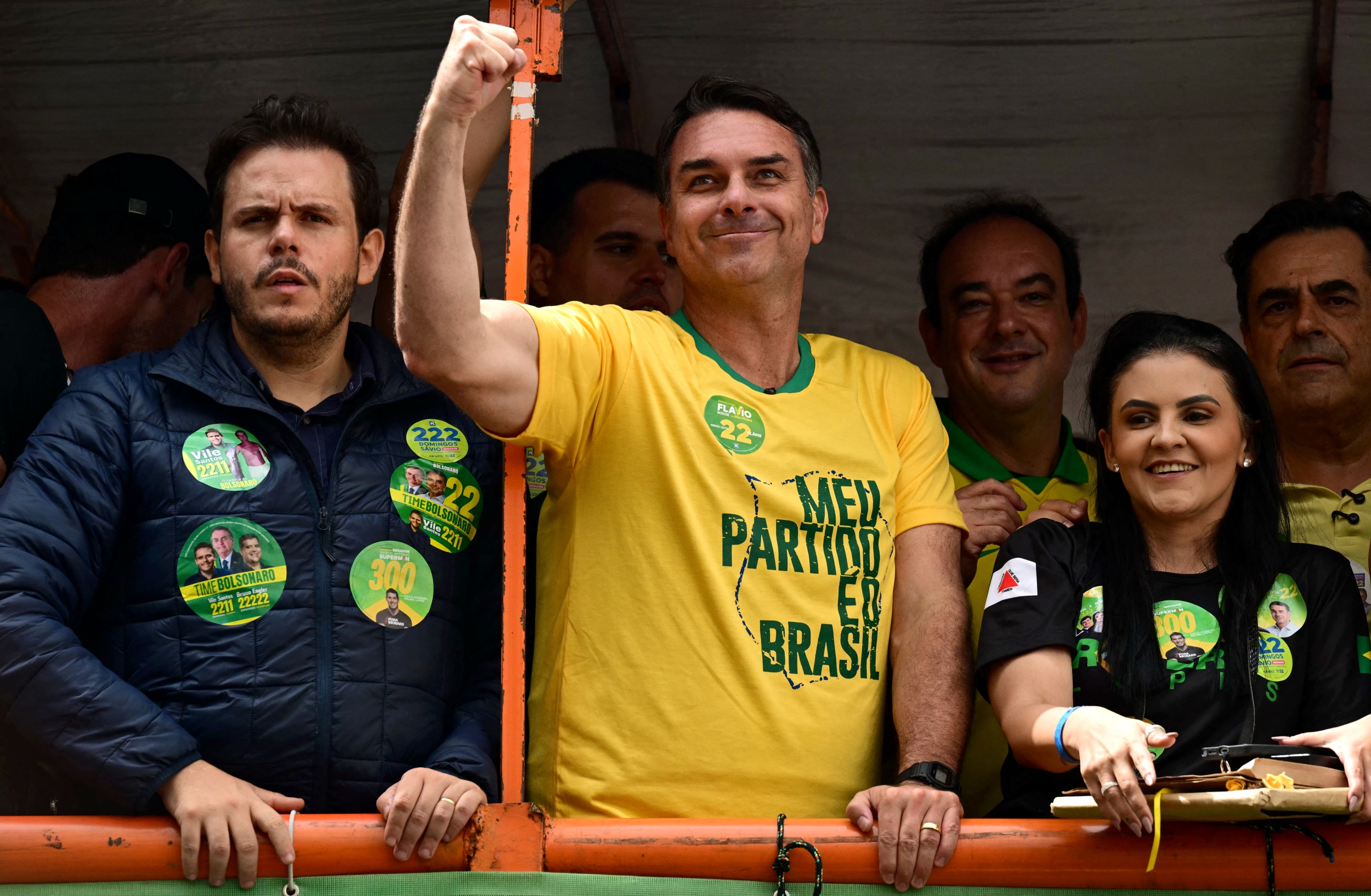
Photo by Pablo PORCIUNCULA / AFP via Getty Images
The Briefing
- Multiple pollsters now show Senator Flávio Bolsonaro and President Lula within a point or two of each other, with two separate surveys giving Flávio a numerical edge for the first time this campaign.
- A public feud between two Supreme Court justices has triggered dueling rulings, a canceled plenary session, and an emergency hearing set for September 15 — an institutional crisis that’s bleeding directly into the campaign.
- Flávio, the Rio senator running to succeed his ineligible father, is fighting a completely separate legal and political battle from his brother Eduardo, who was convicted in June and has since settled into life in the United States.
- South Florida holds one of the largest Brazilian voter blocs abroad — a community that backed the elder Bolsonaro by roughly 4-to-1 in 2022 and is being courted again as overseas registration hits a record high.
Brazil’s presidential race has gone from a comfortable lead for President Luiz Inácio Lula da Silva to a coin flip in a matter of weeks. Senator Flávio Bolsonaro has closed the gap heading into the October 4 vote, and prediction markets that once heavily favored the incumbent now price the race as a dead heat, with Polymarket showing both candidates essentially tied at 49% as of this week.
The shift lines up almost exactly with a separate story: Brazil’s Supreme Court is tearing itself apart over a banking scandal, and the fallout is spilling directly into the election. A third, unrelated thread — the criminal case against Flávio’s brother Eduardo, who lives in the United States — keeps getting stitched into the same headlines, even though it runs on its own legal track entirely.
A Dead Heat After a Summer of Distance
As recently as late August, Lula held a comfortable cushion. An AtlasIntel survey commissioned by Bloomberg had the president ahead 47.1% to 42.6% in that round. Two weeks later, the same series flipped: Flávio edged in front 46.4% to 46.2%, a gap inside the margin of error but the senator’s first numerical lead in that pollster’s history this cycle. A separate PoderData/Aya survey released the same week put Flávio at 47% against Lula’s 45% in a runoff simulation.
An Al Jazeera report on Quaest’s mid-August numbers still had Lula up 43% to 40%, and Datafolha’s early-September fieldwork kept the president numerically in front, 46% to 44%, in a poll that O POVO reported was the first fielded after the candidates skipped an August debate. Line these surveys up side by side and they don’t converge on a single leader but what they agree on is that a race Lula was expected to cruise through has become genuinely competitive.
Inside the Supreme Court’s Meltdown
The senator’s momentum is tangled up with a real institutional crisis, not just campaign spin. It started September 1, when Justice André Mendonça unsealed federal police records containing roughly 30 text messages exchanged between fallen banker Daniel Vorcaro, the former head of collapsed Banco Master, and a phone number tied to Justice Alexandre de Moraes — records that suggested Vorcaro had been seeking Moraes’s advice in the run-up to his arrest. Moraes fired back, requesting an inquiry into whether Mendonça overstepped by questioning Vorcaro without police or prosecutors present.
The clash escalated a week later: on September 8, Mendonça removed federal police Director-General Andrei Rodrigues and intelligence chief Leandro Almada from their posts, alleging their agency had quietly compiled roughly half a dozen unauthorized intelligence reports on him. That order didn’t survive a full day. On September 9, Justice Flávio Dino reversed the decision and reinstated both officials, ruling that a single justice couldn’t unilaterally remove the country’s top police leadership. Chief Justice Luiz Edson Fachin then canceled two consecutive plenary sessions as the crisis deepened, with the full ten-member court now set to weigh whether Moraes himself should face an investigation at an emergency hearing scheduled for September 15.
Lula has waded into the fight directly, if carefully. Without naming Moraes, he argued the country needs “more transparency, not selective leaks that affect the election” and called for full disclosure of every investigation tied to the Master case. Flávio, for his part, has made the feud the centerpiece of his rallies, repeatedly branding Moraes — the justice who sent his father to prison — a “rotten orange” and casting the court’s turmoil as proof of the institutional rot he’s campaigning against. That message lands with an already skeptical public: back in April, Datafolha found 75% of Brazilians believe the justices hold too much power.
One Family, Two Unrelated Legal Fights
International coverage keeps blurring Flávio’s campaign into his brother Eduardo’s legal troubles, but the two run on entirely separate tracks. Flávio is the sitting senator on the October 4 ballot. Eduardo is a former congressman who was convicted in absentia in June, sentenced to four years and two months in prison and barred from holding office for eight years after that sentence is served, for lobbying Washington to sanction Moraes during their father’s coup trial. He’s appealing.
Eduardo now lives in the U.S. on an EB-1A green card granted in July and has said he won’t set foot in Brazil again without amnesty. He isn’t on any ballot, but he is actively lobbying: he told Reuters he’ll press Washington to reinstate Magnitsky Act sanctions on Moraes during a trip to Washington next week, insisting to the news agency that “it is not an election-related issue” — even as he openly campaigns for his brother from abroad. Separately, and adding to the week’s news, Brazil’s Supreme Court opened a week-long virtual vote this month on whether to shave time off Eduardo’s sentence, though a shorter term would do little to change his day-to-day life in the U.S.
Why Florida Is Watching Closely
That transatlantic campaigning lands squarely in South Florida, home to one of the largest Brazilian communities in the United States. Florida counts roughly 130,000 Brazil-born residents, according to Census Bureau estimates, and when Jair Bolsonaro lost in 2022, Brazilians voting through Miami-area polling stations still backed him by roughly 4-to-1 overall — and by 6-to-1 in some precincts.
Overseas registration has climbed sharply since then. Brazil’s electoral court counted 883,969 eligible voters abroad as of late May, and by September that figure had climbed to 918,876, according to the electoral court’s own count — up from roughly 697,000 in 2022, with Miami again ranking among the largest voting hubs abroad alongside Lisbon, Boston, and Tokyo. Given that history, Flávio’s campaign has real reason to expect the diaspora vote to break his way again, even as his U.S.-based brother pursues a legal and lobbying fight that has nothing to do with what’s actually on Brazil’s ballot.
© {{Year}} Latin Times. All rights reserved. Do not reproduce without permission.