Flash floods in Nepal, China kill over 160, officials report | The Arkansas Democrat-Gazette
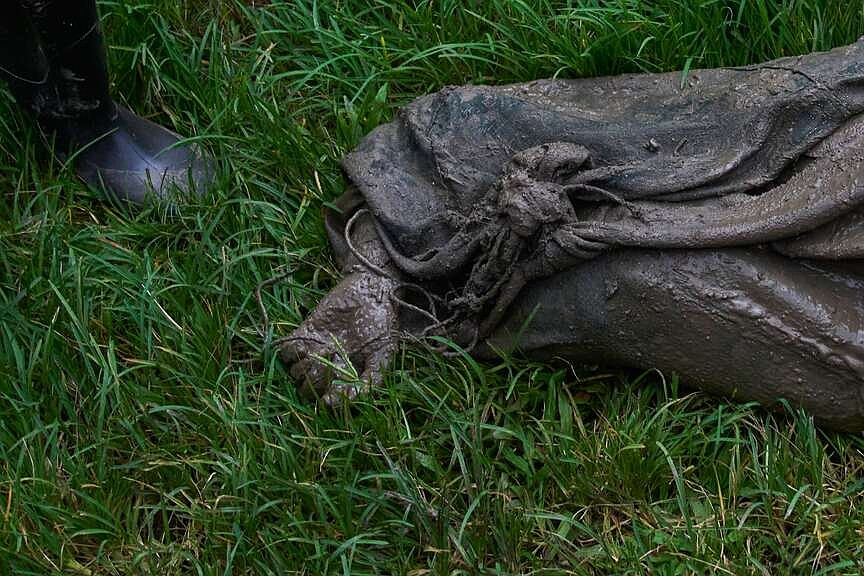
UDIN DHUNGA, Nepal — Flash floods in a border area of Nepal and China on Wednesday killed over 160 people and left hundreds of tourists, workers and others missing after sweeping through communities and bringing travel in some areas to a halt. Experts said a glacial collapse caused the disaster in the warming Himalayan region.
Police in Nepal reported at least 162 dead. China’s Xinhua News Agency on Thursday reported three people dead and 558 missing in Tibet.
Drone footage showed roads destroyed and buildings buried by thundering water the color of wet cement. State news agency Xinhua reported significant casualties.
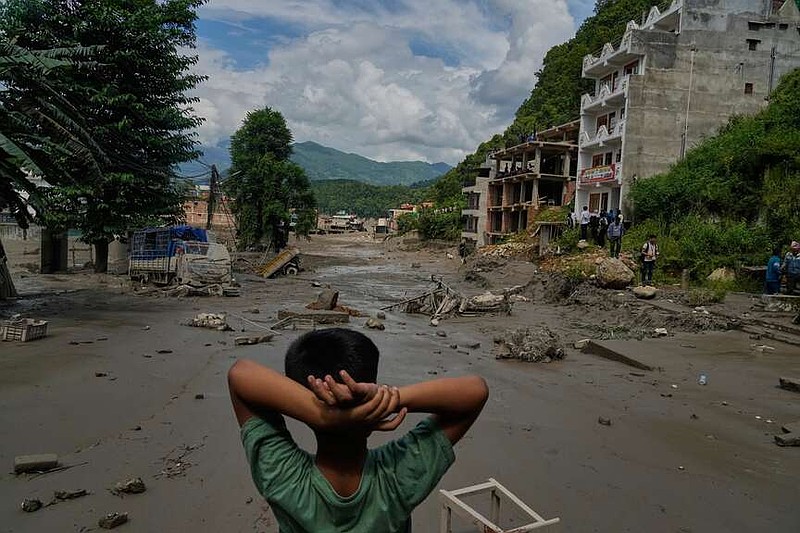
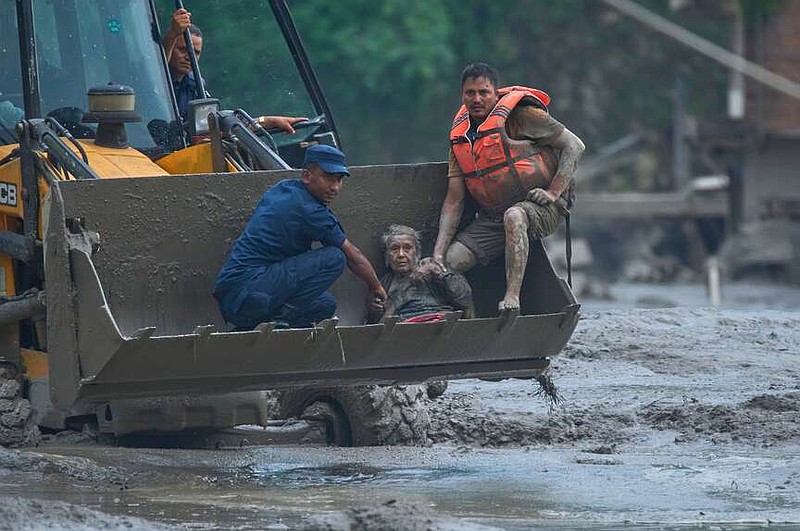
The region’s steep valleys are economic lifelines and travel corridors but precarious ones when disaster strikes. Images showed what appeared to be the second floors of buildings in Nepal’s hard-hit Nuwakot district slathered in mud after the torrent rushed by. Debris hung from tree branches and wires, vehicles were buried and some stunned survivors were caked in mud.
There was little time for anyone to flee.
“When I reached Dhunge bazaar, in half an hour, the flood came and damaged all the market. People were preparing to go to office then,” resident Shoyam Rajbhandari said. “How many people are missing or dead, we don’t know.”
Chinese state broadcaster CCTV reported that 260 of the 558 missing people were foreigners and two villagers were rescued. At least three people were killed as of Thursday morning, it said.
Officials in Nepal on Wednesday said 403 people, including 341 foreign nationals, were reported missing. Sunil Sharma, a tourism board spokesperson, said 133 were from India on a pilgrimage to Mount Kailash in Tibet, a sacred site for Hindus. Also missing were 47 from the United States, 34 from Australia, 33 from Britain and 24 from Canada, he said. The State Department said it was aware of Americans affected.
At least 62 missing Nepali citizens were among hundreds of locals trekking in the Gosaikunda Lake area in hard-hit Rasuwa district bordering Tibet’s Gyirong, coinciding with the local festival of Janai Purnima on Friday, Sharma said. Though the current monsoon season is less favorable for trekking in Nepal, it’s a major season for Kailash trekking, which follows the route in Nepal’s Rasuwa district.
Nepal police spokesperson Abi Narayan Kafle told The Associated Press at least 28 police officials were missing.
Officials warned residents in several districts to stay away from the banks of the Trishuli, Bhotekoshi and Narayani rivers. At least 19 bridges and nearly 25 miles of road were swept away. The Bhotekoshi flooded around 9 a.m. Wednesday, destroying several villages and hydropower projects, officials said.
“We have asked both India and China to help us with the rescue efforts,” said government spokesperson Sasmit Pokharel.
The U.S. Geological Survey first reported a magnitude 4.4 earthquake early Wednesday, about 41 miles north of Kathmandu, near the border. The USGS later updated its analysis to say the seismic event it measured was a magnitude 5.2 glacial collapse that sent debris flowing downstream with catastrophic impact on communities. It said its determination was based on data from nearby seismic stations, long period seismic waves and satellite imagery, and that no earthquake had occurred.
South Korean government officials said nine citizens working on building a hydropower plant in Nepal were among those reported missing. Malaysia’s foreign ministry said its embassy received reports from travel agencies that they had lost contact with 11 Malaysians believed to be in Rasuwa district. Russia’s embassy in Nepal said four citizens reportedly in the affected area were missing.
Indian Prime Minister Narendra Modi spoke with Nepal’s Prime Minister Balendra Shah and offered help. “India is prepared to provide Nepal with all possible types of humanitarian assistance. Our teams are closely coordinating on rescue and relief efforts,” Modi said on social media.
Some United Nations bodies were deploying “in an effort to meet what will clearly be massive humanitarian need,” U.N. spokesperson Stephane Dujarric said.
GLACIER AVALANCHE
Climate experts at the Kathmandu-based International Centre for Integrated Mountain Development said an avalanche from a glacier likely caused Wednesday’s flash flood.
“Hydrological observations indicate the exceptional speed and magnitude of the flood wave,” they said in an emailed statement, noting that water levels at one point on the Trishuli river rose by as much as 27 feet over half an hour.
The Lhende Khola River, a tributary of the Bhotekoshi, had maximum flooding, they said.
“The Lhende Khola has flooded twice in 14 months, this time triggered by an ice rock avalanche from a glacier on the Nepal side that blocked the river and released a sudden surge downstream,” said Saswata Sanyal, a disaster risk reduction specialist at the climate research group.
He noted the importance of early warnings in “a warming Himalaya.”
“It looks like a glacier in the area basically snapped off in a clean break, allowing it to fall just over a vertical kilometer to the valley bottom,” said Daniel Shugar, a geologist at the University of Calgary in Canada who studied satellite imagery to analyze what happened.
“The bottom looks like a bomb exploded — it’s just deposits from the broken-up glacier,” he said.
Warming temperatures caused by climate change may have accelerated the glacier’s collapse, scientists said.
On Wednesday, a chunk of ice with a width of about 2,000 feet snapped cleanly off the glacier, Shugar said, sending a mixture of ice and water to the valley floor. By his assessment, the chunk of ice fell from an altitude of about 17,000 feet, dropping almost 4,000 feet.
“This is a big chunk of ice that is stored at high elevation in the mountain, with a huge amount of potential energy,” said Simon Cook, a glaciologist at the University of Dundee in Scotland who also worked on the satellite analysis. When it breaks off, he added, the sheer force of the drop pounds the ice into a dangerous, fast-moving mix.
“That ice just gets pulverized into water,” he said.
Shugar said it was too early to rule out other contributing factors.
“The amount of water in the videos is astounding, an order of magnitude bigger than other recent glacial disasters like this,” he said. “It’s very possible that there’s another culprit here.”
The region saw similar flash floods in August last year, when a glacial lake in Tibet overflowed because of high temperatures. Nine people were killed, and critical infrastructure, including a bridge connecting Nepal and China, was damaged.
The Himalayan region, which spans several countries including India, is especially vulnerable to heavy rains, floods and landslides because of warming due to human-caused climate change. Research shows that extreme weather events, including heat waves, rains and melting glaciers, have become more frequent.
Researchers in Kathmandu found earlier this year that glaciers across the Hindu Kush Himalaya region are melting at an accelerating rate, with ice loss rates doubling since 2000, primarily due to rising global temperatures and climate change.
Information for this article was contributed by Niranjan Shrestha, Sibi Arasu, Shristi Kafle, Fu Ting, Hyung-jin Kim and Eileen Ng of The Associated Press and Leo Sands of The New York Times.