

FIFA World Cup 2026: Why Congo’s ‘human statue’ stands still for 90 minutes at every match
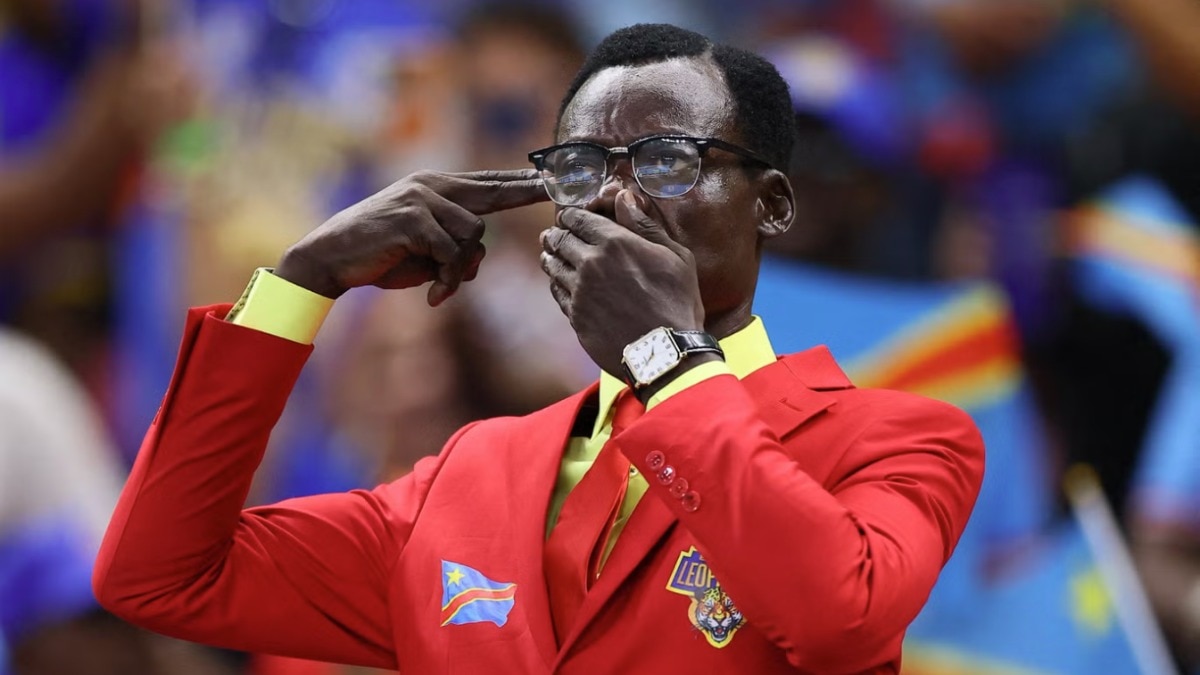
The crowd jumps, flags wave, drums echo around the stadium.
Then there is one man who does absolutely nothing.
He does not clap after a goal. He does not sing. He does not celebrate. For 90 minutes, he stands perfectly still with one arm raised, almost as if someone has frozen him in time.
To millions watching DR Congo’s matches, he has become one of the World Cup’s most fascinating viral images.
Yet there is nothing new about the ritual. Lumumba Vea has been performing this silent tribute at DR Congo’s international matches since around 2013, becoming a familiar sight for African football fans long before the rest of the world noticed him. The 2026 FIFA World Cup simply introduced his motionless figure, and the history behind it, to a global audience.
But Michel Nkuka Mboladinga, better known as Lumumba Vea, is not trying to entertain anyone.
He is keeping alive the memory of a man his country refuses to forget.
THE STATUE IS NOT A GIMMICK
Lumumba Vea has performed this silent ritual since 2013. Dressed in a colourful suit inspired by the Congolese flag, he climbs onto a platform before kick-off and remains motionless until the final whistle, no matter what happens on the pitch.
The pose is deliberate.
It recreates one of the best-known statues in the Democratic Republic of Congo, that of Patrice Lumumba, the country’s first Prime Minister after independence from Belgium in 1960. His raised arm, formal suit and unwavering expression mirror the monument in the capital, Kinshasa.
For many football fans, it looks unusual.
For many Congolese, it represents memory.
THE MAN WHO BECAME A NATIONAL SYMBOL
Patrice Lumumba was only 35 when he became Congo’s first Prime Minister after decades of Belgian colonial rule.
At independence on June 30, 1960, he delivered a powerful speech rejecting colonial oppression, directly challenging the triumphal narrative presented by Belgium’s King Baudouin. Within months, the young nation descended into political turmoil.
In January 1961, Lumumba was arrested, handed over to his enemies in the mineral-rich Katanga region and assassinated. Later investigations established that Belgian officials were deeply involved in the events leading to his killing, while declassified documents also revealed that the United States had viewed him as a threat during the Cold War. Historians continue to debate the precise roles played by different governments, but Lumumba’s death became one of Africa’s defining political tragedies.
Today, he is remembered across Africa as an independence hero and a symbol of Congolese sovereignty.
That is the man Lumumba Vea becomes every time he enters a football stadium.
WHY FOOTBALL IS THE PERFECT STAGE
For Lumumba Vea, football offers something history books cannot.
Millions watch, and every televised match sparks the same question — “Why is that man standing like a statue?”
The answer leads viewers back to Patrice Lumumba and to a chapter of African history that many outside the continent know little about.
His silence is also symbolic. While other supporters express emotion through chants and celebrations, Lumumba Vea’s stillness suggests that some memories deserve reflection rather than noise.
What began as a personal tribute has grown into a national symbol. He has become an official ambassador for the DR Congo football federation, and players have publicly spoken about the inspiration his presence brings.
During the 2026 FIFA World Cup, visa delays briefly prevented him from travelling, prompting another supporter to recreate his famous pose so the tribute would continue.
In an age where fans compete to be louder, brighter and more outrageous, Lumumba Vea has achieved global fame by refusing to move at all.
His statue does not celebrate a football team.
It remembers a nation, a leader and a history that still stands tall every time DR Congo takes the field.
– Ends
Credit: Source link