

Fiddler Crabs Are Shredding Microplastics in Colombia’s Mangroves
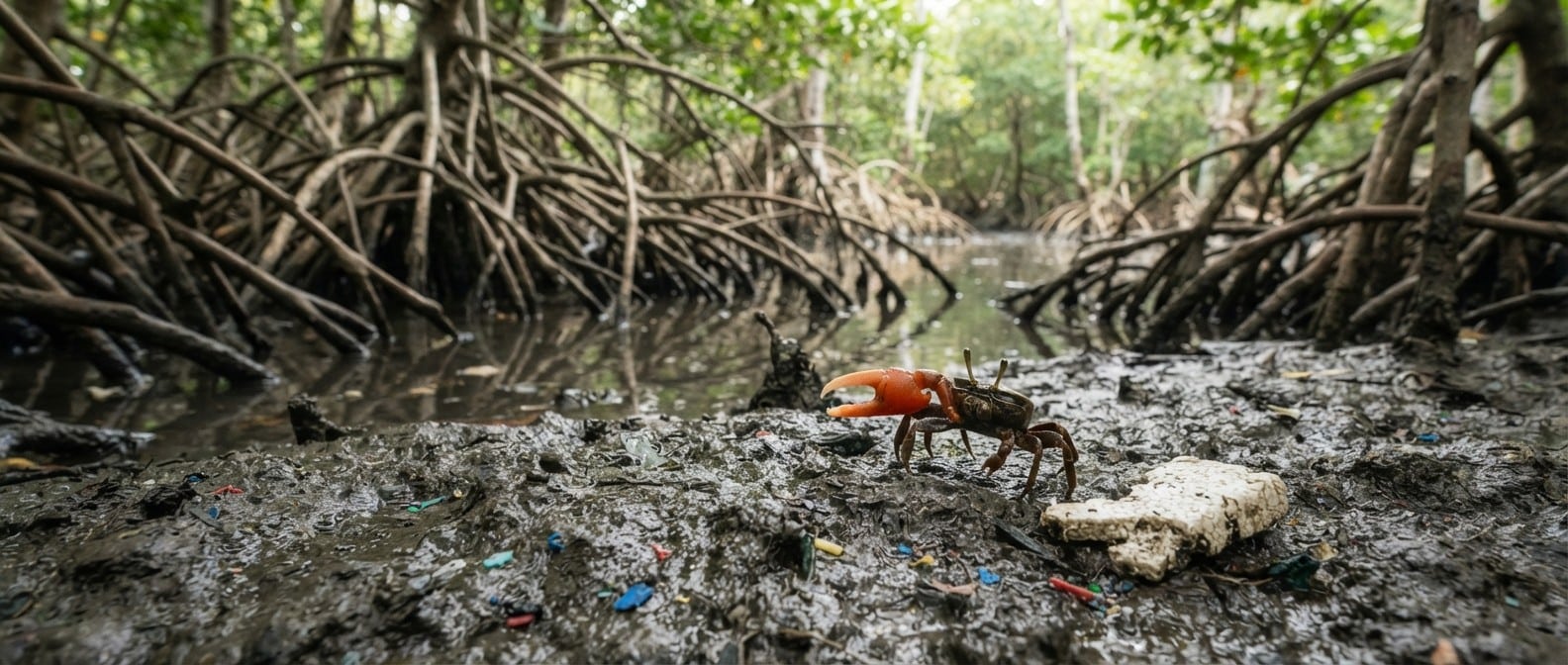
When the tide drops in the urban mangroves of Turbo, on Colombia’s Caribbean coast, hundreds of tiny fiddler crabs emerge from the mud. The crabs, of the species Minuca vocator, measure barely three centimeters and weigh about three grams each, yet they rank among the busiest animals in the mangrove. Every day they scoop up sediment, filter out organic matter, and return the rest to the ground as tiny mud pellets, a habit that earns them the title of ecosystem engineers. In the way earthworms aerate soil, fiddler crabs oxygenate the mangrove floor and recycle its nutrients.
That constant sifting now has an unintended consequence, according to a study published in Global Change Biology. Fiddler crabs in Colombia’s Gulf of Urabá are swallowing microplastics in large quantities and fragmenting them into smaller pieces within days, a process long assumed to take decades and to be driven mostly by sunlight and waves rather than living organisms. The researchers warn that the discovery is bad news: fragmentation does not remove plastic from the environment. It converts the plastic into tinier particles that are harder to detect, harder to clean up, and more mobile inside the bodies of other animals.
The Experiment in the Mangrove
The Gulf of Urabá is where the Caribbean Sea reaches its southernmost point, at the edge of Colombia’s Antioquia department. There, the Atrato River spreads into a delta of channels, islands, and wetlands before meeting the sea, and extensive mangrove forests line the boundary between fresh and salt water. In the roots of those mangroves, branches and leaves tangle with bottles, bags, and expanded polystyrene packaging that arrive by river, from nearby towns, or on marine currents.
The municipality of Turbo, with more than 3,000 square kilometers and roughly 130,000 residents, holds the longest stretch of coastline on the gulf, and its urban mangrove is one of the main plastic debris accumulation points in the region. Marine sediments worldwide hold an estimated 16 million tons of microplastic, and mangrove floors are exactly the kind of sink where it collects. At that site, marine ecology professor José Riascos, biologist Lina Zapata, and then-student Daniela Díaz of the Institute of Marine Sciences at the University of Antioquia designed an experiment to answer a basic question: with plastic piling up all around them, how are the crabs handling it?
“We imagined these crabs had mechanisms to avoid plastic thanks to their morphology. The first surprise was that they don’t avoid the plastic; they ingest it in large quantities,” said Riascos, a research associate with the Centro de Excelencia en Ciencias Marinas, in an interview with Mongabay Latam.
Over 66 days, the team set up small plots in the mangrove and placed fluorescent polyethylene microspheres in the sediment. Polyethylene is the most abundant polymer among ocean microplastics, and the spheres were sized between the smallest and largest sediment particles the crabs normally ingest, none thicker than a human hair. The crabs, meanwhile, went about their usual routine of filtering organic matter from the mud.
The results were striking. Of the 95 crabs studied, 91 incorporated the microspheres. The concentration of plastic in each individual averaged more than 13 times the particle density available in the surrounding surface sediment. And when the researchers examined the particles inside the crabs, about 15 percent of the microspheres appeared fractured.
- 91 of 95 crabs ingested the plastic microspheres during the 66-day experiment.
- Plastic concentration inside each crab averaged more than 13 times the density found in the surrounding sediment.
- About 15 percent of the recovered microspheres were fractured, showing fragmentation in days rather than decades.

Fragmentation Is Not Degradation
The speed of the process is what unsettled the scientists. Plastic in the environment was long thought to break down over decades or centuries through environmental factors rather than biological ones. “With this research we are demonstrating that this plastic fragmentation mechanism occurs in a matter of days,” Riascos said.
The distinction between degradation and fragmentation matters. Degradation is the full process by which a material eventually breaks down into its basic components. Fragmentation is one of the earliest stages: the plastic breaks into ever-smaller pieces but remains plastic.
Fiddler crabs are decapod crustaceans, and their digestive systems include hard structures inside the stomach that grind food. “Once they ingest organic material, they process it; in some way they grind it. That is most likely where they fragment the plastic,” Riascos said. The study could not determine the exact point in the crabs’ bodies where fragmentation occurs, but it left open one possibility that still needs confirmation: bacteria in the crabs’ hepatopancreas may also be helping break down plastic through biochemical processes.
A Paradox: Crabs That Prosper Amid Plastic
At first glance, the findings seem contradictory. The urban mangroves of Turbo are among the most plastic-polluted environments in the gulf, yet fiddler crab populations there do not merely survive; they flourish.
According to Zapata, the plastic ingestion is accidental rather than intentional, with crabs confusing particles for sediment. Whether the plastic affects their health requires further study, she said. Earlier research by Riascos found that crabs in urban mangroves grow larger, carry better body condition, and, in females, reproduce for longer periods than populations in less disturbed mangroves. He attributes that to eutrophication: wastewater and other organic inputs continuously load the mangrove with nutrients, and the crabs feed well while the plastic passes through them.
Why Smaller Particles Raise the Stakes
For the research team, the fragmentation capacity is an alarm rather than good news. “The smaller the plastic particles are, the more capacity they have to migrate within an organism to other tissues,” Zapata said. “And if those fragments are excreted, it means those much smaller plastics will reach the environment and other organisms again. This implies a much greater risk for ecosystems.”
The concern extends up the food chain. Fiddler crabs are prey for birds and fish, and Turbo is a fishing zone. “The fiddler crab is part of a food chain; birds and fish feed on it, and Turbo is a fishing area,” said Díaz, who grew up in Turbo and worked on the study as a student. “If this is happening with the fiddler crab, it is very likely happening with other important species within the food chain. If we throw away our trash, that trash will return to our plates.” Studies of microplastic-eating fish have so far found bolder behavior and shorter lives, a hint of what may await predators higher up this food web.
The pattern echoes other recent findings in the region. Researchers analyzing Maya octopus off Mexico’s Campeche coast found microplastics in 93% of specimens sampled there, evidence that plastic is now moving through coastal food webs across Latin America.
Mangroves themselves sit at the center of the problem. Their roots buffer waves, stabilize the coastline, store large quantities of carbon, and shelter fish, crustaceans, mollusks, and birds. A UNEP assessment values the ecosystem services these forests provide, from coastal protection to carbon sequestration, at $33,000 to $57,000 per hectare per year. That same filtering capacity, which protects coastlines and nearshore waters, also turns mangroves into traps for floating waste. Plastic is no longer a foreign object among these roots; it has become part of a story that scientists are only beginning to understand, with consequences that may extend far beyond the mud where the crabs walk.
Frequently Asked Questions
What are fiddler crabs?
Fiddler crabs are small intertidal crabs found in mangroves, mudflats, and sandy shores around the world. Males carry one oversized claw, which they wave to attract females and ward off rival males. Because they constantly rework the sediment while feeding and digging burrows, ecologists classify them as ecosystem engineers, comparable to earthworms in terrestrial soils.
Do fiddler crabs eat plastic?
Yes, though apparently by accident. In the Gulf of Urabá study, 91 of 95 crabs ingested fluorescent polyethylene microspheres placed in their habitat over 66 days, and the plastic concentration inside each crab averaged more than 13 times the density found in the surrounding sediment. The researchers believe the crabs confuse microplastic particles with sediment as they filter food from the mud.
Does breaking plastic into smaller pieces make it less harmful?
No. Fragmentation is not the same as degradation: the plastic breaks into smaller and smaller pieces but remains plastic. Finer particles can cross biological barriers more easily, may migrate into the tissues of the animals that ingest them, and return to the environment when excreted. From a pollution standpoint, smaller fragments are more difficult to detect, remove, and study.
Which seafood is highest in microplastics?
Contamination levels vary by species, region, and study design, but filter feeders and bottom-dwelling animals that process sediment are consistently among the most affected, including shellfish, crabs, and octopuses. Research on seafood across Latin America and beyond continues to find microplastics in commercially important species, reinforcing the link between coastal pollution and the food supply.