

Families brace for separation as Haitians set to lose protected status next week : NPR
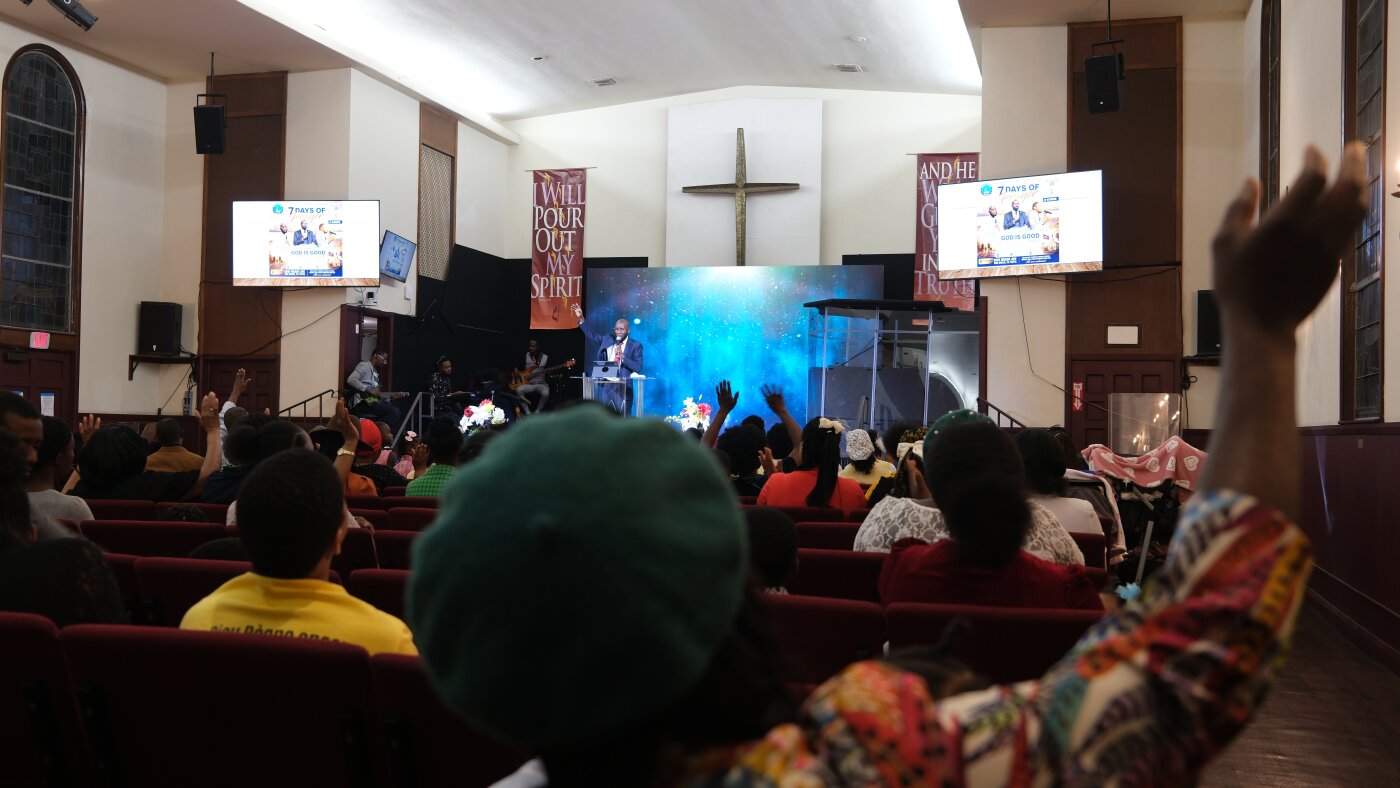
Some 350,000 Haitian migrants are set to lose their temporary legal status next week. Many have had children in the U.S., and now face an agonizing choice: if deported, should they take their U.S. citizen children to a still-dangerous Haiti? Families at this Haitian church in San Diego are leaning on faith as they brace for an uncertain future.
Adrian Florido/NPR
hide caption
toggle caption
Adrian Florido/NPR
SAN DIEGO — Josiane Valsaint has lived and worked legally in the U.S. since 2010. But she and hundreds of thousands of other Haitian nationals are set to lose their legal status as soon as Monday, opening the door for federal immigration agents to round them up for deportation.
The question that sends tears streaming down Valsaint’s face is: If that happens, what will happen to her 10- and 12-year-old children, born in San Diego, who attend public school here?
“Who’s going to take care of my kiddos?” she asked. “They’re not adults yet. They were born here.” Taking them to Haiti, much of which is now controlled by heavily armed gangs, is not an option, she said.
The Supreme Court last month allowed the Trump administration to kick 350,000 Haitians and 6,000 Syrians out of the Temporary Protected Status program that has allowed them to live and work in the U.S. because of unsafe conditions in their countries. There are many uncertainties now agonizing these communities, including how aggressively immigration agents — who have their addresses — will seek to detain them, and what will happen to their children, many of whom are U.S. citizens.

Guerline Jozef is executive director of the Haitian Bridge Alliance, a San Diego-based nonprofit that supports Haitian immigrants. She said if the government begins rounding up Haitians whose Temporary Protected Status has been revoked, family separations are likely because most parents can’t fathom taking their children back to a country largely controlled by armed gangs.
Adrian Florido/NPR
hide caption
toggle caption
Adrian Florido/NPR
By one Princeton researcher’s estimate, there are 50,000 children who’ve been born in the U.S. to Haitian parents with TPS. The loss of those protections means a large new population of mixed-status families are vulnerable to being split apart by the Trump administration’s mass deportation drive.
In deciding to strip Haitians of their temporary legal status, the Trump administration has said it’s no longer justified because “conditions in Haiti have improved sufficiently to support the return of Haitian nationals’ safely. It’s also said allowing Haitian migrants to remain is “contrary to the U.S. national interest.”
Haitian migrants and advocacy groups have disputed those conclusions. In fact, they say, Haiti is more dangerous now than when the Obama administration first granted TPS to Haitians after the 2010 earthquake that killed hundreds of thousands of people. Haiti’s president was assassinated in 2021. Today, armed gangs control vast swaths of the island nation’s territory, infrastructure and economy, and restrict the movement of citizens.
Almost invariably, Haitian TPS holders say taking their children there is unfathomable.
“They cannot take those children back to Haiti,” said Guerline Jozef, executive director of the San Diego-based Haitian Bridge Alliance, which advocates for Haitian immigrants. “Not because Haiti is not beautiful. Not because there’s no hope. But because right now, in July 2026, it is impossible for them to be safe there.”

In late June, Haitians in the U.S. with Temporary Protected Status attended an information session at the Haitian Bridge Alliance, in San Diego, about what the loss of their legal status could mean for them and their families — and how to prepare.
Adrian Florido/NPR
hide caption
toggle caption
Adrian Florido/NPR
Many Haitian TPS holders, Jozef said, are just beginning to consider the impossible decisions they’ll soon face. Leave their children in someone else’s care? Take them back to Haiti? Try fleeing to another country?
“I think family separation is more likely,” Jozef said. “To take them back with them is not even a choice.”
Valsaint, whose 10 and 12-year-olds speak perfect English and sing in a church choir in San Diego, said about her plans only that, “families stick together.” And then, her voice catching, she added: “We can’t go back to Haiti.” She said she’s hoping for a miracle.
Sandra, a Haitian woman with TPS who asked NPR to use only her first name because she fears deportation, said her teen son came to her after the Supreme Court ruling and expressed suicidal thoughts over the prospect of being sent to Haiti, a country he’s never been to but whose troubles he’s kept up with online.
“I cried,” said Sandra, who works as an in-home caretaker in San Diego. “I’m supposed to protect them, and I feel like I’m failing.”
It’s not clear how aggressively Immigration and Customs Enforcement will move to detain and deport Haitians newly stripped of TPS protections, or how much capacity Haiti has to receive deportation flights. Haiti’s top migration official told local reporters that based on a conversation with the U.S. embassy in Haiti, he expects about a thousand deportees to arrive on flights from the U.S. each month.
NPR asked the Department of Homeland Security how it plans to handle the U.S.-born children of Haitians it seeks to detain. In an emailed statement, an unnamed spokesperson wrote, “ICE does not separate families. Parents are asked if they want to be removed with their children or ICE will place the children with a safe person the parent designates. This is consistent with past administration’s (sic) immigration enforcement.”

Haitian flags at the offices of the Haitian Bridge Alliance, a San Diego nonprofit.
Adrian Florido/NPR
hide caption
toggle caption
Adrian Florido/NPR
The statement stressed the administration’s longstanding position that Temporary Protected Status was always meant to be temporary.
“For too long, TPS has been allowed to function as a de facto amnesty program,” the statement said. “The Trump administration is restoring integrity to the immigration system by ensuring that individuals who no longer qualify for TPS either pursue another lawful immigration status, voluntarily depart using the Department’s available return assistance, or face removal in accordance with federal law.”
In some states with large Haitian communities, such as Massachusetts, officials have published guides to help parents who want to designate temporary guardians for their U.S. citizen children. Jozef, of the Haitian Bridge Alliance, said advocates are scaling up other support systems to help Haitians make plans to protect themselves and their children in the weeks and months ahead.
On Monday, a lower federal court in D.C. is expected to implement the Supreme Court’s ruling allowing TPS for Haitians to end. That would allow immigration agents to begin arrests. Advocates are exploring other legal options and urging Congress to pass a bill that would extend TPS protections for Haitians. It passed the House with support from some Republicans in April, but was blocked by Senate Republicans this week.
If you or someone you know may be considering suicide or is in crisis, call or text 9 8 8 to reach the Suicide & Crisis Lifeline.