

Ex-VP Defense Withdraws Evidence Hearing | News
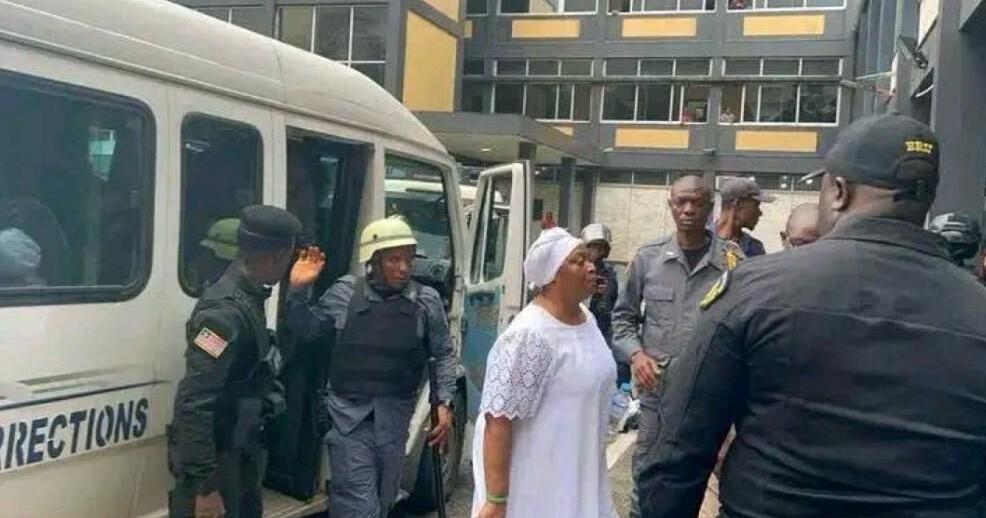
Former Vice President Jewel Howard Taylor’s lawyers spent last week challenging the State’s evidence against her. But on Monday, just as Magistrate Ben Barco was expected to decide whether prosecutors could play explosive audio recordings allegedly containing Taylor’s own voice, the defense abruptly ended the preliminary examination altogether.
The move at the Monrovia City Court means the recordings that dominated the closing moments of Thursday’s hearing will not be played there, while the criminal case against Taylor now moves to Criminal Court “C” for further proceedings.
Taylor’s defense requested the withdrawal when the case was called Monday, according to accounts of the proceeding, effectively waiving continuation of the preliminary examination it had previously sought.
The timing is significant.
Thursday’s hearing ended with prosecutors asking Barco for permission to play audio evidence that their first witness, Liberia National Police investigator Raphael A. Wilson, claimed contained conversations between Taylor and Sheikh Bashiru Kante, an alleged co-conspirator who investigators say surrendered his cellphone.
“By kind permission of the court, the prosecution requests the court to allow its audio evidence to be played,” prosecutors told the court.
Taylor’s lawyers immediately objected: “Not the best evidence, hearsay, unconstitutional, proper foundation for the chain of custody.”
Rather than immediately rule, Barco heard arguments and adjourned the proceeding until Monday, explaining: “Because this Court is to make a decision backed by law, this proceeding is hereby adjourned to resume on Monday next at the hour of 10:00am.”
But Monday’s anticipated ruling never resulted in the recordings being heard. Instead, the defense withdrew the preliminary examination, bringing the City Court’s examination of the State’s evidence to an end.
The withdrawal does not amount to an admission of guilt, nor does it necessarily mean Taylor has conceded the authenticity or truth of the State’s evidence. Those issues can be contested as the prosecution advances.
What the decision does mean, however, is that the State will not have to complete its probable-cause presentation before Magistrate Barco.
And it leaves unanswered the question that hung over the courtroom when Thursday’s hearing adjourned: What exactly is on the tapes?
Explosive Claims, Unheard Recordings
Wilson, acting Commissioner of the Crime Services Department of the Liberia National Police and supervisor of the investigative team, spent much of Thursday describing what investigators say they discovered on Kante’s cellphone.
Wilson testified that Kante voluntarily surrendered the device on August 16 as part of his cooperation with investigators. According to Wilson, analysis uncovered WhatsApp text messages and audio communications involving Taylor.
“This was a voluntary submission to the investigation,” Wilson testified, adding that investigators found “text messages between defendant Taylor and Skeikh Kante and an audio” involving an alleged request for money.
Wilson went much further.
He alleged that the recordings contain discussion of financial support from Nicolas Ivancic, whom investigators describe as a leader of the alleged drug trafficking operation, and an arrangement under which the alleged traffickers would be allowed to continue their cocaine business if Taylor and her political allies came to power.
Wilson also testified that one recording contains an alleged statement concerning former President George Weah.
“You will also hear her saying when they take power after three years, they will assassinate President Weah and Grand Kru people will take their body,” Wilson told the court.
Those are allegations made by a State witness under oath. The recordings themselves were never played in open court, meaning the court and public have not independently heard whether they contain what Wilson says they do.
A Striking Turn
The decision to abandon the preliminary examination is particularly striking because Taylor’s lawyers had earlier pressed the City Court for greater access to the State’s evidence.
The defense told Barco that Taylor’s arrest warrant referenced witnesses, cellphone records, banking transactions and other evidence and complained that requests for discovery had been denied.
Her lawyers therefore asked the magistrate to order prosecutors to provide “all of the species of evidence” the State intended to use during the preliminary proceeding.
Barco denied the request, drawing an important distinction between a preliminary examination and a criminal trial.
The magistrate ruled that his court’s jurisdiction over offenses ultimately triable before the Circuit Court is limited and declared that “the purpose of Preliminary Examination is to determine Probable Cause and not to determine guilt of the defendant.”
The State was therefore required at this stage only to produce sufficient evidence to establish probable cause. Guilt or innocence, Barco said, would be determined before the Circuit Court.
That preliminary examination had nevertheless begun providing the first detailed public look at the prosecution’s case.
The State put Wilson on the witness stand. Prosecutors introduced the police charge sheet and transcripts of alleged electronic communications. Taylor’s lawyers repeatedly challenged portions of the evidence, while reserving their rights under the law when Barco ruled against them.
Then came the audio.
When prosecutors initially asked Wilson whether he could identify the extracted recordings if they were played, the defense objected on hearsay and best-evidence grounds. Barco overruled the objection.
Wilson said he could identify them.
The State then asked to play them.
The defense objected again, this time adding constitutional and chain-of-custody grounds, setting up Monday’s anticipated ruling.
Instead, Taylor withdrew from the preliminary examination.
The sequence does not prove why her lawyers changed course. The defense remains entitled to challenge the State’s evidence as the case proceeds, and Taylor remains presumed innocent unless and until the prosecution proves otherwise in a court of law.
But the chronology is unmistakable.
Taylor’s lawyers initially demanded an opportunity to see and test the evidence the State intended to use to establish probable cause. The prosecution began presenting that evidence. Its first witness described extraordinary alleged recordings. The defense fought their admission. Barco prepared to decide whether they could be played.
And before the Monrovia City Court could hear them, the defense ended the preliminary examination.
The legal battle now moves to Criminal Court “C.”
The battle over the tapes may only have been postponed.
Credit: Source link