

EU Pushes South Caucasus Route Bypassing Russia and Iran as Von der Leyen Plans Visit
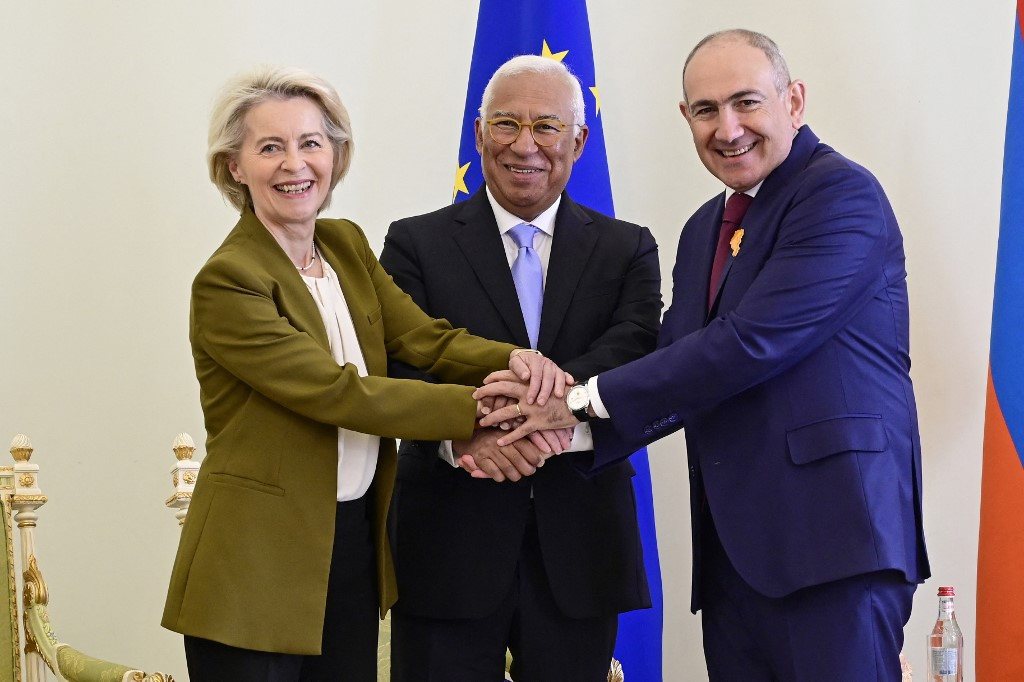
European Commission President Ursula von der Leyen will visit Azerbaijan and Armenia next week, marking a high-profile diplomatic push to strengthen the EU’s role in the South Caucasus.
The EU confirmed that von der Leyen will arrive in Baku on July 1 before traveling to Yerevan for a two-day visit from July 2 to 3. Enlargement Commissioner Marta Kos will join the delegation.
JOIN US ON TELEGRAM
Follow our coverage of the war on the @Kyivpost_official.
In a video posted on X on Tuesday, Kos said Europe’s trade, energy and digital security now depends on building reliable routes through the Middle Corridor, which connects the two continents via Turkey and the South Caucasus.
“One fifth of our economy is trade,” Kos said, noting that European security now extends beyond traditional trade agreements to geography, infrastructure, energy links and data cables.
For years, Europe relied on two main routes to Asia: the northern passage through Russia and the southern route through the Red Sea and Suez Canal. But recent conflicts have made both less reliable, forcing ships around the Cape of Good Hope and pushing air traffic over the Caucasus.
“There is another way,” Kos said, pointing to the Middle Corridor.
Trade along the route has quadrupled since 2022, but transit times can still stretch to 45 days. The EU aims to cut that to 15 days by upgrading roads, railways, ports and border crossings.
Kos argued that the improvements would lower costs for European businesses, reduce prices for EU consumers and stimulate broader economic growth. She also linked the project to regional peace, suggesting that the Middle Corridor could support normalization between Azerbaijan and Armenia after decades of conflict.
Other Topics of Interest
FT: Putin Frustrated as Trump Warms to Ukraine After Drone Successes
Moscow expected a quick peace on its terms, but Kyiv now sees signs of stronger US backing after recent battlefield gains.
“This is a priority for the European Commission: securing our trade, energy and digital links via routes we can trust,” Kos concluded.
Russia’s full-scale war has forced Europe to rethink its logistics and reduce dependence on routes vulnerable to Moscow’s influence. Diversifying those networks also indirectly strengthens Ukraine’s strategic position. Within this framework, Azerbaijan serves as a key partner in Europe’s energy diversification, while Armenia’s gradual shift toward the West weakens Moscow’s traditional influence in the South Caucasus.
However, the Baku stop will revive uncomfortable ethical questions for Brussels. Von der Leyen faced sharp criticism during her 2022 visit to Azerbaijan, when she signed a gas memorandum with President Ilham Aliyev. At the time, human rights groups accused the EU of prioritizing energy security over democratic values.
Those concerns are likely to follow her again. Rights organizations and Azerbaijani activists say the number of political prisoners in the country has risen sharply, with some estimates now approaching 400. Brussels remains under pressure to show that its new partnerships do not compromise the democratic principles it says it is defending against Moscow.
The Yerevan stop presents a different set of political challenges. The visit follows the June 7 parliamentary election, in which Prime Minister Nikol Pashinyan’s Civil Contract party secured a decisive victory, renewing his mandate to pursue a pro-European course and peace with Baku.
Yet that victory may still not be enough to clear one of the largest remaining obstacles to a final peace agreement. Azerbaijan has demanded changes to Armenia’s constitution, arguing that its text contains implicit territorial claims over Nagorno-Karabakh.
Although Civil Contract won a comfortable majority, it does not have the numbers to easily push through constitutional amendments or guarantee a successful referendum. That leaves the issue unresolved as Brussels tries to encourage normalization between Armenia and Azerbaijan.
Brussels has also moved quickly to support Armenia amid renewed economic pressure from Moscow. On June 19, the European Commission disbursed €34 million in immediate support to help Armenian businesses mitigate the impact of Russian trade restrictions.
That support followed the first-ever EU-Armenia summit in Yerevan in May, where von der Leyen and European Council President António Costa pledged stronger backing for Armenian sovereignty, resilience and reform.
Ultimately, the tour highlights Brussels’ delicate balancing act: deepening ties with Armenia while maintaining essential engagement with Azerbaijan during a fragile post-war normalization process.
For Ukraine, the South Caucasus is no longer a distant regional issue. It is part of Europe’s broader effort to bypass Russia and Iran, secure energy and trade routes, and build partnerships that limit Moscow’s ability to use geography as leverage.