

Ethiopia and the United States in the Horn of Africa’s Strategic Architecture – HORN REVIEW
The recalibration of United States–Ethiopia relations in 2025–2026 reflects a deeper structural shift in how Washington approaches the architecture of regional order in the Horn of Africa. Rather than treating the relationship as a residual legacy of earlier eras or a reactive instrument of crisis management, the sequence of institutional, military, and political measures undertaken during this period indicates a deliberate effort to restore Ethiopia as a central node within the American strategic system in the region. This restoration is not merely the product of improved bilateral atmospherics, it arises from a convergence of incentives in which the United States seeks reliable institutional partners capable of generating strategic depth along the Red Sea corridor, while Ethiopia seeks external partnerships that reinforce its capacity to shape regional security outcomes without sacrificing decision-making autonomy. The resulting dynamic privileges institutional consolidation and long-term positioning over episodic tactical engagement.
Historical precedent is instructive here. The 1953 Mutual Defense Assistance Agreement and its associated Defense Installations Agreement gave the United States access to the Kagnew Station communications facility in Asmara, then under Ethiopian administration, while Ethiopia received military assistance, training, and equipment. For more than two decades Kagnew functioned as a node in American global signals architecture proof that institutional access paired with cooperative security arrangements could generate strategic depth for Washington and material capability for Addis Ababa. That arrangement rested on a specific alignment of interests: American need for reliable facilities in a contested region, Ethiopian interest in external support that reinforced rather than subordinated its regional standing. The 1974 rupture and the partial recoveries after 1991 and post-2001 demonstrated both the value of these institutional pathways and their vulnerability to shifts in domestic politics and external alignment. The 2020–2022 northern conflict narrowed that space again; the Pretoria Agreement reopened it. The 2026 measures test whether that space can now support more resilient mechanisms.
The United States–Ethiopia Bilateral Structured Dialogue (BSD) Framework, signed on May, 2026, in Washington, by Ethiopian Foreign Minister Gedion Timothewos and U.S. Under Secretary for Political Affairs Allison Hooker, constitutes the foundational diplomatic architecture of the current phase. By formalizing three interconnected pillars economic engagement, defense and security cooperation, and regional peace and stability the framework moves the relationship from ad-hoc interaction toward predictable transmission mechanisms. Concurrently, the termination of the arms-export policy of denial removed a significant structural constraint on defense-industrial cooperation, replacing a presumption of rejection with case-by-case evaluation. These steps do not guarantee immediate material transfers, they restore the institutional pathways through which such transfers, training, and technical collaboration can occur when mutual interests align. In this sense, the May decisions represent vertical institutional repair rather than horizontal political signaling alone.
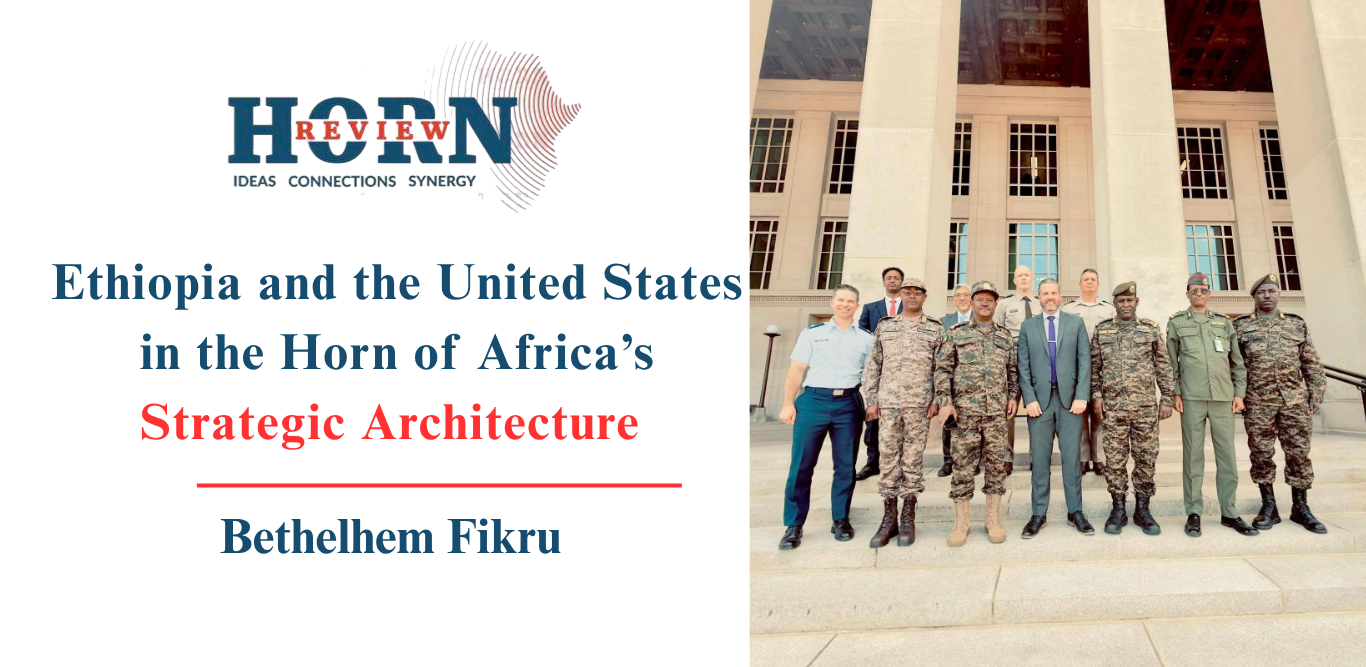
Subsequent military engagement has tested and reinforced these pathways. The visit of the AFRICOM commander in late July, including the co-hosting of a major logistics and communications symposium with the Ethiopian National Defense Force and high-level discussions with Ethiopian civilian and military leadership, demonstrated operational recognition of Ethiopia’s capacity as a regional security actor. The August consultations at the Pentagon between senior Ethiopian defense officials and their American counterparts further elevated the relationship, producing agreement to expand institutional cooperation, strengthen strategic coordination, and pursue a more comprehensive partnership oriented toward mutual interests and regional stability. These interactions reveal a preference for embedding cooperation within professional military and defense-diplomatic networks rather than relying solely on episodic political summitry. The result is a gradual consolidation of decision-making nodes that can sustain coordination even when political attention fluctuates.
Political signaling has complemented institutional rebuilding. The imposition of targeted visa restrictions on hardline elements associated with the Tigray People’s Liberation Front and their immediate family members, undertaken in response to actions assessed as undermining the Pretoria framework and risking renewed conflict, constituted a calibrated measure of alignment. By distinguishing between actors committed to the preservation of regional order and those whose conduct threatened to reopen conflict, the United States reinforced the position of the Ethiopian federal system as the primary interlocutor on matters of peace and security. The measure functioned less as punitive isolation than as a clarifying signal within the broader policy ecosystem, reducing ambiguity about American priorities and thereby strengthening the incentives for institutional cooperation.
Bethelhem Fikru, Researcher, Horn Review