

Egypt foreign minister, Board of Peace envoy discuss Gaza security, regional stability
Rania Abushamala
24 June 2026•Update: 24 June 2026
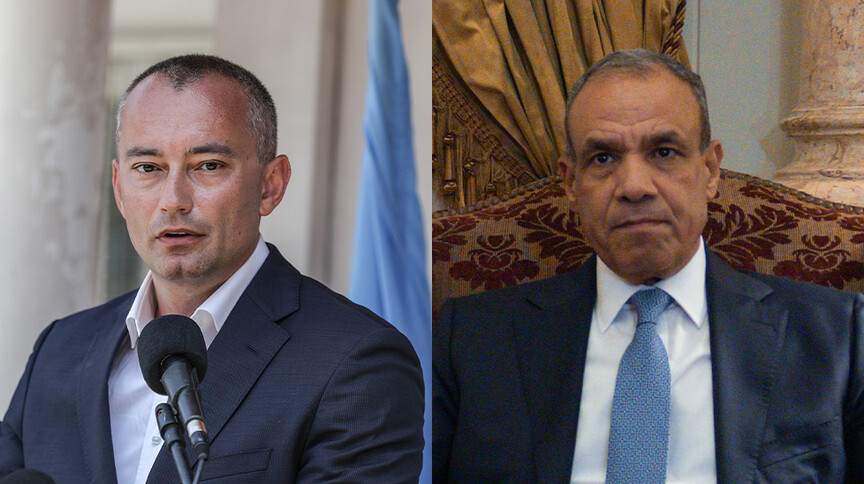
Egyptian Foreign Minister Badr Abdelatty held talks in Cairo on Wednesday with the Board of Peace’s lead envoy for Gaza, Nikolay Mladenov, to discuss developments in the Palestinian enclave and efforts to enhance security and stability in the region.
A Foreign Ministry statement said discussions focused on completing the remaining commitments of the first phase of US President Donald Trump’s plan for Gaza, including the start of work by a national committee tasked with administering Gaza from inside the enclave, the deployment of an international stabilization force, and the delivery of humanitarian, medical and relief aid.
The Egyptian minister said these measures “would help consolidate calm, enhance security, and create a suitable environment for early recovery and reconstruction efforts.”
Mladenov, for his part, praised Egypt’s “pivotal role” in supporting stabilization efforts in Gaza and its continued efforts to bridge differences among various parties and improve humanitarian conditions.
In September 2025, Trump announced a 20-point plan outlining a ceasefire framework that included the release of all Israeli captives in exchange for Palestinian prisoners, Israel’s withdrawal from Gaza, the formation of a technocratic administration, and the deployment of an international stabilization force, along with a call for Hamas to disarm.
The first phase of the agreement included a truce and prisoner exchange between Israel and Palestinian factions, a permanent ceasefire, as well as a gradual Israeli withdrawal from the enclave. Israel, however, has continued to violate the agreement on a near-daily basis.
Under the second phase, Israel is expected to carry out further withdrawals from the territory, while an international stabilization force would assume security responsibilities, including facilitating the delivery of humanitarian aid and reconstruction materials.
Israel’s genocidal war in Gaza since October 2023 has killed over 73,000 Palestinians and injured more than 173,000, most of them women and children, according to Palestinian figures.
Credit: Source link