

Egypt complained about Rosatom’s nuclear work. Now it wants two more reactors
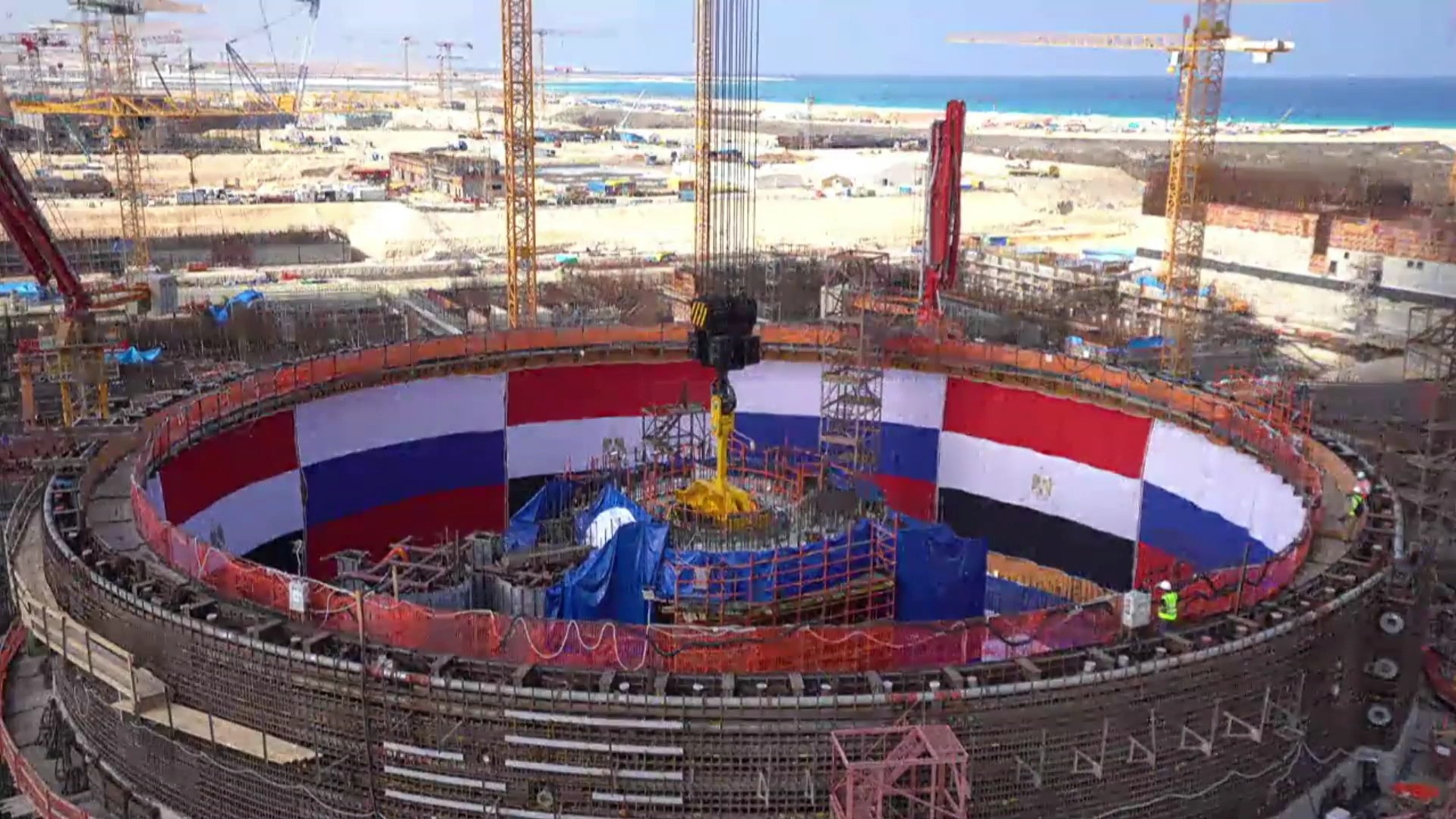
Just days after Egyptian nuclear authorities reportedly accused Rosatom of construction defects, poor management and violations of “nuclear safety culture” at the El Dabaa nuclear power plant, Cairo is considering an unusual response: buying two more Russian reactors.
Egyptian Electricity Minister Mahmoud Esmat met Rosatom chief Alexei Likhachev in Russia this week to discuss progress at El Dabaa, a four-reactor nuclear station under construction on Egypt’s Mediterranean coast. The talks also covered a second phase that could add two more VVER-1200 reactors.
That would expand the plant from 4.8 to 7.2 gigawatts and deepen a nuclear relationship with Moscow that would likely to last decades.
The timing is curious. Earlier this month, POLITICO reported that a confidential June 4 letter from Egypt’s Nuclear Power Plants Authority to Rosatom detailed a series of construction and management problems at El Dabaa.
According to the report, Egyptian officials cited defects in foundation slabs at reactor Units 1, 2 and 3, voids behind metal cladding at Unit 4 and problems with the cylindrical wall of its reactor building. The letter also reportedly accused Rosatom personnel of “deliberate negligence” and violations of nuclear safety culture, including shortcomings in workplace safety and site security.
Separate internal Rosatom documents obtained by POLITICO pointed to construction-quality and management problems of their own. One assessment reportedly warned that completion of El Dabaa’s first reactor could slip by as much as 18 months, from September 2028 to March 2030.
Cairo pushes back
Egyptian authorities have strongly rejected suggestions that the disclosures show El Dabaa is unsafe.
The Nuclear Power Plants Authority called POLITICO’s report “inaccurate and unbalanced” saying that construction non-conformities are routinely identified and corrected during a project of El Dabaa’s scale. Egypt’s nuclear regulator likewise said the plant is being built according to internationally recognized nuclear safety and security standards and stressed that construction remains under continuous inspection.
Egyptian officials have also pointed to an International Atomic Energy Agency review mission in June, which concluded that Egypt has a comprehensive regulatory framework for nuclear and radiation safety, while also recommending further improvements to legislation, licensing and radioactive-waste policy.
However, it’s important to bear in mind that the El Dabaa site is still under construction. El Dabaa and contains no nuclear fuel. The reported defects thus do not constitute a radiological hazard—nor does the purported existence of construction problems necessarily demonstrate that the finished reactors will be unsafe.
But the source of the complaints makes them hard to dismiss. If authentic, the June letter reported by POLITICO did not come from an environmental organization or a Russian nuclear critic. It came from within the Egyptian state authority overseeing the project.
“There is no question that shortcomings and defects arise during construction. Normally, these problems are resolved between the customer and the contractor,” said Alexander Nikitin, a nuclear expert with Bellona. “What is unusual in this case is that complaints about shortcomings and defects have spilled into public discussion. That may indicate that the customer and the contractor were unable to resolve these problems between themselves.”
Dmitry Gorchakov, another of Bellona’s nuclear experts, said that what’s important about the leaked complaints is that they are addressed.
“It is difficult to speculate about how or why this correspondence reached journalists. It could have been a deliberate leak intended to achieve certain political goals, or it could simply have been accidental: the project is enormous, and breaches of confidentiality can occur as well,” he said. “Of course, the existence of these problems is cause for concern — although we are not yet talking about radiological risks. But it would be considerably more worrying if the problems were not corrected, or if their existence were simply denied altogether.”
Rosatom offers more than reactors
Whatever tensions exist behind the scenes, they do not appear to be weakening Egypt’s commitment to Russian nuclear technology. Likhachev said this week that talks are underway on El Dabaa Units 5 and 6, including how the additional reactors might be financed.
Cairo is also discussing possible cooperation with Rosatom on small modular reactors for industrial facilities, remote regions and other applications.
That apparent contradiction points to one of Rosatom’s greatest advantages abroad: it sells much more than just the nuclear reactors.
Under the existing El Dabaa agreements, Russia is financing much of the project while Rosatom companies are building the plant, supplying nuclear fuel for its operating lifetime, helping train Egyptian personnel, assisting with operation and maintenance during its first decade and providing equipment for storing spent nuclear fuel.
That creates a relationship that can continue long after construction crews leave the site, and those long relationships are exactly the point, Bellona’s experts explained.
“When you sign contracts covering everything on the list, you become deeply dependent on the supplier—and getting out of that relationship is extremely expensive,” as countries like Ukraine and Finland have found, Nikitin said.
Gorchakov explained that this model is attractive for customers that are new to nuclear power, or that aren’t in a position to finance the entire project themselves—and who don’t particularly care about the political consequences of cozying up to Rosatom.
“The trade-off is political and technological dependence,“ he said. “Good relations with Russia and attractive financing terms may simply outweigh considerations of independence.”
For Moscow, those ties have only become more valuable since the invasion of Ukraine. While sanctions have pushed Russia out of many Western markets, Rosatom continues to build reactors abroad and preserve technological, commercial and political relationships that can stretch across generations.
The controversy at El Dabaa has thus attracted attention far beyond Egypt. Ukraine cited the reported problems in a renewed call for European Union sanctions against Rosatom, with Foreign Minister Andrii Sybiha arguing that the allegations provided further evidence that the Russian nuclear corporation was not a reliable international partner.
The allegations also resonate inside the EU. Rosatom is building two VVER-1200 reactors at Hungary’s Paks II nuclear plant—the same reactor model under construction at El Dabaa.
“The concerns are understandable,” said Gorchakov. “At the same time, in Hungary— especially following the change of government—the customer and its regulators are far more experienced, rigorous and demanding than their counterparts in Egypt, as are the EU institutions overseeing the project. That is evident from the lengthy delays and the difficulties involved in securing the necessary approvals. In Egypt, things have been much quieter, and this leak is essentially the first major ‘scandal’ associated with the project.”
Credit: Source link