

Economic D-Day is squeezing Iran, but victory requires more than sanctions
NEWYou can now listen to Fox News articles!
I lived in Europe for years, studying World War II not only in books but on the ground, walking battlefields and cemeteries and listening to veterans who had fought their way across the continent.
For America and our European allies, D-Day was an all-in fight. Survival was at stake. There was no ambiguity about the enemy or the objective.
So, when Treasury Secretary Scott Bessent called his new maximum-pressure campaign against Iran an “Economic D-Day,” a term he used this week, one question immediately came to mind:
Where is V-E Day?
The real D-Day came on June 6, 1944. Nazi Germany did not surrender until May 8, 1945. That was eleven months later.
D-Day was not victory. It began the final campaign toward victory.
Americans from the 1st U.S. Infantry land on Omaha Beach during the D-Day invasion on June 6, 1944. Omaha Beach was the most difficult of the Normandy landing sites, with 2,400 soldiers killed in the first wave. (Getty Images)
Bessent deserves credit for launching something much more ambitious than another sanctions package. The administration calls it Operation Economic Outcast: an effort to sever Iran’s remaining economic lifelines in shipping, aviation, technology, gold and digital assets, with secondary sanctions threatened against foreign enablers. About 60 individuals, entities and vessels were targeted in the opening round.
TRUMP THREATENS ‘UNPRECEDENTED’ ECONOMIC CONSEQUENCES FOR ANY NATION AIDING IRAN
And there is an important difference from President Donald Trump’s first-term “maximum pressure” campaign: the U.S. Navy.
Previous sanctions made Iranian oil hard to finance, insure and sell. Today, unlike the first-term campaign, the administration is pairing financial pressure with what AP reports is a Navy-enforced blockade of Iranian ports.
The administration hopes to deepen a decline already evident in Iranian oil shipments to China. Iranian oil shipments to China fell to about 534,000 barrels a day in August, down from 823,000 in July and from a 2026 peak of roughly 1.58 million. Chinese refiners are scrambling for alternative supplies.
Iran is hurting badly.
TRUMP BETS ECONOMIC PRESSURE CAN SQUEEZE IRAN AS REGIME’S OWN FAILURES DEEPEN THE PAIN
Its currency has been battered and its infrastructure has been damaged. Iran’s own Statistical Centre reports annual inflation reached 88% in July, with food prices up 128% from a year earlier. The regime worries that additional hardship could trigger renewed domestic unrest.
All of this proves Bessent can make Iran poorer. It does not prove he can make Iran surrender.
History demonstrates the difference.
Treasury Secretary Jack Lew testified that the sanctions preceding the 2015 nuclear agreement cost Iran more than $160 billion in oil revenue after 2012, with exports down 60% and the rial down by half.
COULD IRAN’S REGIME COLLAPSE? EXPERTS ASSESS BESSENT’S BID TO SEVER FINANCIAL LIFELINES
But sanctions did not produce Iranian capitulation. They brought Tehran to the negotiating table. Iran retained uranium enrichment while accepting restrictions and inspections in exchange for sanctions relief.
What does victory over Iran mean? How long will it take? What price are we prepared to pay? And what happens if Tehran simply refuses to surrender?
Trump tried differently after withdrawing from the nuclear agreement in 2018. His first maximum-pressure campaign again inflicted enormous damage, yet Iran never accepted Washington’s broader demands on nuclear activities, missiles and regional behavior before he left office.
FOX NEWS POLL: VOTERS OPPOSE THE IRAN WAR, SEE PROLONGED COMMITMENT
Outcomes are what matters. Government studies of sanctions have repeatedly found it easier to measure economic punishment than to demonstrate that the punishment produced the desired foreign-policy outcome. GAO also found sanctions work better when they are multilateral and when the target depends on the countries imposing them.
Treasury can count barrels Iran cannot sell, dollars Tehran cannot collect, and banks it can no longer use.
Those numbers tell us how much Iran is hurting.
They do not tell us whether Iran is surrendering.
There is also something unusual about the regime Bessent is trying to coerce.
Ordinary Iranians certainly do not welcome economic misery. They have repeatedly protested inflation, unemployment and declining living standards.
But the Islamic Republic’s revolutionary leadership has spent nearly five decades building political legitimacy around resistance to foreign pressure, sacrifice and self-reliance. The regime’s so-called “resistance economy” was built to help Iran endure sanctions, not capitulate to end them.
Economic coercion assumes the target eventually concludes that continued suffering is worse than concession. Iran’s revolutionary rulers have spent nearly half a century teaching themselves that concession to America can be worse than suffering.
Then there is China.
Beijing purchases more than 80% of Iran’s shipped oil and has already rejected Washington’s new sanctions strategy.
Iranian crude has survived previous sanctions through Chinese independent refiners, shadow tankers, disguised cargo origins and transactions conducted in Chinese currency.
Yet the administration initially spared major Chinese banks, reportedly to avoid disrupting the global financial system, as Trump and Xi Jinping prepare to meet.
Washington sanctioned a smaller Chinese bank once before, cutting off Bank of Kunlun in 2012 for handling Iranian banks’ money. Threatening a systemically important state bank is a different order of confrontation.
How can maximum pressure on Iran be maximum if Washington is unwilling to impose maximum pressure on Iran’s largest economic lifeline?
China does not have to restore normal Iranian commerce. It only has to permit enough oil purchases, financial transactions and sanctions evasion to keep Tehran breathing.
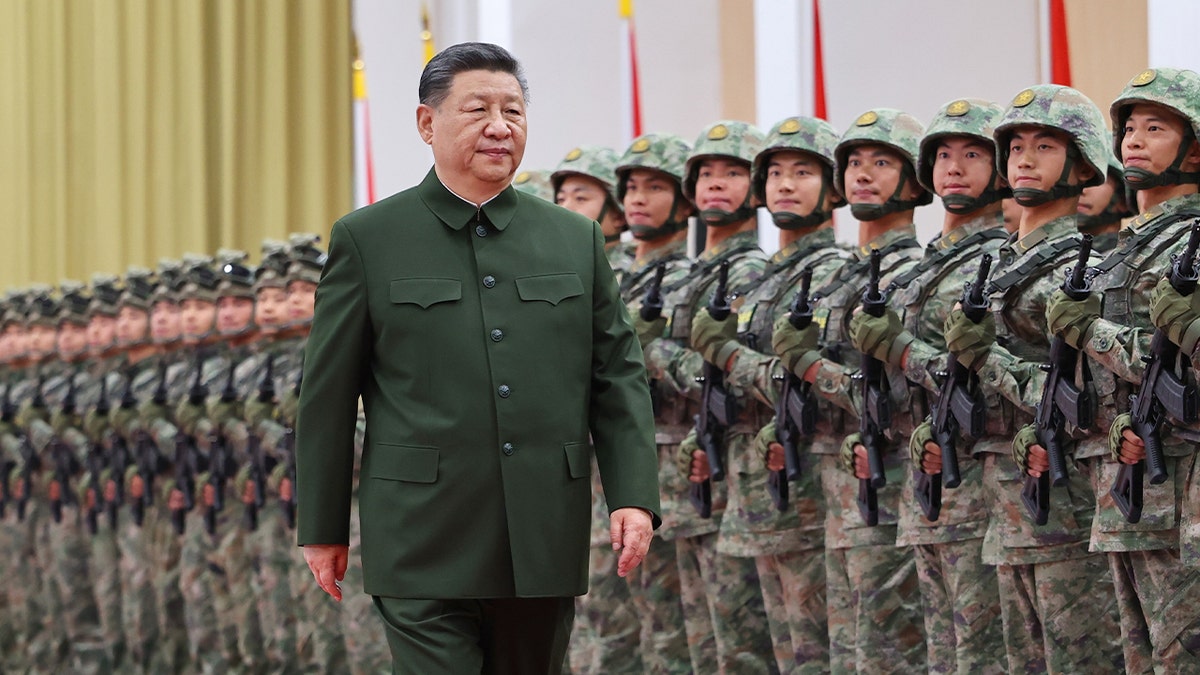
Chinese President Xi Jinping, also general secretary of the Communist Party of China Central Committee and chairman of the Central Military Commission, reviews the troops during his inspection of the Chinese People’s Liberation Army PLA garrison stationed in the Macao Special Administrative Region, south China, Dec. 20, 2024. (Li Gang/Xinhua via Getty Images)
Its strategy can be brutally simple: absorb the contraction, repress unrest, keep commerce flowing through China, and keep Hormuz dangerous enough that Americans share the pain.
Iran doesn’t need to outfight Trump. It needs to outlast him. That turns Bessent’s Economic D-Day into an endurance contest, and endurance depends on the costs borne by both sides.
And America is paying.
The Iran war has already depleted scarce Patriot and THAAD missile interceptors, with a CSIS analysis estimating reductions of 65% and 38%, respectively. Those are munitions we may need in a conflict with China, the same conflict that already forced the Japan-homeported USS George Washington to divert to the Middle East, relieving the USS Abraham Lincoln after a deployment beyond 250 days.
The political cost is rising too. A new Reuters/Ipsos poll finds only 31% of Americans support the Iran war, while 83% believe it will last a long time. Washington also has less room to cushion another energy shock: the Strategic Petroleum Reserve has fallen to roughly 290 million barrels, its lowest level since November 1982, after repeated emergency releases. If Hormuz deteriorates further, that safety net is much thinner.
Iran’s leaders can read an election calendar.
The contest, therefore, is not simply whether Bessent can bankrupt Iran. It is whether Iran’s economy breaks before America’s political patience does.
Secretary Bessent may indeed have launched an impressive Economic D-Day.
But D-Day was never the objective.
Victory was.
The Allies knew what victory meant on June 6, 1944: allies committed to the campaign, a strategy for reaching Germany, and an unmistakable end state.
CLICK HERE FOR MORE FOX NEWS OPINION
Before committing to this costly war’s next phase against an adversary that has spent 47 years learning to endure American pressure, the administration owes Americans basic answers.
What does victory over Iran mean? How long will it take? What price are we prepared to pay? And what happens if Tehran simply refuses to surrender?
CLICK HERE TO DOWNLOAD THE FOX NEWS APP
If Economic D-Day cannot answer those questions, America may not have found a way out of another forever war.
It may simply have found another way to fight one.
CLICK HERE TO READ MORE FROM ROBERT MAGINNIS