

DRC: How disinformation worsens Ebola epidemic
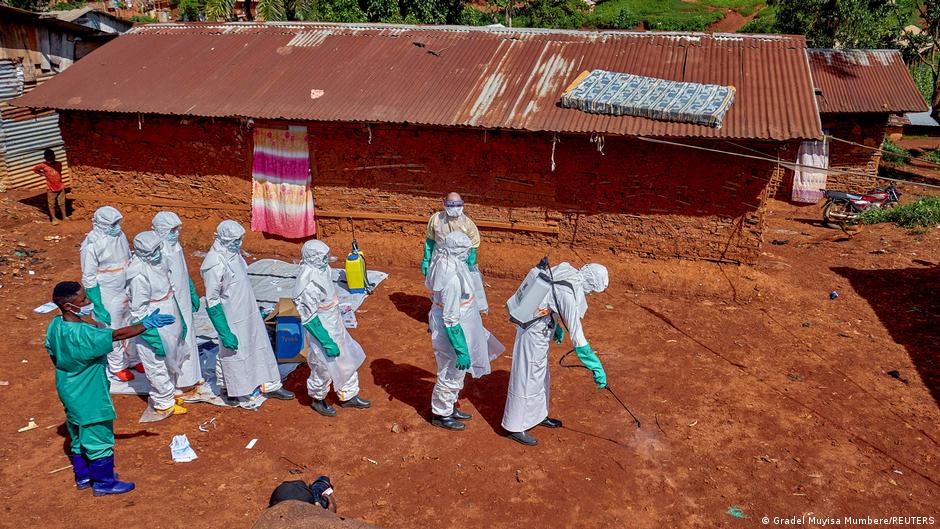
Three weeks since the current Ebola epidemic in the Democratic Republic of Congo was announced, the facts are: 397 confirmed cases, including 63 confirmed deaths, according to the latest figures reported by the African Union’s Africa Centres for Disease Control and Prevention (Africa CDC).
And yet: “The community does not believe in this disease. Despite the deaths, people don’t believe in it,” said John Tumujimbe, head of a team for dignified and safe burials in the small town of Mongbwalu. It’s one of the epicenters of the Ebola epidemic in the Congo’s north-eastern Ituri province.
“We initially thought of malaria, typhoid or diarrheal diseases. But after so many deaths, we sent samples to the INRB,” Tumujimbe told DW.
The INRB — the DRC’s National Institute for Biomedical Research — confirmed that these were indeed cases of Ebola. This led health officials to announce the 17th Ebola epidemic to be recorded in the DRC since the virus was discovered in 1976.
Ebola rumors lead to arson attacks in DRC
Health officials say many residents in Mongbwalu rejected this scientific answer.
“When there were the first deaths, there was talk that the coffins were a problem, that it spread from there,” said one Mongbwalu resident, who did not want to be named.
Tumujimbe also heard this. “That’s how it started: people talked about a coffin that kills people. And then more people died.”
Another rumor: Aid workers and paramedics were spreading the virus via the antennas of their vehicles.
At the end of May, an angry crowd gathered at the general hospital of Mongbwalu. They demanded the bodies of their deceased, eventually setting fire to a tent belonging to the aid organization Doctors Without Borders (MSF). The organization had to withdraw its staff.
“There was a panic,” hospital director Richard Lokudi told DW. “This allowed several suspected cases to escape. 18 patients who were under observation have disappeared.”
The health workers worry suspected Ebola patients could have passed the disease on to the people who were sheltering them. There is still no vaccine for the Bundibugyo variant of the Ebola virus now circulating.
Familiar rumors blunt Ebola response
Christopher Nehring specializes in researching disinformation, and co-authored a report on the current Ebola epidemic for the Konrad Adenauer Foundation (KAS).
He says similar rumors pop up in every health emergency.
“They say the disease comes from the lab as a bioweapon; that the vaccination is more harmful than the virus; that there is a simple cure that is being concealed; that the disease is not real. Big Pharma is mentioned either as the profiteer of the crisis or as the ones who originated it,” Nehring told DW.
“It’s all been known for decades. And it varies, there are 100 different variations of these narratives.”
For the report, Nehring sought information from Congolese fact-checkers. One of them is Ange Kasongo, founder of Balobaki Check, based in the capital Kinshasa. Talking to DW, she recalled conversations she had with miners — gold mining is important for the economy in the province of Ituri.
“They said that the rumors and myths about death were circulating, but that the people there didn’t believe them,” Kasongo said.
The explanation she was given went: “If a trader wants to earn or mine a lot of gold, he may also resort to mystical acts to eliminate his competitors.”
This suggests that economic pressure is also preventing the epidemic from being dealt with openly.
Another rumor Kasongo highlights: Private messages were circulated on WhatsApp claiming there was a conspiracy between Congo’s President Felix Tshisekedi and renowned virologist Jean-Jacques Muyembe — who discovered the virus 50 years ago — to wipe out the population of the eastern DRC.
The Balobaki Check team was unable to find any supporting evidence of this claim.
Without reliable media, disinformation spreads easily
The global community is making significantly less money available for emergency aid measures, which makes fighting Ebola harder.
United States leader Donald Trump withdrew the US from the World Health Organization (WHO) in 2025, and ordered massive cuts to USAID and the crisis management program CDC.
European governments have also cut funding, partly due to the cost of militarization efforts in the wake of the war in Ukraine.
For Nehring, this situation also encourages the spread of fake news. “If the money for health aid has already been cut, then you can’t talk about bigger budgets for health communication either,” said Nehring.
Nevertheless, Ange Kasongo pointed out the authorities were making every effort to communicate clearly. But she also told DW this had limits: “How can we ensure that information is passed on orally — not just in French, not just in the four national languages?”
According to her, it is important to get community leaders on board and give them access to reliable information.
Rachidi Kudra contributed reporting
This article first appeared in German
Credit: Source link