

Dongshin University-KEPCO KDN Consortium Selected for KOICA’s Main ODA Project in Senegal
Building Renewable Energy-Independent Villages in Rural Areas
A Catalyst for Global Expansion of Naju-Based Businesses
The consortium of Dongshin University and KEPCO KDN announced on September 3 that it has been finally selected for the main ODA project in Senegal for 2026 by KOICA (Korea International Cooperation Agency).
The two organizations will launch a full-scale effort to promote energy independence and increase income in rural villages in Senegal through a USD 5 million project titled “Capacity Building for Energy Independence in Rural Development in Senegal.”
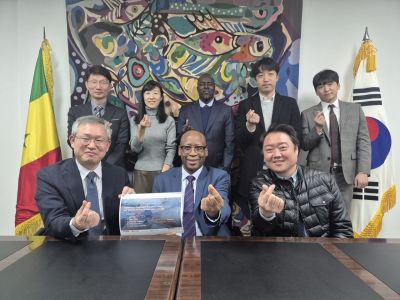
On November 18, 2025, the Embassy of Senegal in Korea held a meeting with the ambassador, counselor, Jeollanam-do international affairs ambassador, Dongshin University professor Dong Hwi Lee, and officials from Korea Electric Power Data Network to discuss the ODA project. Provided by Dongshin University
This project is significant in that it upgrades the achievements of last year’s “Creation of Renewable Energy-Based Energy-Independent Villages in Senegal” initiative promoted by Dongshin University, KEPCO KDN, and others.
Last year, Dongshin University, together with KEPCO KDN, Jeollanam-do, Jeonnam Technopark, and local businesses, won a KOICA ODA QDEEP competition. Leveraging the “Daesil Energy Prosumer Living Lab” model established in Daesil Village, Bonghwang-myeon, Naju, Dongshin University led a project to build renewable energy-based independent villages in rural Senegal. The Energy Prosumer Living Lab is an energy independence model in which residents go beyond being mere consumers and directly produce and utilize renewable energy.
This year’s main ODA project goes a step further.
Whereas last year the model was to “export Korea’s energy regional innovation model to Africa,” this year it has evolved into an Energy-Water-Agriculture Nexus, transforming residents’ lives and income by integrating these sectors.
The goal is to create a virtuous cycle of “energy independence → increased agricultural productivity → higher incomes → local sustainability” by efficiently utilizing power generated from renewable energy for water supply and agriculture, which in turn boosts agricultural productivity and resident income.
Through this project, Dongshin University aims to establish a sustainable, industry-academia-research-led global ODA model by combining KEPCO KDN’s energy and ICT expertise, the university’s capabilities in education, research, and industry-academic cooperation, and Dakar University’s local education and research foundation.
In particular, the project will not merely focus on building facilities, but will also foster local professionals through education, establish the technology base for the local community to manufacture and repair equipment, and provide opportunities for local demonstration of technologies from Korean regional businesses — thus greatly expanding the scope towards “self-sufficient ODA” and paving the way for entry into African markets.
To this end, various departments at Dongshin University, including the Anchor Project Group and the Makerspace Project Group, will consolidate their capabilities. Dongshin University’s Anchor Project Center (headed by Professor Donghee Lee) will jointly develop an educational curriculum with Dakar University and invite local officials to Korea for training programs.
The plan is to nurture professionals who can independently operate and manage facilities and projects in Senegal even after the project ends, by offering practical training in renewable energy, energy independence, energy-water-agriculture convergence, facility operation, and maintenance.
Training programs will also be organized, inviting Senegalese officials and experts to Korea so that they can experience the technologies and operational cases of Dongshin University, KEPCO KDN, other public energy institutions in Bitgaram Innovation City, and regional energy companies.
The Makerspace Project Group of Dongshin University (also headed by Professor Donghee Lee) is responsible for establishing a local technology independence base in Senegal. The group will provide education and technical support so that local residents and youth can directly manufacture, maintain, and repair energy and agricultural equipment, fostering the local makerspace as a hub for talent development, startups, and commercialization. The plan is to build a self-reliant tech ecosystem where necessary technologies and equipment are “learned, made, repaired, and commercialized” locally instead of relying on ongoing external support.
Another core aspect of this project is linking international development cooperation to the global advancement of businesses based in Naju. Dongshin University will utilize its industry-academia cooperation network to identify outstanding technologies and products from energy, ICT, and agriculture-related companies in Naju and Jeollanam-do, offering opportunities for local demonstrations and involvement in projects in Senegal.
The local Senegalese project sites will serve as a “global test bed” for verifying the technological capabilities of regional firms, with the resulting track records used as global references for entry into African markets.
Hot Picks Today

Donghee Lee, Professor of Artificial Intelligence Security at Dongshin University and head of both the Makerspace Project Group and the Anchor Project Center, stated, “If last year we opened up possibilities for exporting the Naju Daesil Village energy independence model to Senegal, this year we have taken it to a new level as a sustainable rural development model that integrates energy, water, agriculture, local talent training, and technological autonomy.”
This content was produced with the assistance of AI translation services.
© The Asia Business Daily. All rights reserved. Unauthorized AI training and use prohibited.
Credit: Source link