

Cuba’s reforms: defending socialist revolution under siege – Revolutionary Communist Group
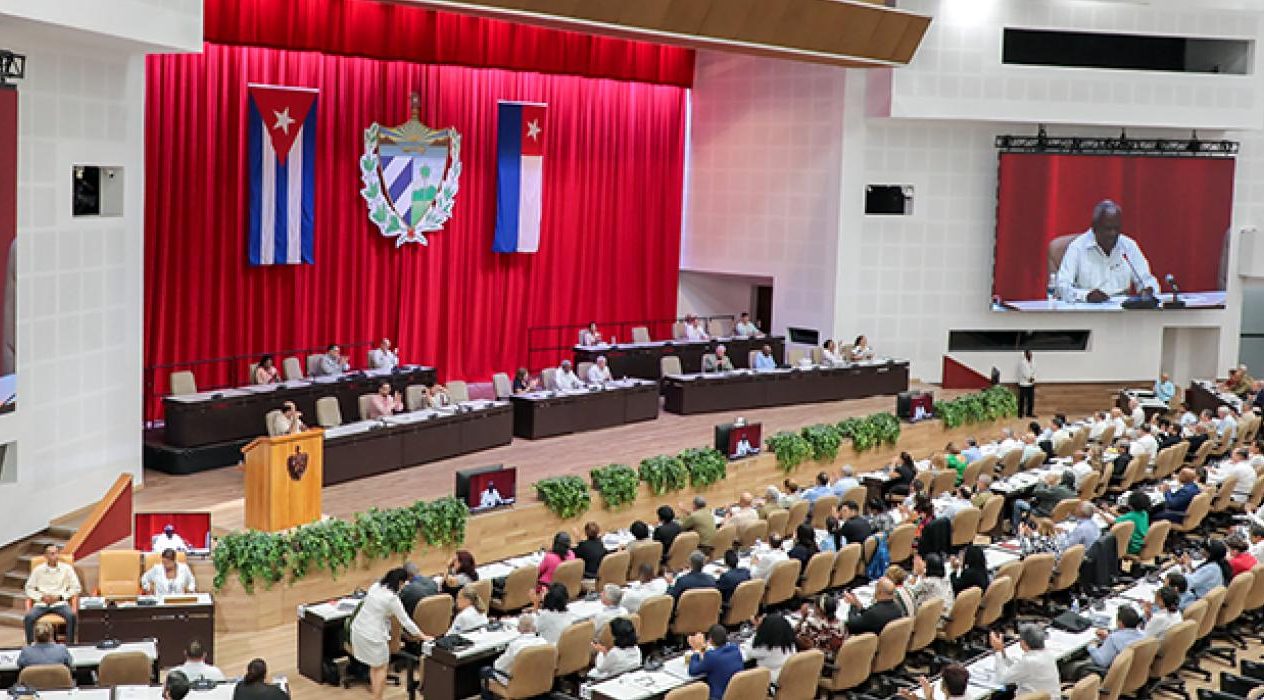
The genocidal US blockade of Cuba has forced the socialist state into its deepest economic crisis since the Special Period, which followed the collapse of the socialist bloc in 1989-91. In response to this situation, the Cuban parliament has approved the country’s most drastic economic reforms in decades. DESTINIE SÁNCHEZ reports.
Cuba’s economy has contracted by more than 15% since 2020, and the UN Economic Commission for Latin America and the Caribbean forecasts a further 6.5% contraction in 2026, making Cuba the worst-performing economy in Latin America for the second year in a row. The Cuban state reported that GDP fell by 1.9% in 2023, while consumer prices rose by 24.88% last year.
The consequences are felt in every aspect of daily life. Power cuts in some parts of the island exceed 30 hours at a time, fuel shortages cripple electricity generation, forcing repeated shutdowns of industry, transport and schools. Food, medicines and transport remain in chronically short supply, while industrial production and agriculture continue to struggle due to a lack of fuel, spare parts and imported production inputs. Conditions have reached such severity that UN High Commissioner for Human Rights Volker Turk warned earlier this year that ‘children are dying’ because hospitals do not have access to basic medical supplies. The severe scarcity affecting Cuba’s world-class medical system was reiterated at an international meeting of the Cuban United Nations Association in May and reaffirmed by Elizabeth Ribalta of ICAP during her recent speaking tour in Britain.
The genocidal blockade
These worsening conditions are the consequences of more than six decades of unilateral coercive measures against socialist Cuba which have been intensified since US President Donald Trump’s return to office in January 2025. This 66-year economic blockade has now been reinforced by an oil blockade and total siege, designed to strangle Cuba’s energy supplies. Following the US bombing of Venezuela and kidnapping of the country’s President Nicolas Maduro and First Combatant Celia Flores in January 2026, Venezuelan oil exports (which had previously supplied around half of Cuba’s fuel) were effectively cut off. Earlier this year, the US announced additional punitive tariffs against any country exporting oil to Cuba, sanctioned the island’s national oil company (CUPET) and other major state enterprises and tightened financial restrictions to cut Cuba off from international banking, remittances and tourism revenue. At the same time, the US has maintained Cuba’s fraudulent designation as a so-called State Sponsor of Terrorism, intensified attacks on Cuba’s international medical missions and imposed sanctions on revolutionary leaders including 95-year-old Raúl Castro, and on mass organisations like the Cuban Institute of Friendship with the Peoples (ICAP). Together, these measures have deliberately deepened shortages and strangled the Cuban economy, a collective punishment of the Cuban people in a concerted effort to force the overthrow of the revolution.
It is under these conditions that, on 19 June 2026, Cuba’s National Assembly of People’s Power (ANPP) unanimously approved the most extensive package of economic and social reforms since the approval of the Guidelines for the Economic and Social Policy of the Party and the Revolution in 2011. These reforms expand market mechanisms in the economy, permit new forms of private ownership of enterprises, and expand the role of private companies, including foreign companies, among other measures discussed below.
Sections of the British left have quickly seized on the reforms as ‘evidence’ that Cuba is abandoning socialism, deliberately ignoring the material conditions that have made the reforms necessary. The reforms undoubtedly involve important concessions to market mechanisms and carry real contradictions. But they cannot be considered outside the concrete conditions that have made them necessary. They are the response of a revolutionary state attempting to preserve socialist planning, universal healthcare, education and national sovereignty while confronting the most severe phase of US imperialist aggression in decades.
A necessary step back
For revolutionaries, these reforms require a serious assessment. They represent a retreat from previous forms of socialist economic organisation: expanding the role of market mechanisms, increasing space for private accumulation, decentralising enterprise management and opening further areas to foreign investment. These measures carry real potential dangers, including increasing inequality, the strengthening of capitalist relations and the emergence of social groups whose interests may come into contradiction with socialist development. These inequalities are not new in Cuba: the growth of the black market in the tourism sector and the introduction of micro, small and medium enterprises (MSMEs) in 2021 have already contributed to rising inequality.
However, these reforms are not a voluntary abandonment of socialism or an ideological capitulation to capitalism, as the Socialist Workers Party, Revolutionary Communist Party or Spartacist League claim. They are emergency measures necessitated by material conditions that US imperialism has created and represent a sovereign decision of the Cuban national parliament in line with the Constitution. They do not follow any US-imposed formula or set of demands. Cuban socialism has been forced to make economic adjustments to preserve the fundamental achievements of the revolution.
The reforms were announced at the Third Extraordinary Session of the ANPP, where Prime Minister Manuel Marrero Cruz presented them as a necessary response to the country’s economic emergency. Fidel Castro addressed this same contradiction during the Special Period following the collapse of the Soviet Union, explaining that revolutionary governments sometimes have to introduce measures that would not have been chosen under different circumstances warning, ‘Life, reality, the dramatic situation that the world is experiencing, this unipolar world, forces us to do what otherwise we would never have done if we had had capital and if we had had the technology to do it.’
This reflects a broader Marxist understanding of revolutionary transition, in contrast to the idealism of British left opportunists. Lenin’s introduction of the New Economic Policy after the Russian Civil War similarly involved temporary concessions to market relations and private economic activity in order to rebuild productive forces and defend the state. Again, this was not a return to capitalism, but a tactical retreat under hostile conditions.
The Cuban reforms must be understood in the context in which they take place: not as a rejection of socialism, but as an attempt to preserve socialism under conditions where imperialist aggression has strangled almost all the economic channels which supply the material foundations on which the revolution depends.
2011 to today
The current measures are part of a longer process of economic adjustment that began with Raúl Castro’s leadership and the 2011 Economic and Social Policy Guidelines. Their central political aim was to preserve socialism by making the economy more efficient, productive and resilient under blockade conditions. This included giving state enterprises more autonomy, expanding cooperatives and allowing limited private businesses to operate. Raúl Castro repeatedly argued that defending socialism required confronting economic realities rather than relying on administrative methods that no longer corresponded to existing conditions.
The introduction of the 2011 guidelines states the principle that:
‘only socialism is capable of overcoming the difficulties and preserving the conquests of the Revolution, and that in the updating of the economic model, planning will be supreme, not the market.’
Like those of today, the 2011 reforms were based on the recognition that socialism cannot survive without developing the productive forces.
Under the US Obama administration (2008-2016), there was a partial rapprochement between Cuba and the US, though all the key pillars of the blockade remained in place. Since then, the situation has rapidly worsened. Under Trump’s first US administration (2016-2020), 143 sanction measures were passed as part of US imperialism’s return to a ‘maximum pressure’ approach towards Cuba. This included the activation of Title III of the Helms-Burton Act, tighter restrictions on remittances and travel, sanctions on shipping and an almost total blockade on fuel deliveries, pressure on banks and third countries, and the use of Cuba’s designation as a State Sponsor of Terrorism to further isolate the island from international finance and trade.
The Covid-19 pandemic compounded the impact of these measures, devastating tourism which had become one of Cuba’s main sources of foreign currency, while the country continued to face restrictions on the purchase of essential goods, fuel and medical supplies.
Although the Biden administration (2020-2024) adopted a less confrontational tone, it left Trump’s new restrictions in place. Trump’s return in 2025, now with Marco Rubio as Secretary of State, has only re-ignited this hostility. Rubio, a leading advocate of regime change and a central figure in the anti-communist Miami exile lobby, signals a continuation of hardline policy at the highest level of the US state. The result has been a severe economic crisis in Cuba marked by shortages, inflation, energy problems and falling living standards. Cuba is responding not to natural economic failure, but to a genocidal campaign of economic warfare.
International solidarity?
This intensification of US economic warfare has not been matched by any coordinated international response to alleviate its impact. When the USSR and socialist bloc existed, Cuba had alternative trade partners and was shielded from the worst impacts of the blockade. Today China, Russia and other countries in the BRICS+ organisation (of which Cuba is a partner country) regularly condemn the blockade in diplomatic forums and maintain trade relations with Cuba, but they have not taken coordinated measures to neutralise the effects of US sanctions. They have chosen not to further jeopardise their economic ties with the US. There is no functioning alternative financial system that allows Cuba to operate outside US-controlled banking networks, nor are there any sustained mechanisms capable of replacing lost access to fuel, credit and hard currency on the scale required.
A similar contradiction is visible in Latin America. The 2026 US kidnapping of Maduro and extortion of Venezuela’s oil resources was the latest hammer blow to Cuba’s economic support from its neighbours. A wave of right-wing governments has assumed power in recent years. Left social-democratic governments such as Brazil, Mexico and Colombia have expressed political solidarity with Cuba and have provided occasional humanitarian assistance, including limited shipments of oil and material aid. However, none have been willing to sustain or escalate this support into a coordinated material challenge to the blockade, as the Bolivarian Alliance for the Peoples of Our America (ALBA) once did under the leadership of Venezuela and Cuba. Even where oil exports and logistical capacity make it feasible, assistance remains constrained by fear of US financial retaliation and secondary sanctions. Bowing to US pressure, in 2026 the governments of Jamaica and Guyana followed Honduras in terminating contracts for Cuban medical personnel early.
The result is a gap between rhetoric and practice. When confronted with the concrete question of defending the independence of countries under siege by US imperialism, ‘multipolarity’ doesn’t translate into collective economic action. Diplomatic opposition to the blockade becomes symbolic, not transformative.
This exposes a deeper structural reality: imperialism operates not only through US state policy but through its domination of global finance, trade routes and its broader institutional power. Without directly confronting these mechanisms, solidarity remains limited in effect.
As Raúl Castro stated at the Sixth Congress of the Communist Party of Cuba (2011):
‘Our brothers and sisters in the Third World, especially those from Latin America and the Caribbean, who are making great efforts to transform the legacy of centuries of colonial domination, should know that they can always count on our solidarity and support.’
Today, the reverse must also be true: the states that claim to oppose imperialism must stand with Cuba in practice, through material support, political defence and concrete action against the blockade. The contradiction is clear: Cuba continues to provide internationalist solidarity, while receiving little material backing in return.
Reforms and contradictions
In summary, the reforms approved by the ANPP in June seek to increase productive capacity through several mechanisms across several categories:
- management model of economic actors
- ownership relations
- economic planning system
- municipality autonomy
- energy
- agricultural recovery
- social security
- labour and wages
- modernisation of the banking and financial system
- pricing policy
- foreign investment and trade
- tourism
- transport
- digital transformations
They represent not an isolated set of technical adjustments, but an acceleration and deepening of a longer-term restructuring of the Cuban economic model that has been unfolding since the 2011 Guidelines.
Non-state actors
A central development is the expansion and normalisation of non-state economic actors, particularly micro, small and medium-sized enterprises (MSMEs), alongside the extension of cooperatives and private activity into wider areas of production and services. These entities are no longer treated as exceptional or temporary supplements, but as an integrated component of the economic structure with their ability to circumvent some blockade restrictions. They have become increasingly important in addressing shortages and providing goods and services where the state sector has struggled under blockade conditions.
Another significant change is the reform of Cuba’s foreign trade system. The previous state monopoly over foreign trade has been relaxed, allowing private companies and other non-state actors to directly import wholesale goods from foreign markets rather than relying exclusively on state intermediaries. This represents a major shift in the organisation of Cuba’s economy; the measure aims to overcome severe supply constraints by creating additional channels for obtaining goods, technology and productive inputs. But it also introduces new contradictions, since expanding access to international markets gives non-state actors greater influence over economic flows and resources that were previously more tightly controlled by the state.
These tensions are further reflected in the reforms’ extension of opportunities for private accumulation. The measures allow individuals to own multiple companies, facilitate access to foreign currency accounts and permit non-state actors to operate more freely in trade, services and investment. For example, private companies will now be able to employ more than 100 employees and individuals are allowed to participate as shareholders in multiple companies simultaneously. While this expands individuals’ capacity for capital accumulation, crucially, it is seen as a means to mobilise production, investment and foreign exchange that the state alone cannot currently generate under economic warfare. The strategic objective is to harness these resources to revive production and strengthen the socialist economy in order to protect the material foundations of the revolution. In his presentation at ANPP, the Prime Minister made it clear that, although these measures may generate new contradictions, emerging economic actors will remain subordinate to the political power of the state.
Transforming property relations?
Closely linked to this is a gradual transformation in property relations, which is unfolding alongside the continued reaffirmation of formal socialist ownership. The authorisation of shareholding in state enterprises by both domestic and foreign actors, the monetisation of state assets and the development of market-based valuation systems introduce new mechanisms through which elements of state property are partially commodified. These processes do not abolish state ownership, but they do alter its functioning, increasingly separating legal ownership from effective economic control.
There are evident contradictions and risks in this direction of travel. The expansion of MSMEs and private activity will tend to strengthen unequal access to resources, particularly foreign currency, remittances and import channels. This risks the consolidation of a differentiated social structure, where a minority of private operators and intermediaries are able to accumulate wealth at a rate inaccessible to wage-dependent workers in the state sector. Similarly, the decentralisation of pricing, wages and investment decisions weakens the coherence of central planning and increases reliance on market signals as a mechanism of allocation.
In addition, the decision to remove universal access to subsidised goods marks a significant shift in Cuba’s social policy. It effectively ends Cuba’s ‘libreta’ ration-book system. The reforms mark the removal of subsidies on economy-wide inputs such as fuel, electricity and passenger transport and water tariffs, passing ‘real costs’ through to wholesale and retail prices, followed by other consumer goods. Replacing universal subsidies with means-tested personal support introduces a potential rupture in the principle of universality that has historically underpinned Cuban social policy. This could create the danger that eligibility for state assistance becomes more explicitly conditional. This would, in turn, create new distinctions between those who qualify for targeted welfare and those who do not. However, to ensure the most vulnerable sections of society are sufficiently supported, the reforms include the introduction of a Social Protection Fund, which will be financed in part by the savings generated from subsidy removal. Díaz-Canel argued in the National Assembly that ‘true social justice cannot be sustained through artificial prices.’
Nonetheless, these changes will exist alongside continuities of socialist social organisation. Key sectors of the economy, including healthcare, education and strategic infrastructure, remain under state ownership as universally accessible public services.
Also, importantly, the reforms include measures that attempt to regulate and contain the very market forces they are expanding. The state retains control over strategic sectors and majority ownership in key enterprises, while new regulatory frameworks are introduced for MSMEs. It sets out the obligations of ‘all economic actors (state and private – national and foreign), as part of their social responsibility at the community level, in the areas of finance, material resources, and services’. The creation of the Social Protection Fund, the digitisation of welfare systems and the formal integration of private actors into obligations of social responsibility all indicate a conscious determination to prevent the uncontrolled emergence of a capitalist sector.
The regulation of remittance flows and foreign currency access is particularly significant. The reforms will ‘implement the figure of last-mile payment agent [private actors in Cuba who can receive international remittance transactions] to formalise remittance flows through a private channel’; and ‘resize the official exchange and remittance market, with the participation of non-state economic actors’. Remittances contribute to inequality through differential household access: those with family abroad can receive remittances to supplement their income compared to those without this opportunity. Their partial formalisation and banking regulation also allow the state to capture foreign exchange and integrate it into national planning mechanisms. Similarly, the inclusion of MSMEs within tax systems and state planning frameworks expresses a resolve to subordinate market actors to regulatory oversight rather than allow their autonomous expansion.
Accompanying agricultural reforms are designed to resolve long-standing problems in food production by expanding producers’ autonomy, increasing access to land and allowing greater participation in markets. Land remains socially owned, but the distinction between ownership and management is widened through expanded usufruct rights and cooperative autonomy.
The key contradiction, therefore, is not simply between socialism and capitalism, but between the necessity of introducing market mechanisms under conditions of scarcity and blockade and the political imperative to preserve the centrality of working-class state power.
How the reforms were developed
The reforms themselves emerged through the established mechanism of socialist democracy and state planning. To prepare the proposal, multiple levels of political and institutional input were taken into account, including the advice of Raúl Castro, agreements made at previous ANEC (National Association of Economists and Accountants of Cuba) Congress and contributions from leaders of the government. In total, 673 proposals were received, of which 79% were accepted, while the remainder were either assigned to the implementation phase or positively assessed without requiring immediate incorporation.
This process was reinforced through the ‘Mesa Redonda’ (roundtable) programme, which aired on TV, where government ministers presented, explained and defended the reforms, addressing public concern. These interventions functioned as part of a broader democratic practice of political accountability and mass education, in which policy is not only formulated collectively but discussed openly within a structured political space.
National Assembly debate
Across the parliamentary debate itself, a clear consensus emerged that the reforms do not represent a retreat from socialism, but a reconfiguration of how it is constructed under conditions of blockade and economic crisis. Support for the measures was grounded in the argument that strengthening the state enterprise system, improving efficiency, and integrating all economic actors into a coherent national development strategy are necessary to preserve the material foundations of socialist society. The reforms do not change the Cuban constitution, its participatory democracy, or the role of the mass organisations or the Party.
At the same time, the debate was not uncritical and set out the immediate priorities the reforms must tackle. Deputies explicitly raised concerns about inequality, opportunities for corruption, territorial unevenness and the risk that expanded market mechanisms could generate new forms of social stratification. This was accompanied by repeated calls to strengthen social protection systems. Deputy Danhiz Díaz Pereira argued that measures such as the social protection fund and comprehensive wage reform must be implemented as priorities in order to prevent the social costs of restructuring from falling disproportionately on the most vulnerable sections of Cuban society.
Deputy Carlos Miguel Pérez Reyes supported the reforms but stressed that socialism must be safeguarded through clear and strict definitions of the fundamental means of production, ensuring that core state assets are not gradually diluted, reclassified or opened up through vague or overly flexible interpretations.
Other deputies spoke of a ‘more Cuban-style socialism’ or incentivising payments based on the achievement of indicators and salary differentials that encourage, among other things, the pursuit of higher education and performance-based pay. Inevitably there will be those seeking to embrace market mechanisms and make further concessions to capitalism out of individual, not collective, interest. The role of the Communist Party is to struggle against such tendencies.
The debate therefore revealed both the opportunities and the risks of the measures, making it essential to follow their implementation closely and not to draw premature conclusions. As President Miguel Díaz-Canel stated, defending the reforms means ‘not only implementing them, but implementing them well and ensuring they produce results.’ Above all, the Cuban people remain steadfast in defending their sovereignty and socialism, determined to confront these challenges without surrendering the independence they have fought to maintain. Under conditions of total siege, these reforms are a necessary step to protect the gains of the revolution. The alternative is total collapse of the economy under the ruthless US blockade and imperialist economic warfare.
In summary, the new reforms represent a difficult compromise forced by extreme circumstances. They are an enforced step back from previous socialist economic arrangements: the expansion of market mechanisms, private enterprise and foreign capital creates dangers that the Communist Party of Cuba will not ignore. But socialism cannot be defended through abstract formulae detached from material reality; these measures have been decided on to safeguard the gains of the revolution.
As Miguel Díaz-Canel has argued, ‘we all talk about maintaining social justice, but the first thing we have to do is produce,’ because without production there can be no material basis for equality. The defence of socialism must therefore combine principle with realism: understanding that temporary concessions made under pressure are not betrayals, but part of a broader struggle whose outcome is still being determined.
We are not passive in this situation. Building international solidarity against the blockade is key to defending Cuba’s socialist system. This does not only mean material support for Cuba. Above all there must be political solidarity. Communists must not give ground to opportunists who use Cuba’s dire situation as an opportunity to further attack its revolution. Breaking Cuba out of its political isolation remains essential to creating a revolutionary movement for socialism in Britain.