

CubaBrief: Kleptocracy, Not Sanctions, Turned Out Cuba’s Lights
Cuba’s Grid Didn’t Collapse. Havana Let It Rot.
On September 7, 2026 CFC’s executive director was interviewed by NTD News about worsening public-health situation linked to the deterioration of basic infrastructure in the country. This CubaBrief provides more background information to the points he raised.
Many are trying to blame the ongoing collapse on U.S. sanctions tightened on Havana beginning in January 29, 2026.
In the interview John Suarez pointed out that the U.S. embargo is not the main cause of hardship in Cuba. Fidel Castro, while subsidized by the Soviet Union for decades, ridiculed American sanctions.
Castro had a point. Cuba’s existential economic crisis was and is not due to the embargo. The Castro regime would go on to purchase billions in American agricultural products between 2000 and the present, but to do so they defaulted on what they owed to others. The peak year of trade between Cuba and the United States was in 2025, the last full year on record of the the Donald J. Trump Administration.
Prior to 2026, when Cuba purchased over 800 million dollars in U.S. exports in 2025, the situation in Cuba was dire.
For example, Havana’s energy ministry said on September 10, 2025 that Cuba is experiencing another nation wide blackout, reported numerous news media outlets. It was its fifth national black out in less than a year, reported The Guardian. The cause of this humanitarian disaster remains the same. University of Pennsylvania Associate Professor Amalia Daché on October 21, 2024 on MSNBC, then in the midst of another nationwide outage in the island, explained it with both accuracy and brevity that eludes many, but remains relevant today.
“This is symptomatic of a larger system that the Cuban regime functions within, and the lack of investment into the power grid, into its electrical system has a lot to do with the fact that they mismanage their economy. They do not invest in the electrical system the way they should, such as modern societies, and the Cuban regime has just been, again, doing in appropriate things with the finances that they get from their allies, and they have not been appropriately funding the electrical grid in Cuba.”
Nora Gamez Torres provided needed background information and context in her reporting that appeared in the Miami Herald on September 10, 2025 in the article, “Another island-wide blackout in Cuba, as power grid collapses amid energy crisis“.
“The Cuban government has blamed the energy crisis on U.S. sanctions, pointing to sanctions on vessels transporting oil from Venezuela to Cuba and the general effect of the U.S. embargo in denying financial resources to the government. The U.S. sanctions, however, appear to have done little to deter the shipments from Venezuela, which continued, though at a lower pace because of Venezuela’s own production problems and decisions to prioritize dollar sales.
A recent Miami Herald investigation revealed that the Cuban military-run conglomerate GAESA held massive dollar reserves last year that could have been used to update the country’s old energy infrastructure.
Lately, the left-leaning Morena government in Mexico has stepped in to send oil to Cuba. Mexican state oil company Pemex sent one billion dollars in subsidized oil to Cuba between July 2023 and September 2024, according to an investigation by a Mexican civil society organization focused on exposing corruption. It sent another $850 million between May and June this year, the report says.”
This is in stark contrast to lazy reporting from NBC News, The Washington Post, and The Guardian which repeat regime talking points without any push back. While NBC News quotes Havana’s claims about the U.S. Embargo. The Washington Post and The Guardian go further claiming that the black outs are due to a lack of foreign currency reserves, ignoring Nora Gámez Torres’s reporting that the Cuban military’s conglomerate GAESA is holding $18 billion in foreign reserves.
Other countries with that amount of currency reserves are Panama, Costa Rica, and Uruguay. They do not have the nationwide power outages Cuba is suffering from.
David C. Adams in his October 19, 2024 article in The New York Times cited an expert on energy that reveals the preventable cause of the present crisis in Cuba.
Jorge Piñon, a Cuban-born energy expert at the University of Texas at Austin, highlighted that Cuba’s electricity grid relies on eight very large power plants that are close to 50 years old. “They have not received any operational maintenance, much less capital maintenance, in the last 12 to 15 years,” he said, adding that they have a lifetime of only 25 to 30 years. “So, No. 1, it’s a structural problem; they are breaking down all the time, and that has a domino effect,” he said.
Nora Gámez Torres of the Miami Herald cited Jorge Piñón, in her October 17, 2022 article “Cuba ramps up imports of Russian oil, helping Putin to evade sanctions” describing him as “a senior research fellow at the University of Texas at Austin’s Energy Center who closely tracks oil shipments to the island” in which the following revelation was made.
Amid economic and political turmoil, Cuba has received at least $322 million worth of oil from Russia since the start of the war in Ukraine as authorities struggle to offset diminished shipments from close ally Venezuela, according to estimates by oil industry experts. The 4 million barrels of Urals crude oil received by Cuba “is the largest quantity since the collapse of the Soviet Union,” said Jorge Piñón, a senior research fellow at the University of Texas at Austin’s Energy Center who closely tracks oil shipments to the island.In 2015, Havana received a $1.36 billion offer from Moscow to fix and construct new generators, but Cuban officials had other plans.
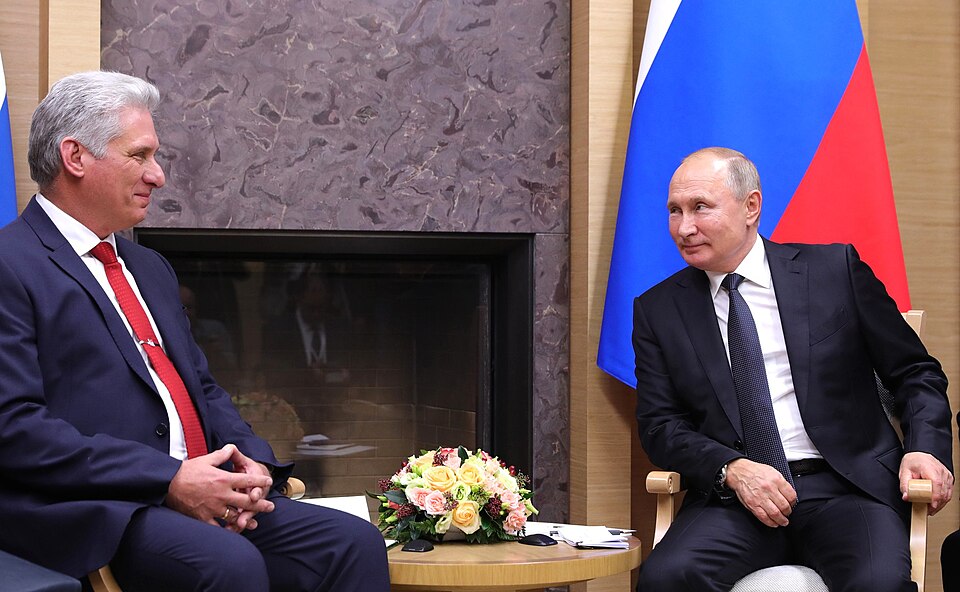
Diaz-Canel and Putin meet in 2019. Source: Presidential Press and Information Office
Cuba Standard‘s Johannes Werner reported on October 20, 2015 that the Russian government will provide Cuba a “€1.2 billion ($1.36 billion) loan, provided as export guarantee for Russian supplies, cover construction of one 200 mw generator at the Máximo Gómez power plant in Mariel, and three 200 mw generators at the Habana Este power plant in Santa Cruz del Norte. Both power plants will continue to use domestically produced heavy oil. This is the biggest single loan for Cuba since the early 1990s.”
CiberCuba in their article ” What did regime officials say happened with the funds for this project? ” published on October 18, 2024 provided an answer that revealed that Havana had “prioritized other issues” than investment in infrastructure. Bold emphasis added by this CubaBrief.
In September 2022, the Deputy Minister of Energy and Mines, Tatiana Amarán Bogachova, stated that the Cuban regime had not been able to access the Russian credit of 1.2 billion euros for thermoelectric plants, as it had not managed to secure the 10% upfront payment (120 million) needed to access this credit. “The money from that loan was not used for anything. Simply put, we have not been able to resume the project. On the other hand, credits are not a gift, but a loan. There is no way for Cuba to use the money for anything other than this project,”
Amarán expressed. The “project preparation work” was carried out by Russian and Cuban companies. It took three years, from 2016 to 2019. Amarán justified this delay by claiming it was a study of great “complexity,” but the situation worsened in 2020 with the coronavirus pandemic and the deep crisis of the Cuban economy.
“It was impossible for us to secure the advance amount that would allow the Russian party to have access to the credit for the project,” said Amarán, arguing that in recent years the government prioritized other issues. … “Between 2006 and 2019, the Russian government lent Cuba $2.3 billion to finance energy, metallurgical industry, and transportation projects. However, the regime did not guarantee the maintenance of the thermoelectric plants. In February 2022, the Lower House of the Russian Parliament ratified the regulation that extended until 2027 the payment of loans granted to the Cuban regime, which has almost completely stopped repaying loans since early 2020, which “increased its debts to Russian commercial banks and exporting entities,” according to the EFE agency.
On August 15, 2024 Tampa resident Mirtza Ocana (age 39) pled “guilty to one count of bulk cash smuggling and one count of conspiracy to commit bulk cash smuggling.” She was smuggling millions of dollars out of Cuba to the United States.
“According to court documents, Ocana returned to the United States on a flight from Cuba on February 5, 2024. Despite telling U.S. Customs and Border Protection agents that she had no cash to declare, Ocana concealed more than $31,000 in her luggage. After agents found this cash, Ocana admitted that she frequently smuggled cash into the United States from Cuba and that she had done so two to three times per month since June 2023. She also told agents that she was paid between $1,000 and $2,500 each time she smuggled cash. Agents searched Ocana and discovered an additional $71,300 in cash hidden in her clothes. In total, agents found approximately $102,700 in cash concealed both in Ocana’s clothes and in her luggage.”
Now the Cuban dictatorship repeatedly claims their troubles are due to a non-existent blockade imposed by the United States, and that they have a lack of foreign currency to purchase food, equipment, and other necessities. Where is this money coming from? Martin Gurri, a former CIA analyst, and presently a visiting fellow at the Mercatus Center of George Mason University, in the March 30, 2024 OpEd originally published in Discourse magazine, “In Cuba, the terminal stage of communism is a mafia,” described what is going on.
“Corruption can be simple or complex. Officials fortunate enough to have control over scarce resources like fuel sell these on the black market and realize enormous profits. The preferred approach is more indirect, however. Following the outbreak of anti-regime protests in July 2021, the government allowed the establishment of private “micro, small, and medium enterprises,” theoretically as a way to open up the economy to market forces. But most if not all of the 9,000 private enterprises operating in Cuba today are owned by powerful regime figures who then funnel public works contracts to them.”
Alejandro Gil Fernández, Cuba’s Deputy Prime Minister and Minister of Economy and Planning until February 2, 2024, was detained on March 7, 2024. He has been linked to Mirtza Ocana and her “bulk cash smuggling” operation from Cuba to the United States by CubaNet. Ms. Ocana has denied the connection, but the timing and word of mouth indicate otherwise.
[ Full entry here ]