Cuba with its heart in the center of its chest › Cuba › Granma
In Cuba, approximately 1,500,000 children and adolescents will attend classrooms when the new general education school year begins on September 1st. This was reported Wednesday morning by the Minister of Education, Naima Ariatne Trujillo Barreto, to the press team of the Presidency of the Republic of Cuba.
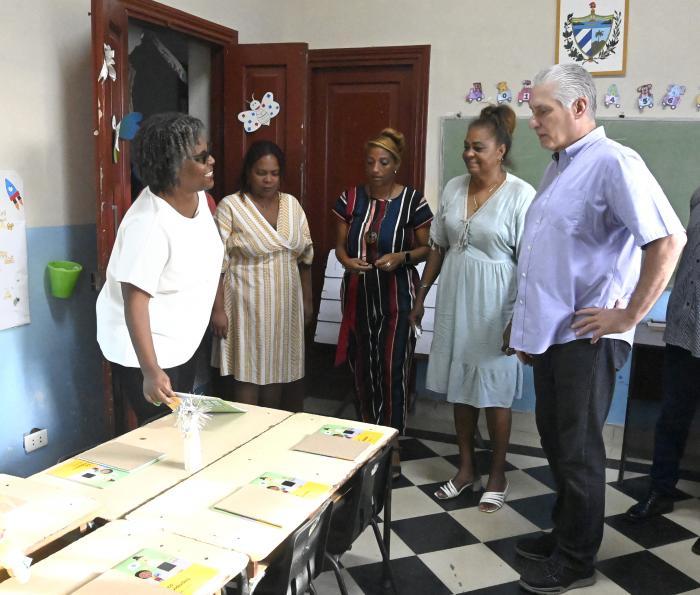
The minister’s remarks came from the Cepero Bonilla Primary School, located in the Víbora district of Havana’s Diez de Octubre municipality, following a visit to the school by Miguel Díaz-Canel Bermúdez, First Secretary of the Central Committee of the Communist Party of Cuba and President of the Republic.
“The school year begins on the 1st. In fact, it has already begun, because our staff started this week,” the minister told reporters, noting that many of the professionals “haven’t had much vacation time, trying, as teachers always do, to prepare the facilities as best as possible.”
The minister affirmed that each school will welcome new students, their families, and returning students.
He emphasized that the new course—designed, he said, to involve “all social and economic actors”—will inherently offer “a great deal of flexibility and individualized support,” without neglecting the institutional and group projects.
In the current circumstances, he reflected, “the response from each educational level, each institution, each region, each group, and each child and adolescent” will require “a level of differentiation” that includes “many variations.”
Along the same lines, he explained that “there will be double sessions, with specific characteristics where possible”; and that, “to complement educational life, there will be other programs with youth participation, from the neighborhood, and from our own professionals; because you might have classes in your group in the morning, and then there’s something that complements the training with an innovative project.”
Among the innovative projects, Trujillo Barreto mentioned, as an example, the interaction with university students passionate about computer science and artificial intelligence (AI), or with another who likes to sing, or with another who likes sports: “In other words, we are trying to create a complementary life, but in each place, decisions must be made according to the existing conditions.”
He shared the observation that, at the start of a tour of the island, “we saw our professionals at all levels very committed,” as well as other forces and actors present in all scenarios. And he emphasized the value of “a response that is not just for the beginning (of this teaching phase), but that can be made sustainable.”
Now we have to evaluate everything, he said, “now we have to be very rigorous in the follow-up.” He expressed this in reference to the students who are further removed from the institutions, and who, for that reason, require more specific and complex responses.
NO CHILD LEFT UNGUARDED
This Wednesday morning prompted reflection and emotion as the Head of State toured the area where the Cepero Bonilla Primary School is located. It is a community council area that also houses homes for children without parental care and an Emergency Shelter—a care model established under the recently enacted Children, Adolescents, and Youth Code.
Díaz-Canel’s tour—accompanied by Deputy Prime Minister Eduardo Martínez Díaz, the Minister of Education, and other officials—began at the Víbora II home for children, adolescents, and young adults without parental care.
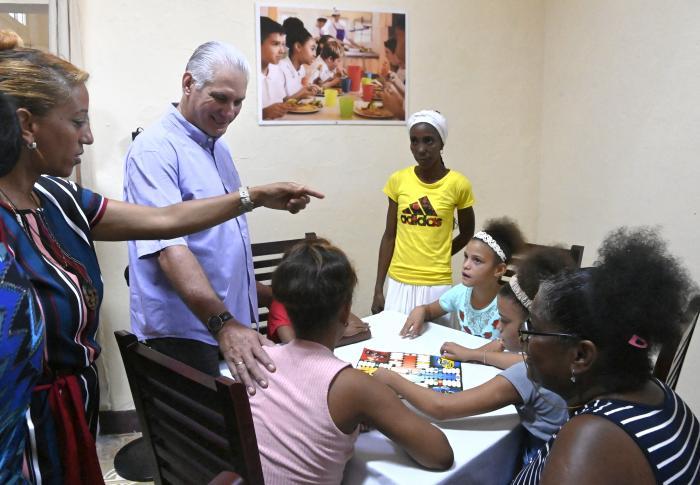
There, the Head of State inquired about the children’s daily lives; how economic actors interact with the operation of the home; and what the children’s school and vacation periods are like.
Not far away, the next place visited was the Víbora i Infant Home. There, the president asked about the children. Regarding the ten or so staff members who work there, he said that they “have their hearts in their hearts.” He said this because it takes great sensitivity and purity of soul to protect the lives of such defenseless beings in need of love.
Next on the itinerary, the next stop was the Cepero Bonilla School. And finally, the Cuban President arrived at the Urgent Shelter, a space designed to provide rapid protection for children, adolescents, and young adults in situations of extreme vulnerability, while specialists develop a personalized care strategy.
From this new foster care space—which serves as a kind of transitional arrangement—children can go to a foster home, a family, or the care of a loved one who decides to assume parental responsibility.
For all children, the new school year and the value of learning are a shared blessing.
This Wednesday morning, as Díaz-Canel toured the Víbora community council in Havana’s Diez de Octubre municipality, home to several institutions vital to human dignity, one truth remained clear: amidst cribs, tables, chairs, toys, and new backpacks—awaiting their first use in the new school year—Cuba, under the Revolution, does not abandon a single one of its children.