

‘Cuba is a sovereign country’: Fidel’s lessons in foreign policy
August 11, 2026
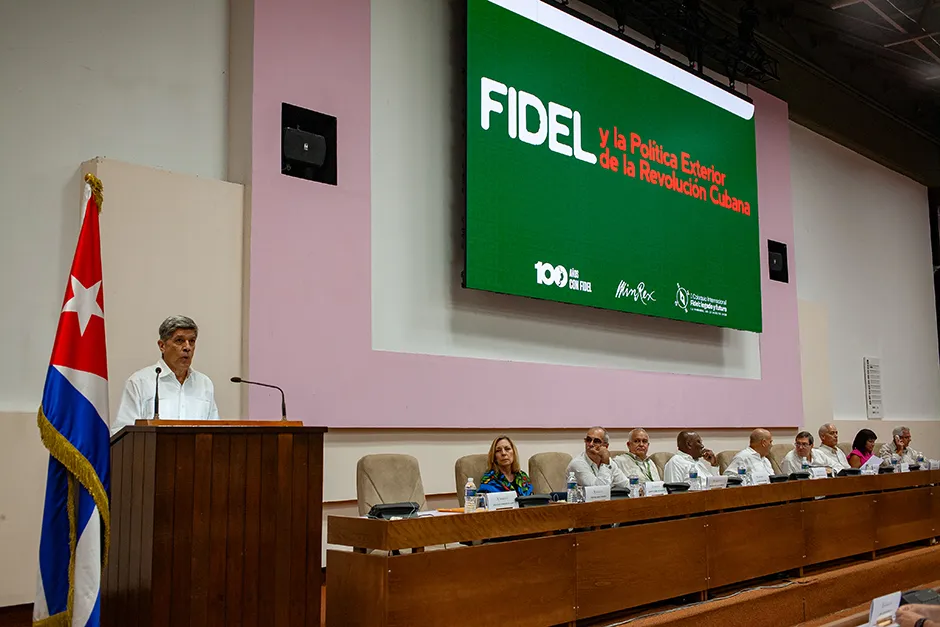
At the forum “Fidel and the Foreign Policy of the Cuban Revolution,” held as part of the First International Colloquium “Fidel: Legacy and Future,” Deputy Minister of Foreign Affairs Carlos Fernández de Cossío delivered a presentation in which he outlined the fundamental principles of Fidel Castro’s thinking regarding the conduct of Cuban foreign policy. Using specific examples, the deputy minister demonstrated how the Commander’s legacy continues to guide Cuba’s actions on the international stage.
Fernández de Cossío began by recalling the October 1962 missile crisis and the visit of then-UN Secretary-General U Thant to Havana on October 30, 1962, to gauge the Cuban government’s position. The United States, through the UN, proposed an inspection mechanism in Cuba to verify the withdrawal of offensive weapons. Fidel’s response was forceful: “What right does the U.S. government have to demand this? Is it based on a legitimate right, or is it a demand imposed by force?”
The deputy minister quoted the Commander’s words verbatim: “Cuba is a sovereign country—no more and no less than any other member state of the United Nations. We have not violated any rights. We have not carried out any acts of aggression against anyone. All our actions have been based on international law.”
“I understand that this inspection is yet another attempt to humiliate our country. For the sake of those rights, we are willing to pay whatever price is necessary.”
Fernández de Cossío emphasized that this unwavering defense of sovereignty became the cornerstone of the Revolution’s foreign policy.
The second issue addressed was Fidel’s refusal to negotiate Cuba’s commitments to solidarity and internationalism. The deputy minister recalled the discreet meetings between Cuba and the United States in the second half of the 1970s and even into 1980, where the U.S. agenda included issues that had nothing to do with bilateral matters, such as Cuba’s solidarity with Puerto Rican independence and internationalism in Africa.
At one of those meetings, in November 1978, the Cuban representative made it clear: “Under no circumstances will we make our aid to our African friends a bargaining chip. This is non-negotiable. We are prepared to continue our constructive and positive policy aimed at eliminating conflict and promoting peace wherever it is threatened. But under no circumstances will we make the agreements and commitments we have established with friendly countries a subject of negotiation. Our bilateral relations with these countries are non-negotiable.”
Fernández de Cossío also cited the November 23, 1981, meeting in Mexico City, where U.S. Secretary of State Alexander Haig offered trade relations in exchange for Cuba withdrawing its support for Nicaragua and its troops from Africa.
The Cuban representative, Carlos Rafael Rodríguez, vice president of the Council of State, was unequivocal: “We are giving and will continue to give Nicaragua our solidarity and support. We consider this our obligation and our right. There is no obligation we have assumed toward any country, group, or government that we have not been able to honor. This must be clear to the United States.”
The third issue addressed was the denunciation of the unjust international economic order, a topic to which Fidel devoted much of his energy.
Fernández de Cossío highlighted the Commander’s speeches and remarks at academic events, which he considered “essential study materials” for understanding the world’s major problems.
Fidel clearly understood and denounced the fact that the current international economic order has led to the underdevelopment of three-quarters of the world’s population, and that the primary responsibility for financing the development of the countries of the South lies with the states that today enjoy the benefits of those historical atrocities.
“Never before has humanity possessed such formidable scientific and technical potential, such an extraordinary capacity to generate wealth and well-being, and never before has the world been so unequal and inequality so profound,” was one of his recurring reflections.
His approach—Marxist-Leninist but free of dogmatism—drew inspiration from Third World intellectuals and dialogues with global experts. As early as the 1970s, Fidel had already identified the risks to the environment and established the link between ecosystem degradation and unsustainable patterns of production and consumption.
On the occasion of his centennial, the vice minister called for spreading the teachings of a revolutionary leader “whose ambition was to defend his country’s unquestionable right to enjoy full and absolute sovereignty, and, together with the brave Cuban people, to strive to bring justice or put an end to injustice in every corner of the planet.”
Former Brazilian President Dilma Rousseff, for her part, sent a virtual message to the Colloquium in which she paid tribute to the legacy of the Commander-in-Chief and recalled her deep connection to the Cuban Revolution. She spoke not only as a former head of state, but as “an activist who, from her youth, was deeply influenced by the example of courage and energy that led Cuba in 1959.”
“For my generation of Latin Americans, Fidel was a living symbol of the struggle for social justice, freedom, and sovereignty,” Rousseff stated. She recalled those dark years of the military dictatorship in Brazil, when the Cuban Revolution was “a beacon” for those who dreamed of a more just continent. “Fidel taught us that the dignity of a people is not negotiable and that solidarity is the most powerful weapon against oppression,” she emphasized.
The former president shared a personal anecdote that reveals the intimacy of her relationship with the Cuban leader. She had the honor of meeting Fidel on several occasions, but she especially recalled a conversation they had at his residence in Havana during the inauguration of the port of Mariel. “He had already retired from public life, but he welcomed me with the generosity that always characterized him. We spent nearly two hours talking,” she recounted. What impressed her most was “his clarity of thought, his prodigious memory, and the passion with which he spoke. That day I saw the man behind the myth, and that only deepened my admiration for him.”
But Fidel’s relationship with Brazil, Rousseff emphasized, was not limited to the realm of ideas. “There was a concrete initiative that transformed the lives of millions of Brazilians.” During her term in office, with Fidel’s full and decisive support, they launched the “More Doctors” program, “one of our government’s finest achievements.” That program was only possible, she recalled, thanks to Cuba’s generosity and Fidel Castro’s internationalist vision.
More than 11,000 Cuban doctors arrived in Brazil to provide care in places where no other professionals wanted to go: on the outskirts of major cities, in the semi-arid regions, in the Amazon, and in the favelas. “In five years, those doctors—whom Fidel affectionately called ‘his army of white coats’—conducted more than 113 million consultations, saved lives, and restored hope and dignity to entire populations,” she stated.
Rousseff emphasized that Fidel’s legacy transcends bilateral relations. “Cuba and Commander Fidel Castro exemplify true foreign policy: it is not built solely on speeches, but on concrete acts of solidarity.”
She recalled that Fidel understood before many others that the struggle of the peoples of the Global South was a shared struggle. “His people were a leading force on the international stage, sending troops to fight apartheid in Africa and building one of the largest networks of medical and educational cooperation the world has ever seen. His internationalism was not merely for show; it was practical, courageous, and deeply human.”
The former president also mentioned Fidel’s speech at the Earth Summit in Rio de Janeiro in 1992. “With his characteristic clarity, Fidel was already warning the world about the dangers of climate change and unbridled consumerism, and calling for the international order to place life and nature at the center rather than profit. He was a visionary,” she affirmed.
Rousseff concluded her message with a statement of principles. “Fidel taught us that the sovereignty of a people is not subordinate to the interests of the great powers and that the integration of Latin America is a path of no return.” Although Fidel Castro is physically gone, she emphasized, “his political legacy, his courage, and his example remain more alive than ever.”
Next, former Ecuadorian President Rafael Correa sent a video message in which he recalled his meetings with the Commander-in-Chief and highlighted the enduring relevance of his ideas and revolutionary practice. Correa spoke emotionally about a leader he met in 2005, when he was still unknown on the international stage but was already a candidate for the presidency of the Republic.
Correa recounted how he first came to Cuba, thanks to Commander Hugo Chávez. At that time, Correa had served as Ecuador’s Minister of Economy and Finance for just three months and was preparing for an election.
But from that encounter emerged “an immense friendship, a brotherhood” with Chávez, and through him, Correa was able to visit Havana and meet Fidel. “We arrived in Havana one morning. We went to his house. We worked until 9 p.m., because you never knew what time the commander would arrive, for security reasons, for matters of state,” he recounted. It wasn’t until 9 p.m. that they were called. “He kept us working all night; he was a night owl,” recalled Correa, who noted that Fidel was “a workaholic and a great conversationalist.”
Although he met him only three times, Correa said those experiences were unforgettable.
“He was an internationalist with a passion for Cuba—the revolution of those who are also unconventional: his speeches, his policies, his unwavering defense against imperialism and colonialism, the search for a third way with the Non-Aligned Movement, to achieve development with justice, dignity, and prosperity for everyone,” he affirmed.
But the former Ecuadorian president emphasized that with Fidel, it wasn’t just rhetoric—”it was action.” Correa recalled that Fidel Castro was “an early—very early—visionary regarding the environmental crisis, when no one took it seriously.”
Correa also referred to the evolution of Fidel’s thinking, which always knew how to adapt and resist: “evolution, block, slow down, attack,” he mentioned, referring to the tools that imperialism has used against Cuba and against the peoples who resist its domination. But he emphasized that, in the face of all that, Fidel and the Cuban Revolution knew how to remain steadfast and creative.
The message from the former Ecuadorian president was a moving tribute to a leader who knew how to combine words with action, thought with practice, and who, like few others, understood that the struggle of the peoples of the South was a shared struggle. “His legacy remains more alive than ever,” Correa affirmed, and he reaffirmed his commitment to the ideals of social justice, sovereignty, and Latin American integration that Fidel defended until the end of his days.
José Luis Centella, president of the Communist Party of Spain, spoke to highlight one of the least explored yet most relevant aspects of the Comandante’s thought: his lucid warning about the resurgence of fascism. Centella emphasized that Fidel was able to identify the key elements of this phenomenon at a time when the European left preferred to look the other way.
He emphasized that Fidel was unequivocal in stating that “fascism is not a historical anomaly, but a systematic response of imperialism.”
The Spanish Communist leader recalled that Fidel argued that “fascism is the most complete expression of capitalist imperialist thought” and that “it is the imperialist countries that create the conditions for the emergence and advance of fascism in the world.”
At a time when Europe and parts of the world are experiencing the rise of far-right movements, “Fidel’s words take on a truly strategic significance today.”
The Communist leader described the new forms of fascism in the 21st century: “It is true that 21st-century fascism does not present itself in Europe as brown shirts or military uniforms. It presents itself through a massive media campaign that seeks to manipulate public opinion so that people believe their enemy is the immigrant and not the capitalist system.”
He also pointed to the use of digital platforms that spread hate and disinformation, as well as policies that “are leading to states of emergency under the pretext of security and an identity-based narrative that promises protection against what might be freedom and social rights, but which are in reality handing over power to corporations and the local bourgeoisie.”
Centella concluded his remarks with a call to action: “Today, in the 21st century, when fascism is unable to resolve capitalism—unable to resolve its contradictions—this contradiction we face is a reality; it is the face of fascism.” He reaffirmed the need to study and analyze these new manifestations in order to combat them, just as Fidel warned decades ago.
Presentation of “Voices with Fidel”: A collective work featuring 44 testimonies on the Commander’s legacy
As part of the panel “Discourse, Oratory, and Political Communication” at the First International Colloquium “Fidel: Legacy and Future,” the book “Voices with Fidel: Memory and Revolutionary Legacy” was presented—a collective work that brings together 44 testimonies from intellectuals, activists, and politicians from around the world on the figure of the Commander-in-Chief.
The volume, compiled by journalists Pascual Serrano and David González with the support of the Cuban Institute of Friendship with the Peoples (ICAP) and the Fidel Castro Ruz Center, serves as a political tool to preserve revolutionary memory and counter anti-Cuban rhetoric amid a growing cultural war against the island.
The book, made possible by the work of the José Martí Valencian Association of Friendship with Cuba and the support of the publisher L’Encobert, features a collective and diverse perspective. As its synopsis states: “The 20th century has produced several leaders who will go down in history. But none like Fidel Castro.”
Forty-four people, one hundred years after his birth, write about Fidel, recounting the values he instilled in them, the social achievements he brought about in their own lives and those of their communities, the void left by his absence, and also everything that inspired them to ensure his legacy is never forgotten.
The book features texts by Cuban authors such as Silvio Rodríguez, Aleida Guevara, Tin Cremata, René González, Michel Torres, Abel Prieto, Israel Rojas, Rosa Miriam Elizalde, Sissy Abay, Fernando González, and Víctor Dreke, among others. It also includes contributions from international intellectuals and activists such as Evo Morales, Pascual Serrano, Ignacio Ramonet, Atilio Borón, Helen Yaffe, Vijay Prashad, Manolo de los Santos, Willy Toledo, and Oleg Yasinsky, among many others. Each offers their personal, political, artistic, and/or academic perspective, reinforcing the idea that Fidel is a universal figure and that his legacy lives on.
The book is complemented by photographs from the Fidel Castro Ruz Center, by the authors themselves, and by intimate portraits by Álex Castro, the Commander’s son.
The panel discussion at which the book was presented was moderated by Rigoberto Santiesteban, president of the Cuban Institute of History, and featured researchers from Cuba, Mexico, and Spain, who addressed Fidel’s communicational architecture, his oratory, his ideology, and his Marxist practice.
The event included presentations such as “Fidel’s Communicational Architecture: From the Clandestine Network to the Dispute Over Meaning,” by Dayron Chang; “Fidel and the Virtue of the Word: An Analysis of Fidel Castro’s Political Discourse During Three Moments of Crisis,” by Danna Márquez; and “A Comparison of the Oratory of José Martí Pérez and Fidel Castro Ruz,” by Julia María López Pardo, among others.
“Voices with Fidel” is not merely a tribute to the figure of the Comandante. It is, as its editors stated, “a political tool to preserve revolutionary memory, dismantle anti-Cuban rhetoric, and offer critical thinking that is useful to the current struggles for justice and the sovereignty of peoples in this new phase of imperialism and cultural neocolonization.” A book that, in this centennial year, brings together voices from every continent to remind us that Fidel is not the past, but the present and the future.
Source: Cubadebate. Translation: Resumen Latinoamericano – U.S.
Join the Struggle-La Lucha Telegram channel