

Cuba expects a Sunday of long blackouts that will leave up to 70% of the country without power
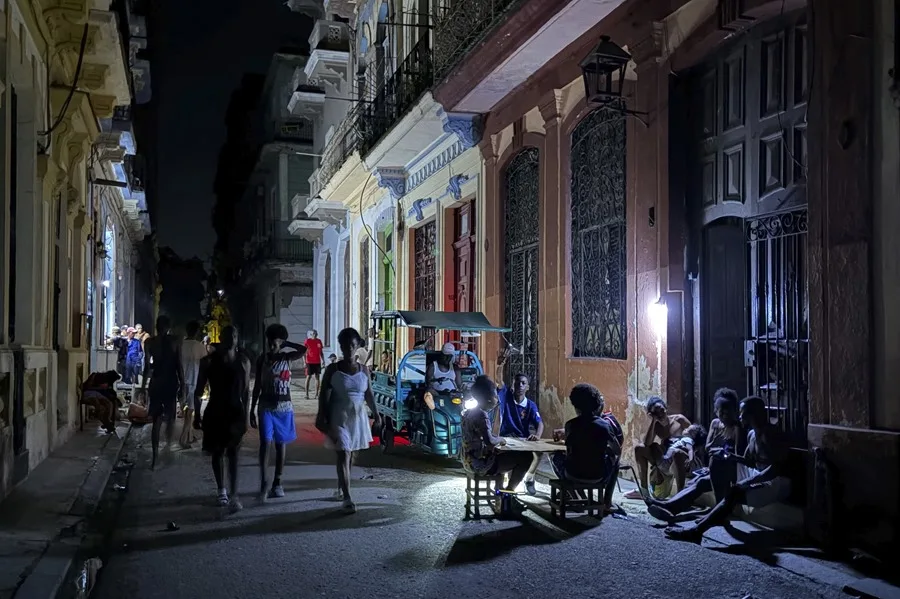
Havana.- Cuba anticipates a Sunday of long blackouts that will leave up to 70% of the country without power during the “peak” hour, in the evening, at the end of a week in which it suffered a double total collapse of the National Electric System (SEN).
In recent weeks, the energy crisis on the island has escalated, with blackouts in Havana exceeding twenty consecutive hours and barely two or three hours of service, while in the provinces, more than two consecutive days without electricity supply are being reported.
Last Tuesday, the state-owned company Unión Eléctrica (UNE) declared the National Electric System (SEN) restored following the double national blackout that Cuba suffered for 36 hours, the seventh so far this year, to which several partial collapses are added.
The largest island in the Caribbean has been suffering from a deep energy crisis since mid-2024, which has progressively worsened since last January due to the oil blockade imposed by the U.S., a measure described by the United Nations as contrary to international law.
Cuba’s obsolete energy infrastructure
This situation is also related to obsolete thermoelectric power plants, generating units affected by decades of exploitation and a lack of necessary investments for their maintenance, which is why they report continuous operational outages and breakdowns.
We recommend reading:
This Sunday, the report from the UNE, which falls under the Ministry of Energy and Mines, forecasts a generation capacity of 1,015 megawatts (MW) for peak electricity consumption hours, compared to a maximum demand of 3,250 MW.
Thus, the deficit -the difference between supply and demand- will be 2,235 MW and the estimated impact -what will actually be disconnected to avoid disorderly blackouts- will reach 2,265 MW.
Currently, seven of the country’s sixteen thermoelectric generation units are out of service due to breakdowns or maintenance work. This source, responsible for 40% of the energy mix, is fueled by domestic crude and is not affected by the oil embargo.
Another 40% of the mix was provided by generation engines, but this energy source requires imported diesel and fuel oil. The remaining 20% of the Cuban energy mix is obtained from gas and renewable sources, especially with the recent boost to solar energy with Chinese support.
The effect on the economy
The Cuban government acknowledges that the situation of the island’s National Electric Power System (SEN) is “acute,” “critical,” and “extremely tense,” marked both by the impact of the oil blockade and Washington’s sanctions, as well as by a deeply obsolete energy system.
According to estimates, Cuba needs about 100,000 barrels of oil per day to meet its energy needs, of which 40,000 come from its national production.
The Cuban economy is almost completely paralyzed by blackouts, after accumulating a 15% contraction between 2020 and 2025, and which, according to independent forecasts, could register up to 6.5% this year.