

Cotton Tree – Sierra Leone
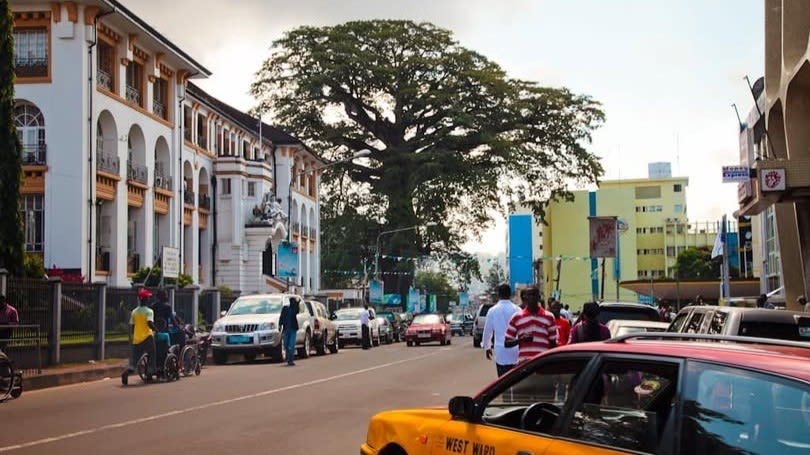
The Tree That Saw It All.
Andrew Benson Greene
COTTON TREE
(Poem Written as part of Andrew Benson Greene’s Collection of Poems entitled (The Peace Pole)
Cotton Tree.
Your once lush and green leaves,
Are now replaced by the flapping wings
Of black bats,
That fumble and tumble at one another,
As if they are in foray for food;
Reminding us of our sheer playfulness during childhood.
Cotton Tree,
You are such an accommodating type
Even to these sets of fugitive bats,
That seem to have nothing to think of
And nothing to cudgel their little brains over.
But it is so disrespectful,
For people to meddle with you Cotton Tree,
A monument for freed slaves,
A lineage of Sengbe Pieh;
Our celebrated hero of the Amistad Revolt.
But look at these bats!
They go away with it unscathed,
As they fight for food.
Mysterious Cotton Tree,
You grow stronger with age,
Many folks will wish to be like you
To enjoy and attain your unique longevity.
Long live the Freetown Cotton Tree!
A monument for freed slaves,
A lineage of Sengbe Pieh;
Our celebrated hero of the Amistad Revolt.
Beautiful Cotton Tree,
You need not comb your hair,
You often wear a beautiful wig like a lawyer.
You make tourists flock the city,
To behold your beautiful face,
In utter admiration for your splendor,
Or their families trace.
Magnificent Cotton Tree,
You stand proud, tall, robust, and majestic,
Adjacent the Law Courts
And your verdicts have never hurt.
You often hear and still remember
The sounds of sirens wailing prisoners to Pa Demba.
You look face down at the Sierra Leone Museum,
You glance askance at the State House.
You are often in the grandiose company
Of business-minded people
In the busiest streets of Freetown,
Where vehicles, taxis and pedestrians
Gambol around you
Day and night,
Throughout the year round.
To some folks, they say you are like a mascot.
You are reticent; you do not talk a lot,
Or maybe, you do not talk at all.
Brave Cotton Tree,
You are really guts!
You never get hurt!
In the midst of all the war and violence
And the way in which our people are silenced
By Ebola dreadfulness,
You were never hurt.
You never looked pale or frail,
You have never been reported sick or ill,
You never shivered and withered,
You never drooped or sagged,
You never in fact budged.
You never felt timid during the attack,
You never lost an arm,
During that fatal entry in January 1999 when those well armed,
Empowered by arms,
Took the city by surprise,
Raided my country, and made it pay a high price.
Cotton Tree,
You have been a dedicated eyewitness
To diverse changes in high seats,
To the chagrin of our country’s visible weakness.
From the changes in Colonial Rule
To Military take-over,
To coups and forceful cross-over,
To times like this when Democracy has taken over
And the people’s wish and power has prevailed.
Cotton Tree,
A new fountain sprouts pure water
At your bosom,
Yet it will be foolhardy for a thirsty man to drink.
Cotton Tree,
My Cotton Tree,
Our Cotton Tree,
You have passed your candid stories
Right down to many generations,
For you are privileged to be
The only surviving one
To tell the country’s legendary tale.
Cotton Tree,
Continue standing tall,
Right at the city centre.
Cotton Tree,
I salute you!
Article content
Andrew Benson Greene October 11, 2009
Reflection and Literary Analysis
When I wrote Cotton Tree in 2009, I was not merely writing about a tree. I was writing about memory, endurance, history, identity, resilience, mortality, and the remarkable spirit of the Sierra Leonean people. Looking back today, especially after the fall of the historic Cotton Tree in Freetown, I see the poem as carrying meanings that have only deepened with time. Read in the context of its fall, the poem is no longer merely descriptive. It functions almost as an elegy written before the loss occurred. It preserves not simply a tree, but an entire national memory.
From the beginning, I sought to transform the Cotton Tree from a physical object into a living presence. One of the poem’s most significant literary devices is apostrophe, the direct address of an absent or non-human subject. Throughout the poem, I repeatedly invoke “Cotton Tree” as though it were a living being capable of listening and responding. The repeated address creates the effect of a direct conversation. I speak to the tree as one would speak to a revered ancestor. This direct conversation transforms the tree from a physical landmark into an elder, companion, witness, judge, historian, survivor, and guardian of history.
Closely connected to this is the poem’s extensive use of personification. Throughout the work, the Cotton Tree acquires human attributes. It hears. It remembers. It glances askance. It wears a wig. It delivers verdicts. It passes stories from one generation to another. Through personification, the tree becomes more than part of the landscape. It becomes a moral presence within the nation and what might be called a national protagonist. In literary terms, the Cotton Tree becomes the embodiment of Sierra Leone itself.
At the center of the poem lies an extended metaphor. The Cotton Tree is never simply a tree. It functions as a metaphor for Sierra Leone and for the resilience of its people. One of the dominant themes throughout the poem is endurance. The Cotton Tree stands against slavery, colonialism, political instability, military coups, civil war, disease outbreaks, social upheaval, and the many challenges that have shaped the nation’s history.
When I write:
“You never shivered and withered, You never drooped or sagged, You never in fact budged,”
I am not merely describing a tree. I am describing a people who have repeatedly found strength in moments of hardship. The repetition of “You never” creates a rhythmic litany of resilience. Through repetition, resilience is not merely stated but reinforced. The tree becomes a metaphor for the Sierra Leonean spirit itself. While governments change, wars rage, epidemics devastate communities, and generations come and go, certain foundational values endure. The Cotton Tree symbolizes that permanence.
The poem also relies heavily on repetition as a structural and thematic device. The recurring invocation of “Cotton Tree” functions as a refrain, creating rhythm, continuity, and ceremonial emphasis. The repeated declaration that the Cotton Tree is “A monument for freed slaves” continually returns the reader to the historical significance of the tree. These repetitions create a tone that resembles public recitation, oral tribute, and praise song.
The poem’s musicality owes much to the traditions of West African praise poetry and oral storytelling. Repetition, cadence, communal memory, and rhythmic invocation are all central features of those traditions. The recurring calls to the Cotton Tree resemble the refrain of a praise poem, elevating the work beyond personal reflection into collective remembrance.
The Cotton Tree is equally sustained by symbolism. It symbolizes freedom, liberation, endurance, memory, dignity, hope, continuity, and national identity. Through repeated references to freed slaves, the tree becomes connected to the founding narrative of Freetown itself. The lines describing it as “A monument for freed slaves” transform it into a living memorial of liberation and survival.
My reference to Sengbe Pieh, the celebrated leader of the Amistad Revolt, broadens the poem’s historical scope beyond Sierra Leone into the wider Black Atlantic struggle for freedom. The Cotton Tree therefore symbolizes not only national history but also the universal human yearning for dignity and liberation.
The poem is rich in visual imagery that places the reader directly within central Freetown. The contrast between lush green leaves and black bats immediately establishes a visual transformation. The bats are rendered dynamically through the phrase “fumble and tumble,” where alliteration and sound work together to create movement and energy. The repeated consonants generate rhythm while helping readers visualize the bats’ chaotic activity.
The imagery extends beyond nature into the life of the city itself. Vehicles, taxis, pedestrians, museums, courts, and government buildings surround the Cotton Tree. Readers can almost see daily life flowing around this immovable center. The tree stands not apart from society but at the very heart of Freetown’s civic, political, and cultural landscape.
One of the poem’s most memorable figurative expressions appears in the line:
“You often wear a beautiful wig like a lawyer.”
This playful yet profound local metaphor draws on the tree’s proximity to the Law Courts. The canopy is compared to the traditional wigs worn by barristers. The image associates the tree with wisdom, justice, authority, and institutional memory. Later, when I write that the tree’s verdicts have never hurt, the symbolism deepens further. The tree is no longer merely dressed like a lawyer; it becomes a judge.
Perhaps the poem’s most powerful literary achievement is its portrayal of the Cotton Tree as a witness. Again and again, I present the tree as observing history unfold. It witnesses colonial administration, military governments, democratic transitions, war, peace, social transformation, and national renewal.
The line “You have been a dedicated eyewitness” appears deceptively simple. Yet behind it lies an enormous historical imagination. The tree becomes a silent archive, preserving memories long after human witnesses have passed away. This idea reaches its climax when I describe the Cotton Tree as being privileged to remain and tell the country’s legendary tale. The tree is transformed into a storyteller and custodian of collective memory.
The journey within the poem mirrors both a personal and national journey. It begins with observation. I first notice the bats inhabiting the tree. From there, the poem moves into childhood memories and reflections on playfulness. It then expands into historical recognition as the tree becomes linked to slavery, freedom, and national identity. Attention shifts to courts, museums, government institutions, and urban life. The poem enters the realm of national trauma through memories of war and the January 1999 invasion of Freetown. It proceeds through reflections on political evolution, tracing the nation’s movement from colonial rule through military intervention and eventually democracy. Finally, it arrives at reverence. What begins as observation ends as homage.
One of the central themes of the poem is the resilience of Sierra Leone itself. The Cotton Tree stands as an enduring symbol of a nation that survived slavery, colonial rule, struggles for independence, political upheaval, military coups, civil war, post-war reconstruction, the Ebola epidemic, and later global challenges such as COVID-19. Like the people of Sierra Leone, it bore witness to extraordinary hardships and yet remained standing.
Yet the poem is not only about endurance. It is also about mortality.
The eventual fall of the Cotton Tree reveals a profound truth at the heart of the human experience. For all its strength, majesty, longevity, symbolism, and historical importance, the tree ultimately succumbed to time. In this sense, it teaches a lesson in humility. No matter how powerful, celebrated, influential, wealthy, or revered we may become, none of us escapes mortality.
The greatest paradox at the heart of the poem is that it celebrates both permanence and impermanence. For much of the poem, the Cotton Tree appears almost immortal. It survives where others fall. It remains standing while history changes around it. Yet its eventual collapse reveals that resilience does not equate to immortality.
Ultimately, Cotton Tree functions simultaneously as nature poetry, historical poetry, praise poetry, symbolic narrative, philosophical meditation, national tribute, and elegy. The physical tree may no longer stand, but the values it represented remain standing. The story it witnessed endures. The history it embodied survives. The lessons it teaches continue to inspire.
The Cotton Tree may have fallen, but through poetry, memory, and the enduring spirit of the Sierra Leonean people, it continues to stand tall.
Andrew’s distinguished record of international leadership, innovation, and public service spans more than two decades and reflects a sustained commitment to harnessing his creativity, innovative technology for human development and social transformation. he was an early advocate for expanding equitable access to technology and for bridging both the digital and social divides. Through his work, he has consistently championed the principle that technological advancement should serve as a catalyst for opportunity, empowerment, and human flourishing.
In 2003, he received the Cable & Wireless Childnet Award at London’s Science Museum in recognition of his contribution to making the internet a safer and more enriching environment for children. That same year, he joined a select group of one hundred African and Canadian young leaders at the inaugural Africa–Canada Youth Leadership Symposium at Saint Francis Xavier University in Antigonish, Nova Scotia, where emerging voices from both continents convened to explore the future of leadership in a rapidly globalizing world.
His international engagement continued as a United Nations Fellow at the first World Summit on the Information Society (WSIS) in Geneva, Switzerland 2003, a landmark gathering that helped shape global conversations on the social, economic, and developmental implications of the digital age. In January 2004, he was invited to address the 36th Annual Session of The Hague International Model United Nations (THIUMN) as a guest speaker, contributing to discussions on global governance and international cooperation. He was featured in the THIMUN Book ‘Shaping Tomorrow – 50 Years of Inspiring Youth’.
Also in 2004, Andrew was shortlisted for the Stanford University–Reuters Digital Vision Fellowship, recognizing innovators whose work demonstrated the transformative potential of technology. He subsequently received the prestigious Jeanne Sauvé Scholarship and spent the 2004–2005 academic year at McGill University in Montreal, joining an international community of emerging leaders dedicated to public service and global understanding.
His leadership was further recognized when the World Bank selected him as one of twenty-five Young Global Leaders at the inaugural World Ethics Forum at Keble College, Oxford University in 2006. He was a distinguished guest speaker at Education without Borders (EWB 2007), organized by the Higher College of Technology in Abu Dhabi. In 2011, he was named a United Nations International Telecommunication Union (ITU) Telecom World Digital Innovation Fellow in Geneva, Switzerland, and in 2012 he presented his Digital Hope Project in Dubai, demonstrating the possibilities of technology as a catalyst for educational advancement and social change. He received the Build Peace Via Technology Fellowship to present at the MIT Media Lab in Boston 2014. Andrew was a Hive Global Leader in San Francisco, California 2015, a Nexus Fellow in Washington DC 2018, and a Kauffman Foundation ESHIP Entrepreneur in Kansas City Missouri USA 2019.
In 2021, Andrew received the Heather Heyer Foundation Award for Social Justice, recognizing his longstanding commitment to human dignity, equity, and civic engagement.
His international presentations began even earlier. In Beijing, China, he addressed “Sharing and Understanding Tele-Education in the Twenty-First Century” (2000); in Cape Town, South Africa, he spoke on “Education in the Internet Age” (2001); and in Moscow, Russia, he advanced a vision that placed “Humanware Before Hardware and Software,” arguing that technological progress achieves its highest purpose only when it serves the development and flourishing of people.
At the heart of Andrew’s work lies a conviction that creativity is both a divine gift and a profound responsibility. Therefore, what Andrew’s innovation is his belief that creativity is a gift from God and that such gifts carry a responsibility to serve others. Throughout his life and career, he has sought to use his talents to expand opportunity, inspire hope, and transform lives across communities and nations. He views innovation not merely as an exercise in technical ingenuity, but as a vocation grounded in faith, service, and the belief that God endows individuals with talents intended for the common good. It is this understanding of creativity as stewardship that has animated his efforts to transform lives, expand opportunity, and foster hope across communities and nations. He holds a BA in International Relations, Civil Law and English from Fourah Bay College in 1998 and a Master of Science in Law Candidate at Francis King Carey School of Law.
Extra Information
First written on October 11, 2009, Cotton Tree is both a poetic tribute and a historical meditation on one of Sierra Leone’s most enduring national symbols. For centuries, the Cotton Tree stood at the heart of Freetown as a witness to the nation’s journey through slavery, colonial rule, the struggle for independence, political transformation, civil war, disease outbreaks, and national renewal. Following the tree’s eventual fall, the poem has acquired an even deeper significance, serving not only as a celebration of its legacy but also as a preservation of collective memory.
Through rich imagery, symbolism, personification, metaphor, repetition, and apostrophe, the poem transforms the Cotton Tree into far more than a physical landmark. It becomes a living embodiment of resilience, dignity, endurance, and historical continuity. At the same time, the poem offers a broader reflection on the human condition, reminding us that while all earthly things are subject to mortality, the values, stories, and lessons they leave behind can continue to inspire future generations.
Presented here alongside a reflective literary analysis, Cotton Tree stands as both a work of poetry and a testament to the enduring spirit of Sierra Leone and its people.
Credit: Source link