

Commercialised, curious, sometimes raucous: USA 94 was a joy to attend | World Cup
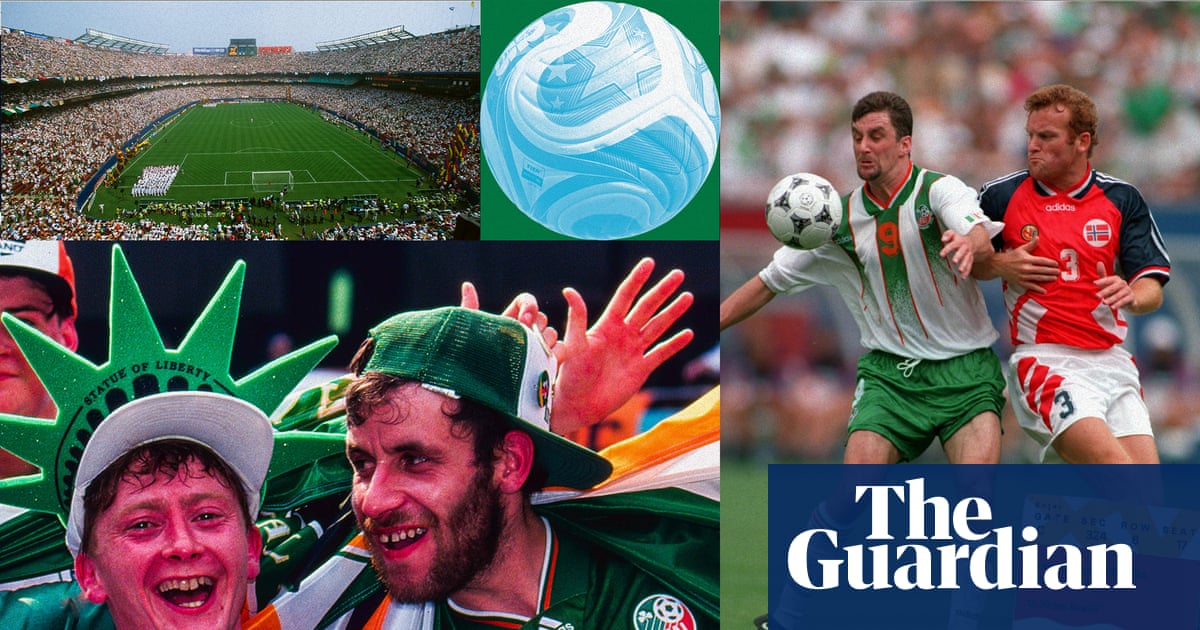
You never forget your first World Cup, and the tournament’s return to American shores this year will stir vivid memories for anyone who attended USA 94. It was a curious and distinctive tournament, one that heralded the World Cup’s more expansive, commercialised future, while also seeming a world away from the jamboree that returns 32 years later, twice as big and at least twice as lucrative.
I managed to do two weeks of it as a skint 23-year-old earning £9,000 a year, alongside my mate Paddy, a student. We took in only two games – both goalless draws – but soaked up enough of the occasionally raucous, often tepid, atmosphere for it to remain a personal favourite World Cup all these years on.
Now, in an age when US investment pumps up pretty much every level of the English professional game, it’s difficult to overstate how distant and mutually suspicious the footballing relationship was between Europe and the US in 1994. Host media seemed fixated on hooliganism and other nefarious perceived threats to the American way of life – England’s failure to qualify did little to dispel this – while Europeans were wont to sneer at an assumed audience of couch potatoes lacking the sophistication or concentration span to appreciate the beautiful game. The Fifa president, João Havelange, unhelpfully stirred the pot in this regard by suggesting splitting games into quarters.
But these fears did not materialise and USA 94 was a joy to attend. Sometimes in spite of itself, but a joy nonetheless. The football and crowds surpassed expectations – the former needed to after Italia 90’s cynical stodge, the latter setting a World Cup finals average-crowd record of 68,991 that still stands.
This, remember, was two years before the inception of Major League Soccer. In 1994 football felt like a countercultural phenomenon in the States, the secret reserve of convivial geeks and obsessives buttressed by the interest of immigrant communities. And while TVs in bars were fixated on OJ Simpson, whose dramatic car chase by LA’s finest dominated the airwaves in the opening week, there was fandom to be found.
Which brings us to New York, and Ireland v Italy, one of the few occasions when the World Cup took over a city in the manner it might be expected to in Milan, Munich or Barcelona. Our attempt to buy tickets foundered on the huge sums quoted in various East Side and Midtown bars, so we watched in a marquee at an Irish festival in Queen’s. On arrival an Italian bloke who was married to an Irish woman thrust beers into our hands, and we were away.
Ireland in New York was much more than a football gathering – it was a huge diasporic celebration of first-, second-, third- and beyond-generation Irishness: Dubliners, New Yorkers, London Irish, Glaswegian lads in Celtic shirts. A guy from Belfast implored us: “Don’t go back, lads,” reflecting America’s promised-land lure and an uncertain moment in wider Irish social history, with the first ceasefire still a couple of months away and the Celtic Tiger hype yet to kick in.
And of course Jack Charlton’s side pulled off perhaps the best result in Ireland’s history, when Paul McGrath produced what at the time I considered the finest individual defensive performance I’d seen. Not being in the stadium really didn’t matter – the party was the thing, and it continued late into the night back on Second Avenue, where even police drawing batons and herding people back inside the Green Derby bar could not dampen the mood. Here was that centre-of-the-world feeling every World Cup needs.
Another striking feature of USA 94 was the sheer number of British supporters there as neutrals, kickstarting a trend for less partisan, more curious spectatorship seen at most tournaments since. At the first game we attended, South Korea 0-0 Bolivia at Foxboro Stadium in Massachusetts, a large group of Cardiff fans made themselves known. Southampton and Derby supporters sat behind us, and a groundhopper from Bury regaled us with red-hot stadium chat on the train from Boston. It was the nerds’ World Cup, all right. And all for $25 ($55 today) for a decent seat close behind the goal.
The stadium experience in some respects reflected those pre-tournament fears: officious stewarding, obtrusive sponsorship and an excessive police presence that jarred with a low-key game between two well-behaved, well-supported teams who would fail to make the knockouts. Games in Boston also reflected a common drawback of the US stadiums: venues this far from city centres are not conducive to the kind of spontaneous street festivities so integral to the tournament experience. Vast crowds would spring up at the grounds, then disappear again.
Twenty-four hours earlier, USA had achieved their most impressive World Cup result since toppling England in 1950 – a 2-1 win over Colombia that subsequently acquired tragic notoriety with the killing of Andrés Escobar, scorer of the own goal that put the Americans ahead. The talk of the Boston bar where we watched this one? OJ.
Our next port of call was Giants Stadium and Ireland’s crucial final group game against Norway. Pub word-of-mouth had put us in touch with a ticket tout based in Trump Tower – named after a bloke I’d not heard of at that point – who relieved us of $120 each (and the chance of affording anything to eat on the final day of our trip) for the privilege of watching the notoriously sluggish 0-0 that took Charlton’s side through and dumped the Norwegians out. Boy was it hot.
Yet some brilliant football was played in those temperatures: Bulgaria’s sensational quarter-final toppling of Germany in New Jersey also took place in a middle-of-the-day scorcher, as did Romania’s 3-2 win over Argentina in the last 16, a generational classic, in Pasadena.
Though only a handful of teams’ supporters travelled in large numbers to the first North American World Cup, it built on the culture that had begun to take off in Italy four years earlier, in which fans could blag, doss and drink their way around a tournament on relatively modest means. That way of World Cup life, stymied at the past two tournaments, will be difficult to revive at this summer’s most politically charged of events, where prices will limit the chances of the many World Cup debutants to enjoy the kind of melting-pot merriment enjoyed in 1994, and where the biggest threat of violence is from forces of the law rather than those they might be policing.
Football is a cussedly resilient thing. Many did not have great hopes for the World Cup in 1994, yet it brought out the best in the US. The chances of a reprise, at these prices and in this climate, are not great.
Crédito: Link de origem