

Colombia’s “Tiger” stalks press freedom
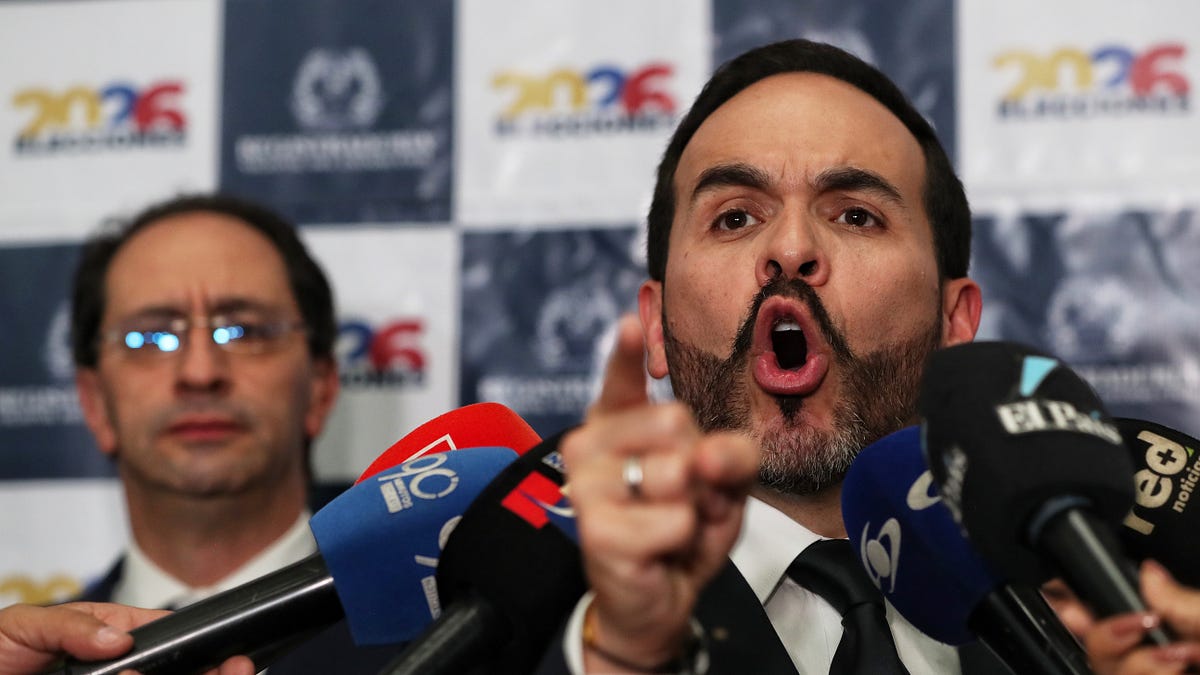
Editor’s note: Charles Sennott is off this week and so he asked our colleague Wilson Liévano to share his analysis of the recent elections in his native Colombia, what the country’s drift to the far right will mean for press freedom, and what role the Trump White House has played in the new president’s victory.
Latin America’s shift to the right took another step last month in Colombia when Abelardo de la Espriella, a right-wing lawyer running on a populist-authoritarian platform who calls himself “the Tiger,” won the presidential election by a slim margin over the government candidate, left-wing senator Iván Cepeda.
De la Espriella’s victory mirrors the ascendance of other right-wing leaders in the region, including Argentina’s Javier Milei, Chile’s José Antonio Kast and El Salvador’s Nayib Bukele. These leaders have in common their closeness to U.S. President Donald Trump, sharing with him their populist discourse, disdain for institutions, and a heavy reliance on social media, which they used to attack their perceived enemies and push misinformation.
Trump had endorsed De la Espriella in a post on Truth Social that left no room for misinterpretation: “The results of this Election are very important to the future of Colombia and its relationship to the United States. Because of his tremendous accomplishments in life, and his political support for me, personally, it is my Honor to give Abelardo my Complete and Total Endorsement.” But De la Espriella takes the comparison with Trump a step further with the disdain he has shown for journalists throughout his life and the extremes he would go to punish those who question him or his dealings. A worrying trend for the small, but mighty independent press of the country.
Months before the election, the Foundation for Press Freedom (FLIP for its initials in Spanish) indicated that De La Espriella had presented 109 lawsuits for libel and slander against journalists between 2008 and 2019, alerting of a pattern of abuse of the legal system to intimidate and silence journalists. The vast majority of these cases were thrown out by the judges, but they forced news organizations and individual journalists to spend time and resources that in many cases they didn’t have, to defend their work.
The stories that landed many of these professionals in court were exposés of the role De la Espriella and his law firm De La Espriella Lawyers Enterprise played in multiple scandals of the last decade, including the “Robe Cartel” where a former chief justice of the Supreme Court was convicted for leading a group that accepted bribes in exchange for favorable outcomes for politicians; the DMG pyramid scheme which left thousands of investors defrauded of millions of dollars; and his relationship with Alex Saab, a Colombian businessman who was at the center of multiple corruption scandals in Venezuela during Nicolas Maduro’s regime, even serving for a time as his minister of production.
Although the facts were on the side of journalists and judges ultimately agreed with them, De la Espriella was successful in his goal: “De la Espriella uses the judicial system not to seek justice or obtain a result in the courts, but to generate fear, force journalists or media to assume very high costs to defend themselves and finally end up self-censoring, thinking twice before publishing,” said Sofia Jaramillo, executive director of FLIP in an interview for the independent site Voragine.
De la Espriella himself admitted that justice wasn’t his main objective: “I have noticed that nothing hurts more that independent journalism in Colombia than their pockets. Pain in their pockets is worse than a toothache,” confessed De la Espriella in an interview seven years ago for the YouTube channel of Carlos Alonso Lucio, a former guerrilla fighter, Congressman and now chief of staff of De la Espriella’s campaign. In the interview, the new president described his approach: “I usually apply the seven plagues of Egypt; I hit them with everything. There are lawyers who only file criminal lawsuits, instead I [file] criminal, tutelas [a special recourse in Colombian law to request action when a citizen feels their fundamental rights have been infringed] and civil action,” adding that “People then have to take money out of their pockets and that is what hurts them. They’re going to think twice next time they want to point fingers again.”
This weaponization of legal procedures is similar to the strategy Trump has employed to persecute critics and perceived enemies like former FBI director James Comey, NY attorney general Letitia James and others. But the similarities don’t end there. During the campaign, De La Espriella attacked any news organization that criticized him by calling them “activists” or “political hacks disguised as journalists.” When the news organization Cambio revealed, days before election day that De la Espriella’s campaign had paid 1.299 million pesos (about $376,300) to a company that didn’t exist for services that weren’t disclosed, the campaign responded with a lawsuit and De la Espriella went on national TV to discredit them: “Many journalists think they are untouchable. Journalists question everything, but no one can question them. Journalists accuse of everything, but no one can tell them anything,” he said during an interview with Noticias Caracol on June 17.
This is particularly dangerous in a country where journalists are killed every year for doing their work, and that ranks 102 out of 180 in the Reporters Without Borders (RSF) free press index. In a recent statement, RSF’s Latin America director Arthur Romeu contextualized the danger of this rhetoric:
“When those who exercise power normalise hostility towards the press, use legal proceedings as a mechanism of pressure or systematically discredit critical journalism, they not only increase the risks for journalists and media outlets: they also weaken society’s right to access free, pluralistic, and independent information. International experience shows that these dynamics must be taken seriously. RSF recalls that the President of the Republic is subject to the highest level of public scrutiny. Investigating his decisions, alliances, contracts, relationships, and exercise of power is an essential function of journalism in any democracy. The new president has the responsibility to demonstrate through his actions that Colombia will become a country where journalists can work without fear, stigmatisation, or without abusive legal pressure. He is also expected to commit to strengthen protections for journalists in a country where two have already been killed since the beginning of the year,”
But perhaps the most concerning attack on Colombian freedom of speech happened in the United States. On June 16, ICE arrested Franklin Humberto Coral-Garrido, a left-leaning online influencer and activist known as Beto Coral. Coral, who lived and worked in Phoenix with a legal work permit, had entered the U.S. with a tourist visa and requested asylum in 2016. Coral had been a vocal supporter of the Petro government, a critic of De la Espriella and the target of a defamation lawsuit in the U.S. against former Colombian president Álvaro Uribe Vélez, where he was forced to issue a retraction for his claims linking Uribe to drug cartels.
Coral, the son of a police captain who was part of the operations that led to the death of Pablo Escobar and was later murdered, was deported shortly after his arrest. On June 19, the New York Times revealed that Secretary of State Marco Rubio issued a memo outlining the rationale for deporting Coral. In the document, Rubio claimed that Coral “has used his presence in the United States to conduct political activity in support of the Petro government.”
Rubio made clear in the memo that Coral’s criticism of De La Espriella was the main reason for his deportation, stating that “Allowing Coral Garrido to remain in the United States undermines U.S. foreign policy interests in Colombia’s democratic processes and signals that foreign nationals may use U.S. platforms to conduct politically motivated disinformation campaigns and litigation targeting foreign democratic actors without consequence.”
In a statement published after his arrest, Coral responded: “I have never been an agent of the aforementioned government, nor have I been an official or contractor. I am a Colombian living in exile; I am an immigrant Colombian who thinks freely.”
Coral’s deportation might be just the beginning. After his victory, the new Colombian president met with Republican Senator Bernie Moreno, who later posted on X: “We talked at length about illegal migration and he immediately agreed that ANY Colombian citizen claiming asylum should return to Colombia and that he would ensure their safety and security. To be clear: America welcomes immigrants who arrive legally, do not file fake asylum claims, are throughly (sic) vetted, learn our language, assimilate, and do not undermine our foreign policy.” The message is clear: if you speak against the Colombian government, you can be deported.
The threats and attacks against the press in Colombia in the last 30 years, which have included assassinations, bombings of newsrooms and harassment of journalists, have forced many reporters to seek refuge in the United States, a place where they thought their freedom of speech would be protected. But De la Espriella’s record of disdain for the press, along with his close relationship with Trump suggest that haven is disappearing.
In his victory speech, De la Espriella said he would hit drug traffickers and “bandits” hard, but within the limits of the law and the constitution. But what will happen when he faces criticism and scrutiny now that he has more power than ever before? If the example of his “friend” Trump serves as a guide, the press freedom organizations in Colombia and globally are right to be deeply concerned.