

Colombia’s $43M Caribbean Airport Has No Fuel, No Fence and Petro Never Disembarked
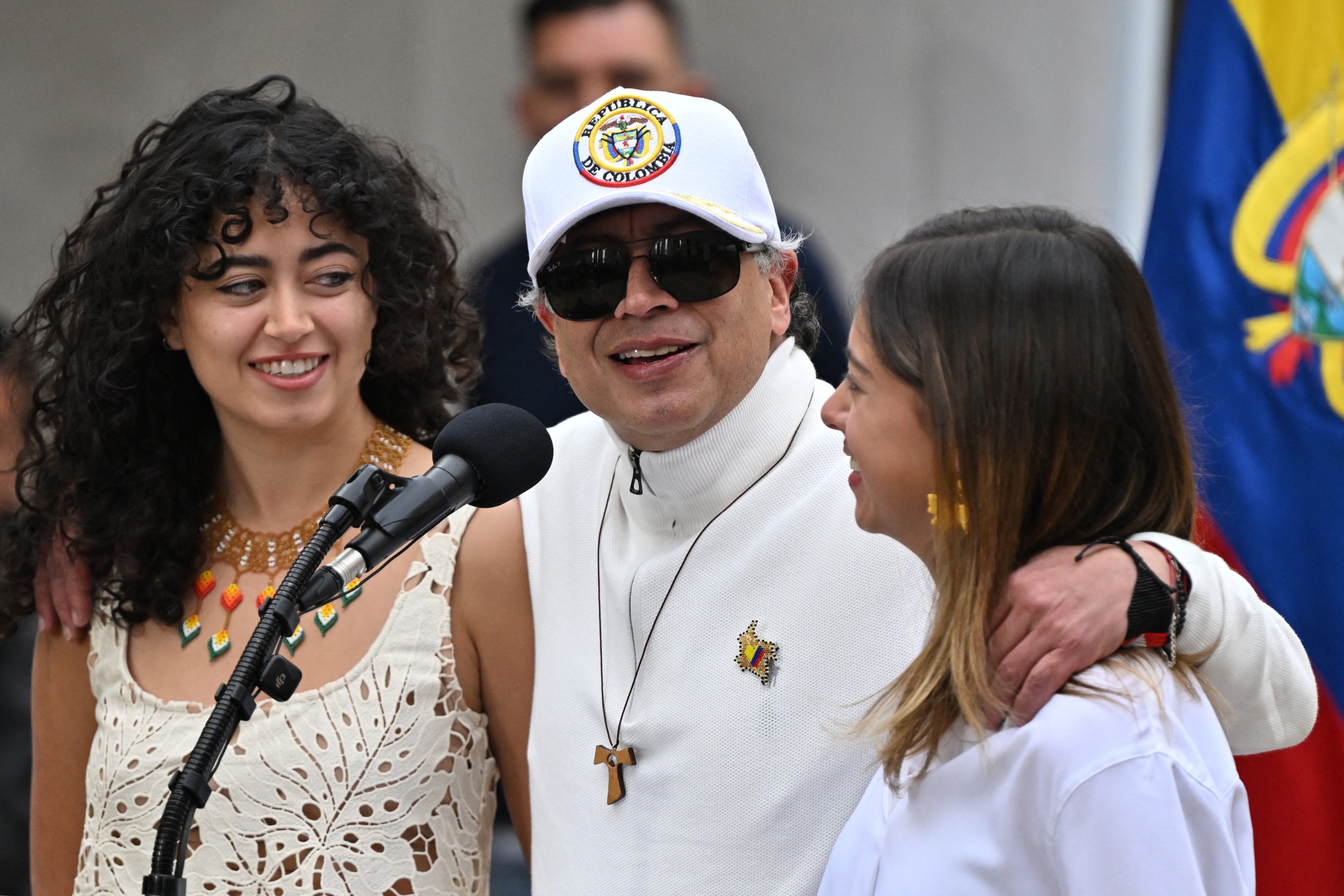
Luis ACOSTA/AFP via Getty Images
President Gustavo Petro’s aircraft landed at the Golfo de Morrosquillo Airport on Colombia’s Caribbean coast Saturday afternoon, sat on the tarmac for roughly 20 minutes with its doors shut and engines running, and then taxied back and departed — leaving dozens of invited officials, regional dignitaries, and journalists standing on the platform in bewilderment. No ribbon was cut. No remarks were delivered. No ceremony took place. The president, by his own subsequent account on social media, never left the plane.
The non-inauguration of the Golfo de Morrosquillo Airport — a $43 million investment in Caribbean air connectivity — instantly became the defining political image of the final week of Petro’s four-year administration. The government’s official social media accounts responded within hours by calling the landing itself a “delivery” of the modernized facility. Colombia’s press, watchdog groups, and the region’s own elected officials disagreed loudly.
Airport Is 15% Unfinished, Has No Jet Fuel
The core problem is not the ceremony. It is the airport’s documented state of completion.
According to the Aeronáutica Civil — Colombia’s civil aviation authority, known as Aerocivil — the Golfo de Morrosquillo project has reached just 84.75% of its contracted scope as of this weekend. In the list of items still outstanding: the airport’s perimeter security fence, which Petro himself acknowledged had not been installed (though he noted the contract for it had been awarded); a jet fuel supply system, whose absence makes commercial aircraft operations physically impossible regardless of runway dimensions; and adequate lighting infrastructure for nighttime operations.
Petro posted on X after departing: “I land in the presidential plane on the airstrip of Tolú built in my government. The fence enclosure is still needed — already contracted — and a company to supply jet fuel, which should be Ecopetrol.” He then pivoted to criticizing Ecopetrol for operating as a source of “private profits,” offering no explanation of why the ceremony was canceled or why he did not disembark.
An Airbus A320 — the 180-passenger commercial aircraft the expanded runway was specifically designed to accommodate — requires jet fuel to operate. A runway of 2,200 meters (7,218 feet) in length and 45 meters (147.6 feet) in width can physically receive an A320 at Tolú’s sea-level elevation. Without a fuel supply infrastructure, it cannot keep one flying. Commercial scheduled service is therefore not yet possible at this facility, despite the Presidency’s framing of Saturday’s flyby as the project’s formal handover.
A Promise Made, Extended, and Then Abandoned Twice
Saturday’s non-event was the culmination of at least two rounds of broken inauguration commitments.
The first missed deadline was December 15, 2025 — the original contract completion date set when Aerocivil awarded the modernization project to Consorcio Aeropuerto Tolú SC (a partnership including KMA Construcciones, Sonacol, and Constructora LHS) in November 2023. The initial contract value was approximately COP $123 billion (approximately $39 million USD). Total investment reported by the Presidency as of this weekend stands at more than COP $136 billion (approximately $43 million USD).
The second missed deadline came on May 27, 2026, when Aerocivil Director Luis Alfonso Martínez Chimenty stood alongside Petro at an official event in Sincelejo, Sucre’s capital, and publicly committed that the president would land at the new Tolú airport on July 31. Martínez acknowledged at that point that archaeological discoveries at the site had caused delays, but insisted those complications would not prevent meeting the date.
They did. The municipality of Santiago de Tolú had already issued special government decrees in preparation — restricting drone use, closing roads, and mobilizing a security apparatus — when, on the night of July 30, municipal authorities officially announced the cancelation and voided all the preparatory measures. The visit was rescheduled to August 1. The result was Saturday’s tarmac idling.
What Stopped Petro From Disembarking?
No official government explanation was ever issued for why the president remained aboard the aircraft.
A source close to the outgoing administration, cited by El Tiempo, offered the most detailed account on record: the presidential delegation had arrived in Colombia at approximately 3:00 PM local time after returning from a final international trip to Cuba, and air traffic controllers at Tolú communicated that operations could not continue past 6:00 PM. The margin was judged too tight for a ceremony.
Critics were unmoved by that explanation. The logistical difficulty of scheduling a Caribbean ceremony on the same day as a return from Cuba, five days before the end of a four-year term, is a planning problem — not an act of God.
A more structural explanation, articulated by civic watchdog Emiro Arrázola, who has followed the project since its contracting phase, is that the airport’s remaining deficiencies made a formal ceremony politically unworkable. In Arrázola’s assessment, the airport cannot yet receive A320s in its current configuration, and Tolú should have been operating those routes “more than a year ago.”
Procuraduría and Contraloría Had Already Flagged the Gap
The Tolú airport’s failure to deliver on schedule was not a surprise to Colombia’s institutional accountability bodies.
Colombia’s Procuraduría General de la Nación — the constitutional organ responsible for disciplinary oversight of public officials — had formally exhorted Aerocivil to accelerate project execution, specifically citing its runway, platform, and perimeter fencing components. The Procuraduría warned that cumulative delays were compromising the Sucre region’s economic competitiveness and limiting one of the administration’s flagship tourism-connectivity projects.
Separately, the Contraloría General de la República — Colombia’s independent audit agency — has flagged Aerocivil under multiple infrastructure project observations, presently combined with ongoing investigations into alleged irregularities including nepotism allegations within the agency. Both agencies had identified the problem before Saturday’s episode.
This pattern — formal warnings from two separate constitutional accountability organs, followed by an administration that continued to announce delivery dates the underlying evidence said were unreachable — is what civic observers in Sucre and national press alike are now pointing to as the essential story of the Tolú airport, rather than the theater of the non-disembarkation itself.
Archaeology, Delays, and a Race to the Finish Line
One genuinely complicating factor in the project’s timeline is legitimate: the site sits in a zone classified as having High Archaeological Potential, and construction crews encountered significant pre-Columbian material under the runway footprint.
Aerocivil reported that more than 360,000 archaeological fragments — belonging to pre-Hispanic communities who inhabited the Golfo de Morrosquillo region before the colonial era — were recovered during the construction process. The Instituto Colombiano de Antropología e Historia (ICANH) approved a Plan de Manejo Arqueológico (Archaeological Management Plan) via Resolution No. 0878 on June 18, 2024, requiring ongoing archaeological monitoring of all soil-disturbance activities at the site. As of the most recent available reporting, that monitoring was still active, with no confirmed end date for the archaeological phase.
Those delays are real. They were, however, known — publicly disclosed by Aerocivil itself as early as 2024. The promise made on May 27, 2026 to deliver the project by July 31 was made with full knowledge of the ongoing archaeological constraints. That the date was promised anyway, and missed, and then rescheduled, and then abandoned as a ceremony while claimed as a “delivery” via a flyby, is the accountability question the archaeological explanation cannot fully answer.
What the Incoming Administration Inherits
Petro’s mandate will end on August 7, 2026, when president-elect Abelardo de la Espriella will be inaugurated. The incoming administration will inherit the Golfo de Morrosquillo Airport at 84.75% completion: runway in place, jet fuel absent, perimeter fence pending, lighting infrastructure unresolved.
Aerocivil has not issued a revised completion schedule. The contract for the perimeter fencing has been awarded, according to Petro’s own post-flyby statement, but execution timelines have not been officially communicated. The fuel supply infrastructure — which requires a commercial fuel service agreement and potentially a dedicated fuel depot — has no named provider and no announced timeline.
For the residents of Tolú, Coveñas, and the broader Sucre coast, who have waited years for better air connectivity, the question is now whether the De la Espriella government will prioritize completing the project and on what timeline — and whether the completed runway, when fuel and fencing eventually arrive, will ultimately deliver the 39,000 annual passengers and expanded tourism flows the project was designed to generate.
For now, the most consequential thing that happened at the Golfo de Morrosquillo Airport on August 1, 2026 was a plane that landed, idled, and left. The airport is open in the sense that aircraft can physically land on its runway. It is not open in any other sense that the word “open” usually means for a commercial airport.
Currency conversions from Colombian pesos to U.S. dollars are approximate, based on rates at time of publication, and subject to change.
Frequently Asked Questions
Why didn’t President Petro get off the plane at the Tolú airport?
No official explanation was ever issued by the Colombian government. A source cited by El Tiempo indicated that the presidential delegation had arrived from an international trip to Cuba around 3:00 PM local time, and that air traffic controllers communicated that Tolú operations could not continue past 6:00 PM — leaving insufficient time for a ceremony. Critics noted that scheduling the inauguration on the same day as an international return, five days before the end of a presidential term, reflected a planning failure, not an unavoidable constraint.
Is the Golfo de Morrosquillo Airport in Tolú open to commercial flights?
The airport’s runway is physically capable of receiving Airbus A320-class aircraft — it now measures 2,200 meters (7,218 feet) in length at 45 meters (147.6 feet) wide. However, the airport currently has no jet fuel supply, which makes sustained commercial aviation operations impossible. The perimeter security fence is also uninstalled, and lighting infrastructure for night operations is incomplete. The airport is at 84.75% of its contracted scope as of August 2, 2026. Satena resumed limited service in late November 2025 using smaller ATR-class aircraft, but full commercial operations with larger jets are not yet possible.
How much did Colombia spend on the Tolú airport expansion?
The total investment reported by the Petro administration stands at more than COP $136 billion (approximately $43 million USD). The original Phase 1 contract awarded in November 2023 was valued at approximately COP $123 billion (approximately $39 million USD). The project’s original completion deadline was December 15, 2025 — more than seven months before the presidential term ended.
What happens to the airport now that Petro is leaving office?
Petro’s mandate will end on August 7, 2026. President-elect Abelardo de la Espriella’s incoming administration will inherit the airport at 84.75% completion, with the jet fuel supply, perimeter fencing, and lighting systems still outstanding. Aerocivil has not issued a revised delivery schedule. Whether the incoming government prioritizes completing this specific project — and on what timeline — has not been announced.