

Colombia Emerges As Major World Cup 2026 Title Contender
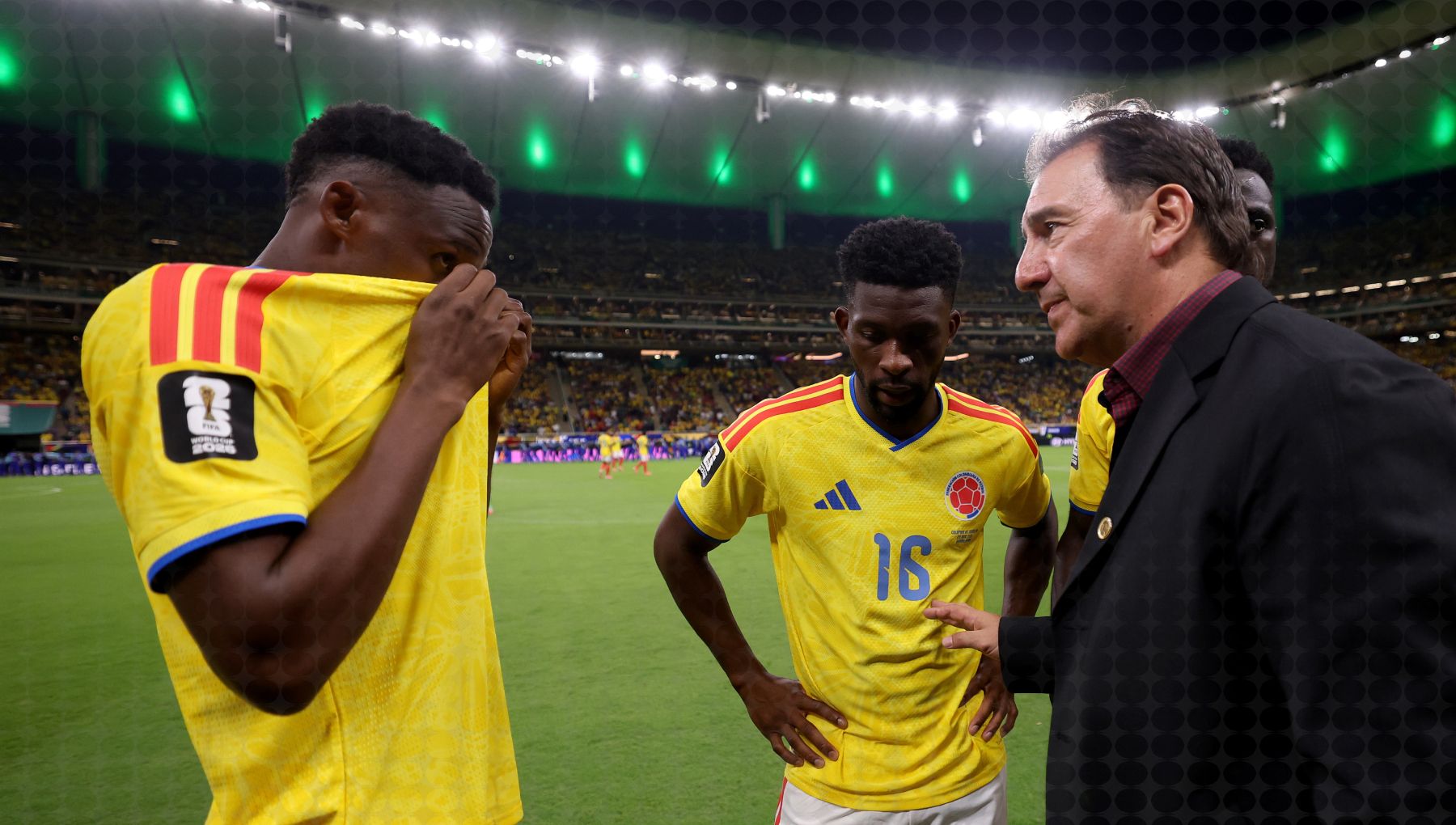
(Photo by Carl Recine/Getty Images)
We have officially reached the halfway point of the 2026 FIFA World Cup, with the field of 48 teams whittled down to 32. Of those 32, only England, Spain, Germany, France, Brazil and Argentina have won the World Cup, leaving several potential contenders with an opportunity to claim their maiden title.
Going into the tournament, several dark horses were tipped to challenge for the ultimate prize, including Senegal, Morocco, Japan and the Netherlands, but none were as heavily favored as Portugal. After all, Portugal has grown accustomed to winning silverware, having claimed the 2016 European Championship and the UEFA Nations League in 2019 and 2025.
Portugal has arguably the best left back in the world in Nuno Mendes and two of the game’s top central midfielders in João Neves and Vitinha, who, alongside Mendes, have helped Paris Saint-Germain win back-to-back Champions League titles. The squad also features Premier League Player of the Season Bruno Fernandes and several other players competing for the world’s biggest clubs, including João Cancelo and Rúben Dias. Portugal was considered one of the leading favorites alongside Argentina and France rather than an underdog.
But on Saturday night in South Florida, Colombia proved it has just as strong a claim as Portugal to the title of the tournament’s prime dark horse.
Odds as of 6:00 a.m. ET on June 29.
Colombia Sets the Tone Against Portugal
Los Cafeteros began their tournament with a gutsy 3-1 win against Uzbekistan in Mexico City before edging the Democratic Republic of the Congo 1-0 in Guadalajara. Portugal, meanwhile, was held to a subdued 1-1 draw by DR Congo before bouncing back with a 5-0 demolition of Uzbekistan, with both matches played in Houston.
Although Colombia had secured its place in the knockout round with one game to spare, it needed to avoid defeat to ensure first place in Group K.
Sensing the need to give his key players a breather ahead of potentially five knockout matches, Colombia manager Néstor Lorenzo made several changes to his team. Daniel Muñoz and Johan Mojica dropped out of the fullback positions, making way for Santiago Arias and Deiver Machado, while Jhon Córdoba replaced Luis Suárez up front. Portugal manager Roberto Martínez made just one change, with Rúben Neves replacing João Neves in midfield.
Colombia nearly drew first blood when Davinson Sánchez sent a pass toward Luis Díaz, who got the better of Cancelo and fired a shot that took a deflection and fell to Córdoba. The striker made a mess of his point-blank header, sending it over the crossbar.
The message had officially been sent: Colombia was not going to take its foot off the gas. With a sea of yellow shirts packing Hard Rock Stadium, Los Cafeteros were constantly encouraged to keep accelerating and forcing the issue.
They played with pace, panache and personality, with Jhon Arias skipping past an array of red shirts and finding Córdoba, who forced a strong save from Diogo Costa before seeing another effort cleared off the goal line by Neves.
After surviving a tempestuous spell of pressure from Portugal before halftime, Colombia took control and continued to play the game on its own terms. James Rodríguez and Jefferson Lerma both tried their luck from long range, forcing Costa into strong saves.
Despite not needing a victory to secure first place, Colombia looked far livelier, spreading the ball around with ease, slicing through Portugal’s defense in transition and showing plenty of conviction and purpose in possession.
Had Davinson Sánchez stretched his foot a fraction farther, he might have sealed a late victory. Instead, the match ended in a stalemate that, in truth, was far closer to becoming a Colombian win than a Portuguese one.
Lorenzo Transforms Los Cafeteros
Just four years ago, Colombia’s players were watching the World Cup from their sofas after a disastrous qualifying campaign. In the wake of that national embarrassment, Colombia hired Néstor Lorenzo, whose only previous head coaching experience had come during a brief tenure with Peruvian club Melgar.
Despite his lack of experience, the Argentine quickly validated the federation’s trust, spearheading a 28-game unbeaten run that included wins against Spain, Brazil, Uruguay and Germany.
Lorenzo guided Colombia to its first Copa América final in 23 years, with the team scoring an unprecedented 12 goals during the tournament before losing to Argentina in extra time. This current version of Los Cafeteros may be even better.
“I think that we needed to improve and evolve in certain aspects,” Lorenzo told RG after the match. “There were also some potholes in our path. When you prepare a player to play in a World Cup, you know that his quality, as well as the team’s collective quality, in the first few games is going to drop because of the nerves and different situations.
“Here, we’ve had players come from second divisions in Europe, like the Segunda División and the EFL Championship. It’s not easy to come and play in a World Cup with this shirt. We had to take it little by little, giving them games and helping them adapt to the shirt.”
“In the Copa América, we achieved it: Our team was flying high, they knew each other by heart, and over the course of two years, one player’s level drops, one player’s level rises, and another player like [Gustavo] Puerta appears and surprises everyone,” Lorenzo continued.
“We have to keep identifying things and seeing what each person gives the team. Sometimes there are distinct characteristics that work for different games or different strategies, and that’s taken into account as well.”
Can Colombia Make History?
For all the world-class footballers Colombia has produced, the country has not managed to translate that talent into sustained success on the world stage. Its only major trophy came at the 2001 Copa América, when Argentina and Canada withdrew shortly before the tournament.
Los Cafeteros were eliminated in the group stage in their World Cup debut in 1962 and needed nearly three decades to return before suffering early exits in 1990, 1994 and 1998.
They returned 16 years later, winning their first four matches before losing to Brazil in the quarterfinals. In 2018, Colombia topped its group before losing to England on penalties in the Round of 16.
Today, Colombia is undoubtedly one of the leading contenders among the teams still searching for their first World Cup title. With Lorenzo at the helm and a group of players working in harmony and putting its best foot forward, there is every reason to believe Los Cafeteros are primed for another deep run.
Canadian fans following the knockout stage can also explore RG’s World Cup 2026 betting bonuses in Canada before Colombia’s next match. Los Cafeteros are priced at 23.00 with Tooniebet to win the World Cup, followed by Bet99 at 28.00, 29Black at 29.00, Stake.com at 31.00, and both 1xBet and 22Bet at 35.00.
Colombia will face Ghana in Kansas City on Friday in the Round of 32, while Portugal will take on Croatia on Thursday in Toronto.