

Colombia Earthquake: 294 Dead, Recovery Tests New President in Conflict-Torn Choco
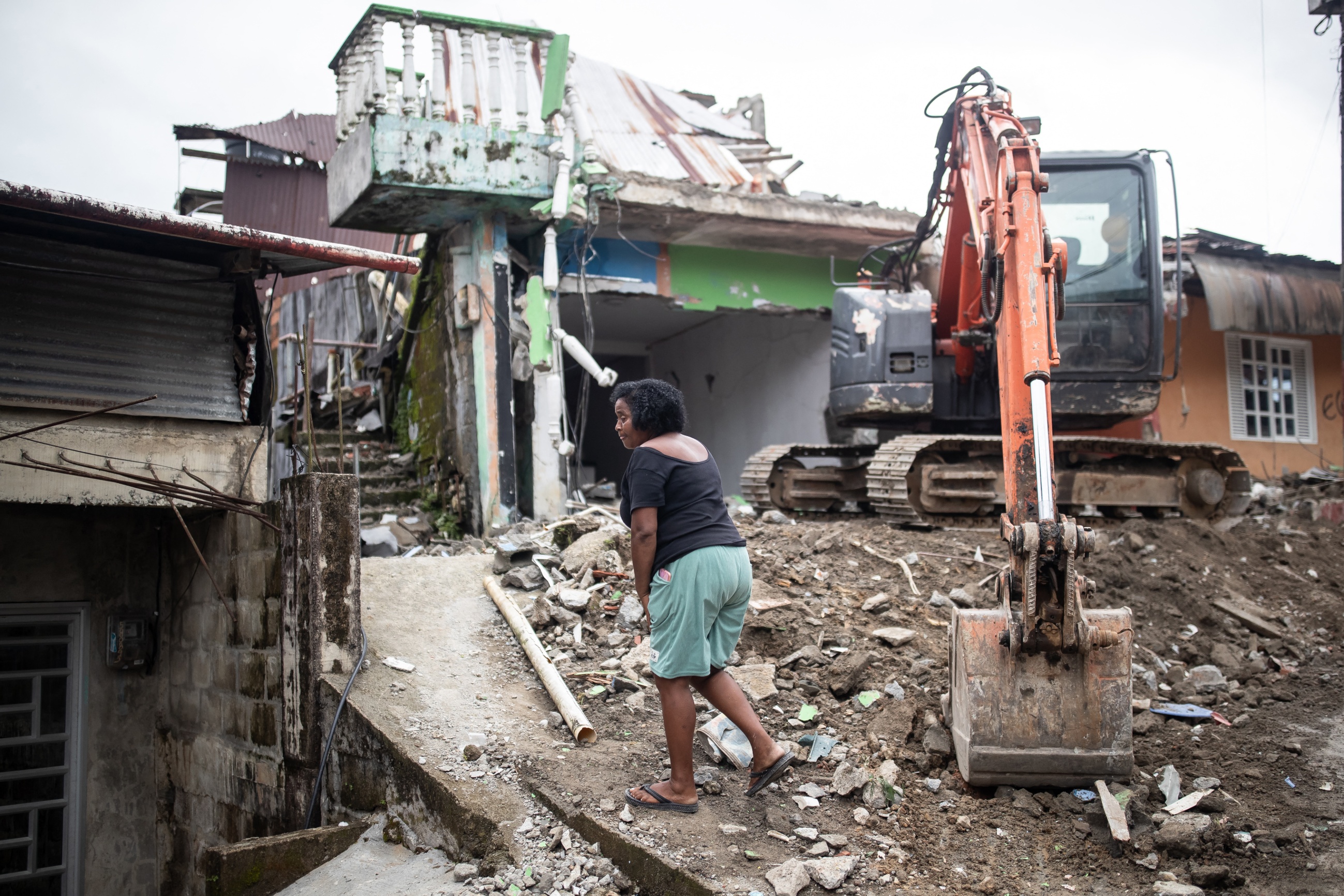
ESTEBAN VEGA LA-ROTTA/AFP via Getty Images
Seven days after a magnitude 7.4 earthquake tore through western Colombia, the confirmed death toll has reached 294 — making this the country’s deadliest seismic disaster since 1999 — with 320 people still listed as missing and the hardest-hit department, Chocó, still largely cut off from the outside world by a combination of geographic isolation, destroyed roads, and armed groups that were actively blocking humanitarian access before the ground began to shake.
The scale of destruction now confirmed is staggering by any measure: more than 12,000 homes destroyed, more than 74,000 residences damaged, more than 200 roads cut or impassable, five airports affected, 44 aqueducts damaged, and 14 of Colombia’s 32 departments touched by the disaster. The United Nations says the earthquake affected more than 34 million people across four countries who felt the shaking on the morning of August 10.
That breadth helps explain why the dollar figures accompanying international aid look so large: the World Bank disbursed $200 million to Colombia on August 13; the Inter-American Development Bank committed $300 million; the United States committed a total of $26.5 million in direct earthquake relief; and the European Union allocated €2 million (approximately $2.3 million USD) — all part of an international aid total exceeding $1.3 billion. Business leaders raised more than $10 million at the ANDI Congress on August 14 alone. The Vuelta a Colombia, the country’s premier cycling race, was canceled after five stages — three days before its scheduled conclusion on August 16 — with road closures required to support rescue operations.
But money and goodwill are not the same thing as access, and access is the problem that no check can solve in Chocó.
What Chocó Faces That Other Cities Do Not
Chocó, the remote Pacific department where the earthquake’s epicenter sits near the small municipality of San José del Palmar, was already in a humanitarian emergency before August 10. According to the Norwegian Refugee Council, nearly 9.9 million Colombians live in areas where non-state armed groups are present, and Chocó registered more people in forced confinement — a condition in which armed actors physically prevent communities from leaving their territory — than any other department in the country. The United Nations Office for the Coordination of Humanitarian Affairs documented 172,395 people forced into confinement across Colombia between January 2025 and March 2026, with Chocó the hardest hit.
The International Rescue Committee’s country director for Colombia, Venezuela, and Ecuador, Nicole Kast, put it plainly on the day of the earthquake: “Local communities were already facing armed conflict and high levels of poverty long before the ground began to shake. We are deeply concerned that today’s natural disaster will make the needs on the ground even steeper as people lose access to health care and other essential services.”
Shirley Hidalgo, senior director of operations for World Vision in Colombia, confirmed that San Juan and Baudó — two of Chocó’s key river-basin subregions — were “currently inaccessible and isolated” as of August 11, with local authorities requesting urgent medical supplies from outside. Those are river-basin communities reachable primarily by boat; roads that existed before the earthquake were already limited, and the quake triggered landslides that, per USGS estimates, affected a significant area with a significant population exposed.
Armed groups in Chocó have been actively fighting each other for territorial control, and those conflicts — involving FARC dissident factions and other organizations — make aid delivery qualitatively different from relief operations in Colombia’s damaged cities. The Estado Mayor Central, a FARC dissident group present in at least 133 municipalities across Colombia, formally banned UN verification missions, the OAS peace process mission, and Colombia’s Ombudsman’s Office from its territories in March 2026, citing “violations of trust.” Relief groups in Colombia recorded 51 humanitarian access restrictions in Chocó and surrounding departments between January and July 2026 alone — 20 more than the same period in 2025 — and had their vehicles stolen, their routes blocked, and their staff’s phones checked at gunpoint.
“The context has been characterized by the expansion and strengthening of non-state armed groups, an increase in territorial disputes, and in high-impact armed actions,” Yann Cornic, director of the Danish Refugee Council office in Colombia, told The New Humanitarian before the earthquake. “These factors have created greater risks for the affected communities and have significantly complicated the conditions for providing humanitarian assistance and protection.”
The International Organization for Migration described critical infrastructure damage across multiple departments affecting water, health, energy, education, and telecommunications. In Chocó’s capital, Quibdó, Governor Nubia Carolina Córdoba-Curi confirmed injuries and structural damage but noted that detailed assessment was hampered by the department’s limited road access — much of it reachable only by boat or plane.
The Cities: Scale of Destruction in Numbers
Outside Chocó, the damage in Colombia’s departmental capitals was severe enough to explain why more than 97 percent of fatalities came from those urban centers — a distribution that points directly to the building stock, not merely the shaking intensity.
Colombia’s seismic building code, the NSR-10 (Normas Sismo Resistentes), mandates earthquake-resistant construction across all formal projects. But research presented at the 2016 World Conference on Earthquake Engineering documented that three of every five new homes in Colombia were being built informally — without legal procedures, without formal design, without NSR-10 compliance. In 2024, the Colombian Association for Earthquake Engineering published the AIS 410-23, the country’s first informal-housing seismic regulation, specifically designed to evaluate and reduce seismic vulnerability in existing informal masonry housing. Those regulations existed on paper; the earthquake tested what had actually been built.
In Cali, Colombia’s third-largest city, at least 40 large buildings collapsed and more than 75 people died in the city alone. The pediatric and neonatal sections of a major Cali hospital were partially destroyed, trapping patients and staff. A pedestrian bridge collapsed. Cali Mayor Alejandro Eder told reporters on Wednesday that “every minute is vital” and that rescue teams were concentrating on 56 large buildings that had collapsed or sustained severe structural damage.
In Pereira, at least 60 people died on the first day. Sixteen people were trapped for several hours in an aerial cable car system before being evacuated. The fate of Pablo Loaiza, a street vendor whom rescue crews believed might still be alive beneath a collapsed bakery — crews using vibration-detection equipment reported possible signs of life, drawing his 16-year-old niece Sara Loaiza to the site — remained unresolved as of August 15. Manizales Mayor Jorge Eduardo Rojas reported that his city had received thousands of requests to assess damaged homes, a process he said would take at least a month.
Daniela Largo, a woman trapped in the rubble in Pereira, was pulled alive from Pereira rubble more than 30 hours after the quake in a complex rescue in which crews carved a small opening in the debris to free her pinned arm and a doctor administered IV fluids to stabilize her. A baby was pulled alive from a collapsed apartment building in Cali hours after the earthquake. A fire broke out at a jail in Buenaventura following the tremor, killing at least four people and hospitalizing two more, according to Valle del Cauca Governor Dilian Francisca Toro.
Colombia’s National Disaster Risk Management Unit (UNGRD) recorded more than 130 aftershocks in the first week, the strongest of which registered magnitude 5.0.
A New President Tested on Day Three
Abelardo de la Espriella had been Colombia’s president for exactly three days when the earthquake struck. The far-right criminal lawyer and businessman, who was endorsed by US President Donald Trump and won Colombia’s presidential election in June, was inaugurated in Cali — the first time a Colombian leader had taken the oath outside Bogotá — on August 7.
In his inaugural address, de la Espriella pledged to make Colombia a leader in digital technology. He called for training Colombian children and young people in “Artificial Intelligence, programming, data science” as pillars of his education reform vision. He also announced that Colombia was joining the “Shield of the Americas,” a US-led regional security alliance, and that the United States would work with Congress on a $1.1 billion security assistance package for Colombia — described by his administration as “the most significant support in decades for the bilateral alliance.” The promised digital transformation and the promised security crackdown would both collide with the earthquake’s demands within 72 hours.
De la Espriella convened an emergency committee, personally toured earthquake-affected cities in the coffee region, and announced economic relief measures including rental subsidies and suspension of utility bills and tax filings for survivors. He pledged to rebuild. “The impact is enormous” and requires great determination, he told reporters.
His administration’s management of international rescue assistance drew controversy, however. In the first days, Colombia restricted which certified urban search-and-rescue teams it would accept, formally requesting assistance only from El Salvador, Ecuador, Israel, and the United States. Mexico’s Topos de Tlatelolco — volunteer rescue specialists with extensive experience responding to natural disasters across Latin America — announced they had been told Colombian authorities would not allow external rescue groups, touching off a public backlash in both countries. Mexico’s President Claudia Sheinbaum confirmed her government was ready to deploy but had not received formal approval. Colombian Foreign Minister Omar Bula pushed back, saying Colombia had “not excluded absolutely any country” in terms of offers received and that decisions reflected international certification requirements rather than political considerations.
The Topos ultimately arrived, redeployed from earthquake relief operations in Caracas, Venezuela, and joined US, Spanish, and other international teams conducting advanced urban rescue operations in Cali with stabilization drones and search dogs. El Salvador President Nayib Bukele, meanwhile, publicly claimed Colombia had rejected international rescue team offers — a characterization that added diplomatic friction to the already-tense early days.
The rescue team controversy matters beyond the optics because it coincided with a broader concern: whether de la Espriella’s pledge to pursue a military crackdown against armed groups — his so-called “Patriot Plan 2.0,” modeled on an earlier Uribe-era offensive against guerrilla groups — will make the humanitarian situation in Chocó worse rather than better. Aid organizations on the ground in Colombia expressed concern that a new military offensive would cause armed groups to tighten their territorial control and increase their restrictions on humanitarian access — precisely the conditions that were already blocking earthquake recovery.
“Armed groups don’t know what’s coming and are already increasing restrictions,” a staff member of one humanitarian organization told The New Humanitarian, speaking anonymously. “There’s more mistrust with humanitarian organizations too, so we’ve tightened our security and focused on building trust with communities.”
How Does This Compare With What Came Before
The 1999 Armenia earthquake, a magnitude 6.2 event that struck Colombia’s coffee-growing region at a relatively shallow depth of approximately 17 km (11 mi), killed more than 1,100 people and left more than 250,000 homeless — catastrophic damage despite its lower magnitude, because shallow earthquakes deliver their energy directly to the surface. Monday’s August 10 earthquake struck at 96 km (60 mi) to 107 km (66 mi) depth — classified as “intermediate depth” by seismologists — which spread its energy over a far larger horizontal area, explaining why 34 million people across four countries felt the shaking while the strongest intensities remained concentrated in the cities closest to the epicenter.
Rodrigo León Loya, a seismologist and geosciences professor at the University of the Andes, noted that the probability of an earthquake of similar magnitude occurring in the same area is low, but added: “Let’s remember that Colombia is full of active fault lines. The question isn’t whether it can happen again.” The seismologist’s comments to NPR reflected a consensus among Colombian earth scientists that the August 10 event should accelerate, not delay, infrastructure investment.
Colombia’s geological survey characterized the August 10 event as the strongest earthquake recorded in the country this century. The event arrived less than seven weeks after back-to-back earthquakes of magnitudes 7.2 and 7.5 struck Venezuela on June 24, 2026, killing more than 6,000 people — both events powered by the same Nazca Plate subduction system that makes South America’s northwestern coast one of the most seismically active regions on Earth.
How Is Help Reaching the Country?
The international response to Colombia’s earthquake mobilized faster than the rescue controversy suggested. Beyond the World Bank’s $200 million and the IDB’s $300 million, Germany, Canada, France, Japan, and the United Kingdom sent field hospitals and relief supplies including water purification systems and medical equipment. UNICEF scaled up operations to support children and families particularly in Chocó and the port city of Buenaventura. Direct Relief, working with Colombia’s Patrulla Aérea Civil Colombiana, airlifted medical aid to Chocó — wound-care equipment, surgical supplies, antibiotics, and blood units — to Condoto and other hard-to-reach communities.
In Pereira and Cali, displaced residents were housed in converted sports arenas, schools, and community buildings. Families like Edith Penagos, 48, sheltering in a temporary tent in Pereira with her teenage son, described conditions as difficult but manageable. “We have the most important things: a roof over our heads, food, water and, in my case, medical care,” she told reporters.
The Red Cross’s director for the Americas warned that the operation would not be short: “This operation is going to be a long process.” That assessment reflected not only the scale of physical destruction but the structural reality of Chocó — where the road to recovery runs directly through armed territory that is now also earthquake-damaged territory.
Does This Have to Happen Again?
Colombia introduced earthquake-resistant building codes in 1984, following the 1983 Popayán earthquake, a 5.6-magnitude event that killed more than 250 people. The current standard, the NSR-10, has been updated multiple times and, according to structural engineering experts, modern buildings built to the current standard are generally well-prepared for the seismic forces this region reliably produces. The problem is that large portions of Colombia’s urban housing stock were not built to any formal standard.
According to data cited at the 2016 World Conference on Earthquake Engineering, three of every five homes in Colombia at that time were being built informally, without formal design or legal procedures — and thus without NSR-10 compliance. The fact that 97 percent of the 294 confirmed fatalities came from departmental capitals — not from remote rural villages — points directly at urban informal construction, concentrated masonry buildings in dense neighborhoods, as the primary failure mode. In 2024, Colombia took a step toward addressing this with the AIS 410-23, its first regulation specifically targeting seismic risk reduction in existing informal masonry housing. That standard existed for less than two years before the August 10 earthquake tested the building stock it was designed to protect.
Exchange rate as of August 17, 2026; conversions are approximate.
Frequently Asked Questions
How many people died in the Colombia earthquake 2026, and what is the current situation?
As of August 16, 2026, Colombia’s National Disaster Risk Management Unit (UNGRD) confirmed 294 deaths, 320 people still listed as missing, and approximately 4,000 injured. Those figures represent a steady increase across the week from the initial confirmed count of 111 on the day of the quake. The rescue phase formally concluded after the critical 72-hour window passed on August 13; operations have since transitioned to recovery and reconstruction. International aid now exceeds $1.3 billion, but physical access to the most remote communities in Chocó remains limited by damaged roads, destroyed infrastructure, and armed groups operating in the department.
Why is Chocó harder to help than Cali or Pereira?
Three factors stack on top of each other. First, geography: much of Chocó has never had reliable road access, relying instead on river transport and air links, both of which were disrupted by the earthquake. Second, active armed conflict: non-state armed groups in Chocó were already restricting humanitarian access before the earthquake struck, and the new president’s announced military offensive against those groups is expected, according to aid organizations on the ground, to make them tighten their territorial control further rather than open up. Third, poverty: Chocó is Colombia’s poorest department, with chronic under-investment in infrastructure that made it structurally vulnerable before any earthquake occurred. The combination means that even when aid money arrives, the pipeline to get supplies to communities in the San Juan and Baudó river regions remains broken at multiple points simultaneously.
What is the new president’s plan for Colombia’s recovery, and what concerns have aid groups raised?
President de la Espriella declared a national disaster, toured earthquake-affected cities, announced rental subsidies and utility bill suspensions for survivors, and accepted more than $1.3 billion in international assistance. His administration also announced a “Patriot Plan 2.0” — a military offensive against armed groups across Colombia, modeled on an earlier Uribe-era crackdown — framed as a national security priority. Aid organizations including the IRC, INSO, and the Danish Refugee Council have warned that intensified military operations historically lead armed groups to tighten their territorial control and increase restrictions on humanitarian actors, which would directly impede earthquake recovery in conflict-affected areas like Chocó. The tension between security and humanitarian agendas in the same territory is real and unresolved.
Did Colombia block Mexico’s earthquake rescue teams?
The situation was more nuanced than the initial reporting suggested. Colombia’s government initially restricted formal acceptance of international rescue teams to those from El Salvador, Ecuador, Israel, and the United States, citing compliance with international certification requirements for urban search-and-rescue operations. Mexico’s Topos de Tlatelolco, a specialist volunteer rescue group, were told by Colombian authorities they would not be allowed to enter. Mexico’s President Claudia Sheinbaum confirmed her government was ready but had not received formal approval. After public controversy, the Topos ultimately arrived in Cali, redeployed from Venezuela earthquake operations, and joined rescue operations alongside US, Spanish, and other teams. Colombia’s Foreign Minister stated that no country had been excluded from consideration.