

Chinese military strategizes to target US warships from 1,800 miles away
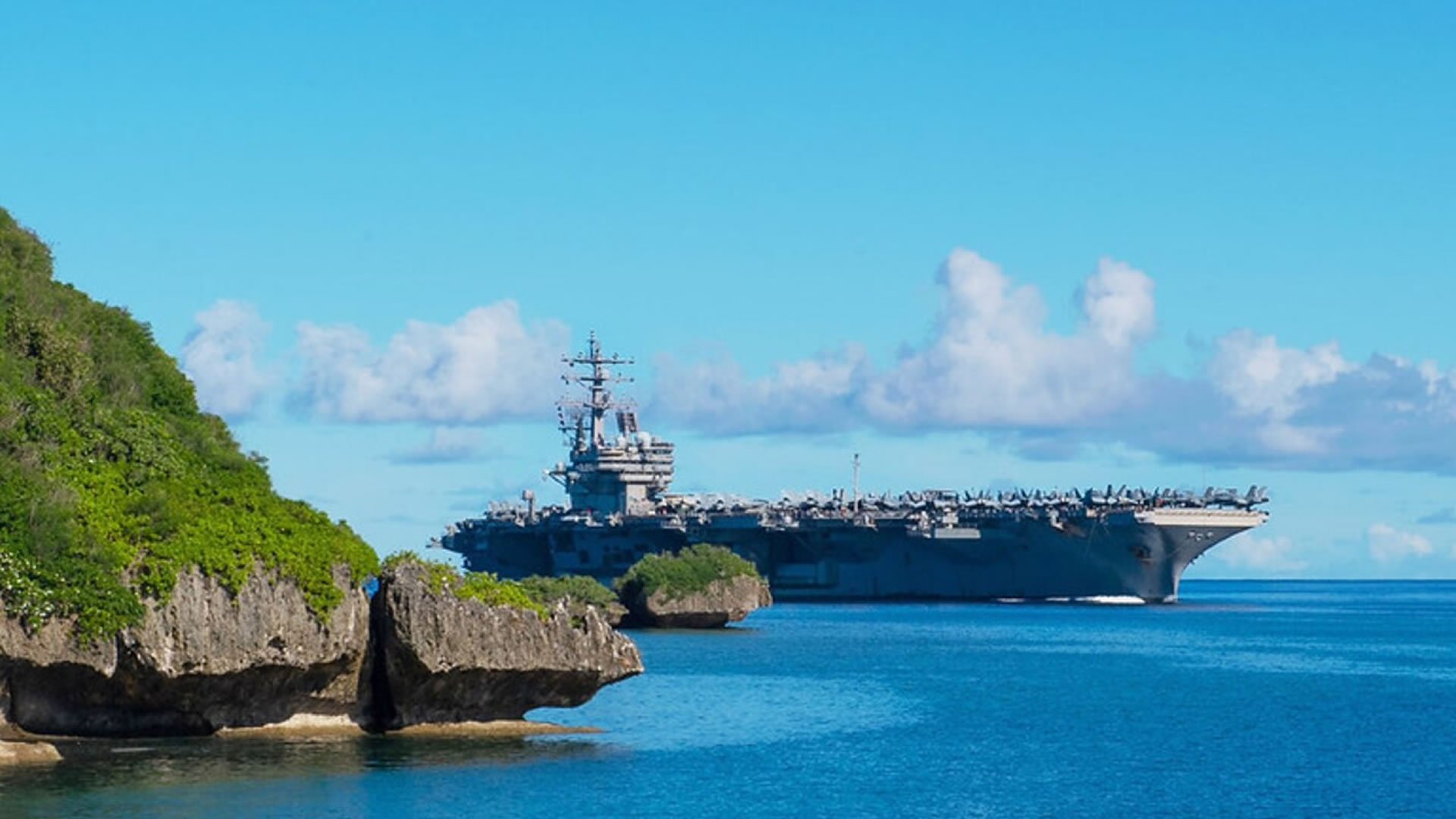
Chinese military planners have reportedly devised a plan to target US carriers in places like Guam. The strategy, published in the Chinese journal Tactical Missile Technology, claims a combination of satellites, AI, and missiles could render carrier groups vulnerable, even at distances of over 1,620 nautical miles (3,000 km).
At present, both the People’s Liberation Army (PLA) and the United States Navy know that the former can threaten critical assets like aircraft carriers close to China. To reduce that threat, the US Navy has increasingly positioned key assets farther from China’s coastline, relying on bases such as Guam and adopting more dispersed operating patterns across the Pacific.
The Navy has also been dispersing deployed ships in the region to make them much harder to find, track, and potentially attack. Not keeping their eggs in one basket, as it were.
However, as the South China Morning Post (SCMP) reports, the PLA has been working on a potential plan to threaten such ships even at great distances. Led by associate professor Gao Tianyun from the College of International Studies at the National University of Defence Technology in Nanjing, the proposal is very interesting indeed.
Dangerous game of hide-and-seek
The study, titled “Research on the effectiveness of anti‑ship missile swarm operation under distributed confrontation,” basically describes an innovative “kill-chain” solution rather than a new wonder weapon.
The idea, in a nutshell, is to first find the group using a mixture of satellites, drones, radar aircraft, ships, submarines, signals intelligence, etc. Once done, the plan would rely on near-constant tracking for long-range missiles to be targeted and launched.
With that achieved, the paper suggests firing many missiles (a mix of hypersonics and “pre-strike firepower packages”) at the target, not one or two.
Once in flight, the plan would rely on the missiles cooperating by sharing target data, sorting real ships from decoys, assigning themselves to different targets, and attacking from different angles.
According to the researchers, such a coordinated attack could overwhelm layers of US naval defense, including Aegis-equipped destroyers, interceptor missiles, electronic warfare systems, decoys, and close-in weapon systems.
So, something of a coordinated, long-range missile swarm attack. The point is to make the US defence system run out of time, interceptors, radar capacity, or correct target choices.
Means and motive
Sounds reasonable on the surface, but the plan comes with one major caveat. That being said, this is just a plan right now, not proof that China can actually do it tomorrow.
Needless to say, hitting a moving carrier group at 1,620 nautical miles distant is not an easy task. Achieving it in reality would be brutally hard because the target moves, hides, jams, uses decoys, and fights back.
The hardest part is not the missile range; it is maintaining accurate targeting data across the whole chain. While effectively just a wargame made public, the release of this information is likely intended to send a warning to the US, rather than actually boast about its technological prowess.
In effect, they are saying that hiding and dispersing your ships won’t necessarily keep you safe. We (China) have the means to get them if we want to.