

China’s YJ-20 hypersonic missile tilting Pacific’s naval balance
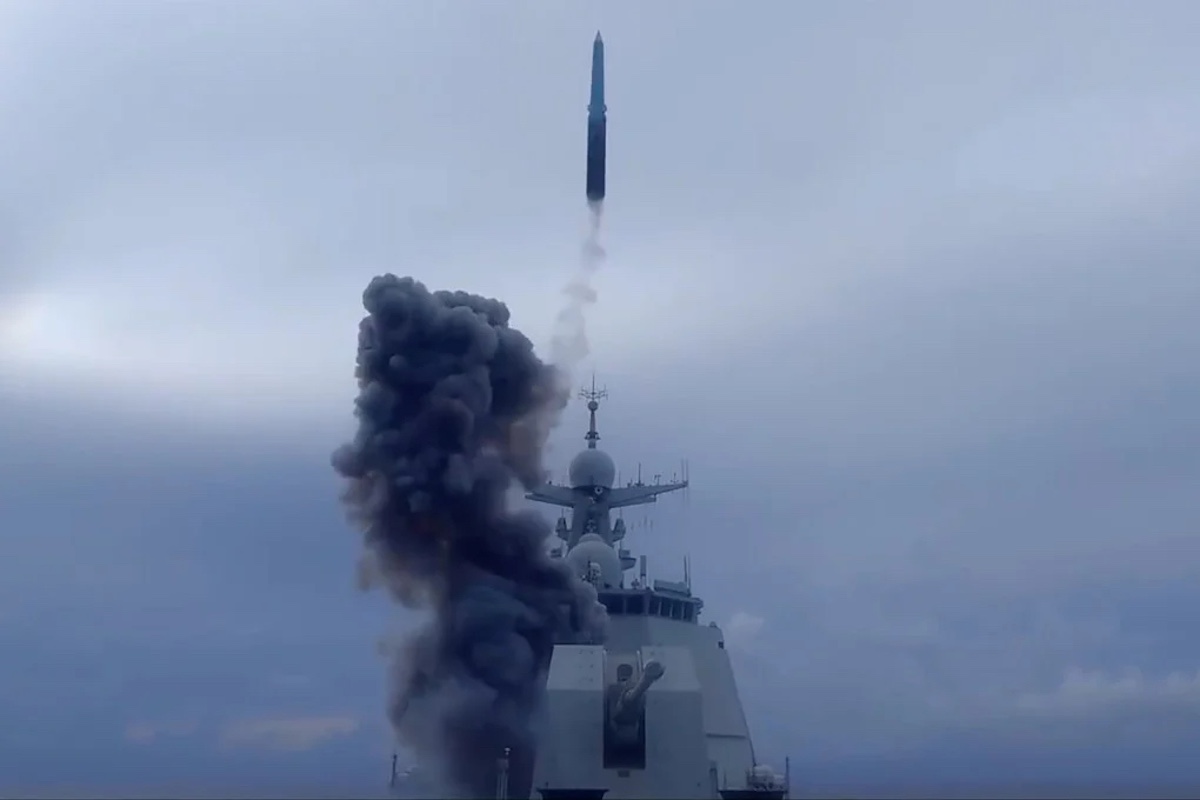
Footage broadcast by Chinese state television in July showed a YJ-20 hypersonic anti-ship ballistic missile fired from the vertical launch system of a Type 052D destroyer, marking a quiet but significant shift in the region’s naval balance.
Until now, the YJ-20 was thought to be reserved for China’s 12,000-ton Type 055 super destroyers, its most advanced ships. It’s now being rolled out across the far more numerous Type 052D fleet, too.
That’s not just a technical upgrade – it’s a sign the weapon is moving from a flagship showpiece to standard fleet equipment. It suggests China’s sea-based hypersonic strike system has matured to the point where it can deny access to the Western Pacific and potentially render traditional surface warships obsolete.
Technologically, the YJ-20 stands at the apex of modern anti-ship missilery. It uses a biconic glide vehicle and a solid-fuel booster, reaching speeds above Mach 6 in mid-course before diving nearly vertical at speeds close to Mach 10.
That’s different from older ballistic missiles, which fly predictable arcs that air-defense computers can calculate in advance. The YJ-20 instead employs quasi-ballistic “skip-glide” maneuvers through the upper atmosphere, changing altitude and direction as it flies.
By dynamically altering its altitude and direction, the hypersonic weapon effectively invalidates the predictive interception algorithms of the US Navy’s premier shipborne defense systems, such as the Aegis-integrated Standard Missile-3 and Standard Missile-6.
This seaward expansion also changes how the roles are divided within China’s People’s Liberation Army (PLA). Historically, Beijing’s anti-access (A2/AD) strategy leaned mainly on the PLA Rocket Force’s road-mobile missiles, like the DF-21D and DF-26. Those are powerful, but they’re tied to the mainland and can be tracked by satellite once they leave their bases.
By integrating the YJ-20 into the universal vertical launch systems of mobile, highly survivable surface combatants, the PLA Navy (PLAN) has unmoored its hypersonic strike capacity from the mainland.
Guided by real-time targeting data from the Yaogan-Beidou satellite constellation, these mobile naval nodes can generate multi-axis, unpredictable attack vectors directly from the open ocean.
In turn, that pushes China’s reach well past the First Island Chain. With an effective range of 1,000 to 1,500 kilometers, and potentially closer to 2,000, a single Type 052D patrolling the Bashi Channel or the Philippine Sea can threaten enemy ships hundreds of miles from China’s coast.
Strategic chokepoints that once served as natural barriers protecting allied naval movements are now transformed into forward launchpads. As a result, the maritime sanctuary that foreign Carrier Strike Groups historically counted on east of Taiwan has effectively vanished.
Saturation math
The strategic weight of this capability lies in the staggering industrial velocity of Chinese naval shipbuilding.
The PLAN currently has 10 Type 055 destroyers, but more than 35 Type 052D destroyers, with new ones joining the fleet every year. Together, these ships carry over 3,800 universal vertical launch cells capable of firing long-range surface-to-air, cruise and hypersonic weapons.
By putting the YJ-20 on both ship classes, China is shifting the operational math from qualitative deterrence to quantitative saturation.
In any major confrontation, a single Surface Action Group can launch a coordinated, multi-directional hypersonic salvo that rapidly exhausts the finite interceptor inventories of allied escort fleets.
Releasing the footage of the YJ-20 was a deliberate move. Timed alongside other state media coverage of military readiness, the imagery sends a blunt message to Washington and its regional allies: intervening in a Western Pacific crisis would come at a steep cost in ships.
This public display is likely designed to manipulate Western risk calculus, raising the political and military costs of intervention to levels Washington decision-makers may find unacceptable. Domestically, it reinforces nationalistic confidence in the military’s technological superiority under President Xi Jinping.
The timing of this operational rollout correlates directly with intelligence projections regarding a potential conflict over Taiwan around 2027.
The year 2027, marking the centennial of the PLA’s founding, represents a critical threshold where the volume of sea-based hypersonic munitions and compatible surface hulls is expected to achieve a tipping point.
Beyond this point, the sheer density of forward-deployed Chinese hypersonic firepower will be capable of neutralizing American forward intervention capabilities before allied strike groups can establish operational dominance.
Escalation dilemma
The proliferation of shipborne hypersonic missiles strikes at the core assumption of Western naval doctrine. For decades, the carrier strike group has been the US Navy’s main tool for projecting power worldwide.
In response to growing A2/AD threats, the US Navy formulated the concept of Distributed Maritime Operations (DMO), spreading its warships across vast ocean spaces to complicate enemy targeting while pooling sensor data.
However, the YJ-20 severely undermines that strategy. To coordinate with each other, spread-out US destroyers need to use active radar, which instantly reveals their position to Chinese space-based and naval reconnaissance networks.
Once spotted, those isolated ships could face high-speed, maneuvering missiles that current defenses offer slim chances of survival against.
Beyond tactical vulnerabilities, the extreme speed and flight characteristics of hypersonic anti-ship weapons create a dangerous instability crisis. With flight times compressed to mere minutes, naval commanders face an acute “use-it-or-lose-it” operational dilemma, forcing pre-emptive decisions under severe time pressure.
Furthermore, because the aerodynamic profile and launch signatures of hypersonic boost-glide vehicles can mirror those of strategic systems, radar operators may struggle to distinguish between conventional strike weapons and nuclear payloads during the heat of a crisis.
In the absence of bilateral crisis communication protocols or hypersonic arms control agreements between Washington and Beijing, this payload ambiguity exponentially elevates the risk of unintended nuclear escalation.
Recognizing this shifting threat matrix, regional powers are aggressively reshaping their defense architecture. Japan has accelerated its adoption of stand-off counter-strike capabilities, procuring long-range Tomahawk cruise missiles and fortifying its southwestern island chain.
Australia, under the AUKUS partnership, is prioritizing the acquisition of nuclear-powered attack submarines and collaborating on counter-hypersonic technologies to bypass China’s surface denial grid.
Meanwhile, the Pentagon is pouring billions of dollars into the Guam Defense System (GDS), seeking to construct a 360-degree integrated air and missile defense shield over its most critical power-projection hub in the Second Island Chain.
New Pacific order
For Taiwan, the distribution of sea-based hypersonic weapons alters the fundamental calculus of cross-Strait survival.
The presence of YJ-20-equipped destroyers operating off Taiwan’s eastern coast eliminates the island’s traditional geographic rear, exposing vital ports, airbases and critical infrastructure to near-instantaneous strikes from the Pacific side.
This capability allows Beijing to execute a tight maritime blockade or quarantine without ever initiating a risky, large-scale amphibious assault. By cutting off energy imports and maritime trade from standoff ranges, China can exert intense coercive pressure while holding foreign rescue fleets at bay.
This reality forces Taipei to execute a rigorous recalibration of its defense posture. Conventional capital assets, such as large surface combatants and centralized airfields, have become liability-heavy targets in a hypersonic engagement zone.
To maintain a credible defense, Taiwan must fully commit to an aggressive “Porcupine Strategy,” prioritizing low-cost, highly survivable, asymmetric capabilities.
This includes mass-producing mobile land-based anti-ship missiles, deploying uncrewed surface and aerial drones, stockpiling smart sea mines, and fortifying decentralized command nodes capable of operating under persistent electromagnetic and missile bombardment.
Looking toward 2030, the integration of the YJ-20 across China’s surface fleet marks the definitive end of unshared naval supremacy in the Western Pacific. The maritime domain is rapidly transforming into a contested arena governed by automated sensing networks and hypersonic reaction times.
As the boundary of Chinese anti-access capabilities expands toward the Second Island Chain, the international order in the Indo-Pacific will no longer be underwritten by the unchallenged presence of foreign aircraft carriers, but by a precarious equilibrium of high-tech deterrence.
Navigating this era will require not only new weapons and doctrines, but an urgent commitment to establishing strategic guardrails before the speed of warfare outpaces the capacity for diplomacy.
Ronny P Sasmita, PhD, is senior international affairs analyst at Indonesia Strategic and Economic Action Institution, a Jakarta-based think tank