

China targets 40% penetration for new-energy heavy trucks by 2030

- China has mapped out a plan to promote new-energy heavy-duty trucks, aiming for a fleet exceeding 1.6 million vehicles by 2030.
- Authorities aim for these vehicles to carry 18% of highway freight volumes by 2030.
The Chinese government has unveiled an ambitious plan to scale up new-energy heavy-duty trucks, aiming to accelerate the low-carbon transition in the transportation sector.
The plan sets a target of achieving a 40% market penetration rate by 2030, according to a joint statement released Saturday by 11 government bodies including the Ministry of Transport.
By then, China’s fleet of new-energy heavy trucks is expected to exceed 1.6 million, accounting for about 20% of the total heavy-duty truck fleet.
The official target is for new-energy heavy trucks to carry 18% of highway freight volumes by 2030.
New-energy heavy trucks refer to heavy-duty freight vehicles with a gross weight of 12 tons or more that use new power systems.
To achieve this goal, the government will roll out massive supporting infrastructure, planning to build 30,000 kilometers of zero-carbon freight corridors along key sections of the national expressway network.
Authorities will support and guide the deployment of about 3,000 heavy-truck charging and battery-swapping stations. New and upgraded highway service areas will be required to build such facilities or reserve space for them.
The implementation plan also sets specific targets for certain regions and scenarios. In key air pollution control areas such as the Beijing-Tianjin-Hebei region and the Fenwei Plain, the electrification rate for fixed short-haul routes will exceed 80%.
To accelerate the adoption of the new technology, the Chinese government outlined several substantial support measures.
Authorities will step up fiscal and financial backing, coordinating funds to support vehicle purchases and the construction of charging infrastructure. Local governments are encouraged to provide funding through special-purpose bonds and green credit.
Policymakers are also actively promoting business model innovation and the improvement of the regulatory system. The plan encourages the development of new business models such as vehicle-battery separation and battery leasing.
The application scenarios for new-energy heavy trucks will also be expanded to heavy-duty transport sectors including logistics, mining areas, and ports.
In addition, authorities require the establishment of a full-lifecycle traceability system for batteries within swapping stations to strengthen safety management.
The setting of the long-term goal comes as the electrification trend in China’s heavy-truck industry is viewed as unstoppable.
China’s full-year sales of new-energy heavy trucks in 2025 stood at 231,100 units, surging 182% year-on-year, with the penetration rate reaching about 29%, according to a January report by CnEVPost.
Last December, the single-month penetration rate hit a record high of 53.89%, largely due to front-loaded demand before the expiration of subsidies.
| Month | Sales | Penetration |
|---|---|---|
| Dec 2024 | 15,200 | 21.89% |
| Jan 2025 | 7,085 | 21.02% |
| Feb 2025 | 8,171 | 16.96% |
| Mar 2025 | 15,000 | 20.93% |
| Apr 2025 | 15,800 | 23.04% |
| May 2025 | 15,100 | 23.92% |
| Jun 2025 | 18,000 | 26.03% |
| Jul 2025 | 16,700 | 25.89% |
| Aug 2025 | 17,800 | 26.61% |
| Sep 2025 | 24,100 | 28.93% |
| Oct 2025 | 20,100 | 28.65% |
| Nov 2025 | 28,000 | 36.45% |
| Dec 2025 | 45,300 | 53.89% |
China new energy heavy-duty truck sales
Sales
Penetration
The fundamental reason consumers are willing to pay for new-energy heavy trucks lies in their significant economic advantages.
Compared with traditional fuel vehicles, new-energy heavy trucks can save about 1.2 million yuan ($177,110) in costs over a 10-year operating cycle, Caijing reported in January, citing Xia Nan, sales director of commercial vehicles at CATL (HKEX: 3750).
CATL is one of the active promoters of electrification in the heavy-truck sector. It launched standardized battery swap packs for heavy trucks in May 2025, stating at the time that the industry was expected to achieve a 50% electrification rate in the following three years.
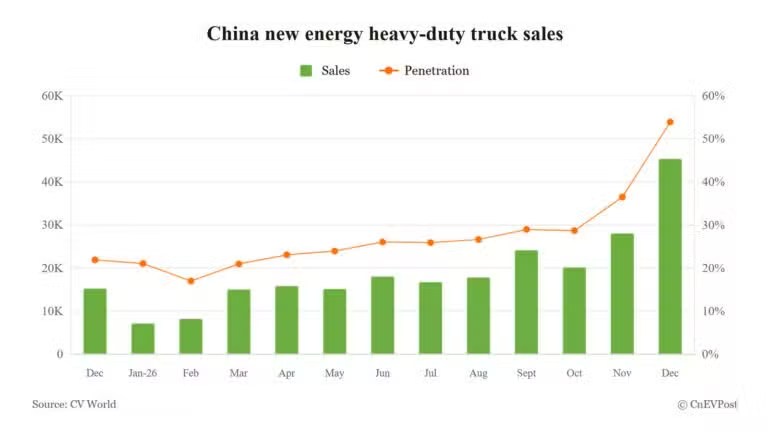
In December, China sold a record 45,300 new energy heavy-duty trucks, accounting for 53.89% of total heavy-duty truck sales of 84,000 units.
($1 = 6.7753 yuan)