

China & Taiwan Update, June 12, 2026

Data Cutoff: June 12, 2026
The China & Taiwan Update is a joint product from the Institute for the Study of War (ISW) and the American Enterprise Institute (AEI). The update supports the ISW–AEI Coalition Defense of Taiwan project, which assesses Chinese campaigns against Taiwan, examines alternative strategies for the United States and its allies to deter the Chinese Communist Party’s (CCP) aggression, and—if necessary—defeat the People’s Liberation Army. The update focuses on the CCP’s paths to controlling Taiwan and cross–Taiwan Strait developments.
Toplines
[A version of this text appeared in the Korean Peninsula Update, June 9, 2026]
CCP General Secretary Xi Jinping implicitly legitimized North Korea’s demands for recognition of its nuclear program and sanctions relief. Xi’s tacit support may embolden North Korea to seek concessions from the United States and South Korea. Xi visited North Korea from June 8 to 9 at the invitation of Workers’ Party of Korea (WPK) General Secretary Kim Jong Un.[1] PRC state-run media outlet Xinhua reported on June 8 that Xi said the PRC and North Korea should strengthen strategic coordination and cooperation and firmly safeguard each country’s “sovereignty, security, and development interest[s]” during the summit.[2] The term “sovereignty” aligns with North Korea’s longstanding framing of its nuclear program as a sovereign security matter.[3] Xi called for increased “people-to-people exchanges and visits,” adding that the PRC hopes to revitalize cooperation in diplomacy, military, and trade, among other sectors.[4] Xinhua reported that Kim agreed with Xi’s proposal and expressed support for the PRC’s “One China principle” and Xi’s “Four Global Initiatives.”[5] The “Four Global Initiatives” are Xi’s diplomatic framework that calls for a multipolar international order that presents an alternative to what the PRC characterizes as the “US-led international order.” This trip is Xi’s first visit to North Korea since June 2019 and his first overseas trip in 2026.[6]
Xi appears to have legitimized North Korea’s nuclear program by acknowledging North Korea’s “sovereignty and security” interests while avoiding using the term “denuclearization” in diplomatic settings. ISW-CDOT has assessed that the PRC has increasingly abandoned its denuclearization rhetoric and shifted away from opposing North Korea’s nuclear program amid deepening North Korea-Russia relations.[7] Russia has openly supported North Korea’s nuclear arsenal as a “guarantee of prosperity,” likely pressuring the PRC to strengthen its support to preserve engagement with North Korea.[8] Xi and Russian President Vladimir Putin on May 20 issued a joint statement opposing sanctions and security threats against North Korea. This indicates that Russia has raised the threshold for support for North Korea, and Xi is signaling efforts to maintain its relative influence in Pyongyang.
The PRC similarly did not confirm whether the May 14 summit between US President Donald Trump and Xi discussed North Korean denuclearization, despite the White House fact sheet stating that the two discussed the issue.[9] The PRC’s deliberate omission of denuclearization language—both in the May 14 Trump-Xi summit readout and during Xi’s visit to Pyongyang—also signals to South Korea that the PRC does not intend to deliver on Seoul’s requests and play an intermediary role in inter-Korean relations.[10] North Korea likely sought an opportunity to consolidate its nuclear status when Kim Jong Un publicly toured a new “nuclear material production plant” ahead of Xi’s arrival.[11] Xi’s visit will likely embolden Kim to continue demanding US recognition of its nuclear status as a precondition in any future dialogue. This further reduces the prospect for North Korean engagement with the United States and South Korea.
Taiwanese opposition Kuomintang (KMT) chairperson Cheng Li-wun completed her two-week visit to the United States on June 12, during which she claimed to promote cross-strait peace and reiterated common KMT talking points. The PRC could view Cheng’s foreign engagements as opportunities to advance PRC-preferred cross-strait policies indirectly. Cheng traveled to multiple US cities including San Francisco, Boston, New York, and Washington DC.[12] Cheng met with US officials while in Washington, including Representatives John Rose (R-Tennessee), Chuck Fleischmann (R-Tennessee), Thomas Suozzi (D-New York), and Senator Steve Daines (R-Montana).[13] Cheng also met with key US policymakers working on US Indo-Pacific policy, including Senator Dan Sullivan (R-Alaska) and Representative Young Kim (R-California).[14] Sullivan sits on the Senate Armed Services Committee and has sponsored legislation supporting Taiwan’s defense; Kim chairs the House Foreign Affairs Subcommittee on East Asia and has likewise introduced legislation to counter PRC actions against Taiwan.[15]
Cheng reportedly scheduled a meeting with the US National Security Council on June 10. The meeting was cancelled for unclear reasons; however, even after its location changed from the White House to the American Institute in Taiwan’s Washington headquarters.[16] Cheng expressed interest in meeting with US President Donald Trump, but did not do so during this trip.[17]
Cheng espoused her foreign policy talking points during the meetings and stated that the KMT does not oppose US arms sales to Taiwan.[18] This statement is somewhat in conflict with Cheng’s previous complaints about the amount of money Taiwan spends on arms purchases and delays of US-purchased equipment. KMT Representative to the United States Victor Chin said that Cheng discussed arms sales to Taiwan, PRC military pressure targeting Taiwan, and the importance of US-Taiwan transparency on arms procurement.[19] Cheng also expressed interest in US-Taiwan collaboration on nuclear technologies.[20]
Cheng’s statements were consistent with her past statements on US-Taiwan and cross-strait relations. Cheng expressed her support for the “1992 consensus” as a means of promoting cross-strait peace during an interview.[21] The 1992 consensus is an alleged verbal agreement between semi-official representatives of the KMT and CCP that says that Taiwan is part of “China,” though the two sides disagreed on whether “China” is rightfully represented by the PRC or the Republic of China (ROC).[22] Cheng said that she did not discuss “reunification” during her April 2026 visit with CCP General Secretary Xi Jinping, and claimed that the mechanisms for effective cross-strait dialogue are not yet in place.[23]
The PRC could view Cheng’s visit as an opportunity to advance PRC-aligned views within US policy and academic communities. Cheng has previously espoused PRC talking points on Taiwan’s ruling Democratic Progressive Party (DPP) and cross-strait relations.[24] Cheng’s past statements criticizing Japanese military modernization under current Prime Minister Sanae Takaichi similarly echo PRC rhetoric.[25] Cheng has also expressed views reminiscent of Russia’s rhetoric on European security issues, blaming NATO expansion for Russia’s war in Ukraine.[26] Cheng’s 2026 meeting with Xi — the first such meeting since 2016 — illustrated the PRC’s desire to present cross-strait engagement positively to the Taiwanese public. The PRC is likely to continue such engagement efforts with amenable Taiwanese politicians prior to the November local elections and 2028 Presidential elections.
The PRC Ministry of Transport (MoT) conducted a “special maritime law enforcement operation” east of Taiwan to assert Beijing’s territorial claims, contesting Japanese-Philippine talks to delimit their overlapping claims in the same area. The PRC derives its claims in the area from its claim to Taiwan and is thus trying to assert its jurisdiction there. The MoT conducted the operation from June 6 to 10 in coordination with the Fujian and Guangdong Maritime Safety Administrations (MSA), the East China Sea Navigation Support Center, and the East China Sea Rescue Bureau.[27] At least three MSA vessels and one search and rescue vessel jointly patrolled in the area, escorted by two China Coast Guard (CCG) ships that had already been patrolling there since June 1.[28] The PRC launched the operation in response to Japanese Prime Minister Sanae Takaichi and Philippine President Ferdinand Marcos, Jr.’s May 28 announcement that their countries would discuss delimiting the boundaries between their exclusive economic zones (EEZs), which currently overlap in an area east of Taiwan.[29] Japanese and Philippine officials did not clarify whether they would discuss the boundaries with Taiwan or the PRC, which also claim EEZ rights in the area, but said that the bilateral discussions would not affect the rights of any third countries.[30] PRC officials condemned the Japan-Philippines delimitation talks as “illegal and invalid” for bypassing Beijing and “seriously infringing on China’s sovereignty and maritime rights and interests,” including the PRC’s claim to sovereignty over Taiwan.[31]
The PRC vessels’ sailing paths, according to ship-tracking software Starboard, show that Beijing’s EEZ claims extend 200 nautical miles (nm) from Taiwan and its eastern offshore islands. The maximum distance that an EEZ can extend from a country’s territorial baseline is 200 nm, according to the United Nations Convention on the Law of the Sea (UNCLOS).[32] The PRC likely perceived Tokyo and Manila not including it in boundary consultations as an implicit denial of PRC claims over Taiwan.
Taiwanese officials condemned the PRC operation as cognitive warfare and a violation of Taiwan’s sovereignty.[33] The MSA and rescue vessels completed their operation on June 10, but Starboard data shows that the two CCG ships are continuing to patrol the disputed area at time of writing.
PRC state media said that the operation aimed to exercise PRC law enforcement jurisdiction, enhance traffic control capabilities in key waters, and safeguard national rights and interests.[34] The PRC’s use of civilian law enforcement vessels to patrol the disputed waters and hail nearby ships is unusual and very likely intended to give the operations a veneer of legitimacy. The PRC has always claimed Taiwan and its adjoining waters as its own and has increasingly enforced this claim through operations by CCG, PLA Navy (PLAN), and research vessels east of Taiwan during exercises or special patrols.
The PRC is also using this incident to portray itself as the only effective defender of Taiwan’s maritime rights, in contrast to the Taiwanese government.[35] Taiwan Affairs Office (TAO) spokesperson Zhang Han called Taiwan’s DPP authorities “traitors to the nation” for “pandering to external forces” by failing to object strongly to the boundary delimitation talks.[36] KMT opposition politicians in Taiwan likewise criticized the Lai administration on similar grounds, demanding that it take a stand against Japan and the Philippines and ensure Taiwan’s inclusion in the boundary talks.[37] Tokyo and Manila cannot easily include either Taiwan or the PRC in maritime boundary talks east of Taiwan, however, because their One China Policies neither recognize Taiwan as a state nor explicitly consider it part of the PRC.[38]
The PRC’s interest in controlling the waters east of Taiwan also stems from the area’s importance to Beijing’s anti-access area denial (A2AD) strategy. The “law enforcement operation” drilled capabilities that the PRC may use to enforce a future quarantine or blockade around Taiwan. The PRC has already shown it can restrict maritime traffic around Taiwan during its military exercises by designating exercise zones that ships should avoid, which is likely to deter most ships from passing through the area at least in the short term.[39] Taiwan’s Coast Guard Administration (CGA) reported that the MSA ship Hai Xun 6 hailed three passing commercial ships by radio during the operation to ask them for voyage and crew information.[40] The PRC would likely use civilian MSA ships to warn, detain, or drive away commercial ships from blockade or quarantine areas, while armed CCG and PLAN ships stand by to engage would-be violators with force.
The PRC likely also wishes to exercise EEZ rights in the area so that it can continue dual-use undersea survey operations east of Taiwan. PRC research ships have repeatedly operated east of Taiwan to map undersea geography, study undersea conditions, place sensors and submarine navigation beacons, and perform other activities that can support PRC undersea warfare operations in a future conflict.[41] The PRC is especially interested in controlling this area of sea to control passage through the Bashi Channel and the Ryukyu Islands chain and to prevent aid from reaching Taiwan in a war or blockade. Starboard data shows that two PRC research ships, the Jia Geng and the Da Yang Hao, surveyed parts of the undersea Gagua Ridge east of Taiwan during the PRC’s “law enforcement” operation.
Key Takeaways
- PRC-North Korea Relations: CCP General Secretary Xi Jinping met with WPK General Secretary Kim Jong Un from June 8 to 9 in Xi’s first visit to Pyongyang since 2019. Xi’s calls for closer cooperation between the PRC and North Korea and likely tacit acceptance of North Korea’s nuclear status reflect PRC efforts to maintain positive relations with North Korea amid closer alignment between Pyongyang and Moscow.
- US-Taiwan relations: KMT Chairwoman Cheng Li-wun finished her US visit on June 12. Cheng met with US policy makers and academics and espoused standard KMT talking points and some rhetoric reminiscent of PRC statements.
- PRC Grey-Zone Operations: The PRC MoT conducted a “special maritime law enforcement operation” east of Taiwan from June 6 to 10 to assert PRC jurisdiction over the disputed waters, contesting Japanese-Philippine talks to delimit their overlapping EEZ claims. The exercise was likely intended to reinforce PRC claims over Taiwan and to exercise PRC A2AD operations.
Cross-Strait Relations
Taiwan
The Taiwanese government is still attempting to develop a domestic drone industry, despite legislative setbacks in acquiring funding to do so. A robust Taiwanese domestic drone industry is critical to Taiwan’s ability to adapt to changes in modern warfare. Taiwan’s DPP, which controls Taiwan’s executive branch but is a minority in the Legislative Yuan (LY), introduced the “Special Act for the Creation of the Uncrewed Vehicle Industry” for legislative review on June 5.[42] The proposal seeks to provide NTD 550 billion (approximately $17.5 billion) on funding for Taiwan’s domestic drone industry over five years.[43] The DPP previously attempted to include such funding in its Special Budget for Asymmetric War, but the opposition KMT and Taiwan People’s Party (TPP) cut the funding allocated to domestic drone industry development from the final version of the bill passed in May.[44] The KMT and TPP voted together to strike down the new DPP special budget on June 5.[45]
The KMT is attempting to argue that the general budget should include funding for domestic drone development rather than a separate special budget to encourage fiscal responsibility.[46] Moving funding for Taiwan’s domestic drone industry to the yearly general budget would likely force the DPP to request a much lower amount of capital for domestic investment, as the general budget is under much stricter spending constraints than Taiwan’s special budget mechanism.[47] Taiwan’s opposition likely seeks to bring discussion of such funding to the general budget to effectively cut funding for Taiwan’s domestic drone industry without directly opposing such funding in principle.
A robust domestic drone industry is critical for Taiwan’s efforts to develop an asymmetric defense strategy capable of deterring a PRC invasion. The war in Ukraine has illustrated the scale and speed of drone production required in modern warfare, and Ukraine’s domestic drone production capabilities have bolstered its ability to rapidly innovate based on battlefield developments.[48] Taiwan’s military conducted training exercises with first-person view (FPV) drones and Altius-600M anti-armor drones for the first time on June 3.[49] Taiwan must develop industrial know-how and flexible drone production capacity in addition to expertise in drone operation to be effective on the modern battlefield. Taiwan will likely struggle to achieve this piece of military modernization without significant investments in its domestic drone industry.
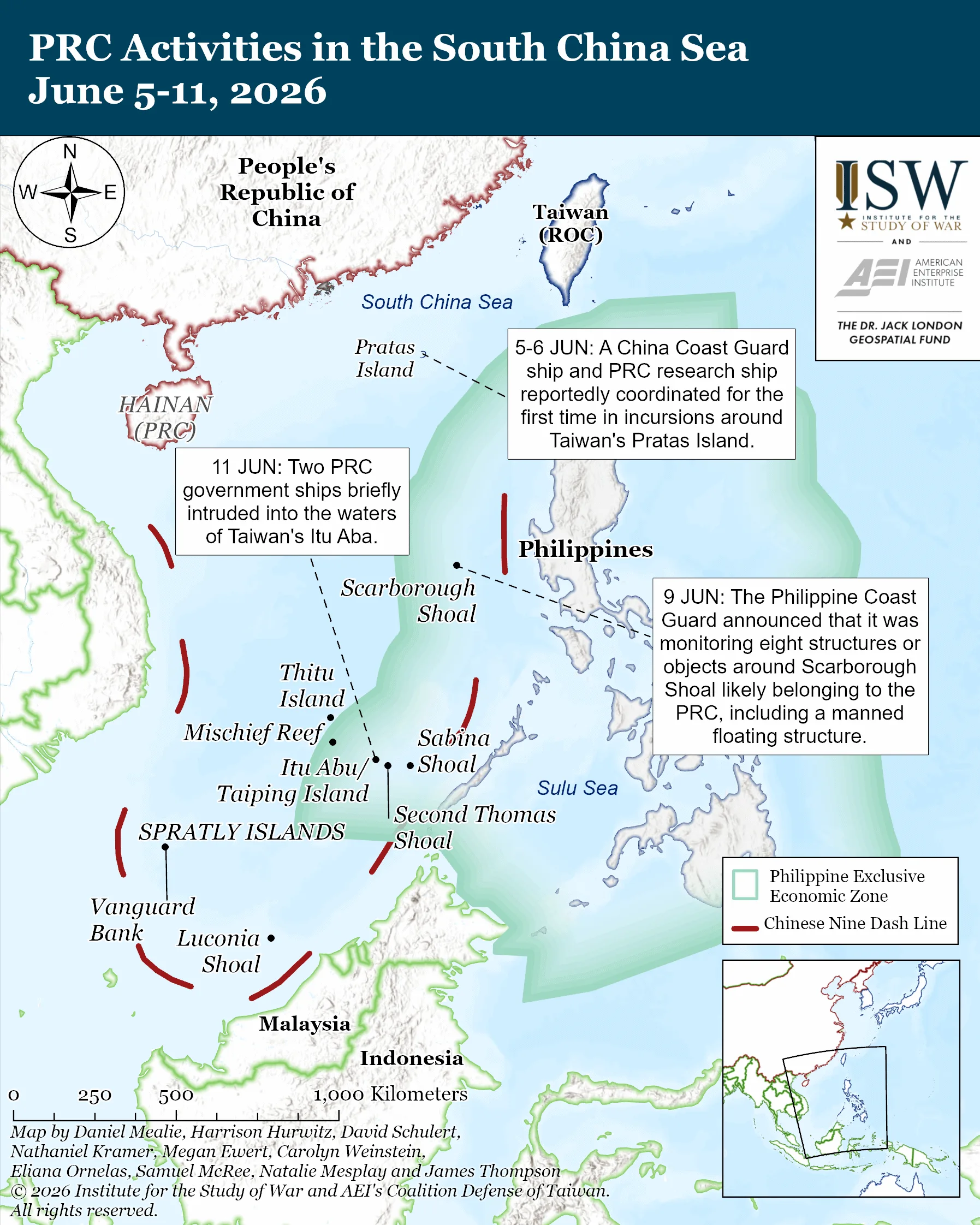
Taiwan’s CGA said that a CCG ship and a PRC research vessel coordinated for the first time in patrols in and around the restricted waters of Taiwan’s Pratas Island. Data from the ship monitoring software Starboard shows that CCG vessel 3501 circled Pratas twice while patrolling in Taiwan’s restricted waters for over 24 hours from June 5 to 6, a patrol pattern that the CCG has normalized since February 2025. The CGA said that it encountered a PRC research vessel, the Hai Si Lu 6, that sailed along the edge of Pratas’ restricted waters on June 6 during the CCG patrol, the first recorded instance of such coordination.[50] Pratas is the site of a Taiwanese atoll coast guard and naval outpost at the north end of the South China Sea.
CCG coordination with research ships to carry out incursions around Taiwan is unusual and may represent an evolution in PRC coercive tactics. The PRC typically deploys research vessels around Taiwan to conduct dual-use undersea surveys and monitoring activities under the guise of civilian scientific research. Direct coordination with PRC paramilitary ships removes the scientific veneer from these activities and may be a way to test Taiwan’s response. The CGA connected this incident to another involving PRC research ship Tong Ji that circumnavigated Taiwan in early May and dropped scientific equipment near parts of Taiwan’s contiguous zone on May 7 and 15.[51] The CGA said Tong Ji responded to CGA radio warnings by declaring that “there is no Republic of China, only the People’s Republic of China.”[52] The ship’s activities indicate that it was openly challenging Taiwan’s control of its waters. The CCG began regular incursions in Taiwan-administered waters around the Pratas and Kinmen Islands over the past two years to assert its legal jurisdiction in those waters, test and strain Taiwan’s response capacity, and practice maneuvers that it may use in a quarantine or blockade of those islands.
Two PRC government ships intruded in the waters of Taiwan’s Itu Aba island in the South China Sea. Taiwan’s CGA reported that a PRC law enforcement ship called Sansha Zhifa 301 and a supply ship called Sansha 2 Hao briefly entered the restricted and prohibited waters of Itu Aba on June 11.[53] The CGA said that this was the first such incursion and strongly condemned it as a violation of Taiwan’s sovereignty.[54] Itu Aba, also known as Taiping Island, is the only Taiwan-administered feature in the disputed Spratly Islands archipelago and the site of a Taiwanese military and coast guard base. Ship-tracking data from Starboard Maritime Intelligence shows that the two PRC vessels sailed from the PRC’s Hainan Province in a path that came close to many disputed island features in the Spratly Islands, including Philippine outposts such as Thitu Island and PRC military bases such as Subi Reef. The PRC has often used naval, coast guard, and maritime militia ships to contest Philippine territorial claims in the Spratly Islands, but generally ignores Itu Aba.
Starboard data shows that San Sha 2 Hao has conducted one voyage around all the PRC’s claimed territories in the South China Sea each year since at least 2020; however, sailing through Itu Aba’s restricted and prohibited waters on multiple past voyages. Sansha Zhifa 301 or another law enforcement ship escorted it on these voyages on multiple occasions, contradicting the CGA’s claim that the June 11 incursion was the first such incident. San Sha 2 Hao is a roll-on/roll-off (RORO) ship whose functions include “transportation and replenishment, administrative jurisdiction, emergency rescue command, emergency medical assistance, and scientific investigation of islands and reefs,” according to the company that built it.[55] Starboard shows that San Sha 2 Hao mostly operates between Hainan, PRC and the PRC-administered Paracel Islands archipelago, beyond its annual tour of the Spratly Islands. Itu Aba could become a new target for PRC coercion in the future, but this incursion does not appear to represent a novel PRC tactic.
Dutch frigate HNLMS De Ruyter transited the Taiwan Strait after operating around the Paracel Islands. PLA Eastern Theater Command spokesperson Senior Colonel Xu Chenghua stated that the PRC deployed naval and air assets to track and monitor the warship, accusing the De Ruyter of first illegally intruding around the Paracel Islands and then the Taiwan Strait.[56] The Dutch government stated that the ship was operating in accordance with international law.[57] The PRC used a combination of verbal warnings and electronic jamming to expel the De Ruyter from the PRC’s claimed territorial waters around the Paracels on May 28.[58] This is the first Dutch transit of the Taiwan Strait in two years, with the HNLMS Tromp previously transiting in June 2024.[59]
The United States and allied countries have conducted Freedom of Navigation Operations (FONOPs) through the Taiwan Strait and parts of the South China Sea multiple times per year since the mid-2010s to challenge illegal maritime claims by the PRC and other countries in the region.[60] The PRC claims the entire Taiwan Strait (including its territorial waters, contiguous zone, and EEZ).[61] Territorial waters only extend 12 nm from a state’s coastline or territorial sea baseline, however, leaving a corridor in the middle of the strait where no country has the right to restrict the passage of foreign ships.[62]
China
Politburo Standing Committee Member Cai Qi, often referred to as CCP General Secretary Xi Jinping’s Chief of Staff, was appointed head of the Central Party School on June 5. Cai’s appointment illustrates his close relationship with Xi and centralizes Cai’s oversight of the CCP. Cai is also first secretary of the CCP Central Secretariat and the director of the CCP General Office.[63] The Central Party School is a top cadre education institution that trains senior PRC officials and drives CCP ideology.[64]
Cai has a long-standing relationship with Xi, having worked under him since the start of Cai’s career as a local official in Fujian and Zhejiang provinces and being promoted rapidly after Xi became CCP General Secretary.[65] Cai was notably promoted to the Politburo without having previously been a member of the CCP Central Committee, an atypical promotional path within CCP leadership.[66] Xi and former CCP General Secretary Hu Jintao previously served as head of the Central Party School before becoming General Secretary, a prospect unlikely for Cai due to his age.[67] This appointment signals that Xi places a significant level of trust in Cai.[68] Cai will now oversee the development and management of the CCP, including CCP the organizational, doctrinal, and administrative functions. Xi’s trust in Cai is particularly notable amidst the latest rounds of Central Military Commission purges, which have left Xi increasingly isolated as he prioritizes loyalty over combat experience.[69] This leaves Cai as one of the remaining important figures close to Xi who may influence his thinking moving forward.[70]
US State Department China coordinator Joshua Young urged NATO allies to replace network and critical infrastructure components from PRC-based Huawei Technologies Co. with defense-related funding during a Brussels summit in May, underscoring European critical infrastructure vulnerabilities. Young’s remarks did not mention specific allies, but were reportedly in reference to Germany, and framed within the context of increased spending on core defense needs to 3.5 percent of GDP by nearly all NATO allies in 2025.[71] Reporting on this issue also made specific reference to German and Spanish opposition to the European Commission’s intentions to exclude PRC suppliers from telecommunications networks, voicing concerns over maintaining state-level control and the prospect of retaliation from the PRC.[72]
Young’s comments reflect Europe’s cybersecurity concerns over critical technology components sourced from PRC manufacturers, particularly Huawei. EU legislation already in motion further illustrates these concerns.[73] Continued skepticism of Huawei’s integration into EU and NATO critical infrastructure is paramount to reducing PRC influence and means of coercion against the United States and NATO.
The PRC may be aiming to establish a manned presence at the disputed Scarborough Shoal in the South China Sea. The PRC could use this presence to gradually reshape the status quo and forcefully impose its claims of sovereignty over the shoal. Philippine Coast Guard spokesperson Jay Tarriella reported on June 9 that the Philippines has been monitoring eight separate structures or objects in the vicinity of Scarborough Shoal.[74] Philippine Air Force aircraft confirmed on June 8 during an overflight of the shoal that one of the structures was manned by six people and possibly housed an antenna.[75] The Philippines issued a formal diplomatic protest to the PRC on June 9 over the presence of the manned structure.[76] A PRC Ministry of Foreign Affairs (MFA) spokesperson did not deny the presence of the structure in a June 9 press conference and stated that the shoal was the PRC’s sovereign territory, allowing it to conduct actions in the area such as scientific research.[77] The 2002 Association of Southeast Asian Nations (ASEAN)-PRC Declaration on the Conduct of Parties in the South China Sea states that all parties will refrain from inhabiting the uninhabited islands, reefs, shoals, cays, and other features in the region.[78] ASEAN and the PRC are in the process of negotiating a more binding Code of Conduct in the South China Sea, although key differences remain between some ASEAN nations and the PRC regarding the Code’s content.[79]
The PRC may be aiming to reshape the status quo around Scarborough Shoal before finalizing a South China Sea Code of Conduct. The PRC has maintained a semi-permanent presence around the shoal with CCG and PLAN vessels, but has not taken steps to inhabit the shoal.[80] The PRC used a similar method of gradually establishing a more permanent presence on South China Sea islands before reclaiming land and developing military infrastructure on them, most notably on Mischief Reef.[81] The presence of a manned structure, albeit a floating one, on Scarborough Shoal could signal the PRC is setting conditions for a similar gradual development of a PRC presence on the shoal.
The PRC has sought to establish significant military infrastructure in the South China Sea to extend its ability to exert sea control in the region and project power throughout Southeast Asia.[82] The PRC also seeks to deny its adversaries the use of South China Sea features due to the region’s critical sea lines of communication and abundant natural resources.[83] Control over Scarborough Shoal would strengthen the PRC’s regional position, particularly in relation to the Philippines, due to the proximity of the Shoal to Philippine waters. The PRC could use the shoal as an outpost for malign maritime activity within the Philippines’ EEZ to undermine Philippine sovereignty over its claims in the South China Sea.
Oceania
The PRC sanctioned four New Zealand Parliament members for violating the “one-China principle” by visiting Taiwan. These sanctions could create a rift between the PRC and New Zealand, which has historically held stronger relations with the PRC than other members of the Five Eyes intelligence-sharing network. PRC MFA spokesperson Mao Ning accused four New Zealand lawmakers of meddling in the PRC’s internal affairs by traveling to Taiwan and banned them from visiting the PRC for one year.[84] New Zealand Prime Minister Christopher Luxon objected to the PRC’s decision, calling it “inappropriate.”[85] Luxon said on June 5 that he would raise the issue in upcoming diplomatic talks with the PRC.[86]
New Zealand-PRC relations have raised concerns among other members of the Five Eyes, an intelligence-sharing network that also includes the United States, Britain, Canada, and Australia.[87] New Zealand and the PRC experienced a diplomatic spat over PRC influence in the Cook Islands, a free associate of New Zealand, in 2025.[88] The PRC likely aims to coalition-break between New Zealand and the Cook Islands, as well as between New Zealand and the other Five Eyes nations.

Endnotes:
[1] https://kcnawatch dot org/newstream/1780639392-872712458/general-secretary-of-c-c-cpc-and-president-of-prc-xi-jinping-to-visit-dprk/
[2] https://www.donga dot com/news/Politics/article/all/20260609/134073927/2
[3] https://news.kbs.co dot kr/news/view.do?ncd=7784755
[4] https://www.scmp dot com/news/china/diplomacy/article/3356384/chinese-president-xi-jinping-pledges-unwavering-support-north-korea-and-kim-jong-un
[5] https://www.scmp dot com/news/china/diplomacy/article/3356384/chinese-president-xi-jinping-pledges-unwavering-support-north-korea-and-kim-jong-un
[6] https://www.thestandard.com dot hk/china/article/333916/Russia-US-and-nuclear-What-to-expect-from-Xi-Kim-summit
[7] https://understandingwar.org/research/china-taiwan/china-taiwan-update-january-9-2025/
[8] https://www.nknews dot org/2026/02/russias-lavrov-calls-north-koreas-nukes-the-key-to-its-prosperity/
[9] https://www.armscontrol.org/act/2026-06/news/trump-xi-said-committed-north-korea-denuclearization
[10] https://www.chosun dot com/politics/politics_general/2026/01/07/JNL5HNH3ZRHHZC7Y52NQGR7W4Q/
[11] https://kcnawatch dot org/newstream/1780782420-987169813/%ea%b9%80%ec%97%ac%ec%a0%95-%ec%a1%b0%ec%84%a0%eb%a1%9c%eb%8f%99%eb%8b%b9-%ec%a4%91%ec%95%99%ec%9c%84%ec%9b%90%ed%9a%8c-%eb%b6%80%ec%9e%a5-%eb%8b%b4%ed%99%94-%eb%b0%9c%ed%91%9c/; https://www.whitehouse.gov/fact-sheets/2026/05/fact-sheet-president-donald-j-trump-secures-historic-deals-with-china-delivering-for-american-workers-farmers-and-industry/
[12] https://www.scmp dot com/news/china/politics/article/3356785/kmt-chief-cheng-li-wun-meets-trump-ally-steve-daines-washington
[13] https://www.scmp dot com/news/china/politics/article/3356785/kmt-chief-cheng-li-wun-meets-trump-ally-steve-daines-washington; https://www.house.gov/representatives; https://www.congress.gov/member/steve-daines/D000618
[14] https://focustaiwan dot tw/politics/202606120012
[15] https://focustaiwan dot tw/politics/202606120012; https://www.congress.gov/bill/118th-congress/senate-bill/1027; https://youngkim.house.gov/2026/05/07/rep-young-kim-leads-bill-to-deter-ccp-aggression-against-taiwan/
[16] https://www.taipeitimes dot com/News/taiwan/archives/2026/06/12/2003858963
[17] https://www.reuters.com/world/china/taiwan-opposition-leader-would-be-very-willing-meet-trump-us-trip-2026-06-01/
[18] https://www.scmp dot com/news/china/politics/article/3356785/kmt-chief-cheng-li-wun-meets-trump-ally-steve-daines-washington
[19] https://focustaiwan dot tw/politics/202606120012
[20] https://www.taipeitimes dot com/News/taiwan/archives/2026/06/12/2003858963
[21] https://www.npr.org/2026/06/11/g-s1-127478/taiwan-opposition-leader-says-xi-meeting-avoided-reunification-talk
[22] https://globaltaiwan.org/2022/09/the-ccp-commemorates-the-30th-anniversary-of-the-1992-consensus-and-seeks-to-change-its-meaning/
[23] https://www.npr.org/2026/06/11/g-s1-127478/taiwan-opposition-leader-says-xi-meeting-avoided-reunification-talk
[24] https://understandingwar.org/research/china-taiwan/china-taiwan-special-report-december-31-2025/
[25] https://globaltaiwan.org/2026/04/cheng-li-wuns-polarizing-trip/
[26] https://asiasociety.org/policy-institute/positioning-kmt-us-china-taiwan-triangle-cheng-li-wuns-early-tenure
[27] http://eng.mod.gov dot cn/2025xb/N/T/16466473.html ; https://www.news dot cn/tw/20260610/1e17a67b473c45da969affe36a260c53/c.html
[28] https://www.cga.gov dot tw/GipOpen/wSite/ct?xItem=168065&ctNode=650&mp=999
[29] https://understandingwar.org/research/china-taiwan/china-taiwan-update-june-5-2026/ ; https://www.mofa.go.jp/files/101035755.pdf ; http://eng.mod.gov dot cn/2025xb/N/T/16466473.html
[30] https://www.mofa.go.jp/files/101035755.pdf ; https://www.reuters.com/world/china/taiwan-says-japan-philippines-must-respect-its-rights-maritime-border-talks-2026-06-03/
[31] https://www.mfa.gov dot cn/web/fyrbt_673021/202605/t20260529_11921244.shtml ; https://www.fmprc.gov dot cn/fyrbt_673021/jzhsl_673025/202606/t20260602_11923344.shtml
[32] https://www.un.org/depts/los/convention_agreements/texts/unclos/part5.htm
[33] https://www.cna.com dot tw/news/aipl/202606080045.aspx ; https://www.taipeitimes dot com/News/taiwan/archives/2026/06/10/2003858840
[34] https://www.globaltimes dot cn/page/202606/1362905.shtml
[35] https://www.globaltimes dot cn/page/202606/1362953.shtml
[36] https://www.gwytb.gov dot cn/xwdt/xwfb/xwfbh/202606/t20260610_12770189.htm
[37] https://www.taipeitimes dot com/News/taiwan/archives/2026/06/06/2003858621
[38] https://www.mofa.go.jp/region/asia-paci/china/joint72.html ; https://ph.china-embassy.gov dot cn/eng/zfgx/zzgx/200011/t20001115_1336097.htm
[39] https://understandingwar.org/research/china-taiwan/china-taiwan-special-report-december-31-2025/ ;
[40] https://www.taiwannews dot com dot tw/news/6379532
[41] https://understandingwar.org/research/china-taiwan/china-taiwan-update-may-15-2026/ ; https://understandingwar.org/research/china-taiwan/china-taiwan-update-may-8-2026/ ; https://understandingwar.org/research/china-taiwan/china-taiwan-weekly-update-may-9-2025/
[42] https://www.taiwannews.com dot tw/news/6377463
[43] https://www.taiwannews.com dot tw/news/6377463
[44] https://jamestown.org/taiwans-special-defense-budget-bill-passes-with-drastic-cuts/
[45] https://www.cna.com dot tw/news/aipl/202606050331.aspx
[46] https://www.cna.com dot tw/news/aipl/202606050331.aspx
[47] https://www.taipeitimes dot com/News/taiwan/archives/2026/05/21/2003857706; https://www.oecd.org/content/dam/oecd/en/publications/reports/2024/07/budgeting-in-chinese-taipei_ca3e88df/3ec16dbd-en.pdf; https://oa-22.adm.ncu.edu dot tw/word/Budget-Act.pdf; https://www.nta.gov dot tw/Eng/singlehtml/310?cntId=nta_6725_310; https://www.mof.gov dot tw/eng/multiplehtml/7013
[48] https://www.justsecurity.org/138164/ukraine-drone-superpower/; https://understandingwar.org/research/russia-ukraine/a-defense-of-taiwan-with-ukrainian-characteristics-lessons-from-the-war-in-ukraine-for-the-western-pacific/
[49] https://www.cna.com dot tw/news/aipl/202606030356.aspx; https://www.taiwannews.com dot tw/news/6376639
[50] http://cga.gov dot tw/GipOpen/wSite/ct?xItem=168059&ctNode=650&mp=999 ; https://focustaiwan dot tw/politics/202606060015
[51] https://www.cga.gov dot tw/GipOpen/wSite/ct?xItem=168059&ctNode=650&mp=999 ; https://understandingwar.org/research/china-taiwan/china-taiwan-update-may-15-2026/
[52] https://www.cga.gov dot tw/GipOpen/wSite/ct?xItem=168053&ctNode=650&mp=999
[53] https://focustaiwan dot tw/politics/202606110018 ; https://www.cga.gov dot tw/GipOpen/wSite/ct?xItem=168078&ctNode=650&mp=999S
[54] https://www.cga.gov dot tw/GipOpen/wSite/ct?xItem=168078&ctNode=650&mp=999S
[55] https://web.archive.org/web/20190821183851/https://www.chinadaily.com.cn/a/201908/21/WS5d5cb74ca310cf3e3556707e.html
[56] https://www.globaltimes dot cn/page/202606/1362856.shtml; https://www.scmp dot com/news/china/diplomacy/article/3356200/pla-says-it-will-stay-high-alert-after-dutch-warship-crosses-taiwan-strait
[57] https://www.reuters.com/world/china/chinas-military-says-it-tracked-dutch-frigate-taiwan-strait-2026-06-05/; https://www.taiwannews dot com.tw/news/6377971
[58] https://understandingwar.org/research/china-taiwan/china-taiwan-update-june-5-2026/
[59] https://x.com/TaiwanMonitor/status/2063313489871901140
[60] https://apps.dtic.mil/sti/trecms/pdf/AD1178287.pdf
[61] https://understandingwar.org/research/china-taiwan/china-taiwan-weekly-update-september-20-2024/ ; https://www.fmprc.gov dot cn/eng/xw/fyrbt/202409/t20240909_11487817.html
[62] https://www.un.org/depts/los/convention_agreements/texts/unclos/part2.htm
[63] https://asiasociety.org/policy-institute/decoding-chinese-politics?policy=top-leadership&group=organizations&size=rank&connection=personal
[64] https://www.reuters.com/world/china/senior-chinese-official-cai-qi-tapped-head-central-party-school-2026-06-05/
[65] https://asiasociety.org/policy-institute/decoding-chinese-politics?policy=top-leadership&group=organizations&size=rank&connection=personal
[66] https://asiasociety.org/policy-institute/decoding-chinese-politics?policy=top-leadership&group=organizations&size=rank&connection=personal
[67] https://www.reuters.com/world/china/senior-chinese-official-cai-qi-tapped-head-central-party-school-2026-06-05/
[68] https://www.economist.com/china/2026/04/30/cai-qi-may-be-chinas-second-most-powerful-man
[69] https://www.reuters.com/world/china/senior-chinese-official-cai-qi-tapped-head-central-party-school-2026-06-05/; https://understandingwar.org/research/china-taiwan/xi-jinpings-military-purges-leave-him-increasingly-powerful-but-isolated/; https://chinapower.csis.org/china-pla-military-purges/
[70] https://understandingwar.org/research/china-taiwan/xi-jinpings-military-purges-leave-him-increasingly-powerful-but-isolated/
[71] https://www.bloomberg.com/news/articles/2026-06-08/us-urges-nato-allies-to-use-defense-funds-to-replace-huawei-gear
[72] https://www.bloomberg.com/news/articles/2026-06-08/us-urges-nato-allies-to-use-defense-funds-to-replace-huawei-gear
[73] https://www.reuters.com/business/media-telecom/eu-phase-out-high-risk-tech-targets-huawei-chinese-companies-2026-01-20/; https://www.iss.europa dot eu/publications/briefs/dragon-grid-limiting-chinas-influence-europes-energy-system; https://www.politico dot eu/article/huawei-eu-research-program-european-commission-crackdown/
[74] https://x.com/jaytaryela/status/2064542079607599354/photo/1
[75] https://www.abs-cbn.com/news/nation/2026/6/9/philippines-protests-over-chinese-structure-built-near-bajo-de-masinloc-2037
[76] https://www.reuters.com/world/china/philippines-urges-china-remove-new-structure-disputed-shoal-south-china-sea-2026-06-10/
[77] https://www.mfa.gov dot cn/web/fyrbt_673021/202606/t20260609_11940686.shtml
[78] https://asean dot org/declaration-on-the-conduct-of-parties-in-the-south-china-sea-2/
[79] https://www.philstar dot com/headlines/2026/06/10/2534209/philippines-targets-end-2026-south-china-sea-code-conduct; https://www.globalpolicyjournal.com/blog/16/02/2026/aseans-push-finalize-south-china-sea-code-conduct-places-indonesia-pivotal-role
[80] https://www.bairdmaritime.com/security/non-naval-security/philippines-protests-illegal-floating-chinese-structure-at-shoal; https://amti.csis.org/developing-scarborough-contingency-plan/; https://www.abs-cbn.com/news/nation/2026/6/9/afp-chief-confirms-moving-structure-in-lagoon-of-bajo-de-masinloc-0006; https://x.com/jaytaryela/status/2064224319178420484?s=20
[81] https://qz dot com/863811/mischief-reef-how-a-fishermens-shelter-on-stilts-became-a-chinese-military-base-in-the-south-china-sea
[82] https://www.lineofdeparture.army.mil/Journals/Warrant-Officer-Journal/Archive/October-December-2024/South-China-Sea/; https://dkiapcss.edu/chapter-13-contesting-the-south-china-sea/
[83] https://wgi.world/wp-content/uploads/2020/06/The-Strategic-Importance-of-South-China-Sea.pdf
[84] https://www.chinadaily.com dot cn/a/202606/04/WS6a214042a310d6866eb4c7a0.html
[85] https://www.reuters.com/world/china/new-zealand-raise-lawmakers-travel-ban-directly-with-china-pm-luxon-says-2026-06-05/
[86] https://www.reuters.com/world/china/new-zealand-raise-lawmakers-travel-ban-directly-with-china-pm-luxon-says-2026-06-05/
[87] https://www.theguardian.com/world/2021/apr/23/new-zealands-stance-on-china-has-deep-implications-for-the-five-eyes-alliance; https://www.voanews.com/a/east-asia-pacific_new-zealand-criticized-five-eyes-alliance-stance-china/6205205.html
[88] https://www.bbc.com/news/articles/cy4n30y75n0o