

China Builds Humanoid Robots Faster Than Any Factory Can Actually Use Them
ADEK BERRY/AFP via Getty Images
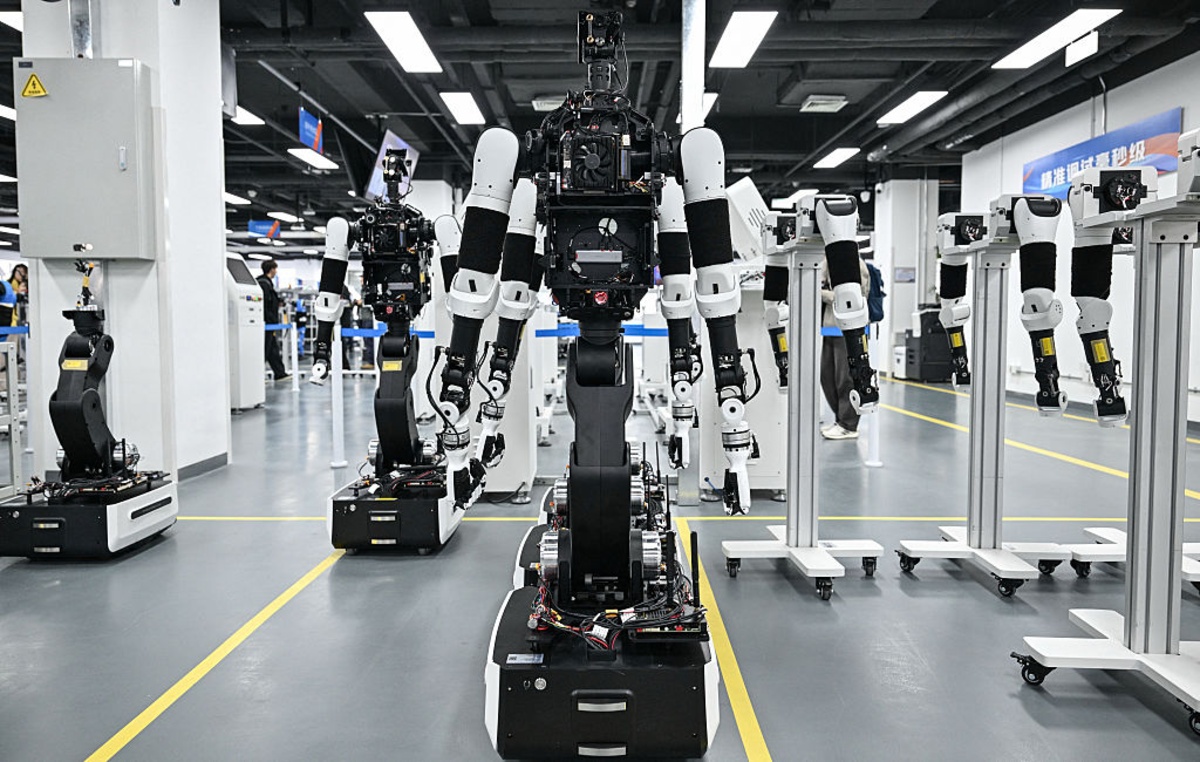
In the five days China’s World Robot Conference ran through August 23, two very different stories played out under the same roof in Beijing. On the show floor, a rock band of four CASBOT robots worked through Chinese classics — guitar, bass, keyboards, drums — before performing an original track titled “Heat Dissipation.” Two Li-Gong LiDian F1 humanoids ran a complete end-to-end industrial sequence — disassembling machine parts, sorting and transporting them, reassembling them — without human intervention at any stage. In a kickboxing final, a North China Electric Power University team remotely piloting a Unitree G1 defeated Unitree’s own operators — a result Beijing Daily described with a headline that translated, roughly, as “biting the hand that built you.”
The other story was in the numbers. A market analysis firm, Interact Analysis, published research in June showing that of the more than 20,000 humanoid robots produced globally in 2025 — a tenfold jump from under 2,000 in 2024 — only about 10% reached real-world applications. The rest went to research institutions, data collection projects, and entertainment demonstrations. China’s manufacturers accounted for more than 90% of that production. The show floor and the spreadsheet were telling opposite stories, and the spreadsheet is the one that matters for the industry’s future.
That gap — between the largest humanoid robot production surge in history and genuine commercial deployment — is the defining structural challenge of the industry heading into the final quarter of 2026. Beijing has decided to resolve it by mandate.
What Happened at WRC 2026
The 11th World Robot Conference drew 373 companies and more than 3,000 products to the Beiren Etrong International Exhibition and Convention Center in Beijing’s E-Town economic zone, including 311 debut products. This year, organizers added a “Procurement Day” — a dedicated buyer-supplier matchmaking session that did not exist at prior editions — as a formal signal that the industry’s self-image has shifted from demonstration to commercial transaction.
The demonstrations carried genuine technical significance beneath the spectacle. The Tiangong Omni robot, standing 1.35 meters (4.4 feet) tall, won the small-size 400-meter race at the concurrent World Humanoid Robot Games in 45.66 seconds. Its running style drew as much attention as the time: arms raised close to its face, body leaning forward in a posture that sparked comparisons on Chinese social media to someone covering their face in shyness. The posture was not designed by engineers. Han Gang, a motion-control expert at the Beijing Humanoid Robot Innovation Center, explained that rapid arm-swinging loads shoulder joints, increasing heat and energy consumption over a sustained distance. The algorithm had learned to conserve heat by pulling the arms in.
What the algorithm discovered is a principle biomechanics researchers have long studied in elite runners: arm motion trades energy against momentum stabilization, and the optimal tradeoff is not intuitively obvious from first principles. A robot trained on reinforcement learning found that tradeoff through trial and repetition, not engineering specification. That is what the posture means — not shyness, but optimization.
The Production-to-Deployment Gap
The most consequential data point from the 2026 humanoid robot landscape is not a shipment figure. It is the ratio between production and genuine commercial deployment.
Interact Analysis, in its Humanoid Robots — 2026 report, found that while global production exceeded 20,000 units in 2025, the vast majority went to research, data collection, and entertainment rather than sustained commercial use. The firm identified what it called an industry-defining impossible triangle — autonomous operation, return on investment at acceptable efficiency, and multi-task generalization — that current humanoid robots struggle to clear simultaneously.
Unitree’s own IPO prospectus, filed ahead of its August listing on Shanghai’s STAR Market, disclosed that through the first three quarters of 2025, more than 70% of its humanoid robot revenue came from research institutions and educational customers. Industrial applications accounted for fewer than 10% of sales. AgiBot’s own senior vice president, describing the milestone of 15,000 cumulative units produced as of June 2026, framed the moment with careful precision: “2026 marks the beginning of large-scale deployment for embodied intelligence.” The word “beginning” is doing significant work in that sentence.
The price structure explains some of the reluctance. Current humanoid robots from Chinese manufacturers sell for roughly RMB 300,000 to RMB 500,000 (approximately $44,600 to $74,400) per unit. A two-year industrial payback at reasonable task-efficiency rates requires the price to fall toward RMB 160,000 (approximately $23,800). That gap is not trivial, and it is not primarily a technology gap — it is a manufacturing-scale gap. More units produced means lower per-unit costs; lower costs enable the deployments that generate training data; better training data produces more capable models that command higher prices and wider deployment. The production push is the first move in that chain, not the last.
How Beijing Is Closing the Gap With a Mandate, Not a Market
In June 2026, China’s Ministry of Industry and Information Technology and the State-owned Assets Supervision and Administration Commission issued a directive requiring local governments and state-owned enterprises to deploy humanoid robots and embodied AI systems into real-world operations by December 31. The target: more than 10,000 commercially deployed units across more than 100 application scenarios, spanning manufacturing, logistics, retail, healthcare, and emergency response. Local governments must submit implementation plans; progress reports are due in November.
The mandate is not a subsidy program or a research grant. It is a procurement instruction. State-owned enterprises — which account for enormous shares of Chinese manufacturing, logistics, and services — are being directed to buy robots and put them to work. That is fundamentally different from a market-driven deployment cycle.
The strategic logic is clearer when viewed through the lens of embodied AI’s core constraint: training data. Unlike large language models, which can be trained on text scraped from the internet at low marginal cost, humanoid robots need physical interaction logs — specific records of how a robot’s joints moved, what happened to an object, whether a grasp succeeded, what the camera saw when it didn’t. That data can only be generated by robots actually operating in physical environments over extended periods. The companies with the largest real-world deployment hours will accumulate the largest proprietary datasets of robot-task interactions. Those datasets are the input to the next generation of VLA models. The state mandate is, in effect, a publicly funded generation of training data at a scale that no commercially self-selecting market would produce this fast.
Interact Analysis projects the commercial inflection point for humanoid robotics at post-2032, with widespread multi-domain deployment not expected before 2035. The Beijing mandate is a deliberate attempt to pull that timeline forward by compressing the data-collection phase through state procurement power. Whether the mandate produces genuine commercial feedback — repeat orders, measurable productivity gains — or merely a fleet of underutilized machines that inflate deployment statistics without creating real learning, is the open question that November’s progress reports will begin to answer.
Who Is Building and Who Is Deploying
Two companies dominate global humanoid robot production. AgiBot, founded in Shanghai in 2023 by former Huawei engineers, hit 10,000 units in March and its 15,000th by late June — a production ramp-up from 5,000 to 10,000 units that took three months, compared to roughly a year for the prior 4,000 units. According to Smart Analytics Global research cited by SCMP and Semafor, AgiBot shipped approximately 8,400 units in the first half of 2026, capturing approximately 44% of the global market.
Unitree, headquartered in Hangzhou, completed approximately 11,000 cumulative units by March and listed on the STAR Market on August 19, the same day WRC opened. Its IPO closed up approximately 460% on its first trading day. The prospectus showed humanoid robots had exceeded quadruped robots in revenue share by fiscal 2025 — accounting for more than 51% of revenue in the first nine months of that year.
Together, Unitree and AgiBot hold roughly 75% of global shipments.
TrendForce estimates China’s humanoid robot market will reach RMB 15 billion (approximately $2.23 billion) in 2026. Morgan Stanley projects $15 billion globally by 2030, with annual shipments approaching 446,000 units.
The deployment picture is more mixed than production leadership suggests. AgiBot has deployed its G2 robots into a live consumer electronics manufacturing line at Longcheer Technology’s tablet production facility — handling precision loading, unloading, and sorting — with plans to expand to 100 robots by the third quarter of this year. UBTECH’s Walker S2 has accumulated orders exceeding RMB 800 million (approximately $119 million) from BYD, Foxconn, and other automotive and logistics customers. But UBTECH disclosed in January 2026 that the Walker S2 robots achieve at most half the efficiency of a human worker. That is the honest number from the company winning the largest order book. Half human efficiency is insufficient for most high-volume assembly — but it is adequate for hazardous inspection, overnight tasks, and environments where the alternative is no worker at all.
What Real Deployment Actually Requires
The gap between a robot that performs well in a demonstration and one that sustains value on a real production line reduces to several specific engineering constraints that no headline speed record or kickboxing victory addresses.
Battery endurance. Current lithium-ion systems restrict humanoid robots to one to four hours of active use before recharging. Continuous 24/7 industrial operation requires hot-swap battery infrastructure, which introduces its own thermal and electrical risks.
Task generalization. VLA models — the end-to-end neural networks that let a robot receive a language instruction and produce motor commands without task-specific reprogramming — still struggle with out-of-distribution scenarios. A robot trained to load tablets onto a test rack will not automatically handle a redesigned rack without additional training data. The full diversity of tasks a real factory presents remains beyond current commercial systems.
Efficiency. Liu Bingbing, an associate professor at Beijing Union University’s Robotics College, described why even familiar tasks remain technically demanding: “Some objects sit above the counter and can be picked up directly; others are below and require the robot to navigate around obstacles. For humans, this is instinctive, but for robots, it demands different motion algorithms and greater trajectory-planning versatility.”
Safety standards. No global standard exists for humanoid robots operating alongside human workers. ISO and ASTM humanoid-specific standards are not expected for ratification until 2027.
The commercial sweet spot, acknowledged by manufacturers and analysts alike, is deliberately narrow: fixed workstations with defined task sequences, warehouse logistics in controlled environments, and hazardous or confined-space inspection where human workers are either unavailable or endangered. Xi Yue, co-founder of robotics company Robotera, articulated the near-term commercial logic at WRC: the path to large-scale deployment runs through closed-loop scenarios where environmental structure is sufficient for current VLA models to succeed without constant retraining.
Regulatory Context for US and European Buyers
Every humanoid robot covered in this article is built by a company headquartered in China and subject to fixed legal obligations that procurement officers outside China should understand before evaluation.
China’s National Intelligence Law (2017), Article 7, requires all Chinese organizations and citizens to cooperate with national intelligence work on demand. This requirement applies regardless of where the device is deployed or what the manufacturer’s privacy policy states. It is not a risk to be weighed against price — it is a fixed legal condition of doing business with a company under Chinese jurisdiction.
The US Federal Communications Commission extended its Covered List to robots on July 28, 2026, blocking new models from receiving the authorization required for importation and sale in the United States. The ruling is country-neutral in its language, though US national security officials have identified Chinese manufacturers as the primary concern. The Pentagon separately listed Unitree as having military ties under Section 1260H on June 8, 2026. These are regulatory signals, not isolated incidents.
The rental market CNN reported in June — more than 153,000 robot rental businesses in China, with operators available for events at roughly RMB 3,000 (approximately $443) per day — tells part of the story about what current Chinese humanoid robots are actually doing in the world: performing at exhibitions, attracting crowds, being photographed. That is not the same as factory work.
Are Chinese Robots Performing or Producing?
A year ago, the 100-meter sprint record for a humanoid robot was 21.5 seconds. At the 2026 World Humanoid Robot Games, it fell to 8.64 seconds — besting Bolt’s world record of 9.58 seconds. The pace of locomotion progress is genuine and remarkable.
But Morningstar equity analyst Kangyuxiao Li, commenting on Unitree’s IPO, put the commercial picture plainly: “Unitree has demonstrated strong technology and commercial traction, but moving from demonstrations and early deployments to widespread industrial adoption will take time.” Morgan Stanley’s July 2026 note warned that commercial adoption “remains narrow and early.” MERICS, the European research institute on China, found in April 2026 that China’s deployed humanoids “lack precision and dexterity and are mostly deployed in limited tasks and in site-specific trials.”
The November progress reports, when local governments and state-owned enterprises must account for their deployment of the robots Beijing mandated, will be the first real audit of the gap between the production numbers and the deployment reality. What they reveal will tell the industry — and anyone who competes with it — more about the state of Chinese humanoid robotics in 2026 than any sprint record or kickboxing championship.
Currency conversions in this article are approximate and based on exchange rates as of September 2, 2026.
Frequently Asked Questions
How many humanoid robots is China actually deploying in real-world operations, compared to what it produces?
According to Interact Analysis’s Humanoid Robots — 2026 report, only 10% of 2025 production — more than 20,000 units globally — was deployed in real-world applications. China accounted for more than 90% of global production. Unitree’s IPO prospectus confirmed that through the first three quarters of 2025, more than 70% of its humanoid robot revenue came from research and educational customers, with industrial applications at fewer than 10% of sales. AgiBot’s senior vice president described 2026 as “the beginning of large-scale deployment” — not the arrival of it. The 40,000-unit H1 2026 shipment figure cited at WRC 2026 reflects production output and sales, not the number of units operating in sustained commercial environments.
What is the Beijing humanoid robot mandate, and does it change the deployment picture?
In June 2026, China’s Ministry of Industry and Information Technology and the State-owned Assets Supervision and Administration Commission jointly directed local governments and state-owned enterprises to deploy humanoid robots and embodied AI into real-world operations by December 31, 2026, targeting more than 10,000 commercially deployed units across 100 or more scenarios. Local governments must file implementation plans; progress reports are due in November. The mandate is a procurement instruction, not a subsidy — meaning entities are being directed to buy and operate robots, not just fund research. Its deeper significance may be the training data it generates: every robot in genuine operation produces real-world interaction logs that feed the next generation of AI models. Whether it produces genuine commercial feedback or merely inflated deployment statistics will become clearer when November reports are filed.
Do the regulatory restrictions on Chinese humanoid robots in the US affect the industry’s global ambitions?
Yes, significantly. The FCC added robots to its Covered List on July 28, 2026, blocking new models from receiving the authorization required for US import and sale. The Pentagon separately listed Unitree under Section 1260H (entities with Chinese military ties) in June 2026. China’s National Intelligence Law (2017), Article 7, requires all Chinese companies — including every humanoid robot manufacturer — to cooperate with national intelligence requests on demand, regardless of where the device is deployed or what the company’s privacy policy states. These legal and regulatory conditions mean the US market is effectively closed to leading Chinese manufacturers under current law, making Beijing’s domestic deployment mandate even more strategically important as their primary proving ground.
What engineering limitations keep current humanoid robots from full factory deployment today?
The three primary constraints are battery endurance (current lithium-ion systems limit active operation to one to four hours before recharging, requiring hot-swap infrastructure for 24/7 use), task generalization (VLA models still struggle to handle the full diversity of tasks in a real factory without additional training data for each new scenario), and efficiency (UBTECH disclosed in January 2026 that its Walker S2 robots achieve at most 50% of a human worker’s efficiency). No global safety standard for humanoid robots working alongside humans exists as of September 2026 — ISO and ASTM humanoid-specific standards are expected for ratification in 2027. Interact Analysis forecasts the commercial inflection point for humanoid robotics at post-2032, contingent on breakthroughs in autonomous task execution, acceptable ROI, and clearer regulatory environments.