

China brings in new travel restrictions for its citizens
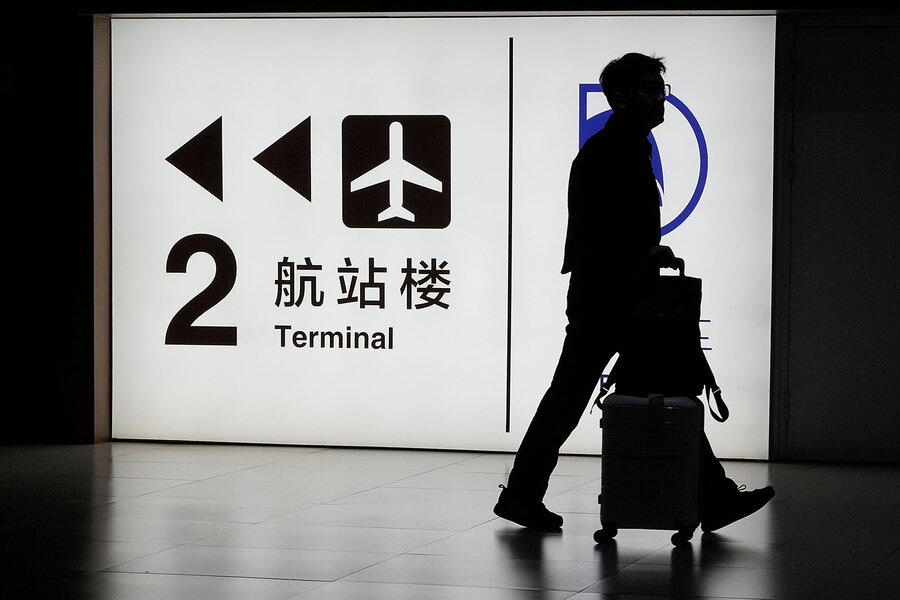
China has introduced sweeping new travel restrictions to try to stop its advanced technology from illegally flowing overseas.
Under new State Council entry-exit regulations that took effect Tuesday, the government may “prohibit … from leaving China” citizens who break export controls that “may endanger national industrial security or technological security.”
The crackdown comes as technological competition intensifies between China and the United States, particularly in the race to develop generative artificial general intelligence (AGI), an AI system with human-level ability to reason and act.
Why We Wrote This
China is one of the world leaders in advanced technology. But as competition intensifies with the U.S., particularly over AI, it has introduced sweeping new travel restrictions on its citizens to try to stop that technology from illegally flowing out of the country.
The new rules mark a broad tightening of controls not only on the technology, but also on civil servants, skilled workers, and other individuals leaving the country – all framed as an effort to “safeguard national sovereignty, security, and development interests.”
In one high-profile case earlier this year, China blocked the Chinese executives of an artificial intelligence startup, Manus, from leaving the country. The travel ban on CEO Xiao Hong and chief scientist Ji Yichao was imposed as the government investigated Meta’s purchase of Manus for $2 billion. Founded in mainland China, but later based in Singapore, Manus was forced to unwind the deal and resume operations as an independent business.
Henry Gao, a law professor at the Singapore Management University, says China’s heightened scrutiny of travel will have a chilling effect, comparing it to the “Hotel California” described in the song by American rock band, the Eagles.
“With the new exit regulations taking effect today, it’s officially reality: You can try to check out any time you like, but you can never leave,” Professor Gao posted Tuesday on the social media platform X.
Chinese Premier Li Qiang signed a decree in July laying out the rules, part of an overarching focus by China’s top leader Xi Jinping on national security. The travel restrictions are a reminder of an earlier era. In the 1980s, Chinese citizens faced far greater limits on their ability to travel overseas, and often had to apply for opportunities through their employers.
The new rules also call for closer regulation of intermediary agencies that assist people with leaving China, and task them with reporting anyone who tries to exit unlawfully. “If government officials, military personnel, or others entrust intermediary agencies to illegally process … foreign residence documents” the agencies should “promptly report them to supervisory authorities,” the rules say.