

China Blacklists US Firms After Sanctions, Forced Labour Tariffs
China has hit back at the United States on Wednesday in response to trade sanctions imposed last week, announcing a tightening of restrictions on drone exports to the US and blacklisting seven companies.
The countermeasures come days after the United States imposed fresh tariffs on China and 59 other countries over forced labour and national security concerns, which added to a series of recent trade measures.
The export controls mean that any shipments of drones, drone components or related technologies to the US will be subject to “strict case-by-case scrutiny,” according to the Commerce Ministry. It said the move would “safeguard national security.”
ALSO SEE: Shan Mines an ‘Environmental Catastrophe for Thailand, SE Asia’
A Commerce ministry spokesperson said in a statement that the US actions last week – on allegations relating to forced labour in the western Xinjiang region – “seriously harm China’s legitimate rights and interests.”
“China can only take necessary countermeasures in response, including strengthening export controls on drones, and their key components and technology to the US.”
Beijing’s measures also include suspending factory follow-up inspections by Chinese certification bodies, blacklisting US compliance testing companies, and launching national security investigations into imports of office printers and copiers, according to the ministry.
It imposed sanctions on six US businesses, including biotech company Applied DNA Sciences and geoscience research firm Stratum Reservoir, barring organisations and individuals within China from “engaging in relevant transactions, cooperation, or other activities with them”.
The six entities “have assisted and supported illegal US sanctions related to Xinjiang; the nature of their actions is egregious”, the commerce ministry said. Those moves ban Chinese entities and individuals from trading and cooperating with them.
A seventh US company, Compliance Testing, was added to China’s sanctions list for allegedly assisting US sanctions related to ‘abuses’ in Xinjiang province.
The UN and multiple human rights groups have warned of possible crimes against humanity in Xinjiang region targeting the mostly Muslim Uyghur minority – accusations China vehemently denies.
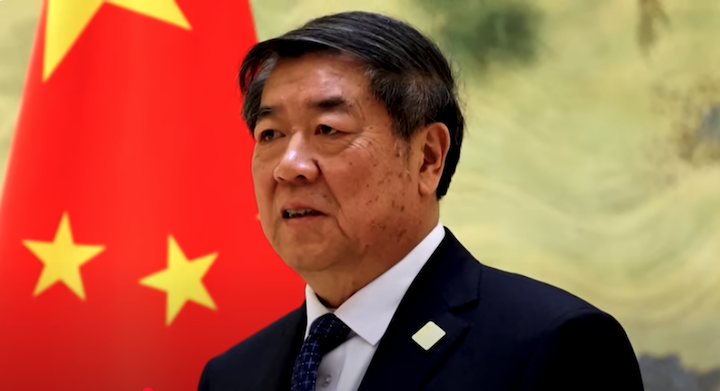
China’s top trade official He Lifeng expressed “serious concern” to US Trade Representative Jamieson Greer in a call over the recent restrictions, state news agency Xinhua reported.
China also accused the United States last week of seeking to “suppress” Chinese companies, after Washington banned imports of humanoid and quadruped robots manufactured abroad in a move separate from the new tariffs.
China and the United States spent much of last year embroiled in an escalating trade war but reached a truce when US President Donald Trump and his Chinese counterpart Xi Jinping met last October.
The latest US tariffs against China and other trade partners, however, have threatened that truce, with Beijing warning Washington against waging a trade war.
Asian markets rise
Meanwhile, Asian equities climbed again on Wednesday, tracking another record on Wall Street, as tech firms enjoyed a recent revival after a month-long rout and with confidence boosted by the Trump administration touting an imminent deal to reopen the Strait of Hormuz.
After spending four weeks unloading their positions over fears that the AI-led rally had come to a shuddering halt, investors were piling back into the sector to extend a rebound that began in breathtaking fashion Friday.
Strong earnings and positive forecasts from market heavyweights including Amazon, Microsoft and data-mining giant Palantir have injected fresh interest in tech, helping overcome worries about massive spending on artificial intelligence and when that will see a return.
All three main indexes on Wall Street chalked up gains on Tuesday, with the S&P 500 and Dow hitting records – while there were also new peaks for Paris, Milan, Frankfurt and Madrid.
That optimism filtered through to Asia where Seoul – which has been at the forefront of extreme volatility in the tech sector over the past month – climbed 3.8%.
Tokyo, which has also benefited from the AI boom, was up more than 3%, while Taipei added 2.9%.
There were also gains in Hong Kong, Shanghai, Sydney, Wellington, Mumbai and Jakarta.
London rose in the morning while Paris and Frankfurt hit fresh record highs.
The gains come as a relief to traders after a wave of tech selling, which was also linked to worries of higher US interest rates, saw Seoul fall more than 40% from its June record high.
The losses were led by chipmakers SK hynix and Samsung, which collapsed up to 50% from their own peaks.
Friday’s rebound – the Kospi surged almost 18% and SK Hynix 30% — came on the back of bargain-buying and positive earnings among other things.
Hope for US-Iran truce
Gains have been helped this week by hopes that the US-Iran truce will be reset after weeks of tit-for-tat strikes.
Crude prices tumbled more than 5% on Tuesday – and are down more than 10% this week – after US Treasury Secretary Scott Bessent said a deal could be reached imminently with Tehran on re-opening the Strait of Hormuz to shipping traffic.
He told CNBC television that “I think there is a chance we may have a deal today or tomorrow to open the strait” – a key sticking point in ceasefire talks.
“I’d expect the energy prices to settle back down, which, as I said, will be good for the entire world.”
President Donald Trump later warned Iran would be “hit very hard” unless the waterway was reopened “very soon”.
His comments to Fox News came as Axios reported that the United States, Iran and Oman were nearing an interim deal to reopen the strait, which Washington was hoping to announce Wednesday.
The Brent and West Texas Intermediate crude contracts edged up on Wednesday in early European trade.
“The past few sessions have been pivotal for financial markets, largely thanks to signs of diplomatic progress around the Strait of Hormuz,” wrote Julian Pineda at City Index.
He said officials’ comments regarding progress in talks “has had a direct impact on market confidence. With geopolitical uncertainty easing, WTI crude has slipped below the $80 mark, helping to dial back fears of global inflation.
“This, in turn, eases concerns about aggressive central bank rate hikes, clearing the way for risk appetite to recover.”
And IG Markets’ Tony Sycamore said “the balance of risks appears to be becoming more skewed back to the upside”.
The drop in oil prices helped ease concerns about inflation and saw traders lower their expectations for the Federal Reserve to hike interest rates, according to Bloomberg.
Investors are keeping tabs on the release this week of crucial US jobs data that should provide them with a fresh idea about the state of the economy, and guide the Fed as it considers its next move.
Key figures around 0810 GMT
Tokyo – Nikkei 225: 3.7% at 66,300.44 (close).
Hong Kong – Hang Seng Index: UP 0.2% at 25,915.82 (close).
Shanghai – Composite: UP 1.5% at 3,878.43 (close).
Seoul – Kospi: UP 3.8% at 6,598.26 (close).
London – FTSE 100: UP 0.3% at 10,912.59.
West Texas Intermediate: UP 0.2% at $75.89 per barrel.
Brent North Sea Crude: UP 0.7% at $79.95 per barrel.
Dollar/yen: DOWN at 157.70 yen from 157.72 yen on Tuesday.
New York – DOW: UP 1.7% at 54,085.88 (close).
ALSO SEE:
China Factory Activity Falls, EU Hits Temu After Raids
Record EV Sales in 50 Countries Since Mideast War, IEA Says
China Says US Suppressing Its Companies After Robots Ban
Asia Tech Stocks Sink on China Chipmaking ‘Advance, AI Doubts
AI Boom Makes Chipmaker CXMT China’s Most Valuable Company
China’s Xi Calls For Global Cooperation to Regulate Use of AI
Taiwan Chip Giant to Splash Another $100bn on Fabs in Arizona
China Puts ‘National Security’ Rules on Overseas Investments
Tech Rules Needed So World Doesn’t Lose Control of AI: China
‘Rogue’ AI Drama Spurs Safety Debate, Oil up 5% on Houthi Attack
