

Charleroi’s Haitian community makes emergency plans in case of ICE
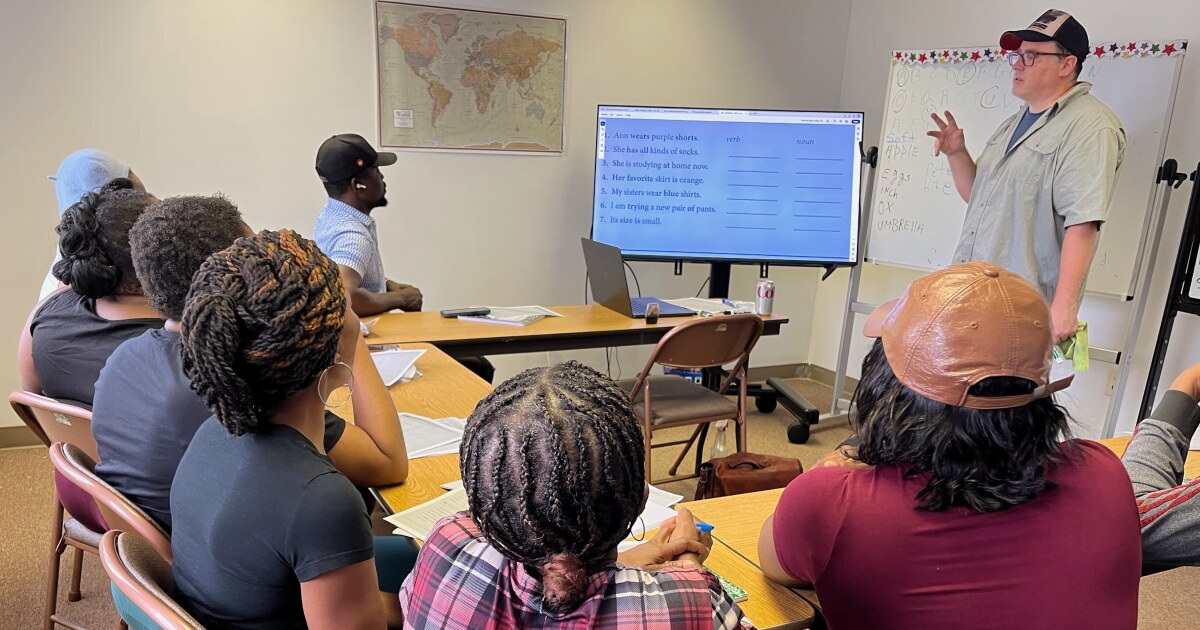
During a mid-August meeting of his English class at Charleroi’s Hope Community Church, volunteer instructor Tim Maddocks moved through his lesson plan. The class of eight Haitian immigrants reviewed vowel sounds. Practiced the names of articles of clothing: boots, sweater, hoodie. Learned, for the first time, how to transform a verb from the present to the present continuous tense using i-n-g.
Then Maddocks introduced another new topic, passing around a handout he’d prepared, in English and French, on the end of Temporary Protected Status. TPS, as it’s often called, is the immigration designation that allowed some 330,000 Haitians to live and work in the U.S. — at least until the Trump administration terminated it earlier this month.
For any students in the class who may have relied on the program, Maddocks explained, “You had TPS. Now you don’t. It’s called ‘status.’ You are out of status.”
TPS has protected many Haitians in the U.S., including a large number of those who have been living in Charleroi, from deportation since 2010. A massive earthquake that year killed and displaced hundreds of thousands, kicking off years of cascading crises in the small Caribbean nation.
After President Donald Trump’s 2025 inauguration, the Department of Homeland Security tried several times to terminate TPS, but the efforts were blocked by federal judges. For more than a year, an existential question for Haitians in Charleroi was “will they or won’t they?” Would federal officials prevail in court and carry out Trump’s plans?
Finally, in June, the Supreme Court cleared the way for the government to do just that.
The decision ended a wrenching limbo about whether TPS would remain in place, but only to replace it with a host of new fears.
Maddocks’ class, for one, now meets remotely rather than in person, due to fears of immigration enforcement. And Charleroi’s Haitian community is drawing up emergency plans for what may be coming, and bolstering networks of mutual aid.
Moving on, staying in, staying put
“ You can fire a cannon down that street and not hit anything,” said borough manager Joe Manning, looking down Fallowfield Avenue from the Charleroi Borough Building. “There’s nobody out there anymore.”
It’s a far cry from the bustling downtown with newly-filled storefronts the town boasted just two years ago, when the Haitian community was growing and flush with cash earned at local employers like Fourth Street Barbecue.
Susan Scott Peterson
/
90.5 WESA
Manning said he’s seen other evidence that Haitian immigrants have been moving out: a spike in requests for dumpster permits.
“That led me to believe there was a lot of houses in Charleroi that were being cleaned out,” he said.
Not everyone has seen signs of an exodus.
While there have been rumors of ICE activity in Charleroi, including a post on a local Facebook group, multiple sources have confirmed no raids or mass arrests appear to have been conducted to date. That’s in contrast to Springfield, Ohio, four hours to the west, where The New York Times recently reported ICE has summoned hundreds of Haitians to fit them with ankle monitors. Those devices will make immigrants easier to locate if mass arrests and deportations begin.
In Charleroi, meanwhile, attendance is down for Sunday services at Hope Community Church, where Maddocks’ English class takes place. But Pastor Sharon Woomer says she believes its Haitian congregants — which in February included more than 60 Haitian adults and around 35 children — have largely stayed in Charleroi.
“ I know lots of people are talking about people leaving the community, but in terms of the folks that come to church or consider this [church] like a home away from home, that’s been a pretty steady population,” Woomer said. “At this point, unless there is an absolute threat, a visible threat of something happening, my sense is that people are going to stay together here and find a way through it together.”
The big question now: How will the TPS termination play out in practice for Charleroi’s Haitian immigrant enclave?
Jimmy Alexandre, owner of Charleroi’s Haitian Resource Center, says while some Haitians have left town, others are simply isolating themselves.
“Everybody’s scared of ICE being on the street, so they are staying at home,” Alexandre explained.
For many Haitians in Charleroi, TPS was just one of multiple immigration pathways and protections, a temporary backstop while they applied for asylum or permanent residency. Many still have legal status while they wait for these processes to conclude.
But even some of those who retain legal status are fearful of federal immigration enforcement, and isolating at home. Others have left Charleroi to join family in places with larger Haitian communities, like Florida, New York and New Jersey. Still others who came to the U.S. via Chile or Brazil have returned to those countries, where they still have residency.
The problem, Alexandre said, is that not everyone has those networks.
“There’s some people that have never left Pennsylvania,” he said. “Charleroi … is all they know for four or five years because they came here by themselves. So they’re not leaving.”
While the federal government is offering $2,600 and a free flight for Haitians who leave voluntarily — a program officials call “Project Homecoming” — many Haitians won’t return to Haiti willingly. The country is under a Level 4 Do Not Travel advisory from the U.S. State Department, due to extremely dangerous conditions.
Earlier this week, the United Nations reported 47 people were killed and more than 50 kidnapped by gangs near Haiti’s capital, Port-au-Prince. It is believed to be one of the largest mass kidnappings in Haiti in years.

Susan Scott Peterson
/
90.5 WESA
Alexandre is both a Haitian and a U.S. citizen, with a broad network of family and friends in the United States and Canada. But even as the Haitian community in Charleroi dwindles, he plans to stay.
“I had my son here. I’m not leaving. I’m not saying I won’t ever leave, but I don’t want to leave,” he said. “I’m building something here. I’m making connections. My life is mixed with other people’s lives. I got friends. I got neighbors. I don’t want to leave all that to start it over.”
Emergency plans
Less than a week before TPS was terminated for Haitians, the rapid-response organization Frontline Dignity hosted a training session on a set of new skills, such as how to recognize ICE agents and their vehicles, and how to assert Constitutional rights in case of an encounter with law enforcement.
“It was kind of unique among the trainings that I’ve given, and I’ve given many of them,” said Jaime Martinez, founder and executive director of the group.
Martinez usually trains volunteers, who are mostly white U.S. citizens, in observing ICE activity. The workshop in Charleroi – which was arranged in collaboration with several churches and the local Haitian community – had a different tone because the trainees could be directly subjected to potential immigration enforcement themselves.
Martinez said the training ultimately turned into a conversation about concrete, immediate emergency plans—such as whether parents should sign temporary guardianship papers, to allow other people to care for their children if they are detained.
As an instructor, Martinez said, “You learn to compartmentalize and you just, like, give the training. But it really brought me to tears to see how this community is pulling together and is trying to keep the community cohesive amidst what’s going to be a very long and tough struggle.”
Family separation has been a chief concern for the Haitian Resource Center’s Alexandre, Hope Community Church’s Woomer and others involved with the community.
As a response, Hope Community Church partnered with Westminster Presbyterian Church in Upper Saint Clair and Bower Hill Presbyterian Church in Mount Lebanon to secure and fix up a four-bedroom rental house in the region for Haitian women and children in crisis. The rent is being paid for a year by an anonymous donor.
Woomer says the property — known as Hope House — was originally acquired “in case we had to have a place for children whose parents were taken.”

Susan Scott Peterson
/
90.5 WESA
In June the house welcomed its first resident: Anide Limage, who moved to Charleroi from New Jersey in 2022. A family emergency pushed her to leave her previous home with her 9-year-old daughter and move into Hope House.
She has since regained some stability: Recently, she purchased a new car that allowed her to start working again, commuting to group homes in the region where she works as a caregiver. She plans to move out soon.
“I think there is more people in need than me,” Limage said.
Limage is particularly in tune with the spike in needs in the Haitian community in the wake of TPS ending.
Last year, she created a mutual aid organization known as Fanm Vanyan, to connect local Haitian women with food, clothes, translation and other services. She now maintains a group chat of more than 150 Haitian women in the area, and keeps in touch with them daily.
“I wake up in the morning and I say, ‘Hi guys, how you doing?’ [They say,] ‘Yeah, we here. We hanging in there. Waiting for ICE coming.’” Anide explained. “They’re scared, you know?
“Everything is on pause,” she added. “We don’t know what’s going to happen.”