

Ceuta, Melilla: Spain’s Inversion of History and the Coming Reckoning with Morocco
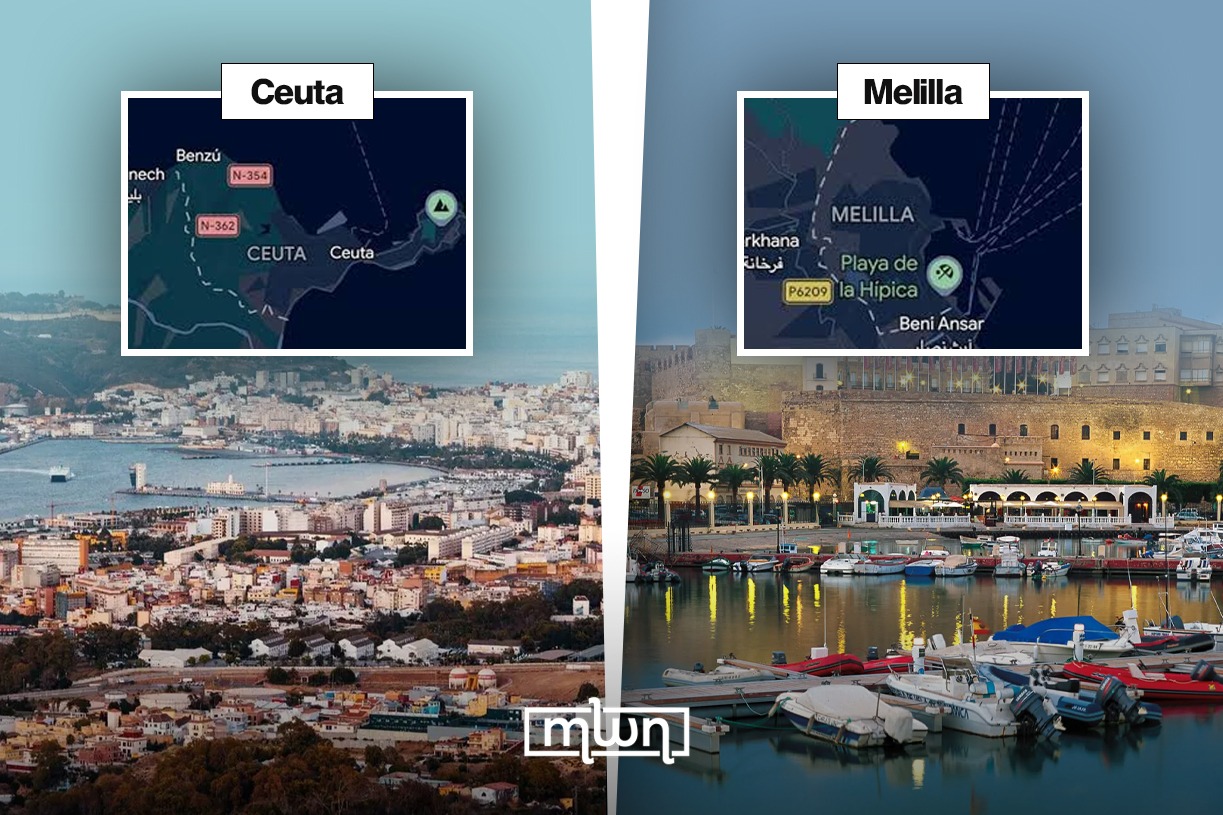
The ongoing Morocco-bashing campaign that Spanish media and political elites have unleashed since the July 29-30 mass rush into Ceuta has thrust back into the spotlight a territorial dispute that Spain would prefer the world forget exists at all. Indeed, in the avalanche of coverage they have devoted to the “españolidad” of the two enclaves, a curiously overwhelming consensus has taken hold among Spanish commentators, journalists, and politicians.
As they see it, Ceuta and Melilla “have never belonged to Morocco.” Some have even gone as far as to provocatively and ahistorically postulate that these two enclaves were never part of the North African kingdom because Morocco was only “established as a state in 1956.” And yet undermining this glaringly anachronistic argument is the irony that the very people insisting Morocco did not exist as a state before 1956 have no qualms about invoking, in defense of their thesis of Spanish sovereignty over the enclaves, the 19th-century treaties Spain and Morocco signed to fix the current borders of Ceuta and Melilla. In other words, their argument appears to be that the Moroccan state is too young to claim sovereignty over Ceuta and Melilla yet old enough to have signed that very sovereignty away to Spain.
Madrid’s manufactured consensus over the historical identity of the two enclaves
Ceuta and Melilla sat at the center of Morocco’s diplomatic discourse throughout the reign of King Hassan II and the first five years of King Mohammed VI’s reign. Despite Spain’s dismissiveness, Morocco never recognized Spanish sovereignty over the enclaves, nor relented in pressing Madrid to acknowledge the existence of a dispute over the status of the two enclaves. In 1987, Hassan II wrote to King Juan Carlos proposing a “célula de reflexión” – a joint task force – to study the enclaves’ future in a way that would safeguard Morocco’s “inalienable rights” alongside Spain’s “vital interests.”
As Rabat prioritized the far more consequential Sahara dispute over the past two decades, it made the conscious and strategic choice of putting its claim to Ceuta and Melilla on the back burner. But Morocco going quiet in official discourse over Moroccan sovereignty should not be misconstrued as a total abandonment or relinquishing of its stakes to Spain. Morocco has instead spent much of the past two decades subtly preparing to recover the two enclaves. Over the past fifteen years, Rabat has built the infrastructure – the Tanger Med port, the industrial zone at Fnideq, the Port of Beni Nssar at Melilla’s border – that will eventually render obsolete the enclaves’ contraband economy that has cost Morocco over a billion dollars a year in trade balance. Morocco has since closed its borders with both enclaves, banning the smuggling economy on which they depend for employment, given their negligible industry or agriculture. But Morocco’s goal is not to pointlessly asphyxiate Ceuta and Melilla. Instead, Rabat’s strategic bet is to lay the groundwork for a formalization of the local economy that can in time turn into an effective socio-economic integration with northern Morocco and put Spain before the fait accompli of the unsustainability of its myth surrounding the social and historical identity of the enclaves.
In that sense, last month’s mass crossing into Ceuta has exposed just the fundamental fragility and anachronistic nature of the enclaves’ status. Yet rather than reckon with the obvious, Spain has chosen a combative, dismissive narrative asserting that its sovereignty claim rests on unimpeachable historical grounds. To Madrid’s dismay, however, a more dispassionate, nuanced, and historically grounded reading of the relevant records tells the considerably different story that Spanish officials themselves have quietly acknowledged for well over a century despite their public rhetoric insisting otherwise.
Since Morocco’s independence in 1956, it has been an open secret in foreign chancelleries that Ceuta and Melilla sit at the heart of an unresolved dispute between Madrid and Rabat. An essential element Spanish analysts conveniently gloss over when discussing the international legal status of Ceuta and Melilla is that the two cities were not excluded from the UN’s Non-Self-Governing Territories list as a result of a decision determining that they did not meet the criteria for such classification. They were simply not included on the list because, as part of a tacit understanding between Hassan II and Franco, Morocco eased its pressure on Spain between 1963 and 1965. While Franco subsequently failed to honor that tacit arrangement, the fact remains that had Morocco maintained its pressure on Spain at the time, the two enclaves might have been included on the list of Non-Self-Governing Territories.
During UN Fourth Committee debates at the time, numerous member states questioned Spain’s sovereignty outright. At the October 12, 1961 session, Guinea, Iraq, Yemen, Mali, Senegal, the United Arab Republic, and the USSR stated that regarding Ifni, Saguia-el-Hamra, Ceuta, and Melilla, they recognized no sovereignty other than Morocco’s. Between 1957 and 1962, Moroccan diplomats repeatedly placed these claims on the UN record, missing no opportunity across sessions of the General Assembly, the Fourth Committee, and the Special Committee on Decolonization to remind member states that Rabat regarded Ceuta, Melilla, Ifni, and the Sahara alike as Moroccan territory under foreign occupation. In a way, this history demonstrates that the international diplomatic community was well aware that a genuine dispute existed. And this is a far cry from the settled, uncontested “Spanishness” that Madrid now claims as historical fact.
At the Committee’s November 7, 1960 session, Spain’s representative Manuel Aznar assured member states of his government’s willingness to cooperate on the matter at hand. Yet a bloc of states, Tunisia foremost among them, kept pressing Madrid to name which territories under its administration fell within Article 73 of the UN Charter. Spain ultimately maneuvered a revised draft resolution through the Committee that named no territories at all. In response to this procedural victory but telling diplomatic victory, Morocco’s delegation immediately placed on record that the resolution’s adoption implied no recognition that Ceuta, Melilla, Ifni, or the Sahara were Spanish provinces. It stressed that Rabat’s position – namely that all four were “integral parts of Moroccan territory” – stood unchanged.
Morocco deprioritized the two enclaves for the Sahara, but it never abandoned them
As I explained in my two most recent books on the Sahara, notably the 2024 book on the long, winding history of the UN-led political process, and the 2026 book on the regional rivalries and schemes that have shaped the territorial dispute, Morocco’s overriding priority following Hassan II’s meeting with Franco at Barajas was securing bilateral negotiations over the Sahara. And yet, rather than a total and settled renunciation of its claim to the enclaves, Rabat’s setting Ceuta and Melilla aside to focus on the Sahara file was a gesture of goodwill meant to signal Rabat’s commitment to a tacit reciprocity with Madrid.
Over the years, a wave of declassified Western records has made unquestionably clear that Spain’s own officials had abiding doubts about their own assured, defiant public narrative. As Sir Richard Parsons, British ambassador to Spain from 1980 to 1984, bluntly put it in a 2005 interview: “The Spanish liked to say that Ceuta was not the same as Gibraltar, that it was an integral part of Spain. Of course that’s nonsense; it’s a very comparable situation.” A 2014 UK House of Commons Foreign Affairs Committee report reached a similar conclusion. Madrid denies any dispute over Ceuta and Melilla while refusing to recognize Gibraltar as fully British, it noted, concluding that Spain’s position on the Gibraltar case leaves it “open to the charge of hypocrisy.”
American intelligence has consistently drawn the same assessment over the past decades. A 1959 CIA report warned, for example, that continued Spanish control of the enclaves could cause “serious difficulties” given Morocco’s claims. Five years later, a follow-up report placed the dispute within the broader context of Morocco’s grievances against Spain since 1956, citing Tarfaya, Ifni, and the Sahara while explicitly linking the lingering dispute between the two neighbors to the Gibraltar question. Spain denies Morocco the very right it has been aggressively seeking from the UK on the Gibraltar case, it emphasized. Similarly, a State Department cable from August 21, 1976 shows the then American ambassador to Morocco warning Washington that a U.S.-Spain military agreement covering Ceuta and Melilla could seriously damage American relations with Rabat if it became known. And, again drawing the Gibraltar parallel, a May 1982 CIA report correctly predicted that Morocco would reactivate its claims to Ceuta and Melilla once the Sahara dispute was resolved.
The UN archives tell the same story. During the same Fourth Committee wrangling over Article 73, Aznar at one point objected that certain items on the proposed list constituted “a personal offence against all Spaniards, whatever their convictions.” Yet in the same breath he described the disputed list as containing “territories which were the subject of legal disputes on the part of friendly countries for whom the door was open for bilateral negotiations,” without exempting Ceuta and Melilla from that description.
Because Aznar did not draw a clear line between Ceuta and Melilla on one side and Ifni and the Sahara on the other when he spoke of “legal disputes” with “friendly countries,” his words can reasonably be read as treating at least some of these territorial questions as open to bilateral negotiation. Still, it would be a stretch to treat that single remark as an explicit Spanish admission that Ceuta and Melilla themselves belonged in that category. But the remark carries more weight when set alongside a conversation Spain’s Foreign Minister, Fernando María Castiella, had with the US ambassador in Madrid on March 23, 1960.
According to a declassified US memorandum of conversation, Castiella told the American diplomat that his government was “negotiating with Morocco to permit the provisioning of the Spanish troops and population of Ceuta and Melilla,” adding that these negotiations “were still secret.” That claim sits uneasily with the notion that Ceuta and Melilla have always been regarded exactly as any city on the Spanish mainland would be. If Madrid saw no need to distinguish the enclaves from Madrid or Salamanca, why negotiate their provisioning with Morocco at all, let alone in secret?
The very fact that Spain felt it had to conduct these talks quietly points to a truth that subsequent degenerations of Spanish governments have unsuccessfully repudiated. And that stubborn truth is that Madrid cannot simply wave away Morocco’s territorial claims or convincingly refute the geographic reality that the enclaves’ survival depended on their Moroccan hinterland, and therefore on Morocco’s willing cooperation.
The Gibraltar parallelism and Spain’s inversion of history
Far from a Moroccan talking point, the parallel between Gibraltar and the enclaves is another reality Spanish leaders themselves have acknowledged in private while denying it in public. During a confidential conversation with the U.S. ambassador in June 1966, Castiella revealed that Spain was “prepared [to] accept the same conditions from Morocco on Ceuta and Melilla as it [was] offering UK on Gibraltar.”
Perhaps even more revealingly, a U.S. Embassy telegram dated May 8, 1979 quoted King Juan Carlos as telling Senator Edmund Muskie in April of that year that since only 10,000 Spaniards lived there, and that any military protest would last “only about two months,” Melilla “could be ceded to Morocco within a relatively short period of time.” King Juan Carlos considered Ceuta more complex given its larger Spanish population, and he even floated a Tangier-style international status for it.
Spanish officials also ran a double discourse on the status of Gibraltar, publicly demanding its return while privately telling London they were in no hurry to settle it. Meeting British ambassador Parsons on July 21, 1983, King Juan Carlos said Spain “did not really seek an early solution to the sovereignty problem,” and that his foreign minister and Britain’s should privately understand the difference “between their actual aim and the methods used to propitiate public opinion.” Two months later, meeting Britain’s foreign secretary, the Spanish monarch explained the reasons behind that strange decision. Madrid feared that settling Gibraltar quickly would prompt Hassan II to “immediately reactivate the Moroccan claims to Ceuta and Melilla,” he suggested. In other words, the Spanish monarch understood that the two disputes are locked together, and that resolving one invites pressure on the other.
Madrid’s slow-walking of the Gibraltar line was in part a strategy for containing Morocco. This is what Rabat’s diplomats have said for decades, and it is also the crux of what Spanish commentary on the current crisis refuses to engage with. Nationalist voices now emerging in Spain can passionately object to outside observers – a British ambassador, a parliamentary committee, American intelligence analysts – drawing a parallel between Gibraltar and the enclaves from the outside. But can they convincingly do so when a Spanish king himself once treated the two questions as functionally linked, suggesting that progress on one would necessarily invite pressure on the other?
The enclaves’ administrative status of ‘presidios’ reveals they were never considered fully Spanish
Most Spanish commentators date Ceuta’s incorporation to 1580, but it only formally became Spanish territory under the 1668 Treaty of Lisbon. And more than two decades later, Ceuta’s own inhabitants were still petitioning the Spanish crown to be treated on equal footing with other Spanish cities. Neither Ceuta nor Melilla ever had representation in the Spanish Cortes in their own right; both were represented through Seville’s delegate. Neither had local municipalities or civilian courts, as military courts handled crimes there under 1890 law. Residents could not even join local Castilian regiments and were considered “Spaniards” only once they left the enclaves for the Peninsula.
For more than two centuries, Spain repeatedly weighed abandoning the enclaves outright or trading them for Gibraltar, largely because of the enormous and recurring cost of defending them against a hostile hinterland. Philip V considered abandonment after Sultan Moulay Ismail subjected Ceuta to a 26-year siege between 1700 and 1726. Spain went further in 1764, weighing the abandonment of all its African possessions except Ceuta and Oran, on the grounds that the rest offered little military, political, or religious value relative to their upkeep.
As Jerónimo Bécker documents in his book “Spain and Morocco: Their Diplomatic Relations During the Nineteenth Century,” Madrid weighed ceding the so-called Presidios Menores – Melilla, the Peñón de Vélez de la Gomera, and Alhucemas – to Morocco in 1801, in exchange for economic concessions, including duty-free access to a million fanegas of Moroccan grain. The proposal reached the point of interministerial review. The Finance and the Indies Ministers favored ceding the territories, while the Ministries of Grace and Justice, War, and the Navy opposed it. The plan only collapsed only because Godoy, the minister then in charge, ultimately preferred pursuing an exchange for ports instead.
Yet the idea of an exchange resurfaced soon after under González Salmón. In 1804, Spain quietly explored trading the same presidios for Moroccan neutrality in its war with Britain, instructing Salmón to approach the Moroccan government “with the utmost secrecy” and to float the handover “while pretending to act on his own initiative.” In a letter from Mohammed Bin Abdeslam Slawi dated September 15 of that year, Morocco signaled it was interested in taking up the offer. Yet the initiative was aborted because Salmón had by then already received instructions to drop it.
In 1811, the Council of Regency asked the Cortes of Cádiz whether Ceuta and Melilla were Spanish territory. It concluded they were not, and instead recommended their restitution to Morocco. During the Trienio Liberal shortly after, the Cortes drew up a plan to abandon the smaller Plazas Menores altogether in exchange for expanding Ceuta’s own surface. But the plan collapsed only because Britain intervened with a competing offer to absorb those territories itself. Later in the century and into the twentieth, successive Spanish governments – those of Leopoldo O’Donnell, Juan Prim, Segismundo Moret, and Primo de Rivera among them – separately pursued the idea of trading Ceuta for Gibraltar. If anything, none of these historical episodes point to a state that regarded these territories as permanently, unquestionably its own.
The enclaves’ own administrative labels thus confirm they were never treated as ordinary Spanish cities. Until 1907, both were classified simply as presidios, fortified penal outposts; Ceuta was a presidio mayor, while Melilla was considered a presidio menor. Only after 1907 were they renamed Plazas Fuertes, and in 1913, Plazas de Soberanía. Under the Spanish protectorate over Morocco, they were administered through Spain’s High Directorate in Morocco, and Spanish citizens needed a passport to enter them. It was not until 1955 – one year before Moroccan independence – that Spain designated them Plazas de plena soberanía, territories of full sovereignty. Even then, they remained under military command until 1983.
The enclaves’ current borders were imposed on Morocco through the unequal treaties of August 1859 and April 1860. The treaties were signed under military duress – the first following border skirmishes near Melilla, the second after Morocco’s catastrophic defeat in the War of Tetouan. In both cases, the Moroccan sultan agreed only to a neutral buffer zone around the enclaves. But Spain used the leverage of victory to expand Melilla’s territory by 90 percent and Ceuta’s by 50 percent. Spanish scholars like Máximo Cajal and Alfonso de la Serna have since questioned the legal validity of these treaties.
Fundamentally, that Ceuta and Melilla were never placed on the UN’s list of Non-Self-Governing Territories does not permanently nullify Morocco’s claims to them. Their exclusion was not the outcome of a UN legal process that examined the two enclaves and found they failed to meet the criteria for listing. They were left off simply because Morocco, at the height of its territorial disputes with Spain, chose to set its claims over Ceuta and Melilla aside and concentrate its diplomatic energy on the Sahara. And even during this period of tacit understanding between Rabat and Madrid, Morocco continued to register its reservations. It kept insisting that the two enclaves were Moroccan territory, and it placed on record that their absence from the UN list should not be read as some irreversible recognition that they were as Spanish as Madrid or Salamanca.
Still, Morocco is unlikely to take a unilateral path aimed at reclaiming its sovereignty on Ceuta and Melilla. A multilateral vote on the matter would hand Rabat a symbolic win, but it would also lock the dispute into the same adversarial, all-or-nothing framework that kept the Sahara question frozen for decades whenever it was treated as a strict binary of decolonization versus sovereignty. And so, Morocco’s more effective lesson from the Sahara file is that patient and bilateral pressure can, when sustained across decades and reinforced by facts on the ground, succeed where multilateral maximalism stalls.
As such, Rabat’s strategic bet is a longer and quieter one. It is that geography and economics, not UN votes, will eventually force the issue in Morocco’s favor. Rabat is thus betting that, sooner or later, the two neighbors will have no choice but to sit down and negotiate a framework that ends what Morocco regards as a historical anachronism, while protecting the interests of both nations and that of the local populations.
Samir Bennis is the co-founder and publisher of Morocco World News. You can follow him on Twitter @SamirBennis.
Credit: Source link