

Central Asia Is Becoming an Arena of Competition Between India and China
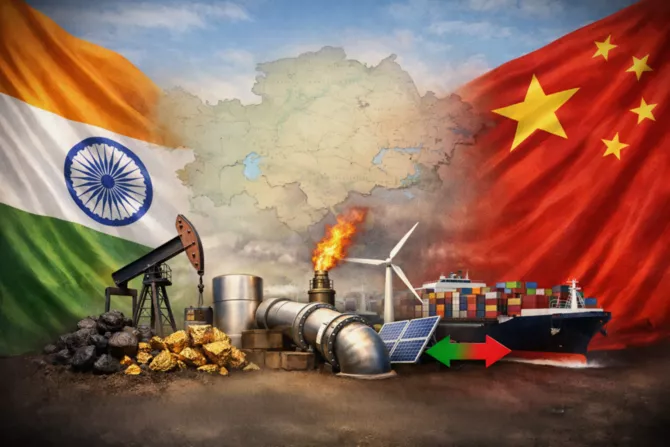
Central Asia is gradually emerging as one of the key arenas of economic competition in Eurasia. China has already secured a leading position in the region through its shared borders, large-scale infrastructure projects, financing capacity and growing demand for energy resources. India remains far behind but is seeking to expand its presence through pharmaceuticals, information technology, education, healthcare and transport routes running through Iran.
However, it would be premature to describe the current situation as a contest between equal players. China is already deeply integrated into Central Asia’s economic and logistical system, while India is still developing the instruments needed to become a major regional actor.
China’s Advantage in Numbers
In 2025, trade between China and Kazakhstan, Uzbekistan, Kyrgyzstan, Tajikistan and Turkmenistan reached a record $106.3 billion, increasing by 12% year on year. Chinese exports to the region amounted to $71.2 billion, while imports from the five Central Asian states stood at $35.1 billion. According to Beijing, China became the largest trading partner of the Central Asian countries as a group for the first time.
By comparison, the Eurasian Development Bank estimated India’s total trade with Central Asia at approximately $1.7 billion in 2023. Even allowing for subsequent growth, the gap between the two Asian powers remains enormous.
The difference in investment is equally significant. By the end of 2022, China’s stock of direct investment in the five Central Asian states had approached $15 billion. Indian investment in the region is estimated at approximately $1.5 billion, with about 65.5% concentrated in oil, gas, coal and other resource-related industries.
In other words, China’s accumulated direct investment was already at least 10 times greater than India’s. China’s economic footprint is also much broader, covering transport, energy, manufacturing, telecommunications, mining and mineral processing, agriculture, e-commerce and financial infrastructure.
It is important to distinguish direct investment from government loans and construction contracts. If Chinese lending, contract work and jointly implemented infrastructure projects were included, the overall scale of Beijing’s economic presence would be considerably larger than official foreign direct investment figures suggest.
Why China Moved Ahead
China’s main advantage is geography. Xinjiang directly borders Kazakhstan, Kyrgyzstan and Tajikistan. Chinese goods can therefore enter the region by road and rail without passing through third countries.
India has no common border with Central Asia. Its direct overland access is obstructed by geography and its political conflict with Pakistan. In theory, Indian goods could travel through Pakistan and Afghanistan, but India-Pakistan relations make this option practically unavailable.
China has reinforced its geographical advantage with physical infrastructure. The China-Kazakhstan oil pipeline connects Caspian oilfields with Xinjiang, while the Central Asia-China gas pipeline transports Turkmen gas through Uzbekistan and Kazakhstan.
These projects have created long-term interdependence. Central Asian states have gained access to a major export market, while China has secured stable supplies of oil and gas.
Another strategic project is the China-Kyrgyzstan-Uzbekistan railway. Its construction is expected to provide Uzbekistan and Kyrgyzstan with improved access to China and eventually connect them with transport corridors leading towards the Caspian Sea, Iran, Türkiye and Europe.
For Central Asia, Chinese projects are important not only as sources of investment. They also reduce the region’s dependence on transport infrastructure inherited from the Soviet Union and largely oriented towards Russia.
Kazakhstan as the Central Pillar of China’s Strategy
Kazakhstan occupies a special place in China’s regional strategy. It possesses major reserves of oil, natural gas, uranium and other minerals, while also serving as the principal overland bridge between China and Europe.
The main China-Europe railway routes pass through Kazakhstan. The dry ports at Khorgos and Dostyk, Kazakhstan’s logistics terminal in the Chinese port city of Lianyungang and Trans-Caspian freight services make the country an essential part of both China’s Belt and Road Initiative and the Middle Corridor.
Chinese companies are involved in Kazakhstan’s oil and gas sector, renewable energy, mining and manufacturing. One example is a 206-megawatt wind power cluster in the Akmola Region.
India has also attempted to establish a position in Kazakhstan’s energy industry. ONGC Videsh acquired a 25% stake in the Satpayev oil exploration block in the Caspian Sea. However, the project did not become the foundation for an Indian presence comparable to China’s portfolio of energy, transport and industrial assets.
Indian investment in Kazakhstan amounts to hundreds of millions of dollars, whereas China is simultaneously present in infrastructure, energy, logistics and trade. Nevertheless, Kazakhstan remains interested in Indian capital because Astana pursues a multi-vector foreign policy and seeks to avoid excessive dependence on any single partner.
Uzbekistan as India’s Main Area of Growth
India has made its most visible progress in Uzbekistan. Bilateral trade reached $1.318 billion in 2025, up from $980.4 million in 2024. Indian exports to Uzbekistan amounted to $1.153 billion, while Uzbek exports to India stood at $164.6 million.
Accumulated Indian investment in Uzbekistan is estimated at approximately $451 million. Indian companies operate in pharmaceuticals, healthcare, construction and education. Four Indian universities have established campuses in Uzbekistan – in Tashkent, Andijan, Jizzakh and Bukhara.
Tashkent is a natural partner for New Delhi. Uzbekistan has the largest population in Central Asia, is seeking to expand domestic manufacturing and has considerable demand for medicines, technology and educational services. India can offer relatively affordable pharmaceuticals, medical services, digital solutions and professional training.
However, China retains a clear advantage even in Uzbekistan. Beijing participates in energy, chemical, transport and industrial projects. One contract alone provided for the delivery of 800 buses to Tashkent by China’s Yutong – 300 electric buses and 500 vehicles powered by natural gas. China is also a key participant in the railway project running through Kyrgyzstan.
India is therefore strengthening its position primarily in selected industries, while China is influencing the broader structure of the Uzbek economy and its transport connections.
Kyrgyzstan and Tajikistan: Chinese Infrastructure Dominates
China’s advantage is even more pronounced in Kyrgyzstan and Tajikistan. Both countries share a border with China, are landlocked and require substantial investment in roads, energy and industrial development.
Chinese institutions and companies have financed or constructed highways, tunnels, power plants and electricity transmission lines. In Kyrgyzstan, the China-Kyrgyzstan-Uzbekistan railway is becoming the central new infrastructure project. It could provide Bishkek with its first major transport route capable of reducing dependence on existing railway networks oriented towards the north.
India’s presence in these two countries is based primarily on educational programmes, professional training, pharmaceuticals, healthcare, digital technology and security cooperation. These initiatives help create a generally positive perception of India, but they do not provide New Delhi with influence comparable to that generated by Chinese infrastructure financing.
Turkmenistan and the Unresolved TAPI Problem
Turkmenistan is particularly important to India because of its enormous natural gas reserves. The main symbol of India’s ambitions remains the proposed Turkmenistan-Afghanistan-Pakistan-India pipeline, commonly known as TAPI.
The approximately 1,800-kilometre pipeline was designed to transport up to 33 billion cubic metres of natural gas annually. However, the project has faced decades of security problems, financing difficulties and political disputes.
Meanwhile, China is already importing Turkmen gas through an operational pipeline system crossing Uzbekistan and Kazakhstan. This illustrates the fundamental difference between the two strategies: India continues to discuss a potential route, while China uses infrastructure that has already been built.
India’s Bet on Chabahar
To change the regional balance, New Delhi needs a reliable route to Central Asia that bypasses Pakistan. The Iranian port of Chabahar is the centrepiece of this strategy.
Indian goods can be shipped by sea to Chabahar and then transported through Iran to Turkmenistan, Uzbekistan, Kazakhstan and other Central Asian states. The port can also be linked to the International North-South Transport Corridor.
India committed $85 million to equip the Shahid Beheshti terminal and assumed responsibility for its operation. In 2024, India and Iran signed a 10-year contract covering the management of the terminal.
However, Chabahar is not yet able to compete with China’s overland routes in terms of scale and predictability. Cargo requires several transfers, while sanctions against Iran complicate insurance, financial transactions and efforts to attract international investors. Continuing instability surrounding Iran creates additional risks.
Transport remains the main obstacle facing Indian businesses. According to the Eurasian Development Bank, high logistics costs reduce the competitiveness of Indian products and limit bilateral trade.
Russia Remains the Third Factor
Competition between India and China is not taking place in a political vacuum. Russia retains significant influence through established economic ties, the Russian language, labour migration, energy links, the Collective Security Treaty Organization and its military infrastructure.
Moscow is losing some of its economic position to China but remains an important security actor. For India, this is both an advantage and a limitation. New Delhi maintains close relations with Russia and is not viewed by Moscow as an immediate strategic threat. At the same time, India depends on Russian or Iranian transit routes because it lacks direct access to Central Asia.
China, by contrast, can combine economic and political instruments without relying on intermediaries. It offers export markets, investment, equipment, loans and transport infrastructure as elements of a single strategy.
Can India Catch Up with China?
India is unlikely to displace China from Central Asia or match the scale of Chinese trade and investment in the foreseeable future. The gap in infrastructure, financial resources and geographical access is simply too wide.
New Delhi’s likely objective, however, is not to replace China but to establish India as an additional centre of economic attraction. The Central Asian states themselves are interested in such a model. Kazakhstan, Uzbekistan, Kyrgyzstan, Tajikistan and Turkmenistan are seeking to diversify their external relations and avoid excessive dependence on either Russia or China.
India can strengthen its position in sectors where it possesses practical advantages:
· Pharmaceuticals and affordable medicine production;
· Healthcare services and hospital construction;
· Information technology and digital public infrastructure;
· Education and professional training;
· Agricultural processing;
· Critical mineral extraction;
· Engineering and consultancy services;
· Solar energy;
· Transport projects linked to Chabahar.
In 2020, India offered Central Asian countries a $1 billion line of credit for priority development projects. However, the political importance of this initiative will depend not on the announced amount, but on how many projects are actually financed and completed.
Competition Without Dividing the Region
Central Asia is indeed becoming an arena of competition between India and China, but the two countries are operating with very different capabilities. Beijing relies on geography, infrastructure, financing and annual trade exceeding $100 billion. New Delhi offers a narrower but increasingly relevant package: pharmaceuticals, technology, education, healthcare services and an alternative route to the Indian Ocean.
At present, China is a systemic economic actor, India is a promising diversification partner and Russia remains an important security and transit power.
The future of the competition will depend primarily on transport connectivity. If India succeeds in turning Chabahar and the International North-South Transport Corridor into stable commercial routes, its regional presence could expand considerably. If the existing logistical constraints persist, the gap with China will continue to widen.
For the Central Asian states, the best outcome would not be the victory of one external power over another. Their main interest lies in using competition among China, India, Russia and other partners to attract investment, develop domestic industries and secure additional access to global markets.
By Anar Musayev