

Can Yemen’s new drone arsenal seriously confront the Houthis?
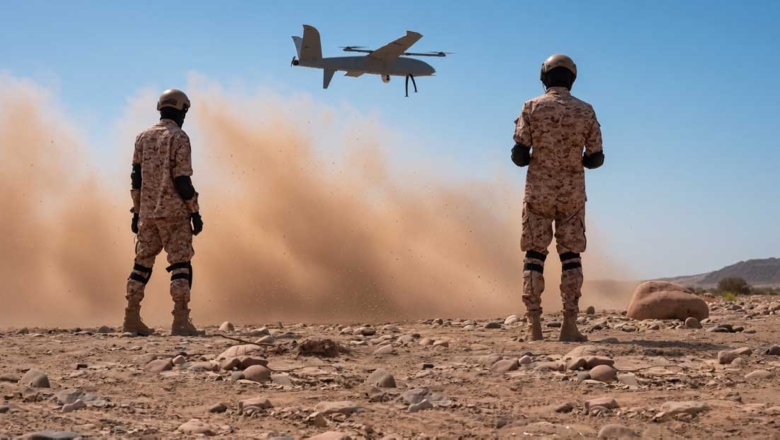
In a potentially significant development, Yemeni government forces from several formations are now deploying unmanned aerial systems against Iran-allied Houthi militias across multiple fronts, and this new air capability has begun to make substantial gains on the ground. In parallel, ground operations are also underway, with both land and air movements unfolding in tandem.
For years, a Saudi-led coalition that was fighting the Houthis in support of Yemen’s internationally-recognised government relied on fighter jets to carry out attacks. But over the past few months, the Yemeni government has enhanced its military capabilities. In June, Defence Minister Lieutenant General Taher al-Aqili said in an interview that the armed forces possessed drones, some manufactured domestically and others acquired from abroad. Then on 29 July, the government publicly unveiled the drones.
Just days later, the Houthis launched a fierce attack on Yemeni government forces, killing 58 soldiers in Marib and paralysing the port city of Mokha. By mid-August, the government announced that guided FPV suicide drones had entered field service for the first time and on 17 August it said it had carried out 100 strikes against Houthi barracks and vehicles, killing more than 200 Houthi fighters.
For its part, the Houthi-run media acknowledged the deaths of 84 of its members in the space of roughly a week, including 28 field commanders. And later on 20 August, the Yemeni government unveiled a dedicated drone unit—the Southern Giants Brigades—equipped with suicide drones, FPV quadcopters, munition-dropping platforms, reconnaissance assets and radar systems.
The Iran-backed militia is seeking to gain complete control of the strategically vital Bab al-Mandab Strait and obstruct maritime trade. This explains its fierce assault on the government-controlled port of Mokha, which killed 16 people and wounded 22 in early August. Since then, the port has been closed to maritime traffic. Military estimates put the number of missiles and drones launched towards Mokha during the latest escalation at around 90.
The August developments raise the question of whether the latest military capabilities can tilt the balance of power on the ground in the government’s favour, after years of Houthi dominance. For a decade, the Houthis enjoyed a tactical military edge, with a near-monopoly over asymmetric aerial warfare. They could monitor their adversaries and strike troop concentrations and command centres far from the front lines, while government forces functioned mainly defensively. But the introduction of competitive weaponry could finally enable government forces to go on the offensive.
Substantial gap
However, the gap in strategic range and industrial depth remains substantial. The Houthis still possess the means to inflict strategic damage without necessarily altering the map of territorial control. Neither side has disclosed the size of its drone arsenal. The Yemeni government has not revealed the types of drones it operates, their range, or their technical and operational capabilities.