

Can Türkiye maintain its “African solutions to African problems” approach in Niger?
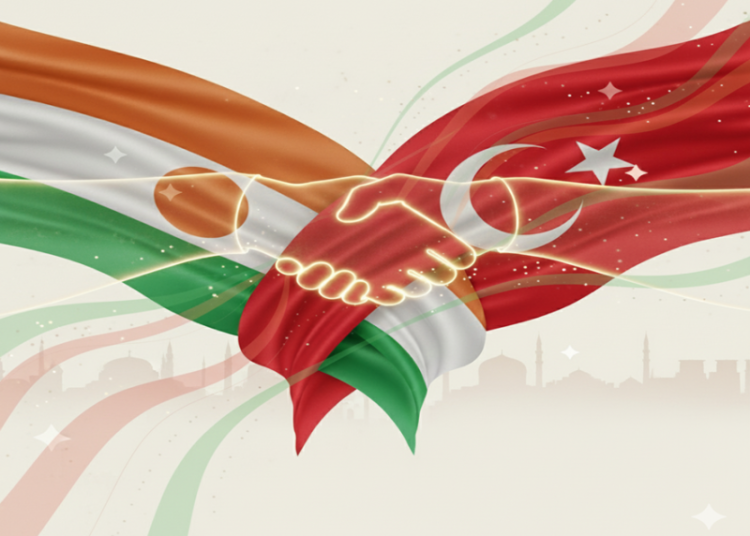
The official visit of Nigerien President Abdourahamane Tchiani
to Ankara has once again underscored the growing transformation of
Türkiye’s Africa policy. More than a diplomatic engagement, the
visit reflects Ankara’s effort to move beyond humanitarian
assistance and establish long-term partnerships centered on
defense, energy, trade, infrastructure, and industrial
development.
Perhaps the visit comes at a time when the Sahel region is
undergoing significant geopolitical change. Growing anti-Western
sentiment, the withdrawal of traditional Western actors over the
span of a few years, and increasing competition among emerging
powers have created new opportunities for regional partnerships.
For Türkiye, Niger’s vast uranium and critical mineral reserves
carry strategic significance as Ankara advances its nuclear energy
ambitions and broader clean energy objectives. For Niger,
cooperation with Türkiye could offer an opportunity to diversify
foreign partnerships, strengthen local industries, and reduce
dependence on traditional external powers.
A series of agreements signed during the visit, spanning
education, healthcare, defense, mining, and economic cooperation,
highlight the increasingly multidimensional nature of Türkiye-Niger
relations.
Commenting on the evolving partnership to
AzerNEWS, ANKASAM International Relations
Specialist Goktuğ Çalışkan argued that Ankara’s ability to preserve
its image as a non-hegemonic actor will depend on how it structures
its growing presence in the country.
“Türkiye can only maintain this image by positioning itself as a
‘capacity-building partner.’ To do this, it needs to steer military
cooperation in Niger away from the logic of permanent occupation or
bases, focusing instead on training, consultancy, joint exercises,
and strengthening the institutional capacity of the local army.
Adding a civilian component to every defense project – for example,
investments in infrastructure, health, agriculture, or education –
will shift Ankara’s presence on the ground from the perception of
being ‘just a country selling weapons’ to a development-oriented
partnership framework.
Furthermore, making Niger’s priorities visible in
decision-making processes and establishing transparent
communication with local parliaments and public opinion will be
crucial. Türkiye doesn’t need to deny its own interests; however,
it needs to concretize these interests through projects that
strengthen, rather than weaken, Niger’s sovereignty, and provide
employment and technology transfer to the local economy. However,
such an approach could make the discourse of ‘African solutions to
African problems’ practically credible.”
As Western influence recedes in parts of the Sahel, countries
such as Russia and China have expanded their presence through
security cooperation, infrastructure projects, and economic
investments. According to Çalışkan, Türkiye currently occupies a
different position within this landscape.
“For now, Türkiye’s role is more complementary. While Russia
stands out with its regime security and hard power capabilities,
and China with its financing and infrastructure projects, Ankara
enters the field with more flexible, medium-sized but
technologically effective defense products and training programs.
For Niger, this means diversified security and economic partners in
the short term, reducing the political costs of dependence on a
single power. Türkiye’s diplomatic language and emphasis on ‘equal
partnership’ in Africa offer local actors a different option
compared to Moscow and Beijing.
However, expecting a completely conflict-free scenario in the
long term would not be realistic. The question of which country’s
standards will be adopted in strategic areas such as security
architecture, mining licenses, ports, and logistics corridors will
inevitably create competition. Ankara’s smart strategy should be a
flexible approach that prioritizes Niger’s sovereign preferences,
involving cooperation in some areas and controlled competition in
others, rather than playing a zero-sum game with Russia and China.
In this way, Türkiye can project a profile not as a ‘power fighting
with third actors’ but as a partner that sets the rules of the game
with the local authority and manages the competition.”
One of the most strategically significant aspects of the
partnership concerns Niger’s uranium reserves, which have
traditionally been dominated by foreign companies and are
increasingly attracting attention amid global competition for
critical resources. Çalışkan noted that while access to Nigerien
uranium may support Türkiye’s long-term energy ambitions,
significant challenges remain.
“Here, we must start with the practical and logistical
obstacles. Because Niger is a landlocked country, uranium must be
transported by sea through one or more neighboring countries to
reach Türkiye. This necessitates long-term transit agreements with
countries like Algeria, Libya, Tunisia, or Benin and Nigeria, as
well as secure corridors and rail/road infrastructure. Each transit
route comes with its own internal security risks, bureaucratic
obstacles, and insurance costs, making the supply chain both costly
and fragile.
The second dimension is the international legal framework. The
extraction, processing, and transportation of uranium and other
nuclear raw materials are subject to strict control. The
Non-Proliferation Treaty, the International Atomic Energy Agency’s
safety standards, and related export control regimes are binding on
all parties. Therefore, Türkiye needs to build a comprehensive
supply regime for every shipment from Niger, including transparent
monitoring mechanisms, a registration system, safety protocols, and
environmental standards.
The third obstacle is at the political and societal level; the
transportation of radioactive materials can raise environmental and
health concerns both in Niger and in transit countries, leading to
serious objections from local opposition and civil society. Ankara
must therefore treat uranium procurement not merely as a technical
‘import’ issue, but as a multi-layered process involving diplomacy,
security, environmental law, and public diplomacy.”
Taken together, Çalışkan views the Türkiye-Niger partnership as
part of Ankara’s broader effort to establish itself as a long-term
strategic actor in Africa. Rather than relying solely on military
cooperation or economic engagement, Türkiye appears to be pursuing
a multidimensional approach that combines security, development,
trade, and institutional cooperation, while attempting to
distinguish itself from both Western and non-Western competitors
operating across the continent
Credit: Source link