

Cameroon Hosts First National Consultation under Regional SALW Governance Initiative in Central Africa
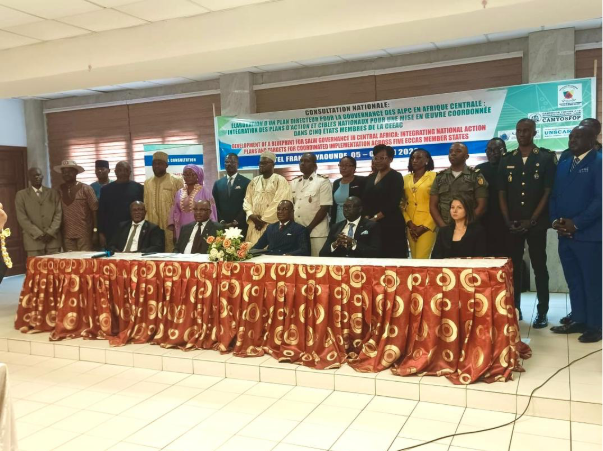
On 5–6 May 2026, the United Nations Office for Disarmament Affairs (UNODA) and its regional centre, the United Nations Regional Centre for Peace and Disarmament in Africa (UNREC), supported a national consultation in Yaoundé, Cameroon, under the UNSCAR-funded project “Development of a Blueprint for SALW Governance in Central Africa” implemented by the Cameroon Youths and Students Forum for Peace (CAMYOSFOP).
The consultation forms part of a broader regional initiative aimed at developing a harmonized blueprint for small arms and light weapons (SALW) governance across five pilot ECCAS Member States — Cameroon, Chad, the Central African Republic, Gabon and the Republic of the Congo. The project seeks to strengthen coordinated implementation of the Kinshasa Convention, the United Nations Programme of Action on Small Arms and Light Weapons (PoA) and the International Tracing Instrument (ITI).
Supporting Cameroon’s national SALW governance efforts
The two-day workshop, implemented by CAMYOSFOP with the support of the Ministry of External Relations of Cameroon (MINREX), brought together representatives from government institutions, civil society organizations and international partners to support the development of Cameroon’s National Action Plan on SALW through thematic working groups. Discussions also focused on the establishment of a National Commission on SALW, the development of implementation targets and indicators under the Kinshasa Convention, and support to Cameroon’s national reporting under the PoA ahead of the Ninth Biennial Meeting of States (BMS9).
National authorities and SALW experts presented the regional and national frameworks guiding SALW control efforts in Central Africa, including the Kinshasa Convention and Cameroon’s national legislation on arms and ammunition. Participants highlighted the importance of political will, institutional capacity-building and regional cooperation in addressing the illicit proliferation of SALW in the subregion.
Technical discussions on implementation and reporting
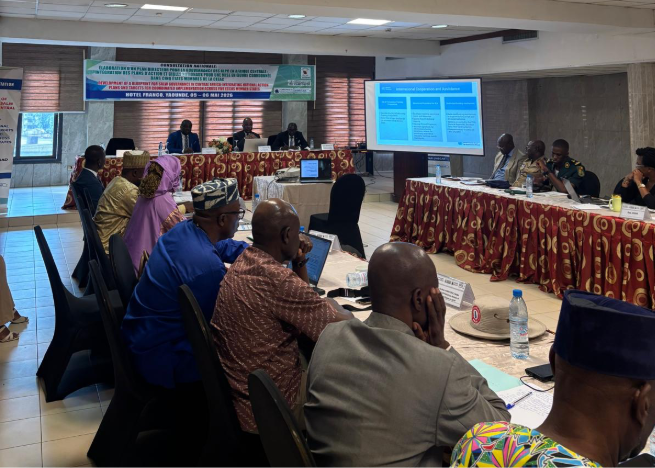
The consultation also provided an opportunity for technical sessions and practical exercises on the development of National Action Plans and implementation indicators related to the Kinshasa Convention.
UNODA delivered guidance sessions on PoA reporting obligations, including practical support on the completion of the PoA reporting template and ways to strengthen national reporting capacities ahead of BMS9. UNREC addressed emerging challenges related to the implementation of the PoA, including technological developments, traceability and data collection challenges, and the need to strengthen regional coordination efforts. The presentation also emphasized the importance of integrating cross-cutting considerations such as gender and youth participation, in line with the outcomes of the Fourth Review Conference of the PoA.
The consultation further enabled participants to discuss draft National Action Plan priorities and related targets as a working basis for the development of the regional blueprint on SALW governance in Central Africa, while supporting ongoing reflections related to PoA reporting and the establishment of a National Commission on SALW.
Towards a regional blueprint for SALW governance
The consultation marked the first national step of the broader regional project and laid the groundwork for similar consultations to be organized in the four other pilot countries in the coming months. The outcomes of these consultations will contribute to the development of a regional blueprint and roadmap for SALW governance in Central Africa, aimed at strengthening coordination, implementation and accountability across ECCAS Member States.
The project also aims to foster greater cooperation among national authorities, civil society organizations, regional actors and United Nations entities working on SALW control, DDR and prevention-related issues in Central Africa.
Through this initiative, UNODA and UNREC reaffirmed their commitment to supporting African States in strengthening SALW governance, enhancing regional cooperation and promoting the effective implementation of international and regional arms control frameworks.
Credit: Source link