

Brazil Crackdown Reveals New Tren de Aragua Playbook
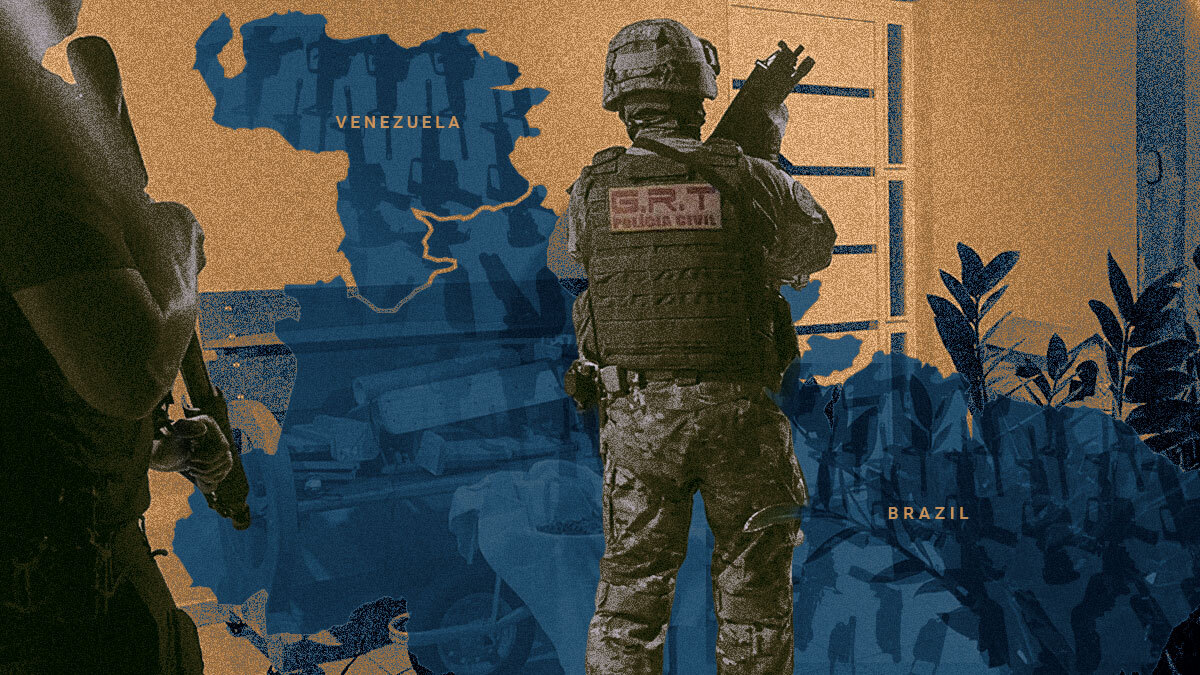
A recent police operation in northern Brazil has revealed how the Venezuelan-born gang Tren de Aragua has established a presence in the country and adapted its model of criminal expansion through alliances.
Police in the northern state of Roraima, which borders Venezuela, reportedly dismantled a branch of Tren de Aragua operating in Brazil in June. The cell allegedly used the state to traffic weapons to other parts of the country and partnered with local criminal groups to launder money from illegal mining, drug trafficking, and other illicit activities.
Seizures also took place in Amazonas—another state in the north of Brazil—as well as in São Paulo, Rio de Janeiro, Minas Gerais, and Paraná in the southeastern and southern regions.
SEE ALSO: Tren de Aragua: Fact vs. Fiction
Officials captured 13 people and froze R$429 million (around $82 million) in bank accounts and financial assets linked to suspected members of the network.
Evidence from the investigation suggests that Tren de Aragua worked with Brazil’s Red Command (Comando Vermelho – CV), Brazil’s second-largest gang, which was recently designated as a terrorist organization by the United States.
This alliance represents a different method for the Venezuelan gang: instead of establishing itself as a dominant criminal power, as it has done in other countries, Tren de Aragua seems to be allying with local gangs in Brazil to extend its reach and profits.
Tren de Aragua in Brazil
The dismantling of the Tren de Aragua network in Brazil demonstrates how the group has made inroads there in recent years.
Tren de Aragua allegedly provided weapons acquired in the United States, Colombia, and Venezuela to Red Command members in Amazonas and Rio de Janeiro, often in exchange for cocaine, said Military Police Colonel Francisco Xavier. Tren de Aragua then sold the cocaine in Roraima, he told InSight Crime.
In other cases, weapons were paid in cash, so Tren de Aragua established a money laundering system using front companies to launder funds. According to Xavier, the group worked with the same network that set up front companies for the Red Command.
These collaborators operate as brokers, without ties to specific criminal organizations. “Whenever there’s a major [criminal] financial operator, they provide services to more than one client. They’re in the market and offer their service to whoever hires them,” Anchieta Nery, Director of Integrated Operations and Intelligence at the National Secretariat of Public Security (Secretaria Nacional de Segurança Pública – Senasp), told InSight Crime.
Tren de Aragua’s biggest presence in Brazil is in Roraima, which borders the state of Bolívar in southern Venezuela. Bolívar has long been a seat of power for Las Claritas Sindicato, a mining gang with deep ties to Tren de Aragua through its cofounder Yohan José Romero, alias “Johan Petrica.” The small town of Las Claritas, located in the Sifontes municipality, became Tren de Aragua’s sanctuary after a state intervention displaced the group from their headquarters in Tocorón prison in Aragua state in 2023.
Roraima’s police say Tren de Aragua has been expanding in Brazil since 2018, capitalizing on waves of Venezuelan migrants moving into the country to establish a foothold in new territories. Tren de Aragua’s money laundering activities now extend to Brazil’s southern and southeastern states.
A New Modus Operandi
In other parts of Latin America, Tren de Aragua’s expansion model involved setting up cells and taking over local criminal economies by using extreme violence and exploiting Venezuelan migrants. But in Brazil, the group has taken a different approach.
In the wave of migration that gathered pace in 2015, millions of Venezuelans left their home country, with the majority settling in Colombia, Chile, and Peru. Tren de Aragua followed them, initially making money off human smuggling and trafficking. In Chile and Peru, the group found illicit markets ready to be exploited, among them extortion, the sex trade, and retail sale of drugs, with little local competition, ill-prepared security forces, and large Venezuelan diasporas living on the legal margins, and thus ripe for exploitation.
At first, in Brazil, Tren de Aragua’s expansion seemed to follow a similar pattern, with its presence initially concentrated along the border, following migration routes. Roraima offered a financial hub to launder money, as well as smuggle goods and minerals mined in Venezuela, as other illegal mining groups did.
But, unlike in Chile and Peru, where new Tren de Aragua cells quickly multiplied and spread, Tren de Aragua’s armed growth was limited—much like in Medellín, Colombia’s overcrowded underworld—by Brazil’s bigger and stronger organized crime actors, the Red Command and the PCC. Roraima is mainly under the control of the First Capital Command (Primeiro Comando da Capital – PCC), Brazil’s largest and most powerful criminal organization.
In Brazil, Tren de Aragua seems to have expanded as a service provider instead, using its alliance with the Red Command to establish networks that support and extend its activities in Brazil, without investing in armed cells or needing territorial control or monopoly over criminal markets.
“There is an identity symbiosis between Tren de Aragua and the Red Command; members of the Venezuelan gang even request to stay in the same prison wings as the Red Command,” Wesley Costa de Oliveira, a Roraima Civil Police chief in charge of the investigation, told InSight Crime.
The Red Command’s alliance with Tren de Aragua has helped both groups extend their reach. According to Xavier, the Red Command is growing stronger in the north thanks to the Venezuelan gang providing weapons and logistics. Data from a 2025 report by the Brazilian Forum of Public Security (Fórum Brasileiro de Segurança Pública – FBSP) shows that the Red Command more than doubled its presence in the Amazon region since 2023.
“We are seeing members of the PCC ‘tearing the shirt’ [defecting] to join the Red Command. While the PCC is still the dominant power in Roraima, the Red Command is gaining significant ground and prestige due to Venezuelan support,” Xavier said.