

Brazil 1970 – How the greatest team of all time won the World Cup
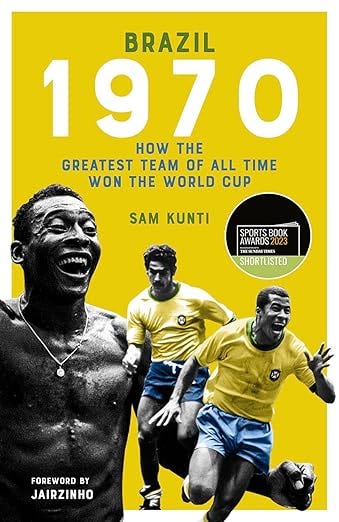
The 1970 World Cup still ranks as one of the greatest World Cups in history: football passed from sporting lore into pop culture: the Telstar ball, the cotton shirts, the grainy colour footage, the crackling TV commentary and the matches with a goal average of 2.97 − still a post-war record − culminated with Brazil defeating Italy 4-1 in the final.
Three delirious weeks in Mexico saw Brazil crowned champions for a third time, consecrating the South Americans as the futebol nation, Pele as arguably the greatest ever and the World Cup as the greatest show on earth.
In the group stage, Brazil met defending champions England in a match dubbed the final avant la lettre. Those 90 minutes in Guadalajara indeed had everything to define the course of the tournament and become part of a true World Cup classic.
At last, on 7 June 1970, the champions, both old and new, met. After all the hype, hysteria and hyperbole in the heat of Mexico’s high-altitude Guadalajara, Brazil, the 1958 and 1962 World Cup winners, and England, the defending champions, were out to play a match that promised to stir the soul and marvel the mind.
The world, once again, fawned over the Brazilians. In their opening match, they had outclassed Czechoslovakia 4-1, reviving memories of some of the magic that had been lost since the finals in 1966. Brazil, despite conceding an 11th-minute goal, had crushed their opponents. Carlos Alberto Torres, the right-back and captain, recalled: “It was a key moment. The first game always is. In the beginning, we were nervous as a team, but when Czechoslovakia scored the team woke up. It was a trigger to start playing the game we had envisaged and wanted to play.”
According to Rivellino: “The adrenaline was … the anxiety was huge. You just wanted to know what was going to happen right until the kick-off. I had levelled the score and Brazil opened with a marvellous 4-1 win. That’s something that provided both calm and a boost. [I celebrated] you know, that way with my arms, swearing …”
In the end, Brazil thrashed the naive Czechs, who allowed their opponents so much space to explore, to roam in, and ultimately exploit. A wildly exuberant Brazil demonstrated virtuosity, artistry and exceeding flamboyance. Yet, Ladislav Petras, Czechoslovakia’s goalscorer, had exposed Brazil’s characteristic insouciance at the back; the crucial flaw in the otherwise near-perfect disposition of the South Americans.
England, however, weren’t impressed. They believed they could topple Mario Zagallo’s team and that the Brazilian rearguard of goalkeeper Felix, Carlos Alberto, central defenders Wilson Piazza and Brito, and left-back Everaldo was suspect. Piazza admitted: “Obviously, in Brazilian football, there was concern about the defence. That wasn’t just in the Selecao. The Brazilian press tolerated the playing formation with advanced wingers. Brazil play a 4-2-4 it was said, but at times it was 4-1-5 or 4-3-3. Zagallo was concerned and told us, you know, to stick to our positions.”
England, by contrast, seemingly wore a tactical straitjacket. As the celebrated “Wingless Wonders”, they had won the 1966 World Cup final in a 4-4-2. Then, the impeccable Nobby Stiles screened the defence, allowing Bobby Charlton to attack through the centre.
It was a tactic that, at the same time, cancelled out Franz Beckenbauer, the creative fulcrum of the German team. In Mexico, Alan Mullery, playing Stiles’s role, along with both Martin Peters and Alan Ball, provided more steel, congesting Alf Ramsey’s midfield. Bobby Charlton dropped deep from the attack. At 32, Charlton, one of the oldest outfield players in England’s squad, was the linkman responsible for the team’s attacking impetus.
Carlos Alberto explained: “History made Brazil pre-tournament favourites, but the real favourites to win the World Cup going into the tournament were England. They were the defending champions and had an excellent team. They were more experienced than in 1966. England had Gordon Banks, Bobby Moore and Bobby Charlton. Brazil had to prove on the field that we were among the favourites. That’s what we set out to do from the first game.”
Under Ramsey, England’s football was practical in design and nature. Flair and flamboyance were dispensed with. Instead, the English coach valued doggedness, perseverance and commitment, all mundane qualities that had collectively seen them triumph in 1966. Four years later, Ramsey’s view of football, and the world, had become more reductive. The English delegation was paternalistic and supercilious.
Slightly aggrieved, Piazza recalled: “England arrived and, in a way, it was natural − they, the English, arrived with a lot of pomp as if they were going to be champions. They even took along their own water. You also saw the Mexicans thinking, ‘The English are like that.’”
Carlos Alberto insisted: “The winner of Brazil-England was always going to reach the final. Everyone knew that. If you wanted to become world champions, you had to beat England!”
The contest was never going to be ordinary. The match, in part, shaped the outcome of the 1970 World Cup and defined Pelé’s place in the pantheon of football gods. It also cemented Brazil’s legacy in the global game. “That game was decisive, the final avant la lettre,” said Jairzinho.
At least, that was the promise; a clash of cultures and different schools of football. England were a precision-engineered machine with a wellspring of energy and a rich seam of resolve, yet without flair in attack. Brazil, on the other hand, were the masters of the beautiful game albeit with a bumbling backline.
Piazza said: “England played the way we had expected, marking well and with a strong mentality. They’d retained a good team from 1966, [and had] the credentials to chase another world title. Those guys were strong and tall, damn! And you wondered: how I am going to deal with them?’
The opening phase of play was circumspect, almost pedestrian, with England pacing themselves. They stroked the ball among themselves at an indecent canter. From the wings, their high crosses tested goalkeeper Félix’s resolve and command over his penalty box.
Jairzinho recalled: “It was a very strategic game in which the two goalkeepers excelled like never before; Félix for Brazil and Banks for England. Félix was accustomed to it. Banks, I don’t know if he had the habit of producing so many saves. It was a high-level game, a type of chess game. One team attacked, and the other one defended and then attacked [in return].”
Whenever Pelé moved into a dangerous position, his direct marker, Mullery, and Moore beset him with almost pernickety precision, along with either left-back Terry Cooper or midfielder Bobby Charlton. Pelé was dispossessed twice but didn’t flinch. He never did. The magnitude of the match didn’t faze either talisman. They both played with stoic detachment and poise.
After 10 minutes, the match ignited with a move of colossal vitality, a sign that Brazil, slightly stuttering at first, were beginning to assert themselves. The Brazilians’ acceleration was almost devastating. Even 50 years later, the Brazil players remembered every nanosecond as if it were yesterday.
Carlos Alberto: “Long pass to Jairzinho with the outside of the foot …”
Jairzinho: “I received the ball, dribbled past my marker Cooper and, from near the goal line, I crossed the ball towards the far post.”
Clodoaldo: “Pelé had already seen Banks a bit out of position a few times and he had been waiting for a moment to strike. It is the most important lesson that I learned from Pelé; to have that different view of the game and the field.”
Carlos Alberto: “When Pelé jumped, I began to celebrate − celebrate the goal.”
Jairzinho: “There rose Pelé with his incredible thrust, heading downwards. But Banks, a quality goalkeeper with his velocity, explosiveness, flexibility and reflexes, was at the near post and got down and tipped the ball over.”
Gérson: “It could only have been Banks because he had foreseen the save. Perhaps he expected it.”
Rivellino: “My God, only players of that level would do what the two did! It was the perfect header. Banks thought the way Pelé did. When the ball bounced, if Banks would have tried to hold it, the ball would have passed him. It was like a volleyball play because he slapped the ball. He followed Pelé’s thinking. It was an incredible move that required two geniuses.”
This is an extract from Brazil 1970 – How the Greatest Team of All Time Won the World Cup (Pitch Publishing) by Sam Kunti, which is out now in paperback. Order a copy here.
Sam Kunti is a roving reporter, who investigates Fifa, labour rights in Qatar and Saudi Arabia, and the gambling industry. He writes for international plublications, including Josimar, World Soccer and Tribune de Geneve. He is a graduate from Leuven Law and pursued a master in journalism at Columbia University.
Nike and its famous airport ad ahead of the 1998 World Cup sold him the dream of the Brazilian dream team at a young age, but, once in France, Ronaldo and co disappointed. Sam however kept following the Selecao and set out to write a book about the 1970 team. It was Carlos Alberto Torres’s goal in the final against Italy that got him hooked on the game after all.
He lived for seven months in Brazil. It was as maddening as it was rewarding, an exercise in patience as most things in Brazil, and journalism, often are. From the pristine beaches of Caraguatatuba, where he met Félix’s daughter, to Batatais, the peaceful home of José Baldocchi, he criss-crossed Brazil, often on overnight buses after a dreary meal at a Graal roadside restaurant.
In Rio, he staked out many hours at various radio stations to chat to Gérson, who, once you found him, became a chatterbox. On Copacabana beach, he played futevolei, a mix of football and beach volleyball, with Jairzinho. In Belo Horizonte, he spent hours with the reclusive Tostao. All those journeys and interviews were crucial to enrich his understanding of Brazil and to ultimately tell the story of the 1970 team.