
Blackburn, Fleischmann talk war in Iran: deal concerns, midterms, gas prices, nuclear weapons
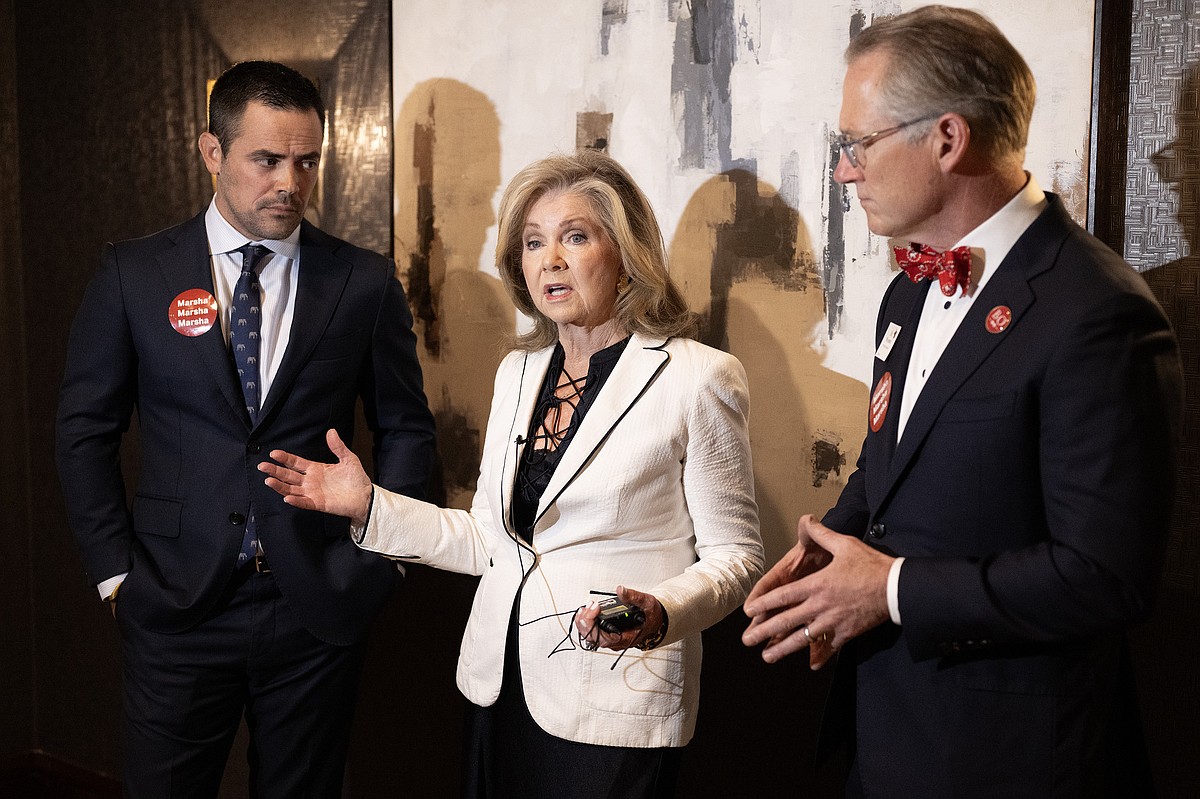
U.S. Sen. Marsha Blackburn, R-Tenn., and U.S. Rep. Chuck Fleischmann, R-Ooltewah, addressed the war in Iran while attending a Republican fundraiser in Hamilton County over the weekend. The two lawmakers also spoke about the preliminary peace deal signed by President Donald Trump.
Blackburn expressed concern over part of the agreement, and Fleischmann reaffirmed the importance for Republicans of keeping gas prices down and reaching a peace deal prior to the upcoming midterm elections.
(READ MORE: US and Iran sign initial deal to end war, ease sanctions and open strait as nuclear talks continue)
Here are five things the Volunteer State lawmakers said about the U.S. war in Iran:
IRAN OIL
The possibility that Iran could sell its oil before key U.S. objectives are met is concerning, Blackburn said.
“I think we do have to realize what we have seen so far is a memorandum of understanding,” she said. “This lays the foundation to actually move toward a deal. Let’s see what is going to transpire as they construct a deal.”
In a concession from Washington, the U.S. agreed to waive sanctions on Iran, allowing it to sell its oil freely, The Associated Press reported.
Some Republicans on Capitol Hill expressed opposition to the agreement, citing the concession, the AP reported.
(READ MORE: Some GOP senators and Trump allies have harsh reviews of his agreement to end Iran war)
The agreement allowing Iran to sell oil freely preempts any signed deal around key U.S. objectives over Tehran’s nuclear program, the reason Trump said he started the war, and reopening the Strait of Hormuz, the vital access point for oil and natural gas globally. The strait’s closure created an energy crisis. Much of the agreement reestablishes prewar status, ending hostilities and reopening talks between the U.S. and Iran to negotiate on key U.S. objectives.
The most important thing, Blackburn said, is to ensure Iran can never have a nuclear weapon. She said the current agreement creates the foundation to create a deal.
For the first time, on Tuesday, the Senate approved a war powers resolution to block U.S. military action against Iran. Blackburn voted against the resolution.
BILLION DOLLAR FUND
None of the $300 billion provided to Iran to rebuild, part of the agreement signed last week, will be from the U.S., Fleischmann said.
“It is not coming from the American taxpayer, and I’m so glad that you asked me that, because there is a 14-point memorandum of understanding,” he said. “This $300 billion fund has been created by its neighbors, and it’s an opportunity fund for Iran, and that’s one of the 14 points, so that they ultimately can rebuild the infrastructure in their country. It’s part of that, but that is not coming from the United States taxpayer.”
Will any come from the U.S.?
“Not to my knowledge,” Fleischmann said. “No, but it will come from other countries in the Middle East and around the world. It’s more of an opportunity fund, actually, for them, but it’s part of the deal.”
(SIGN UP: Get Chattanooga area politics news weekly in your inbox at timesfreepress.com/politics)
The Associated Press reported the $300 billion fund was another point of criticism some Congressional Republicans had with the agreement.
U.S. Sen. Roger Wicker, R-Miss., told the AP that although not funded by U.S. taxpayers, the $300 billion is far greater than the $1.7 billion payoff under then-President Barack Obama in the Iran deal reached in 2015. Trump withdrew from that agreement during his first term.
The money appears to depend on the progress of further negotiations, the AP reported. Trump has said it won’t come from taxpayers, and Vice President J.D. Vance has said Gulf Arab nations would invest that amount.
NUCLEAR WEAPON
Iran can never make a nuclear weapon, Fleischmann said.
“The ability for Iran to actually make a nuclear weapon has gone away,” Fleischmann said. “Their ability as a navy, as an air force, has gone away. I think it’s important that we get a peace deal in place with the hopes of an even broader peace in the Middle East.”
A deal about the future of Iran’s nuclear program has not been reached. The agreement signed last week sets a 60-day timeline to negotiate a deal on the nuclear program.
On Wednesday, the U.S. and Iran offered conflicting accounts of discussions about an agreement for U.S. inspections of Iran’s three major nuclear sites, The New York Times reported. The sites are used to store the vast majority of the nation’s enriched uranium, the material used to make nuclear weapons.
Iran is the only country to enrich uranium to 60% purity without a weapons program, according to the International Atomic Energy Agency.
The agreement calls for monitoring a decrease in that uranium but does not explain beyond that, the AP reported.
GAS PRICES
Gas prices are coming down because of the initial agreement signed by the U.S. and Iran last week, but they’re not dropping quickly or fast enough, Blackburn said.
“We have to realize that it is President Donald Trump that chose to engage, and end, a 47-year war, and we are at this point of an MOU (memorandum of understanding) because he chose to do that,” Blackburn said. “Now, gas prices are coming down. I saw $3.49 today.”
The agreement signed by Trump opened the Strait of Hormuz. Average U.S. gas prices for a gallon fell below $4 on June 18, a price not seen since the beginning of the war with Iran, but still remain 25% higher than last year, reported The Associated Press
In May, the price of a gallon of regular gasoline increased by 31 cents after rising 50% since the war with Iran began in February.
(READ MORE: Higher prices for gas, groceries and flights will likely outlast the Iran war)
MIDTERMS
Lowering gas prices through a peace deal with Iran is a focus ahead of the November midterm elections for Republicans, Fleischmann said.
“Working very hard, not only on the official side, but on the political side as well,” Fleischmann said in response to what Republicans like him are doing to prepare for the midterm elections. “I think if we continue to pass very good legislation, we work hard to make sure that oil prices continue to drop, and they will drop with the peace deal with Iran. There are a lot of factors out there.”
A poll taken by NPR/PBS News/Marist Poll in May, before the initial agreement between the U.S. and Iran and gas prices dipped below $4, found that the war has grown more unpopular and that a majority blame Trump for higher gas prices.
Contact politics reporter Ruby Rayner at rrayner@timesfreepress.com or 423-757-6556.

Ruby Rayner is the politics reporter for the Chattanooga Times Free Press. She has been a journalist since 2023 and holds a degree in geography with a minor in political science from Clark University and attended the London School of Economics.