

Betting suspicions in Mali: the AFE-AS Korofina match (5-3) targeted by IBIA
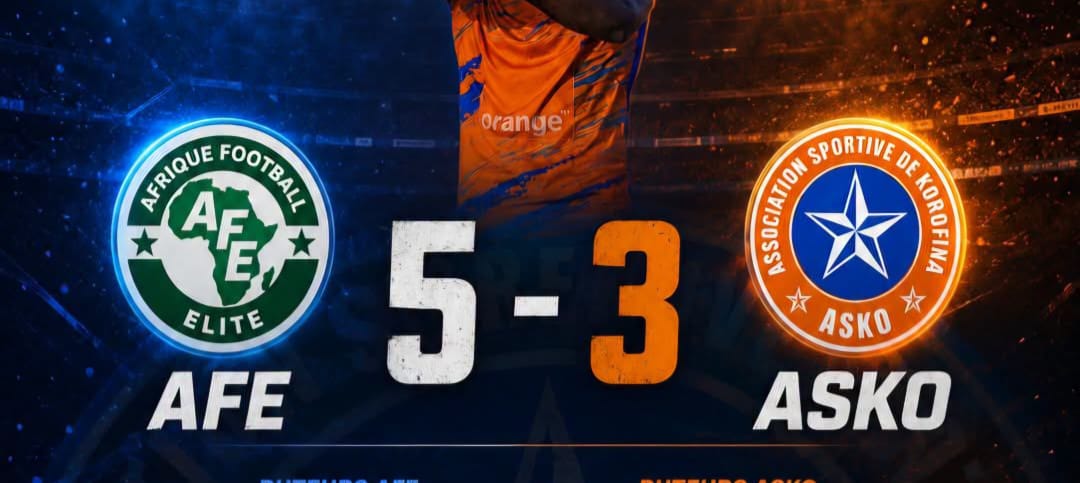
A rain of goals in a Malian league known for its low scoring. Unusual bets on a single scoreline, 5-3, placed before and during the match from several European countries. And, in the end, a 5-3 victory for Afrique Football Elite over AS Korofina. An alert from the International Betting Integrity Association (IBIA), which Sport News Africa was able to consult, describes betting activity deemed concerning enough to be forwarded to several authorities. Story of a match that raises serious questions, even though at this stage no sports manipulation has been established.
On June 10, 2026, in Mali, the penultimate matchday of Ligue 1 could have been just another step in the race for survival and the end of season for two teams on very different paths. Instead, a few weeks later, it became the starting point of an international alert on sports betting integrity.
That day, Afrique Football Elite (AFE) won 5-3 against Association Sportive de Korofina (AS Korofina). A spectacular scoreline, especially unusual in a competition known for tight matches. But it’s not just the result that draws attention: it’s what happened in the betting markets.
A confidential IBIA document, alert number 5400, reports suspicious activity detected before and then during the match. Several betting operators identified stakes focused on the same scenario: a 5-3 victory, accompanied by bets on “Over” lines regarding total goals.
The alert does not state that a match-fix occurred. It describes a concentration of bets sufficiently atypical to warrant a thorough investigation. And it places, as a result, AFE and AS Korofina at the center of these checks.
5-3 as a common thread
The first report came from BetVictor. Even before kickoff, a new British account, whose first bets were placed on this match, focused its activity on the exact score of 5-3 as well as several “Over” markets.
The customer stakes 400 pounds for a potential win of 4,500 pounds. More importantly, the customer tries to place amounts allowing for about 20,000 pounds in potential wins. An attempted bet yielding 15,000 pounds on the sole 5-3 scoreline, offered at odds of 150/1, is denied.
According to the report, this customer alone accounts for 95% of all stakes registered on the match at this operator.
Then, other signals emerge.
With 888 William Hill, two newly opened British online accounts also target 5-3. Two additional bets are registered at retail outlets in the United Kingdom. But most notably, some bets are placed after 30 minutes of play, when the scoreboard already reads 2-1.
The targeted scenario remains the same.
At Betway, a previously inactive British customer places their first bet on this match. They also target the exact score of 5-3 as the match heads toward halftime with a score of 3-1. Several further attempts are denied.
Again in England, Bwin reports three bets on the same score, totaling 126 pounds staked and a potential return of 2,716 pounds.
In Ireland, a customer simultaneously targets 5-3, “Over 3.5 goals” in the first half, “Over 4.5 goals” for the whole match, and a market focused on a win by exactly two goals margin.
In Sicily, finally, StanleyBet notes ten bets on 5-3 during halftime, while the score is 3-1. Forty-seven other bets, for smaller amounts, are placed on different “Over” markets. According to the alert, all of these bets are winners.
In total, the various reports reveal several thousand euros or pounds staked on converging markets with large potential returns.
A match at odds with the statistics
This is where the sporting context becomes decisive.
Before this 25th matchday, Afrique Football Elite had only scored 16 goals in 24 matches. The club was just two points above the relegation zone and was going through a particularly rough patch: only one win in its last thirteen games and eight matches in a row without a victory.
On the other side, AS Korofina approached the match in a radically different situation. With 33 points, the club was mid-table and had little immediate sporting stake.
But more importantly, Korofina had until then a relatively solid defense: 23 goals conceded in 24 matches.
In such a context, the final 5-3 is all the more striking as the Malian league was particularly low scoring.
AS Korofina, notably, had not participated in any match prior to this one with more than three goals scored.
And yet, in a single night, eight goals were scored.
Three in the first half. Five after the break. A 5-3 exactly matching the score targeted by several bettors, sometimes before the match, sometimes after the scenario of the game was already well underway.
Bets that follow the script… or precede it?
This is probably the most sensitive aspect of the dossier.
Betting live on an exact score when a match is already well underway is not in itself illegal. Likewise, betting on a high number of goals may simply stem from a particular reading of how the game is unfolding.
What interests sports integrity investigators is the convergence of indicators.
In this case, several independent operators report similar behaviors. The same exact score appears repeatedly. “Over” markets are also targeted. Some accounts are new or previously inactive. And some of these bets are placed while the match is already in progress.
The IBIA therefore considers that the apparently coordinated nature of the betting activity is sufficiently concerning to justify a report to the relevant authorities.
A report was sent to the British Gambling Commission, in particular due to the involvement of British customers. A summary was also communicated to the Confederation of African Football (CAF).
No previous alert about the two clubs
One point should be emphasized: neither Afrique Football Elite nor AS Korofina had previously been the subject of an IBIA alert.
The report thus attributes a clean record to both clubs on this platform.
This neither ultimately clears them nor incriminates them. But it is an important element for assessing the case.
The alert concerns betting behavior and its unusual nature. It does not, in the materials consulted, provide evidence of involvement by a player, coach, official, or member of either club in potential manipulation.
That is the key difference between an integrity alert and proof of match-fixing.
What really happened on June 10?
This is now the central question.
To answer it, the relevant authorities will have to compare the betting data with the sporting elements of the game: team lineups, minute-by-minute events, individual mistakes, refereeing decisions, player behavior, tactical changes and, most importantly, any communications or connections between those involved and the accounts that placed the bets.
IBIA indicates that its members commit to cooperating with investigations and to providing, when required, data relating to customers.
This data could prove decisive.
Who was behind the British accounts? Did the individuals involved have links with Mali, with either of the two clubs, or with intermediaries? Were the bets coordinated? Did certain bettors have insider information before or during the match? Do the targeted markets match sporting events that were actually foreseeable based on the course of the match?
These are all questions that the alert alone does not answer.
Mali facing the challenge of integrity
The case thus goes beyond the lone 5-3 scoreline.
Above all, it reminds us that African national competitions are now integrated into a global betting market where a match played in Bamako or elsewhere in Mali can generate, within minutes, financial activity monitored in London, Dublin, or Italy.
In the AFE-Korofina case, the unusual pattern is not based on a single isolated bet. It relies on the accumulation of indicators: an exact score repeatedly targeted, bets before and during the match, several operators involved, complementary markets, and, in the end, a result identical to that which had been heavily sought after.
What remains is to determine whether this convergence is a statistical coincidence, exploitation of insider information, or a symptom of possible match manipulation.
For Afrique Football Elite and AS Korofina, the stakes are enormous. For Malian football as well.
Because in this case, 5-3 is not proof.
But it’s troubling enough to pose a simple question: how did several bettors manage to target so precisely the exact scenario of such an atypical match?
Credit: Source link