

Beneath the smoke: Iraq’s children and the education just out of reach – Shafaq News
Shafaq News
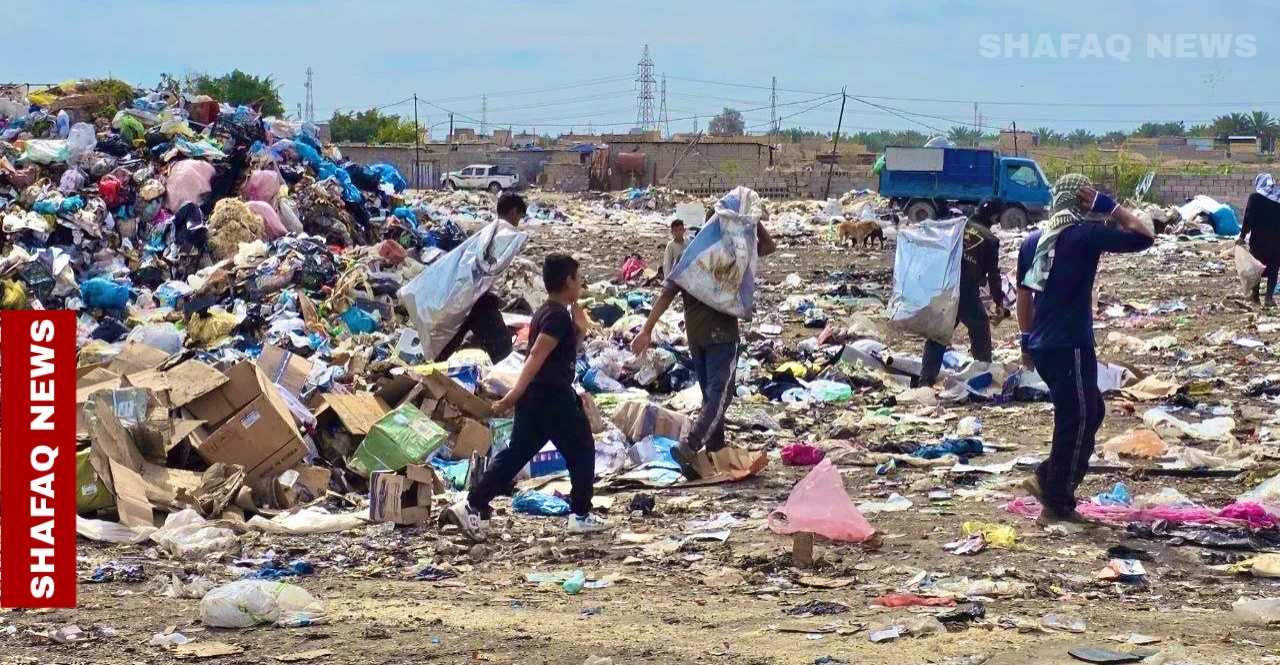
Beneath smoke rising from burning waste on the outskirts of
Najaf, Abu Saif, a father of eleven, found a classroom board in the garbage one
afternoon and carried it home. That evening, he began teaching his children the
Arabic alphabet himself.
He still works the landfill every day, alongside several of
his children. Faced with mounting expenses and an income that does not cover
them, he eventually encouraged his sons to leave school and contribute to the
household. “I advised my sons to stop studying so we could live
better,” he told Shafaq News. “Life is expensive, and our
responsibilities are too many.” Then, after a pause, “It hurts me
when I think about them not finishing school. But our circumstances are
stronger than us.”
That image, a blackboard salvaged from garbage, a father
teaching letters by hand, captures something that poverty statistics alone
cannot. Across Najaf’s landfill sites, children sort waste where they might
otherwise be sitting in classrooms, and the distance between those two
realities is not measured in kilometers.
Voices from the Landfill
Bassem, one of the boys working at the site, described the
moment that stays with him longest. “The hardest part isn’t the exhaustion
or the dust,” he told Shafaq News. “It’s when I find schoolbooks
while searching through the garbage. I open them carefully and look at the
writing, but I quickly skip the pages without pictures because I don’t
understand the words.” After a brief pause, he added: “The pictures
tell me things the words can’t.”
His dream, he said, is simple. “I just want to sit in a
quiet room and read a book.”
Bassem insisted the work was never a choice. “My father
can’t carry all the burdens of life alone anymore. He avoids roads where
students walk to school because he doesn’t want us to feel hurt when we see
children our age going to class.”
Jamal Mohsen’s dream is equally ordinary. He wants to wake
up carrying a schoolbag instead of a sack of recyclable waste. “Education
is every child’s dream if they want a better future and a decent life,” he
said. “Our work is hard, but it’s honest. We collect materials from the
garbage that can still be used and sell them by weight.”
What these children describe reflects a documented national
crisis by the UNICEF, which estimated in 2025 that nearly 47.8 percent of Iraqi
children continue to face multidimensional poverty, a measure that combines
financial hardship with limited access to education and other basic rights.
Iraq’s illiteracy rate reached around 15.6 percent in 2024, leaving reading and
writing beyond the reach of thousands of children outside the formal education
system. In its 2025 ranking, Global Finance placed Iraq 76th globally and ninth
among Arab states by wealth, estimating GDP based on purchasing power parity
per capita at around 15,177 dollars.
Although Iraq officially recorded a decline in poverty rates
to around 17.5 percent in July 2025, families working in Najaf’s landfills say
little has changed in practice.
A Longer Road Back
Not everyone has given up. At 21, Hussein Jassim represents
one of those rare attempts to return, though his path began far from the
landfill, on farmland outside Najaf, where daily life revolved around
livestock, irrigation canals, and seasonal agricultural work.
Hussein enrolled in school like other children in his
village, but repeated failures in fourth and fifth grade eventually pushed him
out. For years, he worked in farming and raising animals before social media
opened a different view of the future. Videos about urban work opportunities
encouraged him to imagine another path. He began commuting to the city and
eventually secured a job at a restaurant overlooking the Euphrates River, where
his dedication earned the owner’s trust.
“My dream was always to continue studying and become
someone useful to my country and my people, but life didn’t go the way I
wanted,” he told Shafaq News.
Work, he said, clarified rather than extinguished that
ambition. “I feel the importance of reading and writing every time I meet
workers who cannot do either.” He has since applied for external
examinations in hopes of resuming his studies. All of his siblings completed
university and postgraduate degrees —something he speaks about with pride, not
bitterness. “The road is still long.”
Kazem Naji left school after fifth grade when his family
could no longer afford the associated costs. “My family needs money for
daily survival,” he said. “But thank God, I can still read and write.
I still dream of going back to school if our financial situation
improves.”
In September 2025, Iraq’s Ministry of Education announced
that national campaigns had returned nearly 251,000 students to classrooms, a
figure that reflects both the scale of the dropout crisis and the limits of
what official initiatives have so far reached.
What the Classroom Cannot Fix Alone
Adnan Abdul Khafaji, head of the Educational and
Psychological Sciences Department at the University of Kufa’s College of
Education for Girls, attributed dropout rates to overlapping pressures:
bullying inside schools, family instability, poor academic performance, and
financial hardship that makes continued enrollment feel impossible. “Some
students lose motivation because they cannot afford suitable clothes or
participate in school activities,” he told Shafaq News. “Others are
influenced by peers who are disconnected from education altogether.”
Read more: Anxiety, Despair, and Dropouts: the human cost of bullying in Iraq
Many parents ultimately push their children into labor
because household income no longer covers basic needs, he added —a pattern
visible across Najaf’s landfill sites and, by extension, across much of Iraq.
Ahmed Al-Moussawi, director of the Literacy and Accelerated
Education Department in Najaf’s Education Directorate, pointed to ongoing
efforts aimed at containing the crisis. Najaf currently operates 30 accelerated
learning schools and 28 literacy centers serving hundreds of learners across
different age groups. “The literacy centers are open to anyone who wants
to continue learning,” he said. “Some attendance is voluntary, while
certain employees are required to enroll under administrative regulations.”
Read more: Iraq’s children face alarming crisis: rising labor, violence, and legal gaps
The gap between those initiatives and the landfill remains
wide.
Among the waste and the discarded textbooks, Abu Saif still
carries the image of that blackboard home with him. He knows the road his
children are on. He taught them their letters anyway.
Written and edited by Shafaq News staff.