

‘Bear with us’ – Jamaica Observer
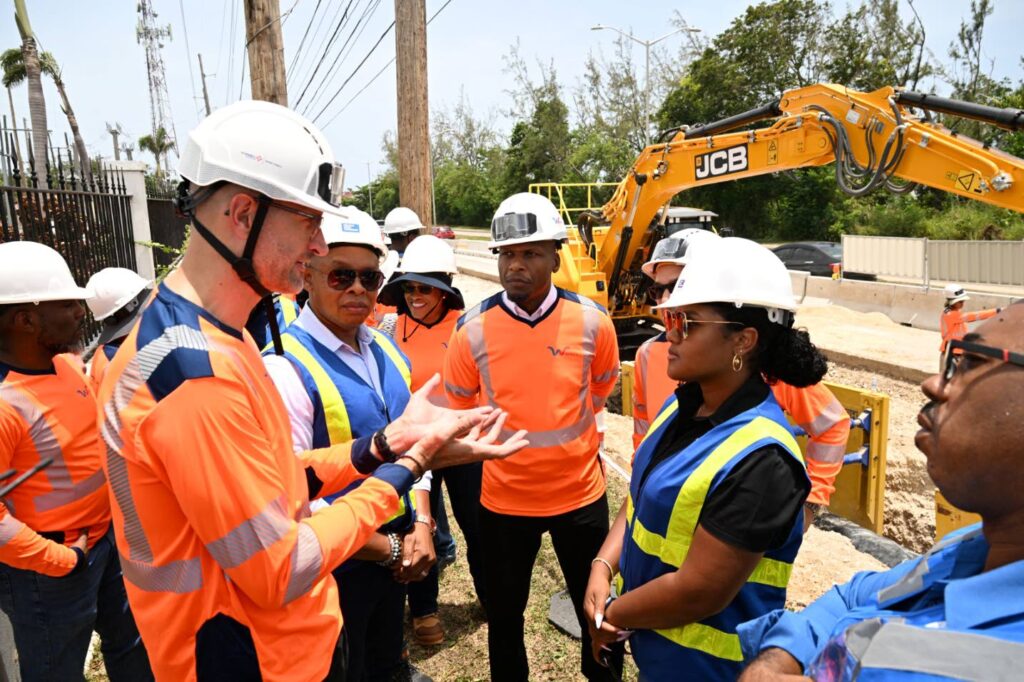
Pierre-Emmanuel Faivre (left), of VINCI Construction Grands Projets, speaking during a tour of the first phase of the US$450-million Western Water Resilience Improvement Project in Montego Bay on Monday. He has the attention of Acting National Water Commission President Kevin Kerr (second left); permanent secretary in the Ministry of Water, Environment and Climate Change Wayne Robertson (third right); advisor in the Ministry of Water, Environment and Climate Change Nicole Ebanks (second right); and acting regional manager, National Water Commission Horace Binns (right).(Photo: Horace Hines)
MONTEGO BAY, St James — The Government is urging motorists and residents to brace for traffic snarls as work begins on the US$176-million first phase of the US$450-million Western Water Resilience Improvement Project (WWRIP), a landmark investment officials say will modernise Jamaica’s ageing infrastructure and significantly improve supply to more than 200,000 people across four western parishes.
The appeal came from permanent secretary in the Ministry of Water, Environment and Climate Change Wayne Robertson during Monday’s tour of construction works along Montego Bay’s elegant corridor. Joining him were officials of the National Water Commission (NWC) and representatives of VINCI Construction Grands Projets, which is implementing the multimillion, US-dollar project. While acknowledging that the construction will inconvenience road users, Robertson said the long-term gains far outweigh the temporary setbacks.
“Jamaicans, just be patient with this project. There will be some disruptions. We will ensure that we communicate consistently. We will provide the necessary information in terms of the areas that will be affected in terms of traffic flows, so that you can make the necessary adjustments. But please bear with us as we seek to make lives better for all of you,” he said.
Robertson described the project as a key pillar of the Government’s drive to build greater resilience into the country’s water sector, particularly in the wake of Hurricane Melissa. He said replacing ageing underground infrastructure will improve both the volume and reliability of water supplied to residents and businesses.
He noted that the western corridor, home to many of the island’s major hotels, has experienced growing demand for water and said the investment, together with other initiatives such as the Rio Cobre Water Supply Improvement Project, signals what he described as a “revolutionalisation” of Jamaica’s water sector.
VINCI Construction Grands Projets Project Manager Pierre-Emmanuel Faivre said considerable effort has gone into minimising the impact on motorists.
“We have been working on the traffic management plan since the project started last October,” he said.
Permanent secretary in the Ministry of Water, Environment and Climate Change Wayne Robertson (left) listens to Kevin Kerr (second right) and Latoya Jackson Morgan (right), acting president and acting vice-president, respectively, of the National Water Commission, during a tour of the Western Water Resilience Improvement Project along Montego Bay’s Elegant Corridor on Monday. (Photo: Horace Hines)
Faivre explained that the traffic management plan was developed in collaboration with the National Works Agency (NWA), the Jamaica Constabulary Force (JCF), the St James Municipal Corporation, members of parliament, councillors, and community representatives. Construction is currently being undertaken using a single lane, although sections of the project will eventually require two-lane closures, Faivre said.
He said the opening of the Montego Bay Perimeter Road would help minimise disruption.
“We would like the bypass to be operational soon. So we can close Top Road whenever we go up the hill. If we can close Top Road, we could allow the traffic to use a bypass, so ideally we need the bypass up and running by Christmas,” he said.
Despite the extensive works, Faivre stressed that customers should not see any interruption to their water supply during construction.
“There will be no disruption to the existing water supply until the water is fully tested, sterilised, and ready to be connected to the existing networks,” he assured.
He said the Greenwood-to-Montego Bay section is scheduled for completion within 24 months.
Acting NWC President Kevin Kerr said the project is being rolled out in four phases to create a more resilient water network stretching from Westmoreland to St Ann.
The first phase includes replacing the transmission main between the Martha Brae Water Treatment Plant and the Terminal Reservoir in Montego Bay, while extending an existing transmission pipeline from Lucea into Negril.

Permanent secretary in the Ministry of Water, Environment and Climate Change Wayne Robertson (right) addresses members of VINCI Construction Grands Projets during a tour of the Western Water Resilience Improvement Project on Monday.(Photo: Horace Hines)
Phase two will increase production at the Martha Brae Water Treatment Plant from 11 million to 20 million gallons per day and expand the Great River Water Treatment Plant from 15 million to 20 million gallons daily. It also includes rebuilding the Great River intake to reduce turbidity problems during heavy rainfall and establishing a more resilient transmission route into Negril.
Under phase three, a new water treatment plant will be constructed at Roaring River in Westmoreland, together with a transmission pipeline to Negril, providing an additional source of supply and strengthening redundancy across the western network.
The fourth and final phase will see the construction of a new 10-million-gallon-per-day Rio Bueno Water Treatment Plant on the Trelawny/St Ann border to improve water distribution to communities east and west of the facility.
Kerr also sought to reassure residents along the construction corridor that the NWC is delivering on its promise to address longstanding water shortages.
“I am also assuring the residents, our customers along this corridor, that the NWC had listened to their complaints of no water… we are actually implementing our promise,” he said.
Once completed, the project is expected to provide more reliable and continuous water supply to communities including Norwood, Salt Spring, Rose Heights, Ironshore, Coral Gardens, Rhyne Park, Barrett Town and Barrett Hall in St James, as well as Hopewell, Sandy Bay, Dias, Askenish, Blenheim and Negril in Hanover and Westmoreland, Kerr said.
The WWRIP is being implemented by VINCI Construction Grands Projets on behalf of the NWC in partnership with the National Environment and Planning Agency, the NWA and the JCF. The four-phase infrastructure programme is expected to benefit residents across Trelawny, St James, Hanover and Westmoreland while strengthening the resilience of the region’s water supply network and reducing non-revenue water losses.