

Bamako Under Siege: Armed Groups Establish Checkpoints Around Malian Capital as Northern Bases Fall
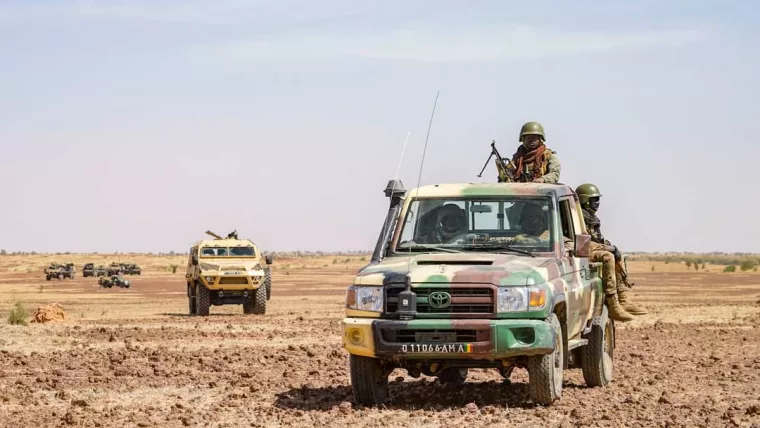
Mali’s ruling military council is facing a multi-front existential crisis as Al-Qaeda-linked militants established strategic checkpoints on major arteries leading to Bamako, while Tuareg separatist rebels seized more territory in the country’s volatile north.
The coordinated pressure follows a wave of unprecedented attacks that hit the heart of the state last week. On Friday, five sources confirmed to Reuters that fighters from the Group for the Support of Islam and Muslims (JNIM) began blocking key transport routes into the capital. Local business owners report that some essential goods are already being prevented from entering the city, signaling the start of a potential economic strangulation.
In a late-night manifesto, JNIM called for a “comprehensive uprising” against the military junta, urging political parties, religious leaders, and the military to unite to topple what they termed the “terrorist military council” in favor of a transition based on Sharia law.
The Battle for Strategic Corridors
Despite the looming blockade, the Africa Corps (formerly Wagner Group) announced it successfully escorted a massive convoy of 800 fuel tankers into Bamako on Friday. This delivery is critical for the capital’s survival, as insurgents have previously attempted to paralyze the economy by cutting off diesel and gasoline supplies arriving from Côte d’Ivoire and Senegal.
While the capital remains on edge, the northern regions are slipping further from government control. The Permanent Strategic Framework (CSP/Azawad) confirmed it has seized the strategic Tessalit military base near the Algerian border. Security sources indicate that Malian forces and their Russian allies evacuated the base before the rebels arrived, leaving behind significant infrastructure and an airfield. Verified footage shows rebel fighters raising their flags over the Amachach military complex, marking the loss of yet another northern stronghold following the fall of Kidal earlier this week.
Unprecedented Coalition and Casualties
The current insecurity is being driven by a rare and lethal alliance between two former rivals: JNIM’s jihadist fighters and the Tuareg separatist rebels. This partnership has enabled simultaneous strikes across the country, including:
- The Kati Military Camp: A massive assault on the junta’s primary stronghold, just 15km from Bamako.
- Central Mali: Rebels released footage showing the capture and burning of a military barracks between Homburi and Sévaré in the Mopti region.
- Gao and Kidal: Intensified combat that resulted in the death of Defense Minister Sadio Camara.
Medical sources report that the violence has claimed at least 23 lives, including both soldiers and civilians, primarily during the assault on the Kati camp.
As the military council attempts to dismiss reports of territorial losses as “psychological warfare,” the reality on the ground—defined by burning barracks in the center and insurgent checkpoints around the capital—suggests that Mali has entered its most dangerous period of instability in 15 years. The junta now finds itself squeezed between an emboldened insurgency in the north and a tightening noose around its political center.
Credit: Source link