

AUSSOM Chief and Turkish Ambassador Discuss Strengthening Security Cooperation
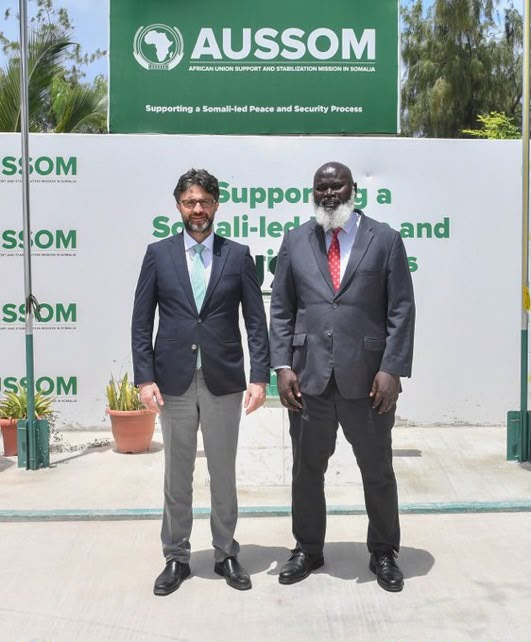
MOGADISHU — The Special Representative of the UN Secretary-General and Head of the African Union Support and Stabilization Mission in Somalia (AUSSOM), Ambassador El Hadji Ibrahima Diene, has received Turkey’s Ambassador to Somalia, Alper Aktaş, for talks focused on strengthening cooperation in support of peace, security and stability in Somalia.
The meeting, held at AUSSOM headquarters in Mogadishu, comes as Turkey has emerged as a key security partner for Somalia, with its military presence in the country expanding significantly in recent years. Turkey has trained thousands of Somali soldiers at the TURKSOM military training facility in Mogadishu, established in 2017, and has provided military equipment, including armored vehicles and drones, to Somali forces.
Both sides emphasised the importance of continued international cooperation and agreed to strengthen coordination and joint efforts in support of lasting peace in Somalia. Ambassador Diene and Ambassador Aktaş discussed the evolving security landscape and the role of bilateral partners in supporting Somalia’s security transition as AUSSOM’s mandate is set to expire at the end of 2026.
Turkey’s engagement in Somalia has expanded beyond humanitarian assistance to include security sector development, infrastructure investment, and economic cooperation. Turkish companies manage Mogadishu’s port and airport, and Turkey has signed a 10-year defence and economic agreement to help Somalia secure its coastline and build a navy.
The Turkish government has also deployed military personnel to protect Turkish assets and train Somali forces. In May 2025, Turkey deployed an additional 500 troops specialising in counterterrorism and drone operations, nearly tripling its contingent. The deployment included 300 commandos and 200 personnel to enhance drone operations, including the use of Turkish-made Akinci drones with night vision capabilities.
Turkey has supplied armoured vehicles to Somalia’s Gorgor special forces and has provided advanced military training to elite units, including the Gorgor Commandos and the Haramcad paramilitary forces. The Turkish military presence includes the deployment of F-16 fighter jets and attack helicopters to Mogadishu [citation:3][citation:11].
Turkey has also deployed M48 and M60 Patton battle tanks to protect Turkish installations in the Warshiikh district, where facilities are reportedly being prepared for missile and satellite launch operations [citation:7].
Turkey has also partnered with Somalia on fisheries and the blue economy through the SOMTÜRK joint venture, reflecting the broadening scope of bilateral cooperation beyond security [citation:4][citation:8].
Turkey has been involved in rebuilding critical infrastructure, including the restoration of a vital bridge near Afgoye that was destroyed by Al-Shabaab, demonstrating Ankara’s commitment to Somalia’s reconstruction and stabilisation efforts [citation:2].
Critical Note
While the meeting between AUSSOM and Turkey reflects the deepening security partnership between the two sides, the broader implications of Turkey’s expanding military footprint in Somalia remain a subject of debate. Analysts have described the security architecture in Somalia as increasingly “bilateralised,” with troop-contributing countries and foreign partners shouldering more of the war burden outside the AU framework.
The risk, as some observers have noted, is that as bilateral actors take on a larger role, they may prioritise their own national interests over AU coordination or Mogadishu’s long-term agenda. The prolonged delay in deploying Egyptian troops to AUSSOM has further opened space for bilateral actors to shape Somalia’s security order.
For Somalia, the challenge lies in managing these competing interests while ensuring that its own sovereignty and long-term stability remain the priority. The government must ensure that security partnerships are structured in a way that serves the national interest and contributes to the development of Somali institutions, rather than creating new dependencies that could undermine the country’s hard-won gains.
Recommended Reading On ftlsomalia.com
Credit: Source link