

Arab fans had an embarrassment of riches at this World Cup.
Sign up for the Slatest to get the most insightful analysis, criticism, and advice out there, delivered to your inbox daily.
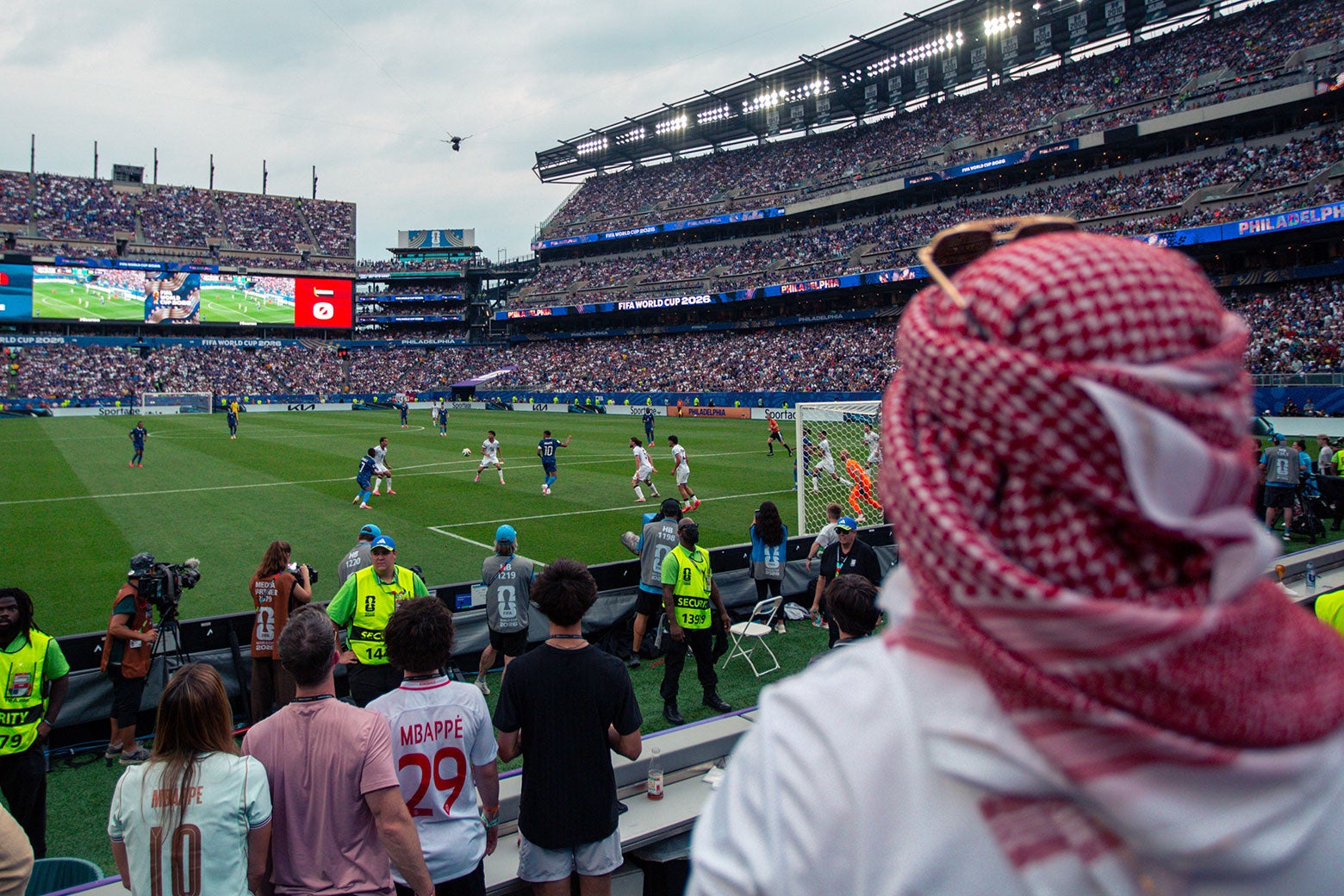
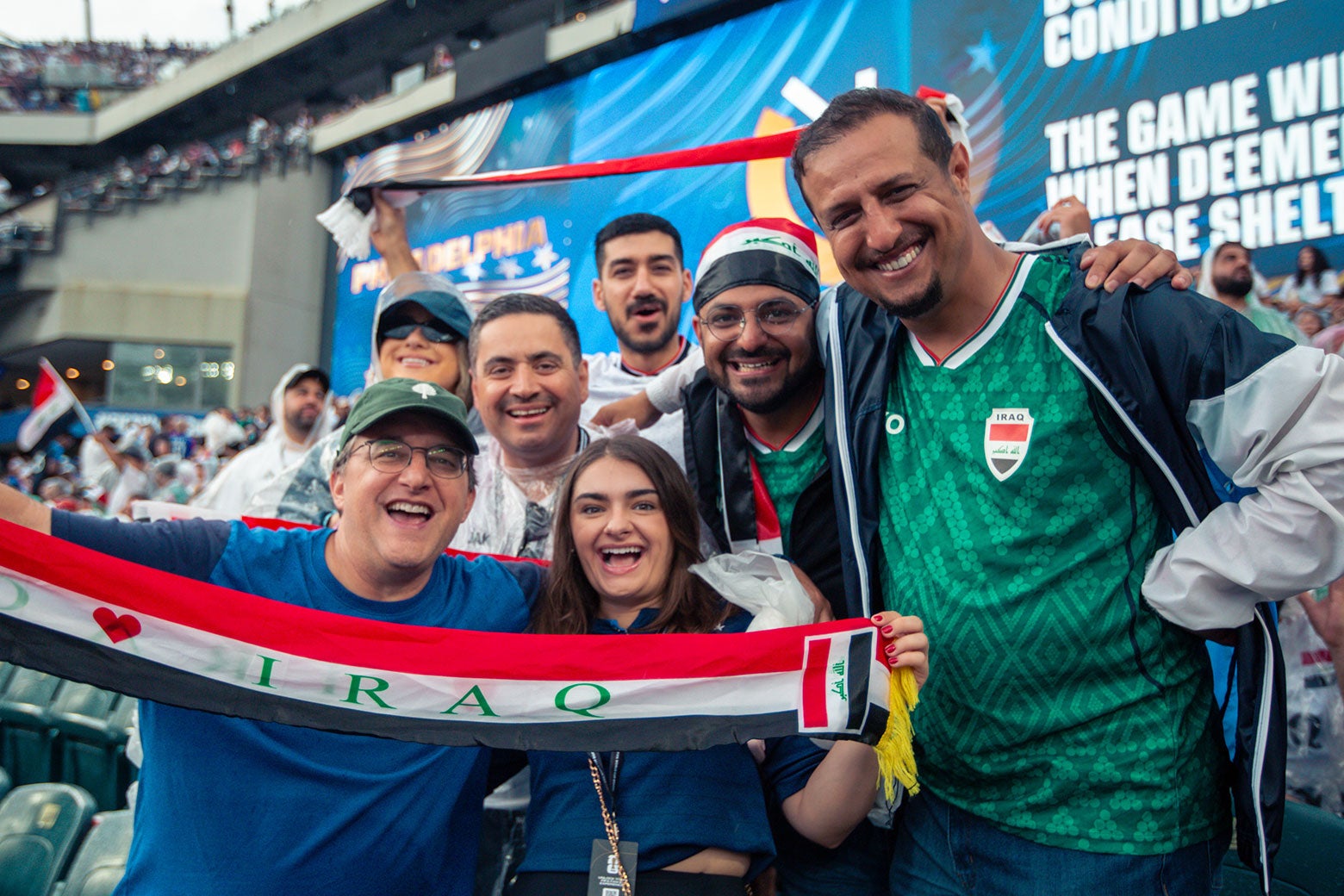
At the moment when Iraq’s World Cup was effectively ending last week in the midst of a storm delay, the Iraqi fans in Philadelphia were dancing. France—a favorite to win the whole tournament—was doing what France does: controlling the ball, stretching the field, feeding two of the most terrifying forwards alive, Kylian Mbappé and Ousmane Dembélé. Aymen Hussein, Iraq’s star striker, who had scored Iraq’s only goal of the tournament, had been subbed off early due to injury. But the Iraqi supporters with his name on their jerseys did not seem especially interested in mourning. They were singing. They were taking smiling selfies. They were waving flags and partying with French fans, even as the rain fell.
Iraq lost that day, as it had in every match at this World Cup. In three games, Iraq scored once and conceded 12. This was not a strong showing, even for a team making only its second World Cup appearance after a 40-year absence. Still, as I left the stadium, the question that stayed with me was how the Iraqi fans had somehow looked like they had the most fun.
I had originally gone to Philly looking for Iraqis who had come from Iraq. I wanted to know what it meant to spend that much money and cross that much distance to a place many Iraqis have mostly experienced through occupation, devastation, movies, and viral social media posts. I found only one: a man named Yassir, who had arrived alone from Baghdad. He told me the visa was nearly impossible to get, that he had needed to scroll through old Facebook posts for immigration officers to prove he was a real fan of the Iraqi national team. He had followed the team for years and had spent a fortune to attend every Iraq match in the United States. I asked him if America was more or less what he was expecting, and what he made of his team’s performance. He smiled wide. “It’s like I’m living in a dream,” he said to me in Arabic.
But as I kept asking other fans where they were from, I encountered Egyptians, Algerians, Jordanians, more Egyptians. There were plenty from the Iraqi diaspora, from the United States and Canada. But there were also plenty who were not Iraqi at all. Some of them had their own teams in the tournament, but those teams were playing in a less convenient location. Iraq was playing its matches on the East Coast. Iraq was also Arab. Close enough, many of them seemed to reason. “I’m Iraqi for the next 90 minutes,” one Egyptian fan told me. Then he leaned into it, repeating “Ish lounak, ish lounak,” the distinctly Iraqi way of saying “What’s up.” Then he put it more plainly: “I’m rooting for all of us.”
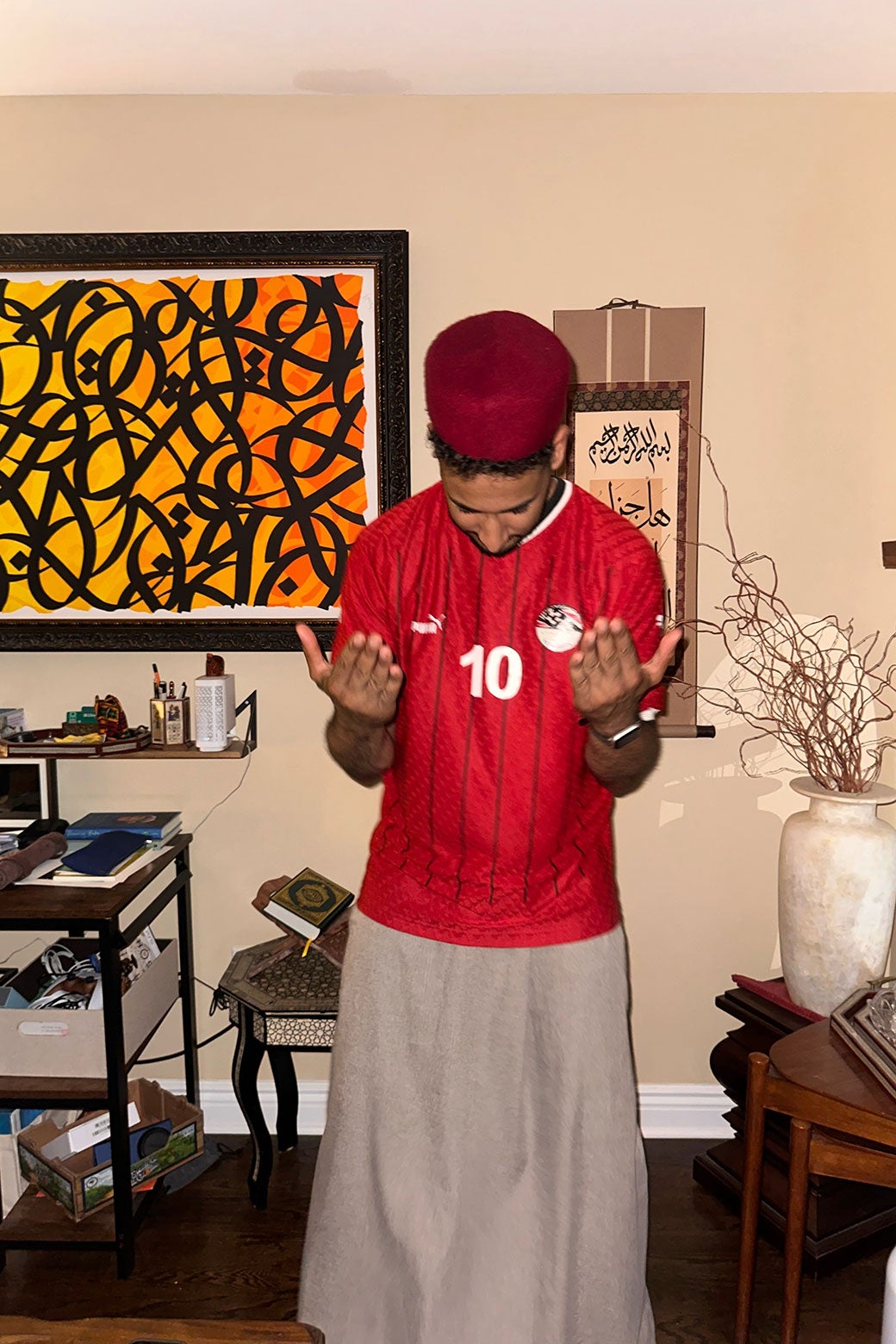
That moment stayed with me. I am Egyptian, and I’m rooting for Egypt like I am personally waiting at the back post for a cross. But I am also rooting for Morocco, Algeria, Iran, Jordan, Senegal, Congo, Bosnia, and any team representing a country or people I could conceivably talk myself into identifying with. Of course I’m rooting for the United States too. I live here. My kids were born here. I would like the American team to do well, if only because in this sport we’re the underdog.
As an Egyptian, I can attest that there is a separate level of investment when it is “us” on the field. I wanted to understand why I would be screaming in agony when the Netherlands scored first against Morocco, then jubilating when Morocco equalized and won in penalties. I’m not alone in feeling that way. So many of my friends from Arab home countries also caught Morocco fever. Is it simply because they’re North African? Is it because they’re the most decorated in Africa? Is it because they’re Muslim? Is it a combination of all three?
Amer, who is Palestinian, said he was rooting for Egypt and Morocco. For him, his fandom originates in tragedy. “Post–Oct. 7, I feel like that’s the only representation we’ve gotten on the world stage,” he told me. He had also been rooting hard for Iran, a team he felt represented something more like a resistance to Western global dominance. “They keep shooting our best players,” he said, making note of the enormous toll Israeli occupation and bombardment has taken on Palestinian athletes, including Suleiman Obeid, nicknamed the Palestinian Pele, who was killed by the Israel Defense Forces in Gaza while waiting for humanitarian aid. More broadly, he said, he was pulling for the underdog: “I wanted Japan to win.” (They lost a thriller on Monday to World Cup superpower Brazil, who needed an injury-time goal to advance to the round of 16.)
Then Maytha Alhassen, who is Syrian, Bedouin, Lebanese, Saudi, and Egyptian, but also from Los Angeles, made it even less tidy. When I asked who she was rooting for, she began: “I’m from L.A., cabrón—¡Vamos, México!”
“My heart was with Iran,” she added, “which should be continuing.” She also is rooting for Algeria, she said, “representing a history of revolutionary spirit, plus now a Zidane on the team.” Luca Zidane, the son of legendary France midfielder Zinédine Zidane, is Algeria’s goalie.
When I asked Alhassen whether she thought Arab and North African fans were all kind of rooting for each other, she said yes, but it’s not all that unique considering Black diasporic populations are doing something similar with African teams. Add to it that Algeria could be read as Arab, North African, African, Muslim, anti-imperial, or all of the above, and she said you’ll find that fans have lots of reasons to show their support. By identifying Iraq as Arab, does that erase their Kurdish players and fans? By proclaiming Morocco the great hope of Arab and Muslim fans, does that erase their Amazigh and African heritage? “Football is political,” she said.
But for people in the diaspora communities like us, “in moments of winning together, that’s when we rise.”
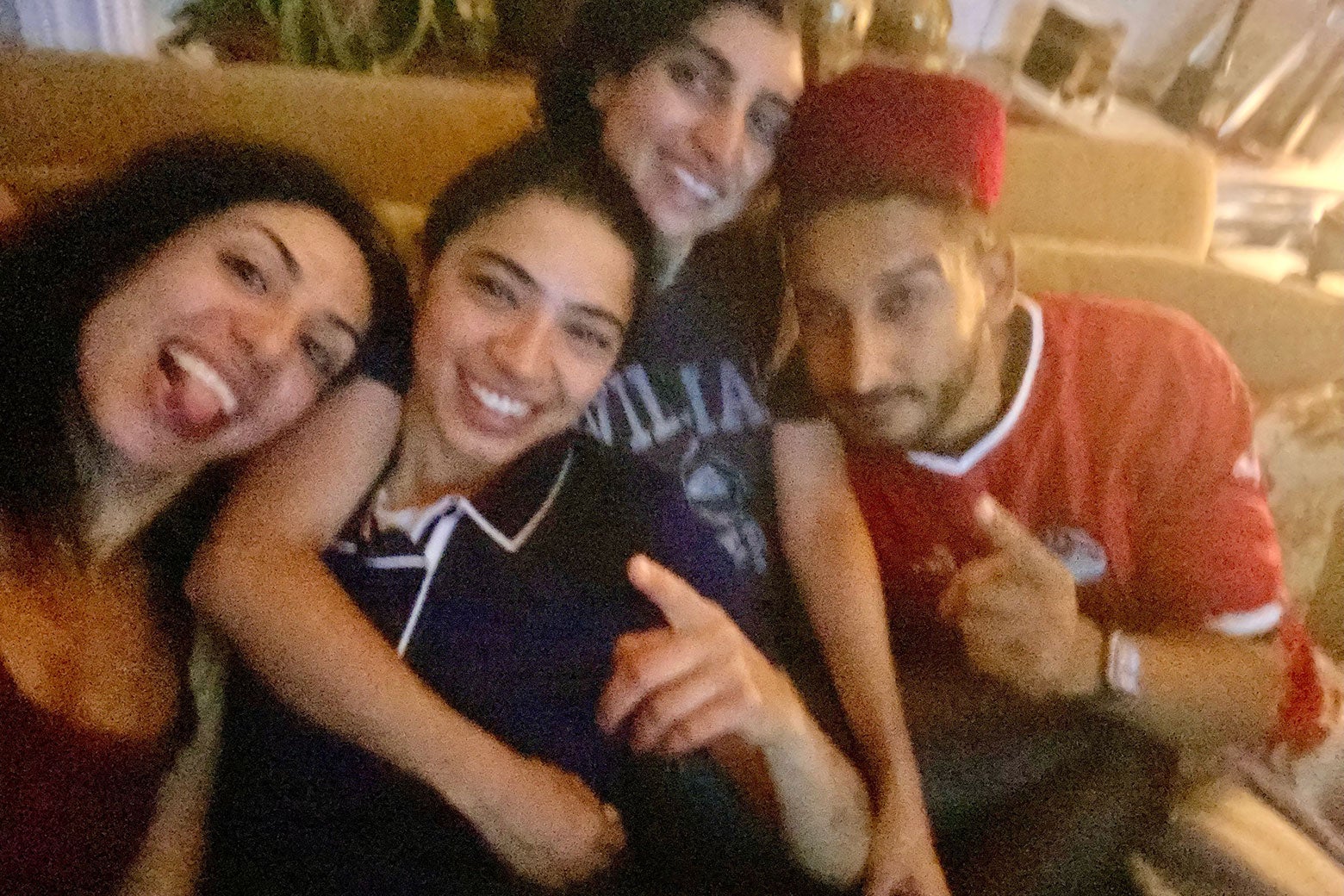
I kept thinking about that phrase: winning together. Was that what I had seen in Philadelphia? Iraq hadn’t won the game, but they beat out many other teams to qualify for the World Cup—something other football powerhouses like Italy failed to do this time. Or maybe I was reaching because I wanted the feeling in that stadium to mean more than it did.
The older idea hovering in my mind is about pan-Arabism. Historically, it means something much more ambitious than other Arabs cheering for Iraq in South Philly. It’s the idea that Arabs are not merely a collection of peoples linked by language, music, cuisine, religion, and overlapping dad jokes, but one nation divided by artificial borders. For my parents’ generation, it invokes the memory of Gamal Abdel Nasser, the Egyptian president who argued that Arab dignity required Arab unity, and that Egypt’s fate could not be separated from Syria’s, Iraq’s, Palestine’s, Sudan’s, Algeria’s, Yemen’s, or anyone else’s in the Arabic-speaking world.
And for a brief moment, that idea felt possible. In 1958, Egypt and Syria actually merged to form the United Arab Republic, which lasted only about three years. Still, Nasser remained the central symbol of an Arab world that could imagine itself under one flag. Then came 1967, when Israel’s victory over Egypt, Syria, and Jordan all but destroyed the project as Arab governments went back to protecting their own regimes. The dream of one Arab nation survived mostly as nostalgia—something my dad might bring up in the middle of a conversation about the Knicks.
I grew up in the diaspora, where pan-Arabism was less a political program than an Egyptian kid, a Palestinian kid, and a Lebanese kid befriending one another and learning to see themselves the way the world saw them. We had our differences, because of course we did. Everybody had their own food, their own Arabic, their own jokes about everybody else’s Arabic, their own claims to tragedy and superiority. But in rooms where no one else knew how to distinguish us, those differences stop mattering altogether. Maybe that’s not unity. Maybe it’s just what happens when the world keeps confusing you for your cousins.
Isma’il Kushkush, who is Sudanese American, urged me not to flatten the whole thing into one tidy feeling. Fans root for teams for many reasons, he told me: “Cultural and geographic ties, style of play, and politics are among the reasons that shape those choices.” He roots for the U.S., Middle Eastern teams, and African teams. He has also been a France fan since childhood, after watching the 1982 semifinal between France and West Germany. Even his American fandom comes with a caveat: He wants the U.S. men’s team to stop ignoring their domestic Latino talent.
On Arab and North African fans cheering for one another, he said it was natural. “Identity is one reason why fans cheer for the teams they do,” he said. Morocco and Egypt had played well and earned wide support. But even that came with an asterisk: Some diaspora fans were rooting against other Arab and North African teams based on rivalries. Kushkush has seen Algerian and Moroccan fans root against each other. He had seen critics of the Saudi monarchy cheer against Saudi Arabia.
Not even the World Cup can remove politics from the equation. Supporters of the Iran team are largely feeling robbed of the opportunity to leave politics aside and just play the sport they love after their team had to jump extraordinary hurdles just to compete. But the fact that the feeling of support beyond borders extends to Iran might be the most honest expansion of my idea of pan-Arabism at a World Cup. They are not an Arab country by any measure, but you’d be pressed to find any supporters of Arab teams who weren’t also rooting for them.
In Philadelphia, I also met two Arab girls who were fully dressed for France, wearing matching royal-blue hijabs. They were happy to talk to me until they saw my press pass and realized that whatever they said might be read by other Arabs in the diaspora. “No way,” one of them said, laughing. “I’m gonna get trashed.” I couldn’t even argue and instead offered anonymity to talk about supporting France at a game against an Arab country. “I’ll be right back,” one told me, chuckling as they fled the scene. They did not come back.
Credit: Source link