

An undersea volcano is erupting in the South Pacific
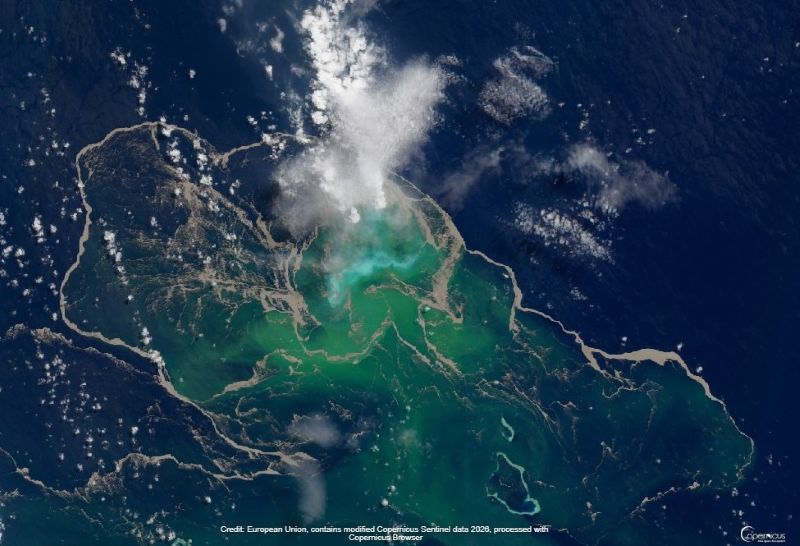
Undersea volcano erupting near Papua New Guinea
Since early May, an undersea volcano has been erupting in the Bismarck Sea, along a feature that scientists call the Titan Ridge. It’s in the southwestern Pacific Ocean, just off the north coast of Papua New Guinea.
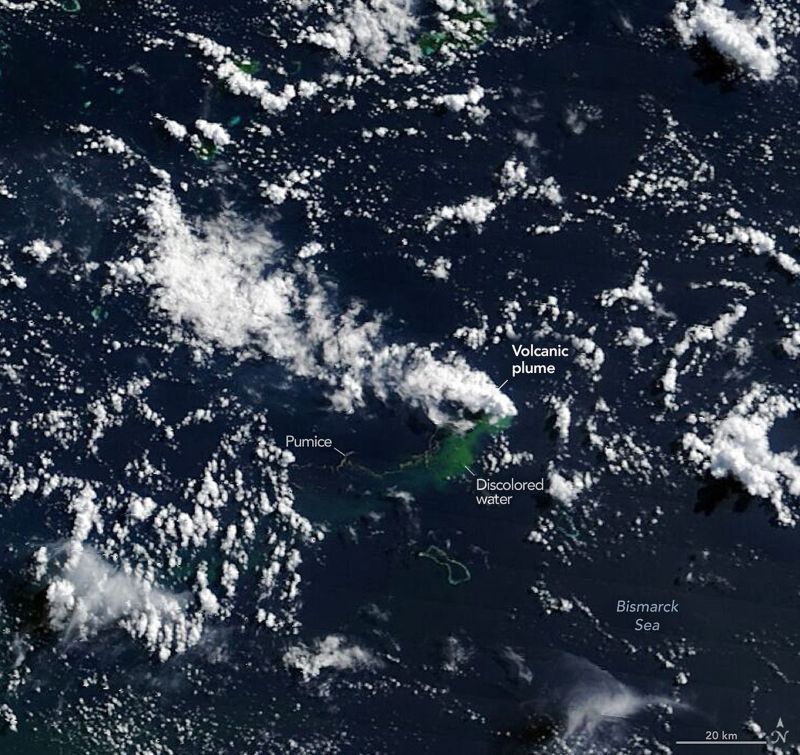
The eruptions have sent giant steamy-white plumes up from the ocean surface to some 10,000 feet (3,000 meters) into the air. It has also spewed out rafts of a volcanic rock called pumice that float away from the volcano.
Scientists say they’re now waiting eagerly to see if a new island is being born.
Scientists’ first inkling that a volcano was brewing came on May 8, when seismometers first picked up a small swarm of earthquakes. Then NASA’s Aqua and Terra satellites caught sight of volcanic plumes rising above the sea.
So far, the new eruption is ongoing. And nobody knows how long it will last. Back in 1972, there was another undersea volcanic eruption about 10 miles (16 km) away. That eruption only lasted four days. In 1957, an underwater eruption in the Bismarck Sea some 62 miles (100 km) away lasted for almost four years.

Our knowledge of the ocean floor is murky
The saying goes that we have better maps of the moon than we do of the ocean floor, and it’s true. The ocean floor at Bismarck Sea is a case in point. There are no high-resolution maps of this area. Scientists think the eruption is occurring along Titan Ridge, but they don’t know exactly which feature is erupting. So some outlets have taken to calling it the Titan Ridge Volcano.
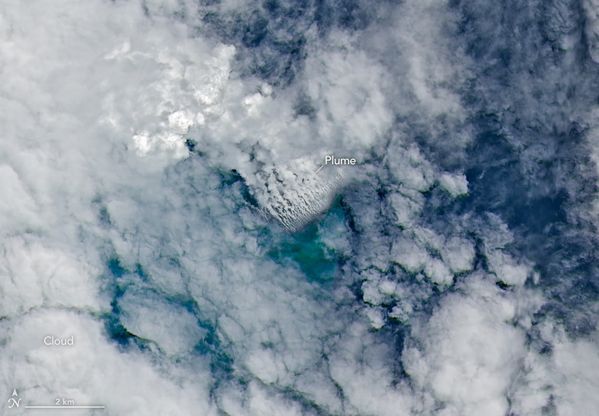
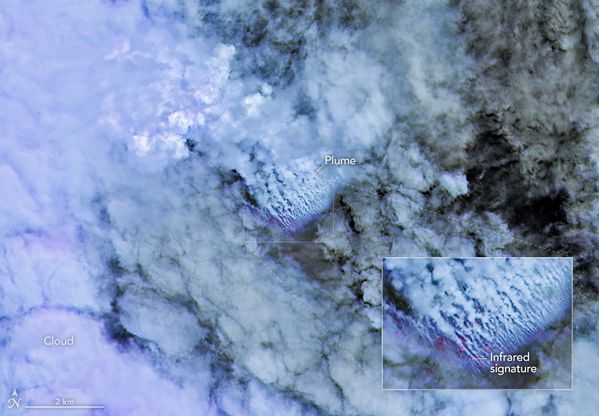
The topographic knowledge of this underwater area – what scientists call bathymetry – had suggested a relatively deep sea. But satellite imagery of the volcano is proving otherwise. Simon Carn, a volcanologist at Michigan Tech, said:
There must be a lot of hot material near the surface to generate so many thermal anomalies. This suggests a fairly shallow eruption vent, much shallower than what’s implied by the existing bathymetry, which shows water depths of several hundred meters or more.
Will a new island emerge?
The images since May 8 show a changing underwater landscape. Will the erupting volcano birth a new island? Jim Garvin, the chief scientist at NASA’s Goddard Space Flight Center, said:
We’re now eagerly waiting to see if a new island is about to be born, something that we’ve only rarely been able to observe with satellites as it happens.
If new land does emerge, Garvin said scientists could visit it to see how plants and animals colonize the new ground. They could also track rainfall and other erosive forces, as some did after the 2022 Hunga Tonga-Hunga Ha‘apai eruption.
The undersea volcano on social media
Click play on the video below to see a formerly unassuming stretch of sea bloom with color from the growing underwater volcanic platform. Steam vents into the air and brown rafts of pumice float away from the volcano.
Sentinel-2 satellite imagery shows a stunning before and after of where an underwater volcano in the Bismarck Sea is currently erupting.Compare the images yourself: tinyurl.com/5a453p8d
Some of these pumice rafts in the Bismarck Sea from the Titan Ridge Volcano, are massive. A rough outline of this one captured by Sentinel-2 this morning gives it at 69 square km. That is an area of floating rocks larger than Manhattan Island.
The eruption of the unnamed submarine volcano at Bismarck Sea continues. Local fishermans posted the photos of the eruption as well as the pumice raft.1-3. www.facebook.com/groups/19995…4. www.facebook.com/photo?fbid=1…
— Fumihiko Ikegami (@fikgm.bsky.social) 2026-05-17T08:16:31.206Z
Bottom line: An undersea volcano began erupting in the Bismarck Sea off the coast of Papua New Guinea on May 8, and it is still going. Will the volcano birth a new island?
Credit: Source link