

Account of Abuse and Rape in Tunisia, the Story of a Cameroonian Migrant Woman
Before Christine attempted to cross the Mediterranean Sea from Tunisia, she lived with her four children and her husband, a Cameroonian soldier who was based in the city of Bamenda, capital of the Anglophone North-West region. The area had been plagued with violence between armed separatist groups and government forces, as well as abuses against civilians, since late 2016. This violence hit home in 2022 when her husband was killed by an improvised explosive device.
After fleeing Bamenda for safety reasons, Christine, 44, whose name has been changed for her security in Tunisia, decided to try to reach Europe. “I had nothing left, so I thought it would be best for me to go to Europe and fight for [a better life for] the children,” she said. Christine left her four children with her mother in Douala, Cameroon, sold what few belongings she had left, then headed to Sfax on the Tunisian coast.
Her overland journey from Cameroon to Tunisia—through Nigeria, Niger, and Algeria—was arduous, she said, but nothing compared to the hardship she endured in Tunisia.
“My problems began when the [Tunisian] National Guard intercepted us on the water; that’s when I was struck by the reality of the journey.”
Intercepted at Sea, Strip-Searched, and Handcuffed
Christine arrived in Tunisia in May 2025 as part of a group and headed straight to the outskirts of Sfax to attempt the crossing to Europe. On the day of her departure, there were 52 people on a 15-square-meter Zodiac-style boat powered by a 40-horsepower engine, she recalled in detail. The group was mainly Cameroonian, along with some Togolese and Guinean people, including three young children. They left the shores of Sfax around 2 a.m.
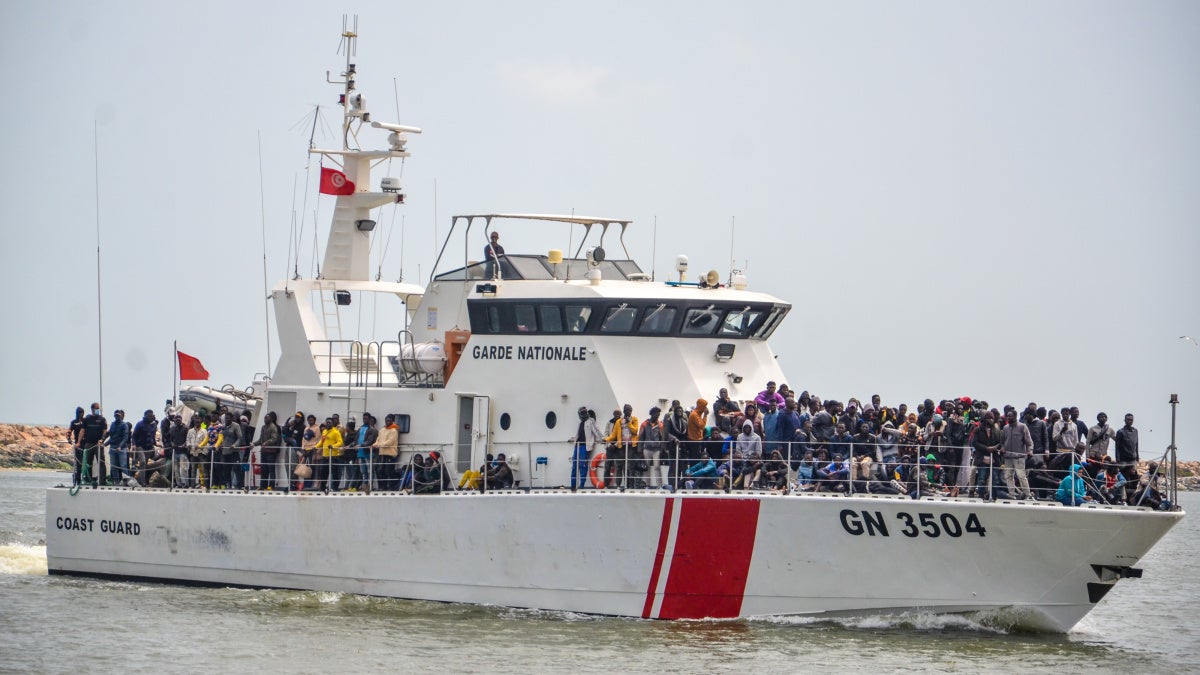
The next day, around 1 p.m. the group was intercepted by the Tunisian Coast Guard, who ordered them to turn off and hand over the engine, she said.
“Our captain didn’t want to turn off the engine, but we were scared of being drowned by the [Tunisian Coast Guard’s] jet skis, so we asked him to turn it off and begged the National Guard to let us go. They refused, so we disconnected the engine and handed it over to them,” she said.
Their fears were not unfounded. Human rights organizations, including Human Rights Watch, have documented reckless and life-threatening actions by Tunisia’s Coast Guard during interceptions at sea.
Although Tunisia is not a safe place for the disembarkation of people intercepted or rescued at sea, the Coast Guard forcibly returned the group to a port near Sfax. There they were beaten and body searched and Coast Guard officers confiscated their belongings, including money and mobile phones, Christine said. “I had my phone on me and some cash. That was all I had left.”
“They really beat up the men, and even the women who were noisy… They told us to undress, so you had to take off your clothes and bend over. They’d look at your anus to see if you’re hiding anything. They’d also make you to lift your bra and look underneath,” said Christine who explained that both men and women were strip-searched by male officers, one after another.
Once at the port the authorities gave them only water, no food, Christine said. The officers made no attempt to individually assess anyone’s health, immigration status in Tunisia, or international protection needs.
The European Union and Tunisia signed a deal in 2023 enhancing cooperation over migration control, which—alongside the president’s and government officials’ xenophobic rhetoric against Sub-Saharan African foreigners–has contributed to increased abuses against migrants. The deal, three years old on July 16, was established without adequate human rights safeguards. The EU continues to outsource its border control to Tunisia, while remaining utterly silent on the grave and widespread abuses committed by Tunisian security forces, particularly against people from other African countries, like Christine.
Rape and Expulsion at Algeria’s Borders
When Christine and her group arrived at the port, they found another group of people who Tunisian authorities had likely intercepted earlier. They were all transferred to medium size vehicles, such as cargo vans, and taken to the border with Algeria during the night, she said
The vans had no windows in the back and she was handcuffed to a metal bar and to people beside her in the vehicle.
When the vehicle finally pulled over, it was still dark; Christine could not identify the specific location they were taken to. As officers led the group on foot, Christine struggled to keep pace.
At some point, she was left behind with only one officer. That’s when he raped her, she said.
Christine wanted her story and the abuse she endured to be told: “He [the officer] told me to stop and asked me to take off my clothes. He took out his [genitals]. I had no choice but to obey. I told him I hadn’t washed in three days and that I was dirty, but he didn’t care.”
“The rest of the group and the officers had moved on; I don’t know if his brothers [fellow officers] know what he did to me.”
The officer rejoined the group after sexually assaulting her and pointed toward Algeria, telling them to cross the border.
Christine said she was left behind once again, unable to continue walking long distances across the remote, rugged terrain. When she eventually reached a paved road, a man offered her a ride toward Sfax, but drove her the opposite direction instead, back toward the Algerian border. “He said ‘We don’t want you here anymore. Go to Algeria, it’s that way.’”
Sick and Isolated in Tunis
Christine said it took her three to four weeks to get back to Tunis, the capital of Tunisia, on foot, and that she only survived the journey with the help of a Nigerien woman who brought her food and water and encouraged her to keep going despite pain from her swollen feet.
When she returned to Tunis, Christine said she had no contacts, no phone, no money, and nowhere to stay. She lived on the streets before being taken in by a Cameroonian man who had been subjected to similar abuse in September 2023.
After weeks of walking in appalling conditions to reach Tunis, Christine’s feet were severely swollen, and she began experiencing intense cramps in her lower abdomen. She said she had not seen a doctor in nearly a year, unable to afford care and with no contacts to refer her to a practitioner. It was only recently that an association referred her to a doctor, who performed an ultrasound revealing masses in her lower abdomen that will require a costly procedure to remove. Her surgery has not yet been scheduled, nor has she secured coverage for the costs.
Christine has been looking for a job ever since arriving in Tunis, hoping to cover at least some of her basic needs. But she has not been able to find any work, mainly due to difficulty walking because of her weight and foot problems, she explained. The Tunisian authorities’ criminalization since 2023 of assisting people without regularized immigration status has made this even harder. With EU backing, Tunisian authorities continue to target migrants like Christine, as well as organizations and individuals working to help them.
“I’m overwhelmed,” she said. “I sold everything in Cameroon, I have nothing left, and I don’t know where to start if I wanted to go back. If I could work for even a year, I could return … to feed my children.”
Credit: Source link